Section 21 Ban 2026: What UK Landlords Must Do Before the Deadline
Section 21 no-fault evictions will be abolished in May 2026 under the Renters’ Rights Act. This guide explains how the new “just-cause” system works, why it impacts HMO and portfolio landlords, and the essential steps you must take now to stay compliant and protect your ability to regain possession.
Section 21 No-Fault Evictions: Essential Changes for Landlords
Section 21 no-fault evictions will officially end on 1 May 2026 for both new and existing tenancies in England under the Renters’ Rights Act 2025. This marks the biggest shift in landlord legislation since the Housing Act 1988 and will fundamentally change how landlords regain possession of their properties.
Under the new rules, landlords must provide a legally recognised reason—such as rent arrears, breach of tenancy, selling the property, or moving in themselves—to end a tenancy. Section 21 will no longer be an option.
Impact on Portfolio & HMO Landlords:
For portfolio and HMO landlords, the change is particularly significant. The new “just-cause” system requires stronger documentation, clearer evidence of breach, and a more professional approach to tenancy and compliance management.
This guide breaks down:
- What exactly is changing
- Why it’s happening
- How the transition will work
- The new possession grounds
- Operational challenges for landlords
- Essential actions to take before May 2026
Why is this happening?
The government frames the change as fulfilling a long-standing promise to rebalance the power dynamic between landlords and tenants, and to reduce insecurity, forced moves and homelessness. For landlords, the implication is that the sector will operate under a “just cause” eviction regime, rather than the default “without cause” model. The official guide emphasises that this will apply to 11 million private renters and 2.3 million landlords in England.
From a compliance perspective, landlords who might have previously relied on Section 21 as a default “get-out” route will now need to ensure one of the valid grounds (fault or other valid reason) under the revised regime.

Why the Section 21 Ban Especially Impacts HMO and Portfolio Landlords
The abolition of Section 21 makes “just-cause” evidence and compliance absolutely essential for any landlord managing HMOs, multiple units, or properties subjected to licensing. These operational upgrades are now crucial:
Possession planning:
For HMOs and portfolios, build longer exit timelines into your business strategy. The era of automatically regaining possession for sales, refurbishments, or reconfiguring rooms is ending. Update tenancy agreements to ensure all new lets are compatible with the new just-cause regime.
Continuous compliance and licensing:
Expect councils to scrutinise your operation and paperwork more intensively. Make sure all HMO licences, EICRs, gas safety certificates, and fire safety documentation are current and easy to retrieve. If a tenant over-stays, you are locked into all obligations for the entire duration.
In HMOs, any delay in removing a tenant who creates fire-safety, behavioural, or licensing risks can expose the landlord to enforcement action. Councils will expect evidence of proactive property management, and failure to manage a problematic occupant may be treated as a breach of the HMO Management Regulations 2006.
Evidence-based management:
Maintain incident logs, rent arrears files, complaint records, and communication trails. Digital property management software can make this much easier, ensuring courts or councils see you as a professional operator.
Professionalism and tenant relations:
With increased legal and reputational scrutiny, ensure your tenant communications are fair, clear, and proactive. Only serve notices with valid grounds, and never rely on informal “side deals” or old Section 21 practices. Avoid sham licences—these will not withstand legal challenge post-2026.
Portfolio risk management:
Revisit your voids and rent review strategy: plan for rent reviews once per year and use robust data and procedures if you must apply for market rent. Expect enforcement and requirements to evolve council-to-council—factor this into your local planning.
Essential Landlord Actions Before the Section 21 Ban
Conduct a full tenancy audit
Identify all properties by tenancy type (fixed-term or periodic). Check if any Section 21 or break clauses have been used. For tenancies ending after 1 May 2026, create a plan for lawful possession using the new just-cause system.
Update your tenancy agreements and template documents
Collaborate with legal professionals or letting agents to ensure agreements include only permitted grounds for possession, reflect new deposit and rent increase rules, and provide tenants an updated statement of their rights.
Adjust your possession strategy
If you intended to regain properties for sale, refurbishment, or re-letting soon, adjust timelines for longer tenant stays—especially for any actions that previously relied on a Section 21 notice. Prepare for a possible increase in void or transition periods.
Strengthen tenant management and evidence gathering
Set up or formalise systems for documenting late rent, tenancy breaches, and complaints. Use digital property management tools to keep records in preparation for evidencing grounds in court.
Train staff and letting agents on the incoming regulations
Ensure everyone involved with your lettings understands the new regime: annual rent increase limit, no bidding, anti-discrimination, and fair notice rules. Remove non-compliant practices from your processes and advertising.
Communicate proactively with your tenants
Send clear communications about the Section 21 change. Reassure responsible tenants, build trust, and address concerns early. If needing to regain possession before the law changes, begin a constructive discussion as soon as possible.

What the New Regime Means for Landlords & How to Prepare
1. The new possession landscape: what replaces Section 21?
The abolition of Section 21 does not mean landlords lose the ability to regain possession—but it does mean you must rely on specific, legally recognised grounds. While the government will publish finalised regulations in stages throughout 2026, the core model is clear: England will move to a “just-cause” eviction system, similar to regimes in Scotland and parts of Europe.
Financial breach grounds (rent arrears)
- Persistent or serious rent arrears will remain a fast-track ground.
- Evidence will matter more—clear arrears schedules, communication logs, and notices of breach will be essential.
- Courts may require proof that you attempted to resolve the arrears reasonably before escalating.
Tenant breach grounds
These include:
- Damage to the property
- Breach of house rules or tenancy clauses
- Antisocial behaviour
- Misuse of the property (e.g., subletting without consent)
For HMOs, this is particularly relevant. One problematic tenant can jeopardise:
- Licence renewal
- Fire-safety compliance
- Neighbour relationships
- Council enforcement standing
But the challenge is evidential. Without Section 21, you must demonstrate breach—meaning incident logs, communications to the tenant, warning letters, photographic evidence, and statements from neighbours or contractors. The professionalisation of documentation becomes non-optional.
Landlord sale or occupation grounds
The government has made clear that landlords will still be allowed to:
- Sell the property
- Move in themselves
- Allow a close family member to move in
However, these grounds will require clear evidence and may require a minimum notice period. Abuse of these grounds (e.g., claiming “sale” but then re-letting to a new tenant at a higher price) will attract sanctions. This raises operational challenges if you time your sales around mortgage expiries or interest rate cycles.
Re-development or major works
If you need vacant possession to carry out significant refurbishments, the new regime will allow this only where the work is impossible to complete with the tenant in situ. You must prove the work is substantial; cosmetic or discretionary improvements won’t count. Councils and courts may expect contractor quotes, schedules of work, fire-safety upgrades, or planning documents.
HMO-specific grounds
While not yet explicit in legislation, the direction of travel suggests local authorities will gain:
- Stronger ability to compel landlords to keep unsafe tenants (e.g., low-level but ongoing behavioural issues), unless the landlord can demonstrate risk to other occupants.
- More scrutiny of room-by-room management and landlord attempts to move tenants between rooms. Such changes will require clear justification and must not be used as a disguised possession tactic.
This means HMO landlords will need fault-based evidence trails far more consistently than under the Section 21 regime.
2. Transitional issues: the messy middle period
Because changes take effect in May 2026, landlords must navigate a transitional stage where:
- Existing ASTs remain valid.
- Section 21 notices served before 1 May 2026 remain valid, but must fully comply with all existing requirements (deposit protection, How to Rent guide, EPC/GSC/EICR, prescribed information). Improper notices will still fail, even if served before the cut-off.
- Courts will still process existing Section 21 claims until the system fully transitions.
The key risk: landlords who react too late may find themselves locked out of possession even when they had planned to exit.
For example:
- A fixed-term tenancy that ends in August 2026.
- A landlord wants to sell at or shortly after the end of the fixed term.
- But because Section 21 is gone, the landlord can no longer rely on a simple “no-fault” route and must instead prove a sale-based ground—which may require longer notice, evidence and specific statutory forms.
- If the sale is time-sensitive (e.g., mortgage term expiry), the delay could cause financial difficulty.
If you have properties that you expect to sell, refurbish, or re-position, you should review them now, not in 2026.
3. Expected operational challenges after the ban
A. Court delays
Courts are already experiencing lengthy timelines for possession hearings. With Section 21 gone:
- More cases will move to breach-based grounds.
- Breach-based cases typically take longer.
- Evidence requirements will increase.
- Hearings may require witness statements, contractor reports, or neighbour testimony.
This means your possession timeline will grow, your legal costs will rise, and your risk of rent arrears during the process will increase. You will need reserves or contingency planning for extended disputes.
B. Enforcement inconsistency (council to council)
HMO landlords already know councils vary: some are supportive and pragmatic, others are highly interventionist. Under the new system, expect tighter enforcement of HMO licence conditions, more pressure to maintain safe occupancy even when tenants create low-level issues, and more scrutiny of alleged retaliatory or pre-textual evictions. The reputational aspect for landlords increases significantly.
C. Risk of “weaponised tenants”
Under Section 21, some landlords managed smaller breaches informally. Now:
- Tenants who understand the new protections may push boundaries.
- Failure to pay rent for short periods may be used strategically.
- HMOs may see increased friction where one tenant disrupts the living environment but eviction takes longer.
The solution is not aggressive management, but consistent, well-documented processes that demonstrate professionalism and fairness. Evidence becomes the cornerstone of any possession claim.
4. Strategic plan for HMO & portfolio landlords
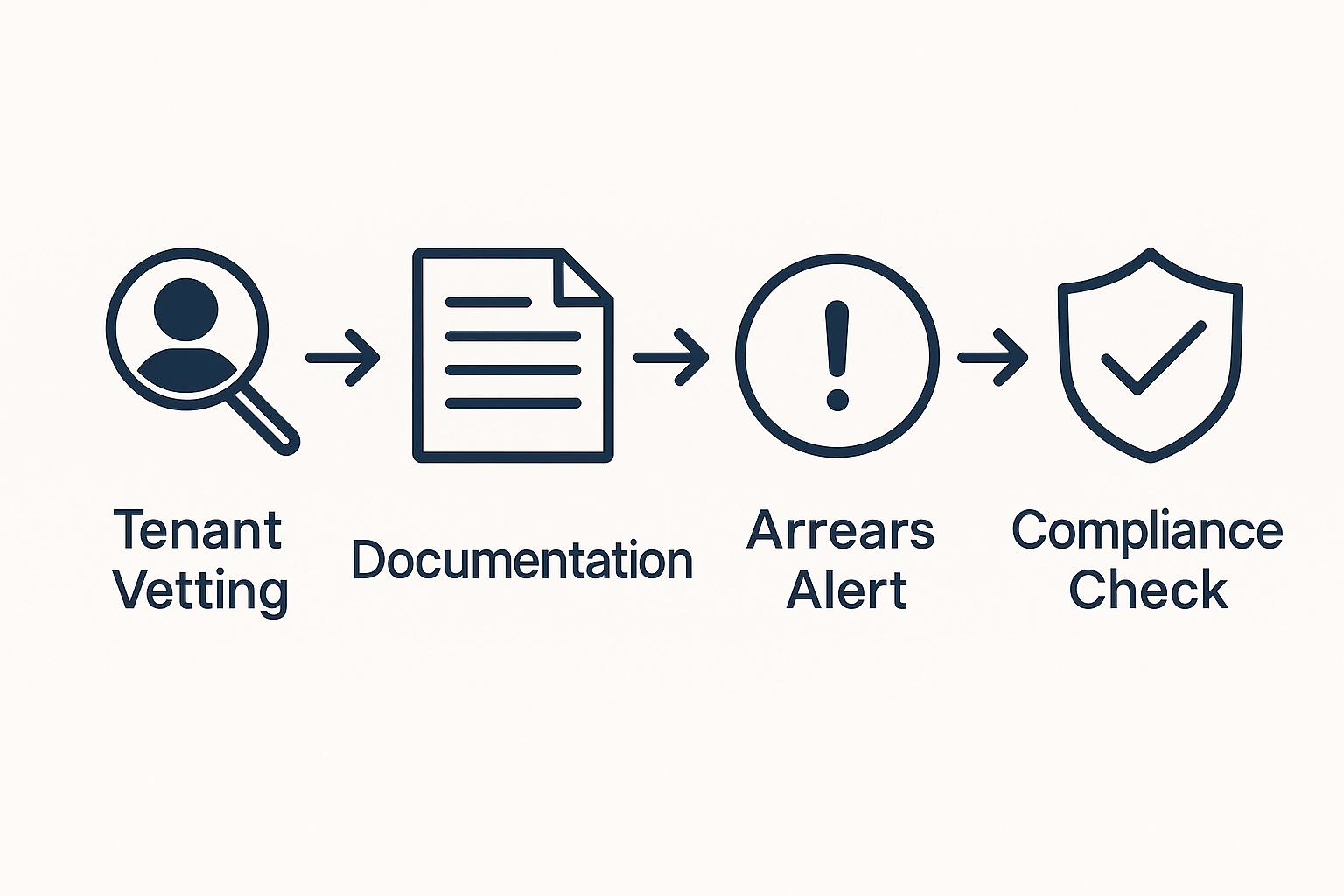
1. Build a formal arrears-management pathway
Informal arrears management is no longer viable under a just-cause system. A compliant pathway should include:
- Day 1 missed rent: automated reminder.
- Day 7: formal arrears notice.
- Day 14: payment plan proposal and documentation.
- Day 21: final warning and record of breach.
- Day 28+: escalation to grounds-based possession.
This protects you and improves your court standing.
2. Strengthen tenant-vetting workflows
Since removal will be harder, selection becomes more crucial:
- Prioritise references.
- Use comprehensive credit checks and screening.
- Avoid gut-feel lettings under time pressure.
- Require guarantors where appropriate.
- Store all vetting data securely.
HMOs in particular benefit from more extensive screening given shared living dynamics.
3. Introduce structured behaviour-monitoring
In HMOs this is essential. Use:
- Incident logs.
- Neighbour statements.
- Photographic evidence of damage.
- Email trails confirming warnings.
This is the difference between a failed possession claim and a successful one.
4. Tighten compliance cycles
Without a quick eviction route, non-compliance is far more risky. Ensure:
- EICRs every 5 years.
- Gas Safety every 12 months.
- Fire alarm tests and records.
- Emergency lighting checks.
- PAT tests where required.
- HMO licence conditions updated and met.
If a tenant remains in occupation longer than expected, the compliance burden simply extends.
5. Use software to manage compliance & documentation
The new regime punishes disorganisation. Landlords who rely on spreadsheets, paper files, and ad-hoc reminders are far more likely to run into trouble in a fault-based eviction world.
Dedicated compliance or property management software gives:
- Evidence trails.
- Timelines for certificates.
- Clear audit data.
- Property-by-property compliance tracking.
- Professional reporting to satisfy councils, solicitors and courts.
Your future possession claims may depend on your ability to demonstrate that you have acted professionally.
6. Re-think tenancy lengths
Long fixed terms may become riskier because:
- You cannot rely on Section 21 at the end.
- You may need to prove a valid ground to exit.
- Tenants can challenge ground-based claims more easily.
For many landlords, a rolling periodic tenancy may become the sensible default.

Common Myths and Facts About the Section 21 Ban
Myth 1: “I’ll never be able to get possession again.”
Fact: You can still regain possession—but only with a valid ground, clear documentation, and evidence. The Section 8 pathway will remain and has been expanded to include new grounds.
Myth 2: “This only affects ASTs, not HMOs.”
Fact: Section 21 abolition applies to almost all assured shorthold tenancies (ASTs), including the vast majority used in HMOs, shared houses, and room-by-room lets. Don’t assume HMOs are exempt.
Myth 3: “I can’t sell my property anymore.”
Fact: You can regain possession to sell, but must use the correct legal ground and provide evidence (estate agent instruction, a valuation letter, or mortgage communication). Notice periods may now be longer.
Myth 4: “I’ll just move everyone to licences to avoid the Act.”
Fact: Sham licences are extremely risky. The courts will usually recognise most HMO occupants as assured shorthold tenants, even if the contract says “licence”. Attempting this could result in costly legal challenges.
Myth 5: “I can rush through Section 21 for all tenants before May 2026.”
Fact: Only serve genuine, legal notices—retaliatory or blanket Section 21 actions are not permitted and may be challenged or overturned. Bad-faith evictions bring major risks, including reputational harm.
Final Recommendations: Preparing for the New Regime
Plan well in advance—don’t wait until spring 2026
Review all tenancy agreements, possession plans, and compliance documentation now. Landlords who act early will avoid last-minute risk and uncertainty.
Professionalise your operation, modernise processes, and ensure every property has a clear, provable compliance trail. The legitimacy of future possession claims will depend on it.
Use dedicated property management and compliance software, keep your documentation thorough, and ensure your team understands the new legal requirements for possession. Professional evidence trails will be required for all Section 8 court actions from May 2026.
Train all staff, agents, and contractors
Make sure everyone involved in your lettings, management, or administration is briefed on the Section 21 ban, the new just-cause regime, rent increase rules, and anti-discrimination laws. Remove any outdated practices from your workflow.
Strengthen tenant relationships and communication
Proactively communicate with tenants about the law changes to minimise conflict and build trust. Responsive, transparent communication reduces reputation risks and keeps tenants engaged.
Adapt to the new regulatory and data environment
The new landlord database, ombudsman arrangements, and compliance culture mean landlords must provide a professional asset and tenancy management experience. Those who adapt will thrive; those who don’t will face increased operational difficulties.
Closing summary
The abolition of Section 21 in May 2026 marks the biggest shift in private renting since the Housing Act 1988. For landlords, especially HMO and portfolio operators, it transforms possession, compliance, documentation and risk. But with early preparation—and a shift toward professionalism, structured processes and stronger documentation—landlords can still operate efficiently, profitably and with confidence.