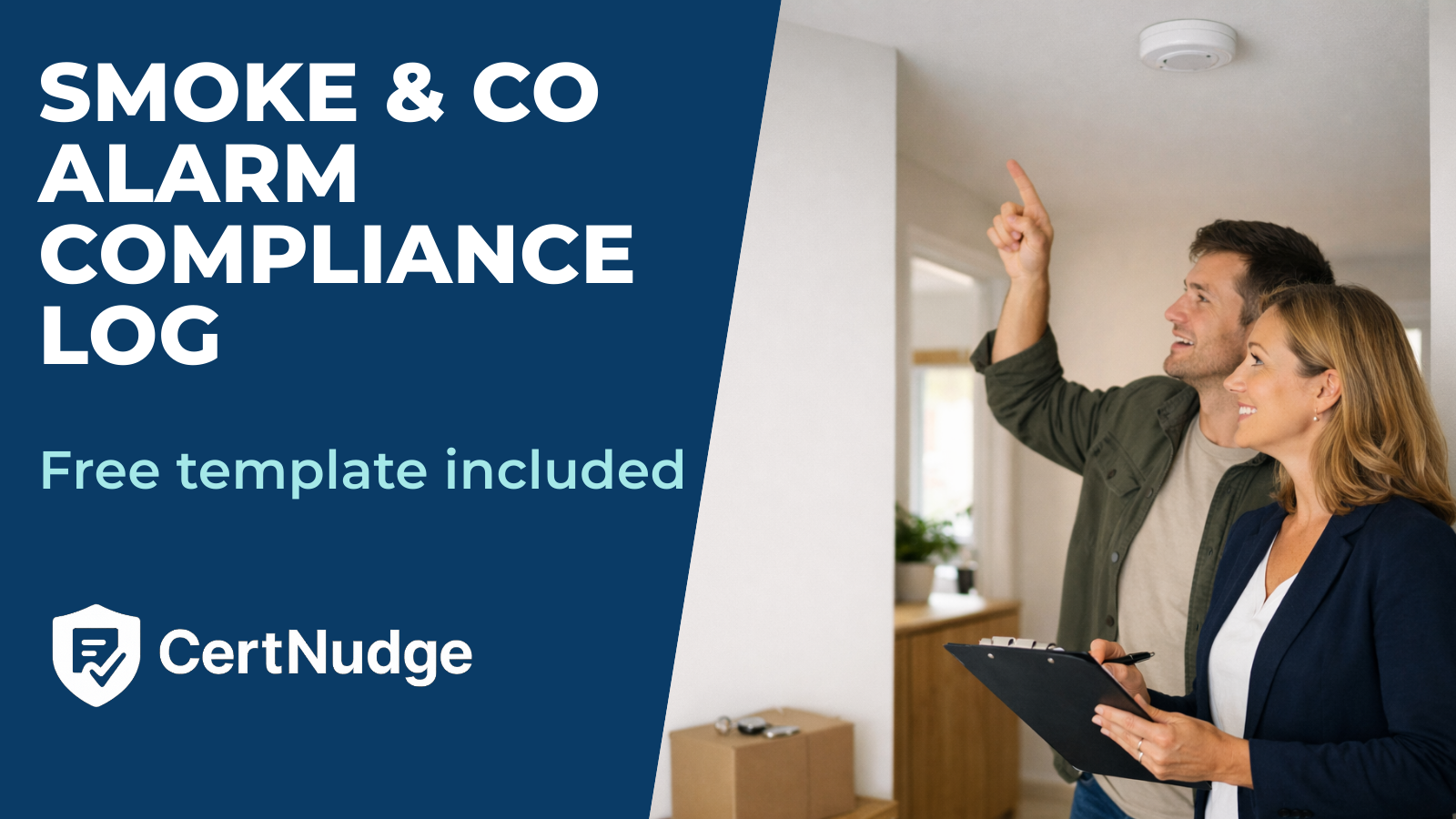
Smoke & CO Alarm Compliance Log Template for Landlords (England)
A practical guide for England landlords on smoke and carbon monoxide alarm checks, evidence, and record-keeping, with a free compliance log template for check-in day.
Key takeaways
- In England, landlords must have at least one smoke alarm on each storey used as living accommodation and a carbon monoxide alarm in any room used as living accommodation with a fixed combustion appliance other than a gas cooker.
- For a new tenancy, landlords must check the required alarms are working on the day the tenancy begins.
- GOV.UK guidance says landlords should keep a record of when alarms are tested.
- A signed inventory can help prove compliance, but it is not always enough on its own.
- If a landlord fails to comply with a remedial notice, the local authority can impose a civil penalty of up to £5,000 per breach.
Download the free Smoke & CO alarm log template (England)
Want a version you can print now? Download the free template and keep it with your check-in paperwork.
A landlord hands over keys at 6pm. The tenancy starts that day. The alarms are tested, everything works, and everyone moves on.
Six months later, the tenant tells the council the alarms were never checked.
That is the real problem this article addresses. Not just whether the alarms were working, but whether the landlord can prove they were checked when they needed to be.
In England, the alarm rules are simple in principle. The harder part is evidence. A smoke and carbon monoxide alarm compliance log gives landlords a practical way to show what was checked, when it was checked, and what the outcome was. For landlords managing a few properties, that can make the difference between a clear paper trail and a weak “I’m sure I did it” defence. If you want a printable version, you can download the free template here.
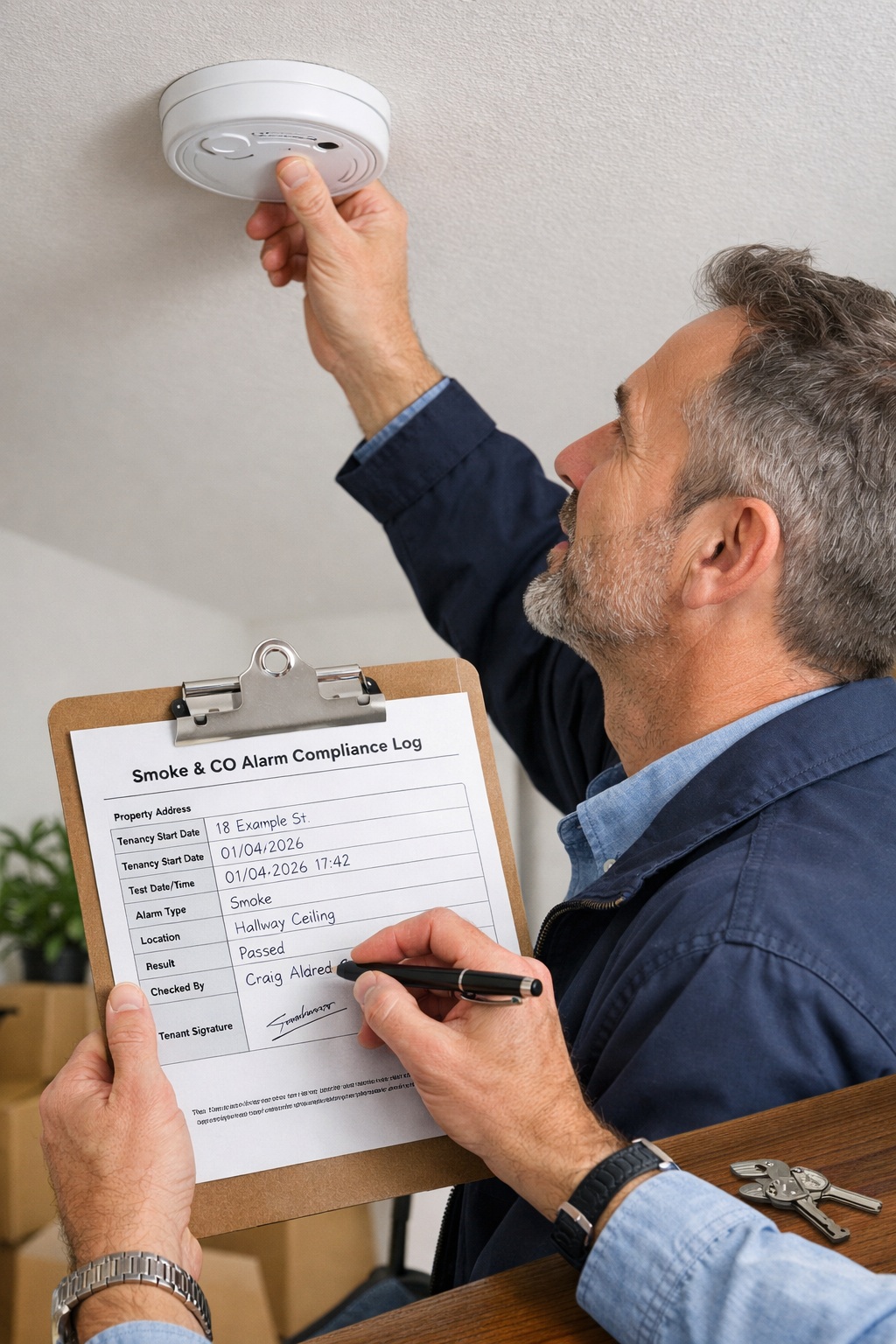
Smoke & CO Alarm Requirements for England Landlords
The core rules are straightforward.
Requirement
Smoke alarms
Have at least one smoke alarm on each storey used as living accommodation.
Requirement
Carbon monoxide alarms
Have a CO alarm in any room used as living accommodation with a fixed combustion appliance, excluding gas cookers.
Requirement
Start-of-tenancy check
Check the required alarms are working on the day a new tenancy begins.
Requirement
Faults during the tenancy
Repair or replace alarms as soon as reasonably practicable after being informed and finding they are faulty.
For smoke alarms, the rule is based on storeys, not number of rooms. A landlord with a two-storey house in Sheffield would usually need at least one smoke alarm on the ground floor and one on the first floor if both are used as living accommodation.
For carbon monoxide alarms, the focus is the room and the appliance. A lounge with a log burner needs a CO alarm. A bedroom with a fixed boiler may need one too. A kitchen with only a gas cooker does not trigger the specific CO alarm duty under these regulations.
There are a couple of practical nuances worth remembering. The regulations do not prescribe one exact model or exact position for every alarm, so landlords should follow the manufacturer’s instructions. And the phrase “used as living accommodation” matters. In plain terms, think about the rooms where people actually live or spend meaningful time, not just the rooms listed on a floorplan.
Tip: For a landlord doing a rushed check-in after work, the safest mental checklist is simple: each lived-in floor for smoke alarms, then each relevant room with a fixed combustion appliance for CO alarms.
What is a compliance log, and why does it matter?
A smoke and carbon monoxide alarm compliance log is not a special legal certificate. It is simply a record showing:
- what alarms were present
- where they were located
- when they were tested
- who checked them
- whether they worked
- what happened if they did not
That matters because the regulations deal with the legal duty, but disputes usually turn on evidence.
The law does not prescribe a particular format for this record, but the more detailed and contemporaneous it is, the stronger it will be if compliance is challenged.
A landlord with three rental properties in Leeds might genuinely test alarms at every new check-in. But if there is no record, no signed inventory note, and no dated photo or follow-up note, that good habit becomes hard to prove later.
That is why the compliance log is best thought of as a proof file, not an admin exercise. It should sit alongside the inventory, check-in photos, and any follow-up notes, so the evidence is easy to retrieve if questions are raised later.
When must landlords test the alarms?
The timing rule is more exact than many landlords realise.
Warning: For a new tenancy, the required alarms must be checked on the day the tenancy begins. Not sometime that week. Not when the cleaner was in. Not when the gas engineer last attended. The safest operational approach is to test them on check-in day and record that test immediately.
That is where many landlords weaken their position without meaning to. If the tenancy starts on 1 April but the alarms were last tested on 29 March, that may feel close enough in day-to-day life, but it is not as strong evidentially as a test recorded on 1 April itself.
For a landlord with a two-bed flat in Leeds, the best record looks something like this:
“1 April 2026, 17:42 - smoke alarm tested in ground-floor hall, passed; 17:43 - first-floor landing smoke alarm tested, passed; 17:44 CO alarm in lounge tested, passed; tenant present.”
That gives you something much more concrete than “alarms checked before move-in”.
This timing rule is linked to the start of a new tenancy, so it does not usually re-trigger when the same tenant simply rolls into a statutory periodic tenancy. Even so, landlords should still behave sensibly during the tenancy: make it clear how tenants can test alarms and deal promptly with faults if they are reported.

What should a compliance log include?
The best compliance log is not the fanciest one. It is the one that makes the facts easy to understand later.
At minimum, the log should include:
- Property address
- Tenancy start date
- Date and time of the test
- Alarm type
- Alarm location
- Result
- Who carried out the check
- Tenant acknowledgement
- Follow-up action, if any
A few of those are especially important.
Date and time matter because the legal duty is tied to the day the tenancy begins.
Location matters because “hallway” is vague, while “ground-floor hall ceiling” or “first-floor landing outside bedroom 2” is much easier to rely on later.
Tenant acknowledgement is not mandatory in itself, but it is useful. If the tenant was present and signs to confirm the alarms were tested and working at check-in, that strengthens the record.
Follow-up action matters when something goes wrong. If an alarm failed, the log should show what happened next: battery changed, unit replaced, contractor called, and re-test completed.
A landlord in Manchester managing four properties does not need a complex compliance system just to do this properly. But they do need something better than a mental note or an email to themselves saying “checked alarms”.
Tip: If you want a more robust paper trail, add:
- alarm make and model
- battery or power type
- installation or replacement date
- photo reference
- inventory page reference
These extra details are useful when a tenant later says an alarm was not working or when you need to show which device was checked at the start of the tenancy.
Is a signed inventory enough?
Sometimes, but do not rely on it on its own.
A signed inventory is useful because it can show that the landlord went through the property with the tenant on the first day of the tenancy and recorded that the required alarms were present and working. That is far better than having no written evidence at all.
But a signed inventory is not a magic shield.
If the inventory simply says “alarms checked” and the tenant signs at the bottom, that is only a modest piece of evidence. If it says which alarms were tested, where they were, what time they were tested, and that the tenant was present, it becomes much stronger.
A landlord with a flat in Leeds is a good example. Compare these two records:
Weak record:
“Alarms checked.”
Stronger record:
“1 April 2026, 17:42 — smoke alarm tested in ground-floor hall, passed. 17:43 — smoke alarm tested on first-floor landing, passed. 17:44 — CO alarm tested in lounge near log burner, passed. Tenant present and signed.”
The second version is far easier to defend.
The safest approach is to keep more than one form of evidence:
- compliance log
- signed inventory
- dated photos where useful
- check-in notes
- repair or replacement notes if needed
That is much stronger than relying on one vague sentence in the inventory.
Common mistake: Treating a tenant signature as the whole answer. A signature helps, but detail is what makes the record persuasive.
What happens if there is no record?
No record does not automatically prove a breach. But it puts the landlord in a much weaker position if compliance is questioned.
If a tenant later says the alarms were never checked at move-in, and the landlord has no log, no inventory note, and no other evidence, the argument quickly becomes one person’s memory against another’s. That is not where you want to be.
In practice, enforcement may begin with a complaint or other intelligence. If the local authority believes there may have been a breach, it can serve a remedial notice. The landlord then has 28 days to comply and can make written representations within that period.
If the notice is not complied with, the authority can arrange remedial action itself, with the occupier’s consent, and may impose a civil penalty of up to £5,000 per breach.
Warning: For a small landlord, the real damage often starts before any penalty is imposed. The missing log means stress, time wasted, and a much weaker ability to show that the correct checks were carried out on the day the tenancy began.
That is why the record matters. It is not just about avoiding penalties. It is about being able to prove you did what you were supposed to do.
Free Smoke & CO alarm log template (England)
Want a version you can actually use at check-in?
Download the free Smoke & CO Alarm Compliance Log template (England) as a printable PDF
For most landlords, a one-page table is enough.
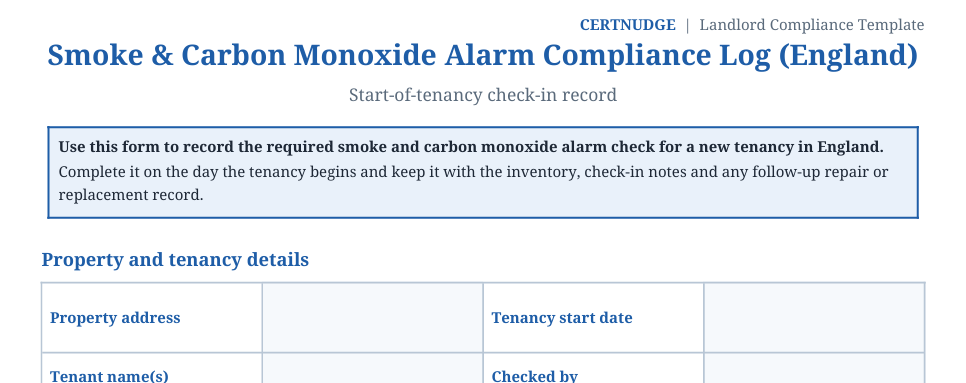
The downloadable version is formatted as a one-page table for printing and filing, but the fields below show the same information in a mobile-friendly format.
Example entry 1
Property address: [Insert address]
Tenancy start date: [DD/MM/YYYY]
Test date/time: [DD/MM/YYYY HH:MM]
Alarm type: Smoke
Alarm location: [e.g. Ground-floor hall ceiling]
Result: [Passed/Failed]
Checked by: [Name]
Tenant acknowledgement: [Yes/No]
Follow-up action: [If needed]
Example entry 2
Property address: [Insert address]
Tenancy start date: [DD/MM/YYYY]
Test date/time: [DD/MM/YYYY HH:MM]
Alarm type: Smoke
Alarm location: [e.g. First-floor landing ceiling]
Result: [Passed/Failed]
Checked by: [Name]
Tenant acknowledgement: [Yes/No]
Follow-up action: [If needed]
Example entry 3
Property address: [Insert address]
Tenancy start date: [DD/MM/YYYY]
Test date/time: [DD/MM/YYYY HH:MM]
Alarm type: CO
Alarm location: [e.g. Lounge shelf near log burner]
Result: [Passed/Failed]
Checked by: [Name]
Tenant acknowledgement: [Yes/No]
Follow-up action: [If needed]
Here is what a completed version might look like:
Completed example 1
Property address: 18 Example Street, Manchester
Tenancy start date: 01/04/2026
Test date/time: 01/04/2026 17:41
Alarm type: Smoke
Alarm location: Ground-floor hall ceiling
Result: Passed
Checked by: Pete Alarm
Tenant acknowledgement: Yes
Follow-up action: —
Completed example 2
Property address: 18 Example Street, Manchester
Tenancy start date: 01/04/2026
Test date/time: 01/04/2026 17:42
Alarm type: Smoke
Alarm location: First-floor landing ceiling
Result: Passed
Checked by: Pete Alarm
Tenant acknowledgement: Yes
Follow-up action: —
Completed example 3
Property address: 18 Example Street, Manchester
Tenancy start date: 01/04/2026
Test date/time: 01/04/2026 17:43
Alarm type: CO
Alarm location: Lounge wall shelf near log burner
Result: Passed
Checked by: Pete Alarm
Tenant acknowledgement: Yes
Follow-up action: —
Prefer to track this digitally? Try CertNudge free to store alarm checks alongside your Gas Safety, EICR and EPC records.
If an alarm fails, the record should also show when it was repaired or replaced and when any re-test was carried out.
Some landlords are happy keeping this as a printable sheet or spreadsheet. Others prefer to keep alarm logs alongside gas safety records, EICRs, EPCs and other compliance documents in one place. If you want a cleaner audit trail across multiple properties, CertNudge can help keep those records organised.
FAQs
Do landlords need a smoke alarm on every floor in England?
In England, landlords must have at least one smoke alarm on each storey used as living accommodation.
Where is a carbon monoxide alarm required in a rental property?
A carbon monoxide alarm is required in any room used as living accommodation that contains a fixed combustion appliance, excluding gas cookers.
Do landlords have to test alarms on check-in day?
For a new tenancy, the required alarms must be checked on the day the tenancy begins.
Is a signed inventory enough to prove compliance?
It can help, but it is stronger when it includes detail about which alarms were tested, where they were, when they were tested, and who was present.
What should a landlord alarm log include?
At minimum, it should include the property address, tenancy start date, test date and time, alarm type, location, result, who carried out the check, tenant acknowledgement, and any follow-up action.
Compliance notice
This article is for general information only and is not legal advice. Regulations change — always check the latest guidance at GOV.UK or speak to a qualified professional.
Conclusion
For most landlords, the fix is simple: test the required alarms on the day the tenancy begins, record exactly what you checked, and keep that record with the rest of your tenancy paperwork.
That small habit makes it much easier to prove compliance later if there is ever a complaint or dispute.
If you want a printable version of the log, download the free template. If you would rather keep compliance records and supporting documents organised by property, you can try CertNudge free.
Last reviewed: 9 March 2026
Next review recommended: 9 September 2026
Sources
- GOV.UK: Smoke and Carbon Monoxide Alarm (Amendment) Regulations 2022: guidance for landlords and tenants
- GOV.UK: Smoke and Carbon Monoxide Alarm (England) Regulations 2015: explanatory booklet for local authorities
- Legislation.gov.uk: The Smoke and Carbon Monoxide Alarm (England) Regulations 2015
- Legislation.gov.uk: The Smoke and Carbon Monoxide Alarm (Amendment) Regulations 2022