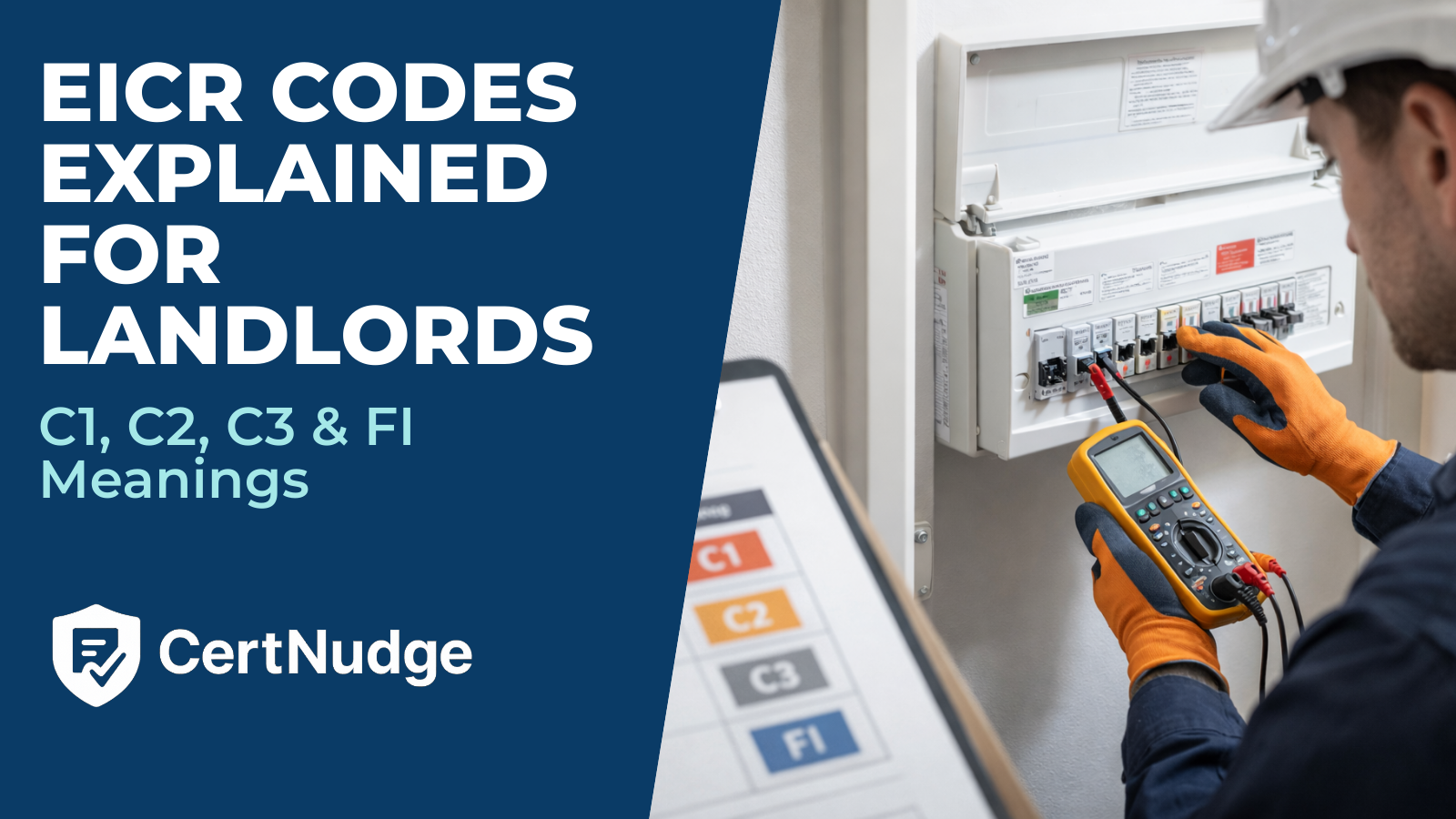
EICR Codes Explained for Landlords: C1, C2, C3 & FI Meanings
Confused by EICR codes? Learn what C1, C2, C3 and FI mean, when an EICR becomes Unsatisfactory, and what work you must arrange within 28 days to stay compliant in England.
- C1, C2, and FI codes result in an Unsatisfactory report (a "fail").
- C3 codes are recommendations for improvement but do not fail the report.
- You must arrange for the necessary investigative or remedial work on C1, C2, and FI items within 28 days (or sooner if the report specifies a shorter deadline), and demonstrate that it has been completed or commissioned.
- FI (Further Investigation) is not a ‘maybe’ it means the report stays Unsatisfactory until the investigation is completed and any issues are resolved.
- An ‘Unsatisfactory’ EICR means you have a legal duty to act within the 28 day window; failure to arrange or complete the required investigative or remedial work on time is a breach of the Electrical Safety Standards in the Private Rented Sector Regulations.
What to do if your EICR is Unsatisfactory (28-day checklist)
- Identify the codes: any C1, C2 or FI = Unsatisfactory.
- Book the work fast: arrange remedial or further investigation within 28 days (or sooner if the report says).
- Get written confirmation: ask for an EIC, Minor Works certificate, or other suitable confirmation covering what was fixed.
- File the evidence together: keep the original EICR + the remedial proof in the same place.
- Send copies where required: provide the relevant documents to tenants (and the council if asked).
This article is for general information only and is not legal advice. Regulations change and circumstances vary. If you need advice, speak to a qualified professional.
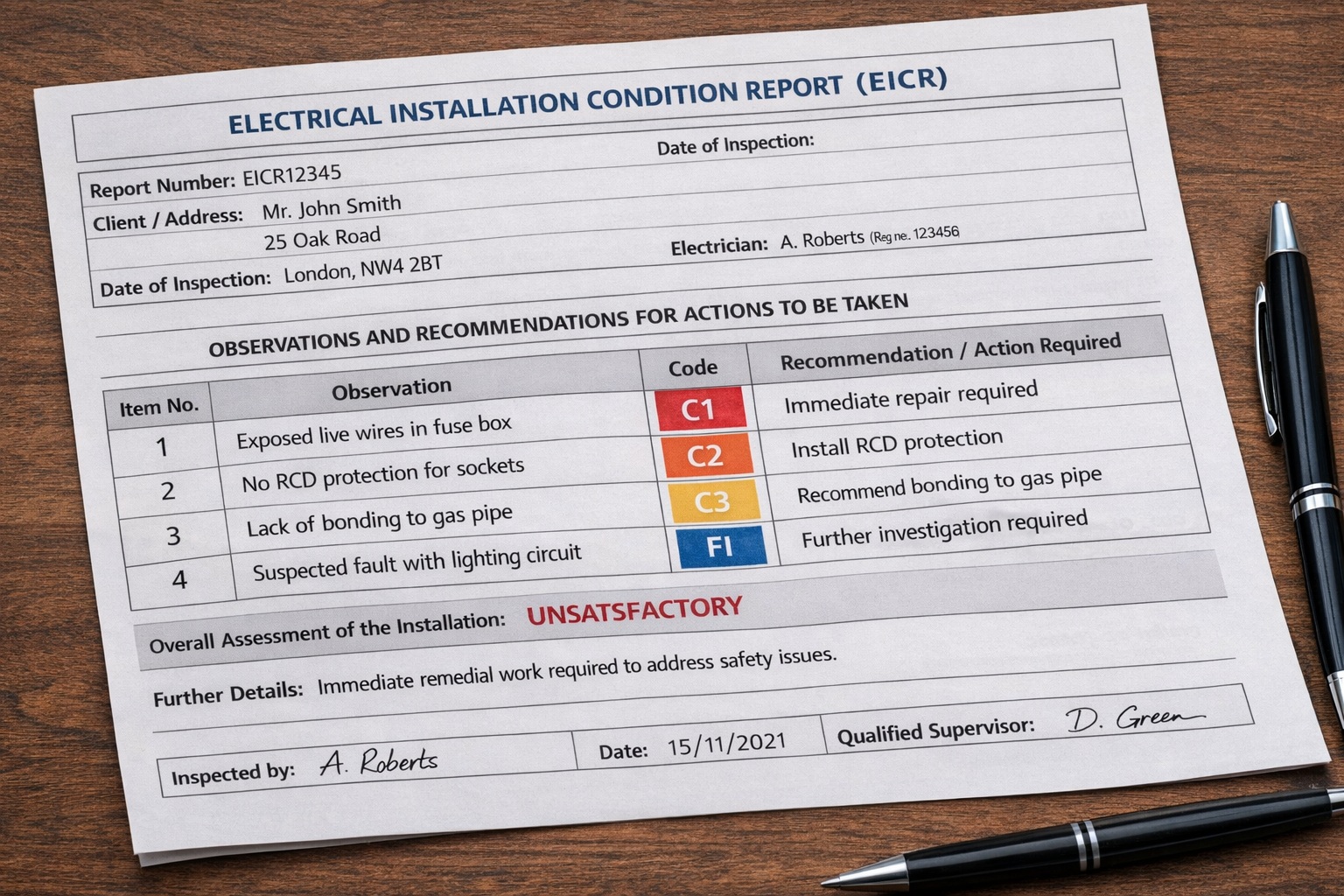
If your EICR shows C1, C2 or FI, the report is usually classed as Unsatisfactory and you’ll need to act. If it only shows C3, the report can still be Satisfactory C3 is an improvement note, not a fail.
(Mandatory EICR rules in England explained)
This guide translates the BS 7671 wiring regulation codes into plain English so you can prioritise repairs, challenge unclear decisions, and ensure your property remains compliant.
Inspection-Ready Evidence
Store your EICR and remedial proof in one place
If your EICR is Unsatisfactory, you’ll need to evidence the follow-up work (e.g., Minor Works or an Electrical Installation Certificate). CertNudge keeps your EICR and remedial documents linked to the property and generates a professional Compliance Pack PDF in one click.
No card required. Upgrade or downgrade at any time.
Reference links: Electrical Safety Standards Regulations 2020 (SI 2020/312) • GOV.UK guidance: Electrical safety standards • NICEIC Best Practice Guide 4 (EICR coding)
EICR Codes Meaning: C1, C2, C3 and FI Explained
The electrician inspecting your property will assign a classification code to any defect they find. These codes indicate the level of danger and the urgency of the remedial work required.
At a glance (fast meanings)
Here is the definitive breakdown of what each EICR code means for your compliance status, with real-world examples of what you might see on your report.
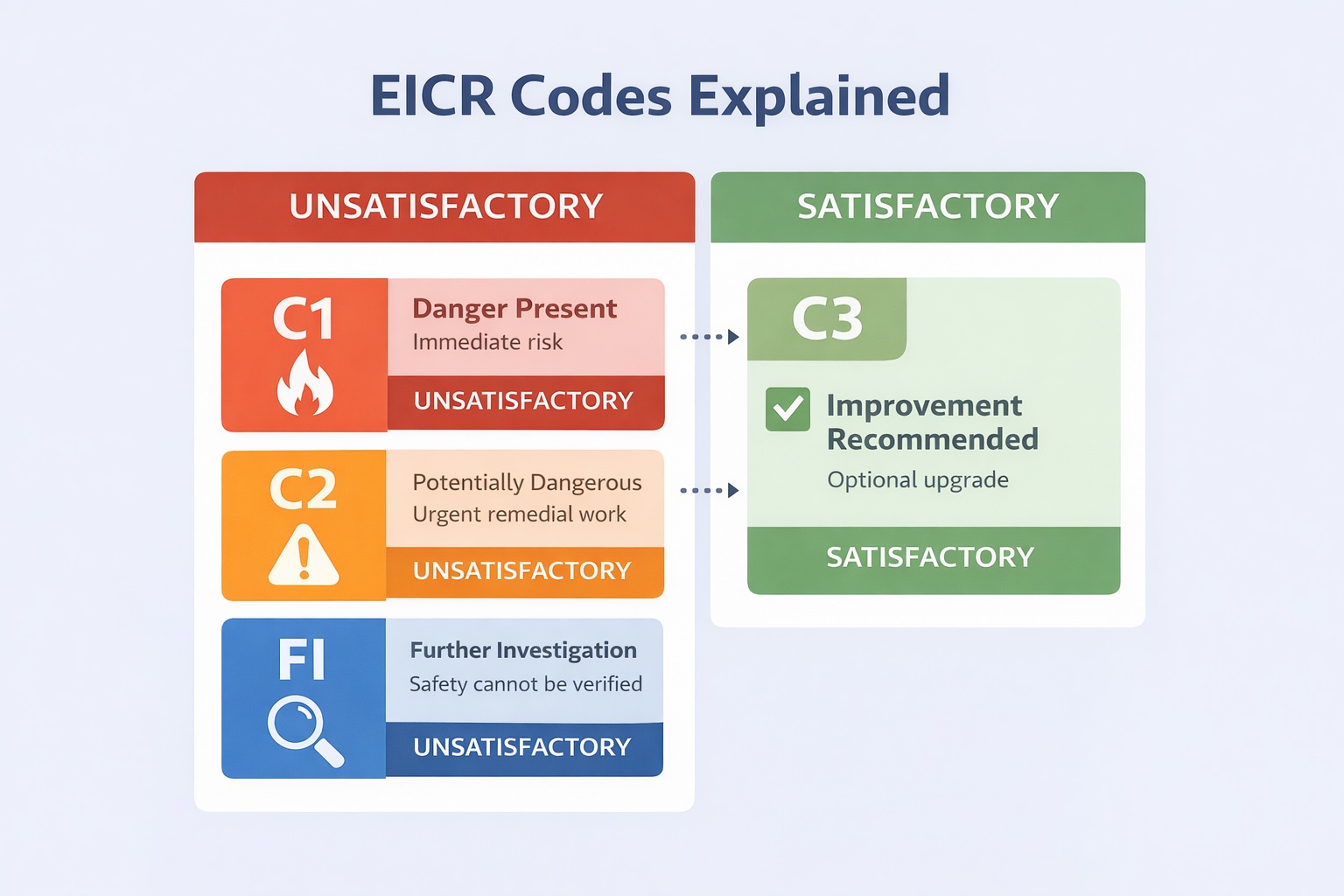
Code C1: Danger Present
Status: Unsatisfactory (Fail)
Meaning: Risk of injury. Immediate remedial action required.
The Reality: A C1 code means there is an immediate, active threat to the safety of your tenants. This isn't a "potential" risk; it is a hazard that could cause fire or electric shock right now.
Common Examples of C1 Faults:
- Exposed live wires: Cables hanging from a ceiling or wall with the copper conductor visible and accessible to touch.
- Thermal damage: A socket or switch that is smouldering, melted, or showing signs of severe overheating.
- Damaged consumer unit: A fuse board with a missing blanking plate, allowing a finger to touch live parts inside.
Landlord Action: The electrician should not leave the property until this is made safe. Often, they will perform a temporary fix immediately during the inspection (like isolating the circuit or fitting a blanking plate) to downgrade the risk. C1 indicates immediate danger and should be made safe straight away. The inspector may isolate circuits or take immediate steps during the visit, and you should arrange urgent remedial work.
Code C2: Potentially Dangerous
Status: Unsatisfactory (Fail)
Meaning: Urgent remedial action required.
The Reality: While not immediately life-threatening, a C2 defect creates a sequence of events that could lead to danger. For example, if a fault occurred, the safety mechanism (like the earth wire) might not be there to save the tenant.
Common Examples of C2 Faults:
- Missing Earthing: No earth bonding to gas or water pipes.
- Cracked Accessories: A socket or light switch faceplate that is cracked, exposing the inner workings.
- RCD Missing: No RCD protection on a socket circuit that could be used for outdoor equipment.
- Incorrect Circuit Breakers: A fuse or breaker that is the wrong rating for the cable it protects (e.g., a 32A breaker protecting a thin lighting cable).
Landlord Action: You must arrange for these repairs to be completed. Because this code makes the report "Unsatisfactory," you are legally required to complete these works within 28 days (or sooner if the report specifies a shorter period).
Code FI: Further Investigation Required
Status: Unsatisfactory (Fail)
Meaning: The inspector cannot verify safety without further work.
The Reality: This is often the most confusing code for landlords. It does not explicitly mean "dangerous," but it means the electrician hit a roadblock and couldn't test something. Because they cannot prove it is safe, they cannot mark the report as "Satisfactory".
Common Reasons for FI Codes:
- Untraced Circuits: The fuse board has a breaker labeled "sockets," but the electrician cannot find where it goes or what it powers.
- No Access: A locked door prevented testing a specific room, or a heavy appliance blocked access to a crucial socket.
- Strange Readings: A test result was borderline, and the electrician needs to dismantle floorboards or walls to find the cause.
Landlord Action: Do not ignore this. Under the Electrical Safety Standards in the Private Rented Sector (England) Regulations 2020, an EICR with any C1, C2 or FI codes is considered an Unsatisfactory report, and the landlord must arrange the necessary investigative or remedial work within 28 days. You must commission the investigation within the same 28-day deadline. Once the investigation is done, the electrician will either pass the item or code it as C1/C2, which then needs fixing.
Code C3: Improvement Recommended
Status: Satisfactory (Pass)
Meaning: Non-compliance with the latest regulations, but not dangerous.
The Reality: Wiring regulations (BS 7671) change frequently (the "18th Edition" is the current standard). A C3 code usually means your installation was safe when it was built and remains safe today, but it lacks the latest safety features.
Common Examples of C3 Items:
- Plastic Consumer Units: Modern regulations often prefer metal, non combustible units to limit fire spread, but many existing plastic units are still safe if they are in good condition and compliant for their original installation.
- Low Sockets: Sockets mounted lower on the wall than current "accessibility" standards recommend.
- Missing RCDs on Lighting: While recommended, lacking an RCD on a lighting circuit (in a non-bathroom area) is often just a C3.
Landlord Action: You are not legally obliged to fix C3 items simply to obtain a Satisfactory report, and your property remains compliant for letting as long as the overall EICR is Satisfactory. However, addressing C3s can improve safety and reduce the risk of future C2 issues.
Satisfactory vs Unsatisfactory: The Triage Decision Tree
When you receive the report, look immediately at the "Observations" section. The overall outcome of the EICR depends entirely on the "worst" code found.
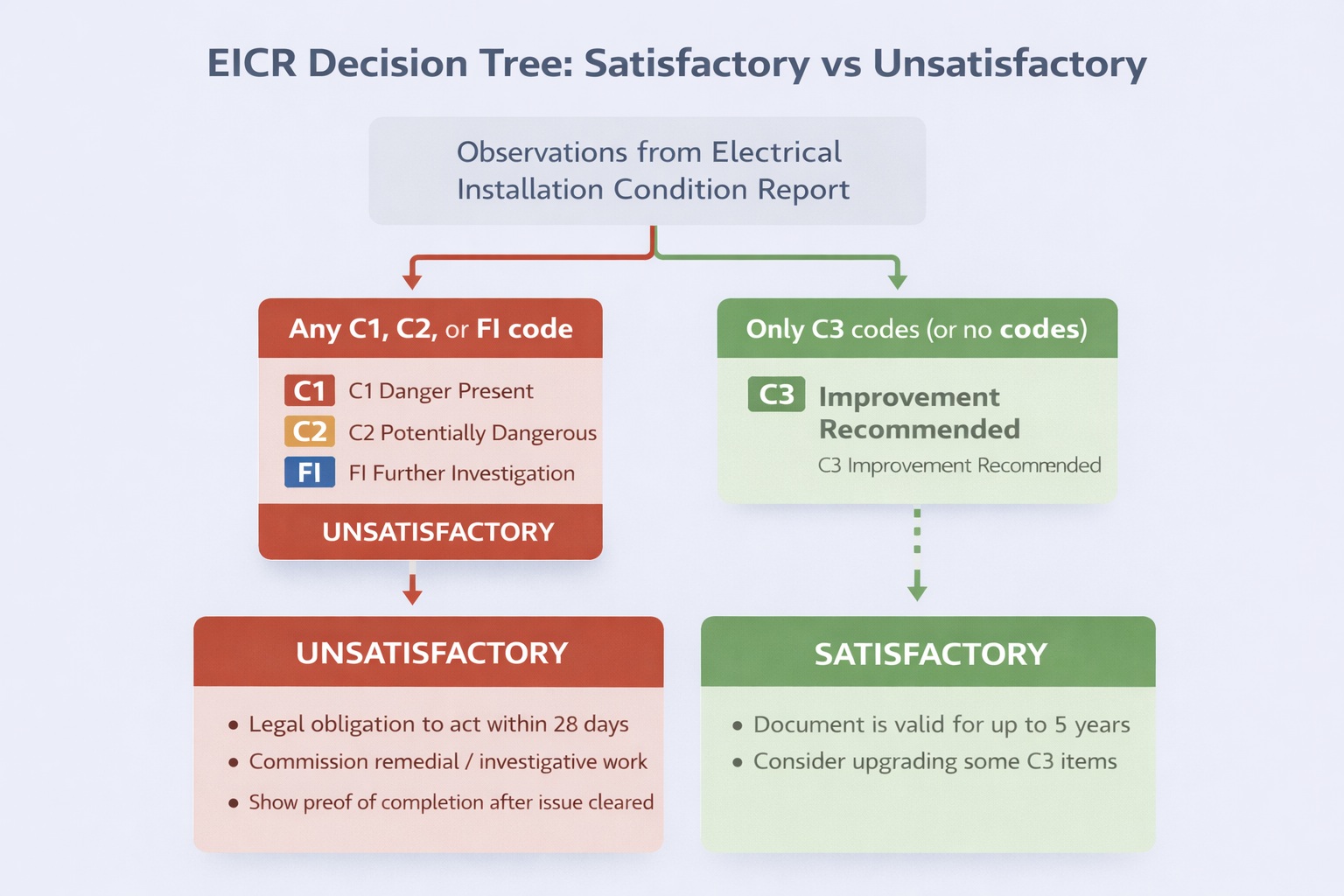
Scenario A: The Report is UNSATISFACTORY
Triggers: Any C1, C2, or FI codes. Legal Consequence: Your property is currently in breach of the Electrical Safety Standards.
- The 28-Day Clock: You have 28 calendar days (not working days) to fix C2s or investigate FIs. (7-day & 28-day EICR deadlines)
- The Evidence Rule: Once the work is done, you do not need to pay for a brand new EICR. You only need an Electrical Installation Certificate (EIC) or a Minor Works Certificate (MW) from the electrician confirming the fix. You attach this to the original "Failed" report to prove compliance.
- Insurance Tip: Many landlord insurance policies require a valid, compliant electrical report. An unresolved ‘Unsatisfactory’ EICR may weaken your position or affect a claim, so it’s important to act promptly on C1, C2, and FI items.
Scenario B: The Report is SATISFACTORY
Triggers: Only C3 codes (or no codes at all). Legal Consequence: You have met your obligations.
- Validity: The report is typically valid for 5 years, unless the inspector specifies a shorter interval in the ‘Recommendations’ box due to the condition or age of the installation.
- Best Practice: Review the C3 recommendations. If you are planning renovations or the property is vacant, it is often cheaper to upgrade these items now than to wait for them to fail.
Can I rent a property with a C3 code?
Yes. A C3 code does not make a property "Unsatisfactory." The government guidance explicitly states that C3 codes do not trigger the requirement for remedial work. Your property is compliant.
How to Talk to Your Electrician (Without Being Upsold)
Before booking, check they are registered with a competent person scheme like NICEIC or NAPIT. This is your first line of defence against 'cowboy' contractors and invalid certificates. Not all electricians interpret codes exactly the same way. Some are risk-averse and may mark an item as C2 when others would mark it C3. While you should never pressure an electrician to ignore safety, you should ask for clarity.
If you see a C2 code that surprises you, ask:
"Can you explain exactly why this is a C2 (potentially dangerous) rather than a C3 (improvement recommended)? Is there a specific regulation it breaches that poses an urgent risk?"
If you see an FI code, ask:
"What specifically prevented you from testing this? Do I need to arrange access, or is this a complex fault that needs a separate quote?"
If you have many C3 codes, ask:
"If I choose not to do these C3 upgrades now, will any of them likely deteriorate into a C2 before the next inspection in 5 years?"
How to Prioritise Without Panic
When a report comes back with a list of codes, use this simple workflow to manage your response:
- Scan for C1s: Confirm with the electrician that these were made safe during the visit. If not, book an emergency call-out immediately.
- Schedule C2s and FIs: These are your legal priority. Book these works in to ensure you beat the 28-day deadline.
Tip
Set a reminder for the 28-day deadline the moment you receive the report. You can use tools like CertNudge Compliance Reminders to track these deadlines and ensure you stay within the required timeframes.
- Review C3s: Ask your electrician for a quote to fix these while they are on-site fixing the C2s. It is often more cost-effective to bundle the work than to call them back later.
"Unsatisfactory" does not mean "Evict"
An Unsatisfactory EICR is a safety and maintenance instruction, not an eviction notice. You do not need to move tenants out unless a specific C1 fault presents an unavoidable danger that cannot be made safe quickly. As long as you act within the 28-day window to investigate or repair the issues, you are acting lawfully.
Conclusion
Understanding EICR codes turns a confusing technical document into a clear to-do list. The rule of thumb is simple: C1, C2, and FI require action to stay legal; C3 is optional for safety improvements.
The most common mistake landlords make is fixing the issues but losing the paperwork. Keep the original Unsatisfactory EICR together with written confirmation of remedial work (e.g., Minor Works/EIC) as your evidence.
EICR codes FAQs (Landlords in England)
Does a C3 code mean I have to do remedial work?
No. C3 means “improvement recommended”. It doesn’t require remedial work for the report to be classed as satisfactory.
That said, fixing C3 items can reduce risk and may prevent future issues being coded as C2.
Does an FI code fail the EICR?
FI means the inspector can’t confirm safety without further checks. In practice, many reports are marked Unsatisfactory if an FI is present, because further investigation is required.
Treat FI like a priority: book the investigation quickly and keep the written outcome with the original report.
Do I need a brand new EICR after repairs?
Not always. After remedial or investigative work, you typically need written confirmation from a qualified person showing what was done and that standards are met (for example, an EIC or Minor Electrical Installation Works Certificate).
Keep the original EICR together with the remedial certificate(s) as your evidence pack.
Who needs a copy of the EICR, and when?
- Existing tenants: within 28 days of the inspection and test.
- New tenants: before they occupy the property.
- Prospective tenants: within 28 days of a request.
- Local authority: within 7 days if they request it.
- After remedial/investigative work: provide the report and written confirmation to the tenant and local authority within 28 days of the work being completed.
What if my tenant won’t allow access for the investigation or repairs?
You’re expected to take reasonable steps. Keep evidence: emails/texts, proposed dates, contractor availability, and any refusals.
If you can show you’ve taken reasonable steps but were prevented from entering, you may not be treated as in breach solely because access wasn’t granted.
How often do I need an EICR?
In England’s private rented sector, electrical installations must be inspected and tested by a qualified person at least every 5 years.
The report can specify a shorter interval depending on the installation’s condition.
Note: This FAQ is written for England. Requirements differ in other UK nations.
Would you like to keep your certificates and remedial evidence organised in one secure place? CertNudge allows you to upload your EICRs and link the remedial evidence directly to the property, so you can prove compliance instantly if the Council asks.
See plans (Start with the plan that fits your portfolio.)
Last Reviewed: February 27, 2026
Next Review Recommended: August 2026