EPC C Confirmed for 2030: The Landlord’s Master Guide (England & Wales)
The deadline is now clear: 1 October 2030. This guide explains what compliance looks like under reformed EPC metrics, how the £10,000 cap and low-value safeguard work, and what to do now to avoid a last-minute scramble.
What EPC C by 2030 means for landlords (England & Wales)
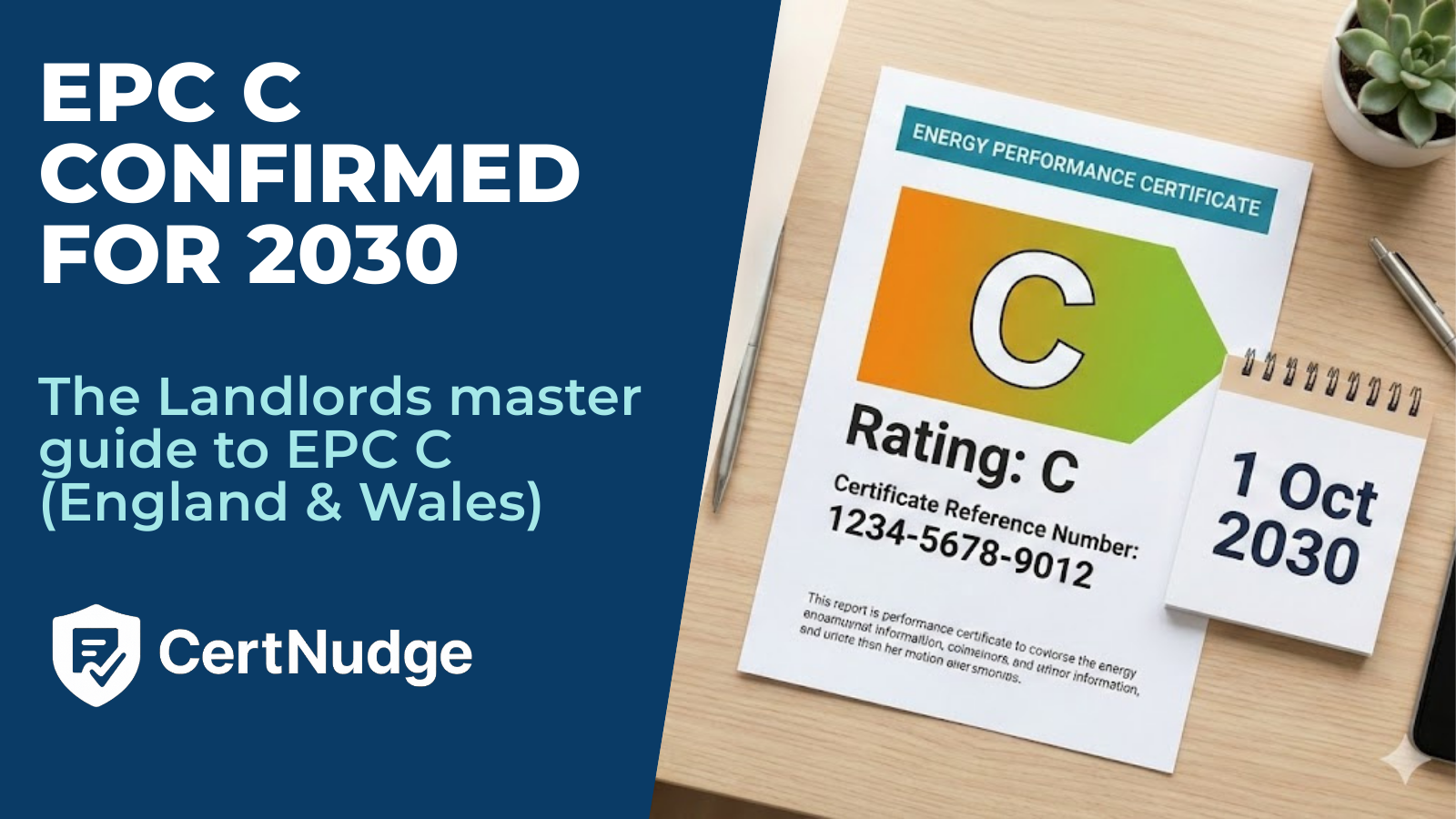
After years of mixed signals, the Government has confirmed one date: private rented homes in England and Wales must meet a higher minimum energy standard by 1st October 2030, unless a valid exemption applies.
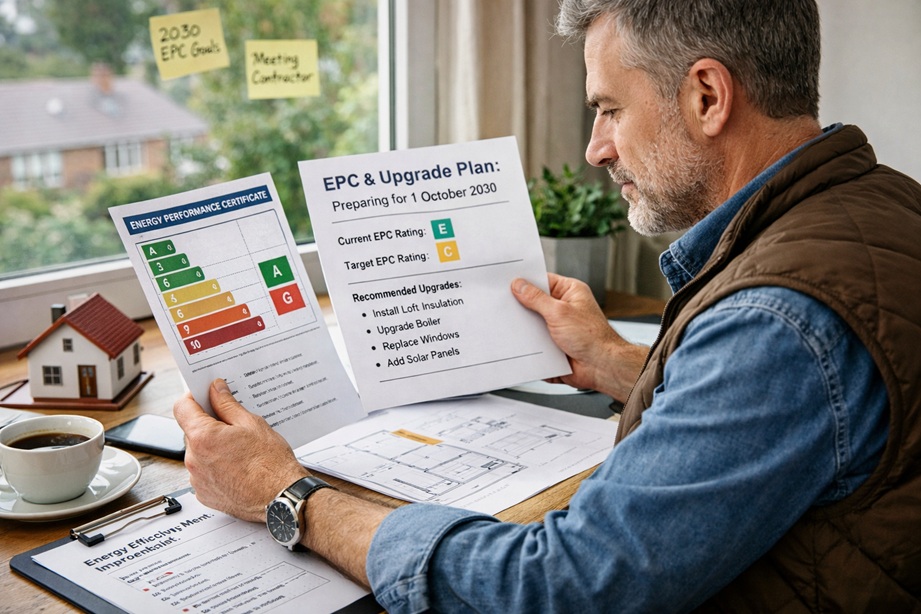
By 1st October 2030, for each rented property you must:
- Meet the new minimum standard (an EPC C-equivalent outcome under reformed EPC metrics), or
- Register a valid exemption, or
- Stop letting the property (because you would not be compliant with PRS MEES rules without compliance or an exemption).
You’ll be required to invest up to £10,000 per property over a 10-year period, with a lower cap for some lower-value homes.
The Government response confirms policy direction, but the detailed regulations and guidance are still subject to Parliamentary approval and final publication.
Disclaimer: This is general information, not legal advice. Rules can change and your circumstances matter take professional advice where needed.
What landlords should do now (5-step checklist)
- List every rented property and note its current EPC band and expiry date. (You can check the official record here: GOV.UK: Find an energy certificate. For a quicker landlord-focused triage view, try the free EPC risk checker.)
- Flag anything at D or E (and any existing exemptions on F or G) as priority stock.
- Gather invoices and receipts for relevant upgrades completed from 1st October 2025 onwards (dated, addressed, with clear descriptions).
- Identify properties likely valued under £100,000 and decide how you’ll evidence value if you may rely on the Property Value Adjustment route.
- Check which schemes are live for your area and tenant profile (for example BUS and locally delivered Warm Homes support), so you know what funding might reduce your out of pocket spend. See: GOV.UK Boiler Upgrade Scheme (BUS) and GOV.UK Warm Homes: Local Grant signposting.

Portfolio Organization
Track your EPC expiries in one place.
As you renew your properties for 2030, CertNudge tracks your certificate expiry dates and alerts you (60/30/14/7 days) before they lapse. See which properties are current or missing documentation on your Red/Amber/Green dashboard.
The core rule: one deadline (no phased dates)
There is one compliance date for tenancies in scope: 1st October 2030. There is no earlier deadline for new lets the earlier phased approach has been dropped in favour of a single compliance date. For current MEES rules and compliance context, see GOV.UK MEES landlord guidance.
If your property is already EPC C
If your property scores EPC C (EER C or above) on an EPC lodged before 1st October 2029, it will be treated as meeting the higher standard until that EPC expires or is replaced, provided it remains valid.
If your property is currently EPC D or E
You can generally continue letting under the current minimum (EPC E) until the higher standard takes effect—but by 1st October 2030 you’ll need compliance under the new standard or a valid exemption in place.
What’s changing: new EPC metrics and the Home Energy Model (HEM)
The Government is reforming EPCs using the Home Energy Model (HEM) and new headline metrics. The 2030 standard is designed to deliver outcomes similar to today’s EPC C, but measured differently as part of wider reforms to the Energy Performance of Buildings regime.
- You won’t just be “chasing points” on today’s EPC in the same way.
- The minimum standard will be based on reformed EPC metrics, rather than the current cost-based scale.
A practical point many landlords will welcome: the Government response aims to ensure you are not forced to replace a working heating system as the only route to compliance. That makes a fabric-first strategy a safer bet while the scoring framework changes.
Timing note: Government materials point to introducing revised EPC metrics alongside the transition to HEM in the second half of 2026, with implementation detail still being finalised and consulted on. See: GOV.UK Home Energy Model (HEM) consultation.
What is the £10,000 cost cap and how does it work?
The £10,000 cost cap is the maximum required investment per property over a 10-year period.
- If you spend up to the cap on eligible improvements and the property still doesn’t meet the standard, you can use a cost-cap exemption. Evidence requirements often apply see GOV.UK PRS exemptions register guidance.
- The Government response indicates the cost-cap exemption can be valid for 10 years, allowing you to continue letting while it remains registered.
The “retroactive” rule: spend from 1st October 2025 can count
Spend on relevant measures from 1st October 2025 onwards can count towards the cost cap, which is helpful if you act early. However, the Government response makes it clear that spend on installing fossil fuel heating in that early period is excluded from counting towards the cap.
Practical takeaway: Keep your evidence, but don’t assume a new gas boiler will help you “use up” the cap.
Do grants count towards the cap?
Some third-party funding can be counted towards the cap (depending on scheme rules and how the final regulations are written). One clear exception: Boiler Upgrade Scheme (BUS) funding is excluded from counting towards the £10,000 cap, even though it can reduce your out-of-pocket cost.
That’s a key planning point if you’re budgeting around heat pumps: BUS may help cashflow, but it does not reduce the amount you are deemed to have spent for cost-cap exemption purposes.
Keep your portfolio "Inspection-Ready."
CertNudge compiles your latest EPC, Gas Safety, and EICR into a professional Property Compliance Pack. One click generates a structured PDF dossier for your tenants, councils, or insurers.
Create My First Compliance PackWhat is the low-value safeguard (Property Value Adjustment)?
A Property Value Adjustment is being introduced to stop the cap being disproportionate for cheaper properties.
- It applies to properties valued below £100,000.
- In that case, the maximum required spend becomes the lower of £10,000 or 10% of the property’s value (so the cap could be lower than £10,000).
If you hold stock in lower-value areas, it’s worth modelling this early. It can change whether you upgrade fully, plan an exemption route, or decide whether that asset still fits your long-term strategy.
“No regrets” upgrades while EPC reform beds in
With EPC reform underway, the safest early work is still fabric first measures that reduce heat loss and tend to score well across methodologies.

Examples include:
- Loft insulation to current recommended depth
- Cavity wall insulation (where suitable)
- Draught-proofing and basic airtightness
- Hot water cylinder and pipe insulation
- Sensible glazing or door upgrades when you’re already replacing failed units
These improvements also tend to reduce tenant complaints and improve comfort—practical wins rather than theory.
A practical timeline to avoid a 2030 scramble
You’ve got just under five years until 1st October 2030. Use it.
- Centralise EPCs, expiry dates, and current bands. Start by using the free EPC risk checker to review current and potential EPC signals by postcode.
- Flag D/E properties (and any existing exemptions on F/G).
- Identify likely sub-£100k homes and get a valuation approach lined up.
- Fabric-first basics (loft top-ups, draught-proofing, lagging, LEDs).
- Plan works around voids where possible.
- By this stage, reformed EPC tools and metrics should be clearer, making it easier to choose between options with more confidence.
- If you’re going for low-carbon heating, plan installer capacity early—good installers get booked up fast.
- Don’t leave EPC assessments to the last minute capacity will tighten. If yours is expiring, see GOV.UK: Get a new energy certificate.
- Register exemptions early where needed (cost cap, Property Value Adjustment, third-party consent, and other routes set out in final regulations).
Funding support: what’s real and what to watch
Boiler Upgrade Scheme (BUS)
- Grants up to £7,500 for heat pumps (and support for eligible biomass), subject to eligibility and installer criteria. Official page: GOV.UK Apply for BUS.
- Current published closing date: 31 December 2027 (subject to change through future funding decisions).
- Planning tip: BUS may help cashflow, but it does not count towards the £10,000 cap in the Government’s policy summary. (More scheme guidance: Ofgem BUS guidance for property owners.)
Warm Homes: Local Grant and local delivery
Warm Homes programmes, including Warm Homes: Local Grant, are part of a wider support mix delivered locally, often alongside other energy-efficiency schemes. Details vary by area and eligibility, so:
- Start with your local authority’s scheme rules, eligibility criteria, and application windows.
- Keep an eye on updates, because local delivery can change year to year. GOV.UK signposting: Warm Homes: Local Grant (via Home Upgrade Grant page).
Record-keeping is now a compliance tool (not just admin)
Because spend from 1st October 2025 can count towards the cap (with exclusions), your paperwork can directly affect what you’re required to do later.
If you’re unsure what paperwork you should have to hand, see: What certificates do landlords need?
Keep, ideally in one place:
- EPCs and recommendation reports (old and new)
- Invoices and receipts with dates, addresses, and clear descriptions of work
- Quotes (useful if you need to evidence cost-cap logic)
- Valuation evidence for Property Value Adjustment
- Evidence for consent-related exemptions (emails, letters and timelines)
CertNudge tip: Store invoices, quotes, EPCs and supporting documents as you go (for example, in a Compliance Vault). It’s far easier than reconstructing a paper trail in 2029 or 2030.
FAQs (quick answers)
Do all landlords need EPC C by 2030?
For privately rented homes in England and Wales within scope, the higher standard applies by 1st October 2030, with exemptions where permitted.
If I spend £10,000 and still can’t reach the standard, what happens?
You can register a cost-cap exemption, which the Government response indicates can be valid for 10 years, allowing you to continue letting while the exemption remains registered.
Does the Boiler Upgrade Scheme reduce my £10,000 obligation?
It can reduce what you personally pay, but BUS funding is excluded from counting towards the £10,000 cap. You still need to meet the required landlord spend for cost-cap exemption purposes.
What’s the low-value exemption (Property Value Adjustment)?
For properties valued below £100,000, the maximum required spend becomes the lower of £10,000 or 10% of the property value.
Final thoughts
The deadline is now clear: 1st October 2030. The sensible approach is sequencing.
Audit first. Fabric-first early. Make bigger decisions once the reformed EPC metrics are clearer. Keep evidence as if you’ll need to defend every decision. That is how you keep options open and avoid a last-minute scramble.
Centralise EPCs, invoices and supporting evidence per property, track expiry dates, and keep an exportable record.
Check EPC risk by postcode first or start a free 14 day trial.