Landlord Gas Safety Certificates: Complete Guide (CP12 & Rules)
Gas safety is one area where a single missed date can cost a landlord thousands of pounds – or their right to evict. This guide explains CP12 rules, penalties, Possession risks, digital certificates, typical costs and a simple annual routine to stay compliant.
Gas Safety Certificates: Fines, Grace Periods and CP12 all Explained
If you’re a landlord, gas safety is one of the few areas where a single missed date can cost you thousands of pounds or even your right to evict a tenant.
This guide explains, in plain English:
- What a CP12 gas safety certificate actually is
- How often it must be renewed
- Whether there is a gas safety certificate grace period
- What the penalty for no gas safety certificate can be
- How missing a CP12 affects your right to regain possession
- What digital CP12 requirements look like
- Typical gas safety check costs
- A simple routine to stay compliant every year
Use this page as your reference hub, then dive into dedicated guides when you need more detail:
Use this page as your reference guide, then dive into detailed articles whenever you need more depth.
Quick Answers for Anxious Landlords
If you’re here because you’re worried, start with these:
Is there a gas safety certificate grace period?
No. There is no legal grace period after a gas safety certificate expires. Once it lapses, you are in breach. The only flexibility is:
- You can renew up to 2 months early and keep the same anniversary date (the “MOT-style” rule).
- If tenants refuse access, you may avoid prosecution only if you can prove “all reasonable steps” to arrange the check. That is a defence, not a grace period.
What is the penalty for no gas safety certificate?
Penalties vary, but can include:
- Civil penalties up to £30,000 per offence (council enforcement)
- Unlimited fines and even imprisonment in serious HSE prosecution cases
- Insurance problems – claims refused or reduced
- Section 21 issues – your notice can be thrown out if you can’t prove you gave the tenant a valid CP12
The yearly cost of a gas safety check is tiny compared to the risk.
Can I regain possession without a gas safety certificate?
No.
You must give the tenant a valid CP12 before or at the start of the tenancy, and each renewal within 28 days of the check.
- From 1 May 2026, Section 21 is abolished under the Renters' Rights Act 2025 Section 8 is the only possession route.
- Case law (Trecarrell v Rouncefield) still offers some flexibility for late certificates, but if you never had one, your possession position is very weak.
- Maintaining a continuous chain of CP12s is now more important than ever.
What Is a CP12 Gas Safety Certificate?
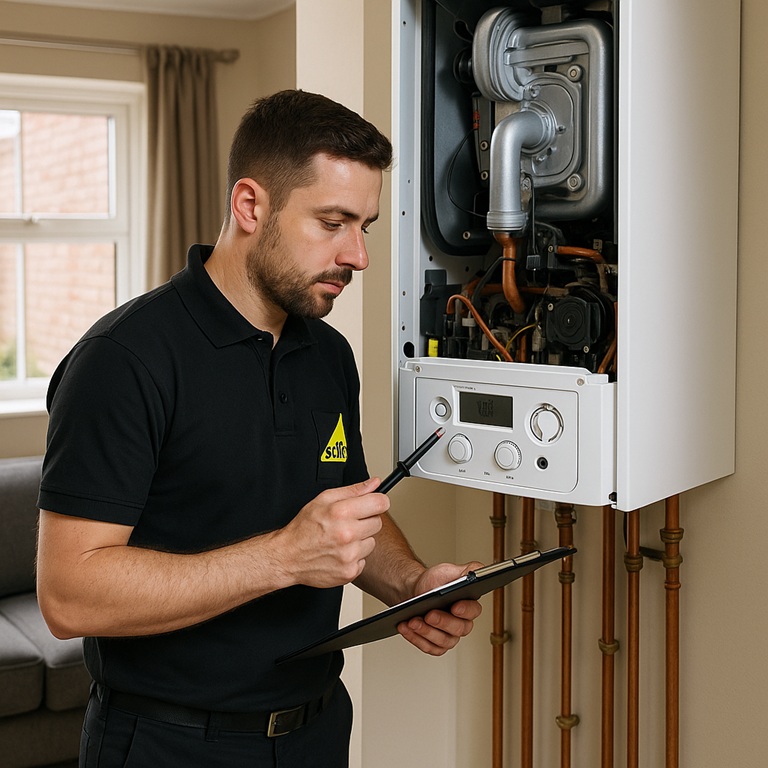
A CP12, often called a landlord gas safety certificate, is the legal record confirming that a Gas Safe registered engineer has checked the gas appliances, flues and pipework in a rental property and found them safe on the day of inspection.
A valid CP12 should include:
- Engineer’s name, signature and Gas Safe registration number
- Date of the inspection
- Address of the property
- Each appliance tested (boiler, hob, fire, water heater, etc.)
- Results of safety checks and any defects
- Whether anything has been classified “At Risk” or “Immediately Dangerous”
- The next check due date
The Gas Safe Register also explains what must be included in a valid record. See Gas Safe guidance on gas safety records .
How long does a gas safety certificate last?
It is valid for 12 months.
Most landlords renew every year, on or before the expiry date.
If you let property with any gas supply, you must have a current CP12 and provide it to your tenants. It’s not a “nice to have” – it’s a legal requirement.
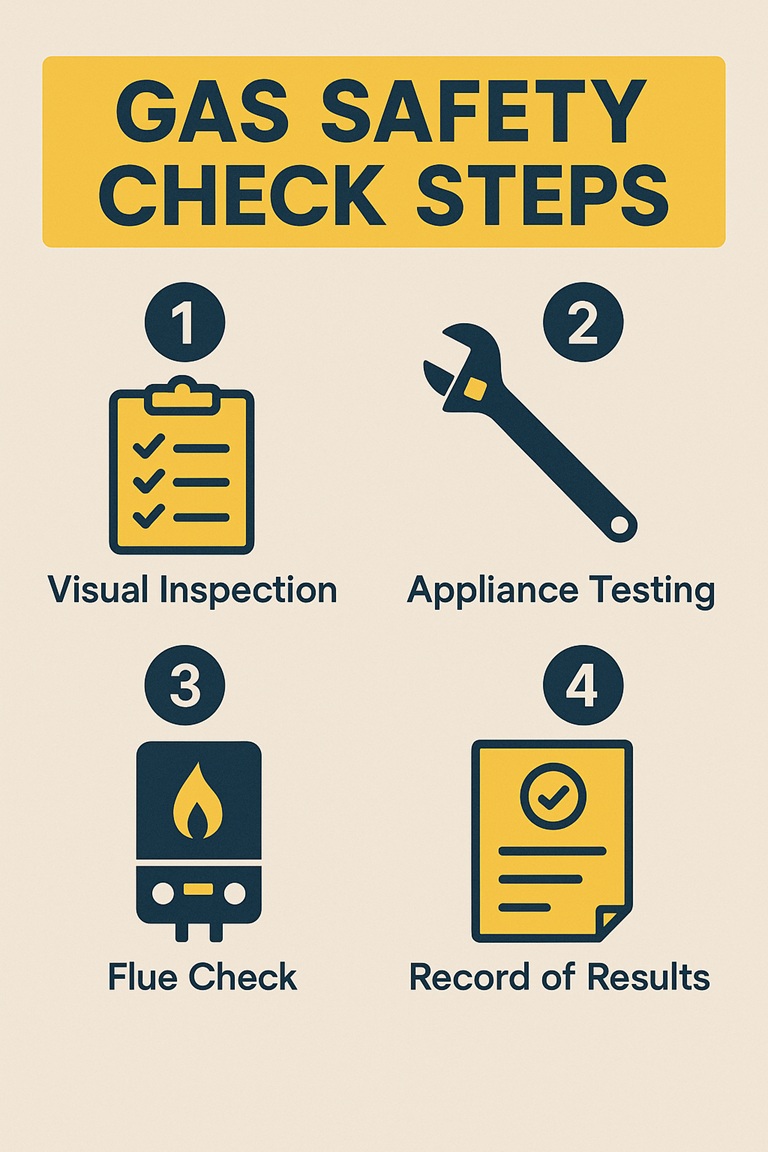 CP12 landlord gas safety check – a typical sequence of steps your Gas Safe engineer will follow.
 Your Core Legal Duties as a Landlord
In simple terms, UK gas safety law requires you to:
- Arrange an annual gas safety check
- At least once every 12 months
- Carried out by a Gas Safe registered engineer
- Keep a record (the CP12)
- For at least 2 years
- With all the required details
- Provide the CP12 to the tenant
- New tenants: before or at the start of the tenancy
- Existing tenants: within 28 days of each annual check
- Maintain appliances in a safe condition
- Repairs and follow-up work must be done promptly
- Unsafe appliances may need to be isolated or disconnected
Failing on any of these points exposes you to enforcement and legal risk.
For full regulatory guidance, see the official HSE landlord gas safety responsibilities .
The Truth About the “Gas Safety Certificate Grace Period”
A lot of confusion online comes from two ideas being mixed together: the MOT-style renewal rule, and the concept of “reasonable steps” when tenants won’t give access.
1. The MOT-style rule (early renewal)
Since 2018, landlords can:
- Renew the gas safety check up to 2 months before the expiry date
- Keep the same anniversary for next year’s expiry
Example:
- Current CP12 expires on 10 July 2026
- You renew on 15 May 2026
- Next expiry is still 10 July 2027
This is designed to encourage early checks, not permit late ones. It is not a grace period.
2. “Reasonable steps” when tenants won’t allow access
If a tenant repeatedly refuses access or isn’t home, HSE expects landlords to:
- Offer multiple appointment dates
- Send written reminders / letters
- Retain evidence (emails, texts, engineer notes)
- Keep trying at reasonable intervals
If you can show you took all reasonable steps, you may avoid prosecution even if the certificate went out of date temporarily.
But legally:
- The certificate is still expired
- You are still technically in breach
This is a defence, not an extension.
Bottom line: There is no official “grace period” window where you can let the property without a valid certificate.
Penalties for No Gas Safety Certificate
The penalty for no gas safety certificate depends on context:
Key risk: For something that typically costs under £150 a year, the financial and legal consequences of non-compliance can be severe.
Civil penalties – councils (Housing Act 2004)
Local authorities can issue:
- Civil penalties up to £30,000 per offence
- Often in the £2,000–£25,000 range for gas and other serious hazards
These are common in:
- HMO licensing checks
- Selective licensing schemes
- Responsive inspections after complaints
HSE prosecutions – serious or repeated failures
The Health and Safety Executive can prosecute where:
- There are serious gas safety failings
- There’s a history of non-compliance
- Tenants have been put at significant risk
Penalties include:
- Unlimited fines
- Up to 6 months’ imprisonment in the Magistrates’ Court, or more in serious Crown Court cases
- A criminal record that can affect future licensing and reputation
Indirect consequences
On top of fines, you also face:
- Insurance problems – claims refused or reduced if you were non-compliant
- Possession difficulties - Section 8 claims can be refused by courts if gas safety compliance has lapsed (Section 21 is abolished from 1 May 2026)
- Reputation damage with councils and licensing teams
Tenant advice bodies such as Shelter also highlight the consequences of failing to provide a valid CP12, including enforcement action and problems with possession claims.
For something that typically costs £70–£120 a year, the risk is clearly not worth it.
 Section 21 eviction notice – why missing CP12 certificates can invalidate possession claims.
 Possession and Missing Gas Safety Certificates
Gas safety and your right to regain possession are tightly linked. From 1 May 2026, Section 21 no-fault evictions are abolished under the Renters' Rights Act 2025. Section 8 is now the only possession route and a lapsed gas safety certificate can be used against you in court.
The basic rules
To bring a valid Section 8 possession claim, you must be able to show:
- The tenant received a valid CP12 before or at the start of the tenancy
- They received each renewal certificate within 28 days of the check
- You have a continuous chain of certificates, or at least a solid explanation and evidence if not
If you cant prove service – especially of the initial certificate – your notice is vulnerable.
The government summarises possession requirements at GOV.UK: Evictions for private renters. These include the need for landlords to have provided a valid gas safety certificate now critical under the Section 8 route.
Relevant case law
- Caridon v Shooltz (2018) – found that if the initial CP12 wasn’t given before move-in, a Section 21 notice could never be valid.
- Trecarrell House Ltd v Rouncefield (2020) – softened that position: a late CP12 didn’t automatically invalidate Section 21, as long as the tenant received a valid certificate before the notice was served.
However, if you’ve never had a gas safety check carried out, or there are large unexplained gaps in certificates, your position is still very weak.
For possession claims, judges look for responsible, consistent compliance – not last-minute fixes.
⚠️ Important — from 1 May 2026
Section 21 is abolished under the Renters' Rights Act 2025. The above case law applies to Section 21 notices served before that date. For new possession claims, Section 8 applies and courts can refuse a claim where gas safety compliance has not been maintained.
Are Digital CP12 Certificates Accepted?
Yes. Digital CP12s are fully valid.
Most modern Gas Safe engineers now issue certificates electronically, usually as a PDF via email or a customer portal. This is accepted by:
- Local authorities and HMO licensing teams
- HSE inspectors
- Letting agents
- Insurers
- Courts and tribunals
What matters is not whether the certificate is paper or digital, but that:
- It is issued by a Gas Safe registered engineer
- It contains all required information
- You provide it to the tenant within the required timescales
- You can produce it quickly if a council, insurer or court asks to see it
Digital certificates are often safer from a compliance point of view because they’re harder to lose, easier to store and back up, and can be shared instantly.
How Much Does a Gas Safety Check Cost?
Prices vary by region, but typical ballpark figures are:
- £60–£120 for a standard check on a single boiler
- £15–£35 extra per additional gas appliance (hob, gas fire, additional boiler)
- £110–£160 for a combined boiler service and gas safety check
- Higher prices are common in London and the South East
Very low prices (for example, £35 “certificates”) can be a red flag. A proper check takes time and should include:
- Visual inspection
- Flue checks
- Burner pressure tests, where appropriate
- Ventilation checks
- Appliance operation tests
A certificate that’s just a piece of paper — without a proper inspection — does little to protect you if there’s an incident or investigation.
A Simple Annual Routine to Stay Compliant
You don’t need to obsess over the regulations. You just need a system that makes forgetting almost impossible.
The NRLA also provides practical guidance on keeping compliant. See NRLA: Landlord gas safety responsibilities .
1. Book early
- Set reminders 60 and 30 days before expiry
- Book the appointment 1–2 months in advance
2. Use a trusted Gas Safe engineer
- Stick with one engineer or firm where possible
- They’ll understand your properties and can flag issues early
3. Store certificates digitally
- Keep all CP12s in a secure digital folder or compliance tool like CertNudge
- Use clear file names (for example, “12-Oak-Road-CP12-Jul-2025.pdf”)
- Keep at least 2–3 years of history per property
4. Always send the CP12 to tenants
- New tenancy: send before or on move-in day
- Renewals: send within 28 days
- Keep proof – email, WhatsApp, signed document pack, etc.
5. Keep an evidence trail
If anything goes wrong (access issues, tenants cancelling, engineer notes), log:
- Messages attempting to arrange access
- Engineer job sheets showing “no access”
- Letters or emails sent to tenants
- Photos or scanned documents where relevant
This log can make the difference between enforcement and understanding if the council or HSE becomes involved.
Final Thoughts: Gas Safety Is a Legal Duty – and a Safety Net
A landlord gas safety certificate is more than just a yearly chore. It is:
- Proof you’ve taken your legal responsibilities seriously
- Protection if something goes wrong and there’s an investigation
- A key part of protecting your right to regain possession via Section 8 (Section 21 is abolished from 1 May 2026)
- A simple way to protect the people living in your property
There is no grace period, and the penalty for no gas safety certificate can be severe – but with a clear routine, digital storage, and good reminders, compliance can become a quiet, low-stress part of running your portfolio.
When you’re ready to go deeper, explore the dedicated guides on fines, possession rights, costs and the grace period myth to keep your gas compliance airtight.
Important: This article is for general information only and is not legal advice.
Always seek independent legal advice or consult a specialist with regards to any legal matters regarding gas safety certificates.
Information accurate as of April 2026.