EICR for Landlords in England: Rules, Deadlines and Proof to Keep
If you’re a landlord in England, this EICR checklist covers who’s in scope, the 5-year rule, who must get the report (and when), what to do between tenancies, and how to file proof so you can respond fast if the council asks.
Landlords in England must ensure every electrical installation is inspected and tested at least every 5 years. Often called the “Landlord Electrical Safety Certificate,” the EICR (Electrical Installation Condition Report) is mandatory for all new and existing tenancies. This article covers
- Whether your property is actually in scope
- What “qualified person” means in practice
- Who must receive the report and by when
- What to do between tenancies
- How to keep proof so you can produce it quickly if asked
This guide focuses on the private rented sector in England. Public guidance also covers the social rented sector, but that is outside the scope of this article.
Important: This article is for general information only and is not legal advice. Regulations change and circumstances vary. If you need advice on your situation, speak to a qualified professional.
Key takeaways: EICR rules for landlords in England
- Frequency: EICR at least every 5 years (or sooner if the report specifies).
- Deadlines: Share with existing tenants within 28 days; new tenants before move-in; council within 7 days if requested.
- Remedials: If unsatisfactory (C1/C2/FI): remedials or investigation within 28 days (or sooner) + written confirmation to tenant and council.
- Proof: Keep: latest EICR + remedial proof + proof of supply + access attempts evidence (if relevant).
These rules come from the Electrical Safety Standards in the Private Rented Sector (England) Regulations 2020. This guide is for private landlords in England only.
What is an EICR (and what does it cover)?
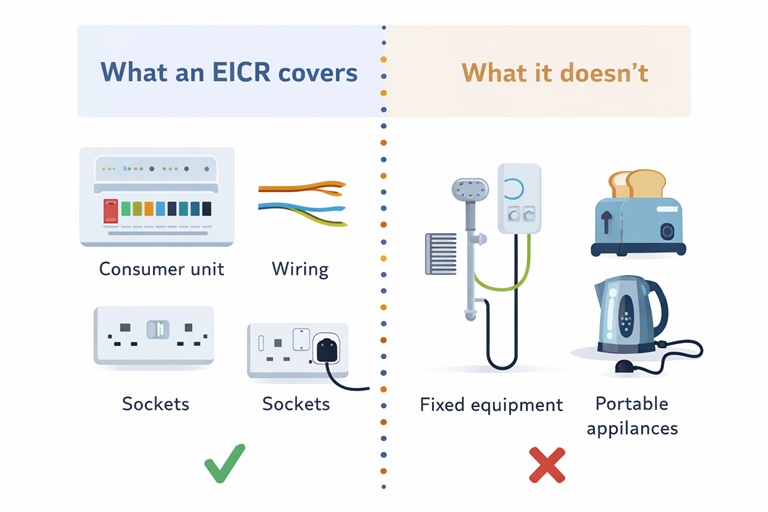
An Electrical Installation Condition Report (EICR) is the report you receive when a qualified person inspects and tests the fixed electrical installation in a property. It typically covers:
- Wiring
- Plug sockets (socket-outlets)
- Light fittings and switches
- The consumer unit (fuse box)
- Permanently connected items such as showers and extractors
- Circuits for specialist installations such as solar PV or battery storage (where relevant)
It is different from checking portable appliances such as kettles or microwaves. The focus here is on the fixed electrical parts of the premises.
Plain-English landlord takeaway: an EICR tells you whether the installation is safe for continued use, what work (if any) is needed, and when the next inspection is due.
Do the EICR rules apply to your tenancy?
The duties come from The Electrical Safety Standards in the Private Rented Sector (England) Regulations 2020.
Official guidance explains that the regulations apply to landlords where the tenant:
- Has the right to occupy the premises as their only or main residence, and
- Pays rent (even if it is not at market rent).
Common exemptions (do not guess – check)
There is a list of excluded tenancies in Schedule 1 of the regulations. Examples include:
- Long leases (7 years or more)
- Some student halls of residence
- Certain forms of shared accommodation with the landlord or the landlord’s family
- Care homes and some other specialist accommodation types
These are examples only - see Schedule 1 of the Regulations for the full list of excluded tenancies.
Practical tip: if you are unsure whether your specific letting is excluded, treat that as a “stop and verify” moment. Do not rely on forum answers or hearsay; refer back to the regulations or take professional advice.
How often do landlords need an EICR in England?
Landlords must ensure inspections and testing are carried out by a qualified person at least every 5 years, and must obtain a report that sets out the results and a date for the next inspection.
Two common timing “gotchas”
- “At least every 5 years” does not always mean exactly 5 years.
The report can specify a shorter interval, and you are expected to follow the date stated on the report. - New build or full rewire evidence can change the clock (in some cases).
Where the premises are newly built or completely rewired and have an Electrical Installation Certificate (EIC), landlords can sometimes rely on that certificate as evidence for a period of 5 years, provided they comply with their other duties. Check the official guidance or take advice if you are unsure how this applies to your property.
Do you need a new EICR before every new tenancy?
Official guidance is clear: no, you do not automatically need a new EICR each time you re-let provided the previous report has not expired. If the inspection and test took place less than 5 years ago and the report does not identify remedial or further investigative work, you won’t usually have additional work to complete under these specific duties - but you should still act on any safety issues that arise.
However, you must supply the most recent report to the new tenant before they occupy the premises. It is also recommended that landlords carry out at least a visual inspection before a new tenancy starts, to check nothing has been damaged or deteriorated since the last report.
Landlord reality check: even a “fine” installation can be affected by a loose socket, DIY wall mounting, water ingress or general wear and tear. A quick visual check between tenancies is a sensible habit.

Who is a “qualified person” for EICR reports?
The regulations refer to a “qualified person” who is competent to undertake inspection and testing.
Official guidance points landlords towards recognised industry resources and registers to help choose appropriately qualified electricians.
You can also search approved schemes via the NICEIC contractor search or NAPIT member search.
A sensible landlord approach:
- Ask which inspection and testing standard they work to (for example, British Standard 7671, the 18th Edition wiring regulations).
- Confirm what you will receive: a report stating the results, any classification codes, and the date for the next inspection.
- If you manage a portfolio, standardise how you book EICRs and how you store results so nothing gets lost.
What landlords must do with the report (deadlines that matter)
It is not just about having an EICR; it is about supplying it to the right people within set timeframes and keeping evidence.
EICR sharing deadlines (England)
| Who receives it | Deadline |
|---|---|
| Existing tenant | Within 28 days of the inspection and test |
| New tenant | Before they occupy the premises |
| Prospective tenant | Within 28 days of receiving a request |
| Local council | Within 7 days of receiving a request |
Retention and handover to the next inspector
You must also:
- Retain a copy of the EICR until the next inspection is required (or, if later, carried out), unless a newer report replaces it; and
- Provide it to the person carrying out the next inspection and test.
Practical implication: your system needs to handle dates (next inspection due, any remedial deadlines) and documents (the report plus proof you supplied it).
That is exactly the workflow CertNudge is built around: track expiry dates, store certificates and produce a shareable pack when needed.
A simple way to avoid deadline slips
Even if you are not using software, create one repeatable routine:
- Save the EICR PDF the same day you receive it.
- Email it to the tenant (or upload it to your portal) and keep the sent email or system log.
- Add a note such as: “EICR sent to tenant on DD/MM/YYYY”.
- Log the “next inspection due” date from the report.
Access denied: What if the tenant refuses entry?
You cannot complete an inspection if you cannot get in.
Official guidance explains that a landlord is not in breach of certain specified duties if they can show they have taken all reasonable steps to comply. Examples include keeping copies of communications while trying to arrange access.
Practical landlord habit: keep an “access attempt” thread per property (emails, texts, letters). It acts as a reminder trail and evidence if your actions are ever questioned.
What the EICR codes mean (C1, C2, C3, FI) – and what you need to do
Your EICR will use classification codes to show the severity of issues found. The key codes broadly mean:
For the formal definitions and examples used by inspectors, see Electrical Safety First’s Best Practice Guide on EICR classification codes.
| Code | What it broadly means | What it usually means for you |
|---|---|---|
| C1 | Danger present; risk of injury. The inspector may make hazards safe. | Treat as urgent. The installation will be unsatisfactory; work is required. |
| C2 | Potentially dangerous. | Work is required. The report will be unsatisfactory until it is resolved. |
| FI | Further investigation required without delay. | You must arrange further investigation and complete any resulting work. |
| C3 | Improvement recommended. | Not mandatory under these regulations, but sensible to plan improvements. |
“Satisfactory” vs “unsatisfactory”
If the report does not require investigative or remedial work, the landlord will not be required to carry out further work under these duties.
If C1 or C2 issues are identified, remedial work will be required and the report will state the installation is unsatisfactory for continued use. If FI is used, you must ensure further investigation is carried out. C3 does not require work for the report to be satisfactory, but acting on it can improve safety.
Landlord operator tip: if you have multiple properties, triage reports the same way every time:
- Any C1/C2/FI → treat as a tracked task with a clear deadline.
- Any C3 → log as “recommended improvements” for your next planned maintenance window.
If the EICR is unsatisfactory: remedial works and written confirmation (the 28-day workflow)
Where the report shows remedial or further investigative work is needed, landlords must:
- Complete the work within 28 days, or within any shorter period specified in the report.
- Within 28 days of completing the remedial or investigative work, supply the tenant and the local council (where required) with:
- the report; and
- written confirmation from the qualified person who carried out the works.
What counts as “written confirmation”?
Written confirmation is the document from the electrician confirming what work has been completed. In practice, your electrician should confirm what’s appropriate for the work:
- An updated or satisfactory EICR following remedials; or
- An appropriate electrical certificate for the work completed (your electrician will advise what is appropriate for the job).
Practical point: when booking remedials, ask: “After the work, what document will I receive as written confirmation, and when will I get it?”
A simple “unsatisfactory EICR” checklist
If the report comes back unsatisfactory (C1/C2/FI):
- Record the issue codes and deadline (28 days, or sooner if stated).
- Book remedial or investigative work (ideally immediately).
- Save: original EICR, remedial invoice/quote and appointment confirmation.
- Receive written confirmation after the work and save it with the EICR.
- Send the report and confirmation to the tenant (and the council if required/requested).
Not sure whether your EICR (or any other certificate) is in date across your properties? Run a free compliance check – enter your properties and see at a glance which certificates are missing or expiring, and what your exposure is.
Run my free compliance check →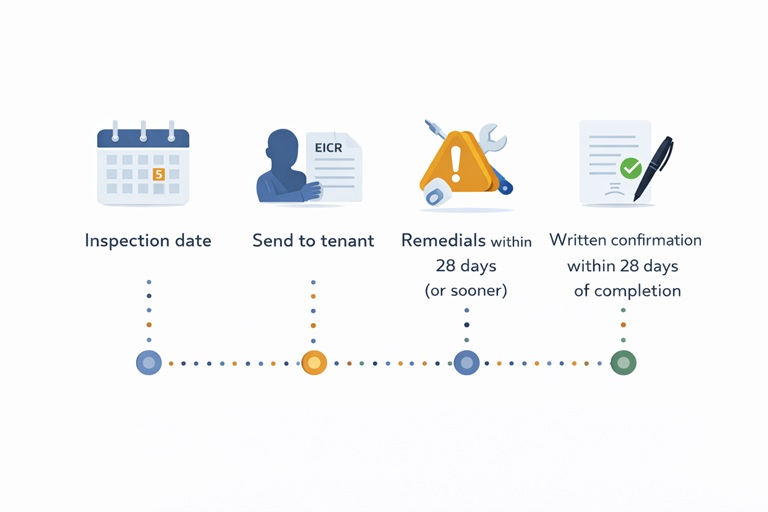
What proof to keep (and a “can’t-miss-it” filing system)
You must retain a copy of the report until the next inspection and test is required (or, if later, carried out), unless it is superseded by a newer report. You must also provide a copy to the person doing the next inspection and test.
Minimum evidence pack (practical suggestion)
For each property, keep:
- Latest EICR (PDF).
- If applicable: written confirmation of remedial/further investigative work, plus any follow-up certification.
- Proof of supply (for example, email sent to the tenant, portal log or dated letter) to show you met the sharing duties.
- Notes on access attempts if access was an issue – keeping evidence of “reasonable steps” is a sensible approach.
- Optional but useful: invoices/receipts and a brief “what was fixed” note (helps next time you renew).
If you are compiling documents for a possession claim, you can verify you have the correct paperwork using our free Eviction-Ready Evidence Pack.
For a broader landlord document list, see: What certificates do landlords need?
A clean folder structure (works for single lets and portfolios)
If you are storing this yourself (Drive, Dropbox, OneDrive), keep it boring and consistent:
Property Name Or Address/Compliance/Electrical/
├── EICR/
├── Remedials/
└── Photos-Notes/ (optional)
File naming convention (simple and searchable)
- 12HighSt_EICR_2026-01-10.pdf
- 12HighSt_EICR_RemediationConfirmation_2026-01-24.pdf
- 12HighSt_Electrical_Invoice_2026-01-24.pdf
“Inspection-ready” means you can answer these in 60 seconds:
- What is the latest report?
- When is the next one due (and did the report shorten the interval)?
- If it was unsatisfactory, what did you do – and where is the written confirmation?
- When did the tenant receive the report?
Enforcement basics (calm overview)
Local councils may impose a financial penalty on landlords who breach specified duties under the regulations. The maximum was £30,000 for breaches before 1 May 2026, rising to £40,000 for breaches on or after that date. Councils can also serve notices; landlords can make representations and appeal to the First-tier Tribunal (Property Chamber).
Two timing points worth noting:
- Official guidance highlights different references for offences committed before and from 1 May 2026.
- The same guidance includes social rented sector timings. This article stays focused on private landlords in England.
The key is to understand your duties, keep a repeatable system and keep good records.
If you’re preparing for tighter evidence expectations in 2026, see our related guide: Renters’ Rights Act 2026: landlord compliance audit.
More on the EICR rules in detail: the 7-day and 28-day deadlines explained, what the C1, C2, C3 and FI codes mean, and what to do when your EICR is close to expiry.
The “inspection-ready” landlord system for EICR
Here is a routine that works whether you self-manage one property or oversee 50.
Step 1: Treat the EICR as a repeating cycle
When the EICR arrives, immediately capture:
- The inspection date.
- The next due date shown in the report (which may be sooner than five years).
- Any action codes (C1/C2/FI) and their implied urgency.
Step 2: Make sharing the report a standard checklist item
- Send the EICR to the tenant the same day you file it.
- Save the proof of sending.
- Log the date sent in your property record.
Step 3: If unsatisfactory, run the 28-day playbook
- Book remedial or investigative work.
- Get written confirmation.
- File it with the original report.
- Share the report and confirmation with the tenant and, where required, the council.
If you manage more than one property, a simple tracker can help, for example, storing EICRs per property and reminding you before the next one is due.
Real-world landlord scenarios (and how the EICR workflow changes)
Scenario A: High-turnover lets (students, sharers, lots of move-ins)
With frequent changeovers, the risk is losing track of documents and forgetting the “give the latest EICR to the new tenant before they move in” step.
What to do:
- Keep a “new tenancy pack” checklist that includes: latest EICR attached before move-in.
- Store the latest EICR in one obvious place per property.
Scenario B: DIY / decorating between tenancies
Between tenancies is when sockets get swapped, new lights are fitted and holes are drilled for TVs.
Official guidance recommends at least a visual inspection before a tenancy starts, to check the electrical installation has not deteriorated since the last report.
What to do:
- Run a quick visual check
- If anything looks off, raise it with a qualified person.
Scenario C: Renovation, new kitchen, rewire, consumer unit change
After substantial electrical works, you may receive an Electrical Installation Certificate (EIC). Guidance explains how a valid EIC for a newly built or completely rewired property can sometimes be used as evidence for a period, with conditions.
What to do:
- Keep the EIC alongside the EICR history in the same “Electrical” folder.
- Keep your routine: record dates and save documents.
Scenario D: Tenant access problems
For certain duties, landlords are not treated as in breach if they can show they have taken all reasonable steps, such as keeping evidence of attempts to communicate and arrange access.
What to do:
- Use a simple “access attempt log” and keep it with the EICR documents.
- Keep messages calm, specific and consistent.
The between-tenancy “visual check” mini-guide (5 minutes, no tools)
This is not a substitute for a proper inspection and test, but a visual inspection before a tenancy starts is a sensible extra step.
What to look for
Walk the property and note anything like:
- Cracked or broken sockets or faceplates
- Scorch marks or discolouration around sockets and switches
- Loose sockets that wobble when touched
- Buzzing or crackling sounds from switches
- Signs of water damage near electrical fittings (especially kitchens and bathrooms)
- Obviously overloaded extension leads
What to do if you spot something
- Do not attempt electrical repairs unless you are properly qualified.
- Contact a qualified electrician and keep the outcome in writing.
Portfolio tip: make this a standard “end of tenancy / pre-let” checklist item.
FAQs
How often do I need an EICR as a landlord in England?
At least every 5 years, but follow the interval stated on your report if it requires a sooner check.
Do I need a new EICR every time I change tenants?
No. If the existing inspection is within the required timeframe and does not require investigative or remedial work, you can usually rely on that report – but you must give the new tenant the most recent EICR before they move in.
When do I have to give the EICR to my tenant?
Existing tenants must receive it within 28 days of the inspection and test. New tenants must receive it before they occupy the property.
What if the council asks for the EICR?
You must supply the local council with a copy within 7 days of receiving a request.
What if my EICR is unsatisfactory?
If remedial or further investigative work is required, you must ensure it is completed within 28 days (or sooner if stated), and then provide the report plus written confirmation of the work to the tenant and, where required, the council within 28 days of completion.
Want an “inspection-ready” EICR pack per property?
CertNudge is built to help landlords track key dates, store EICRs and supporting proof in one place, and generate a shareable compliance pack when you need to produce evidence quickly.
Last reviewed: 09 July 2026 | Review again by: 09 January 2027