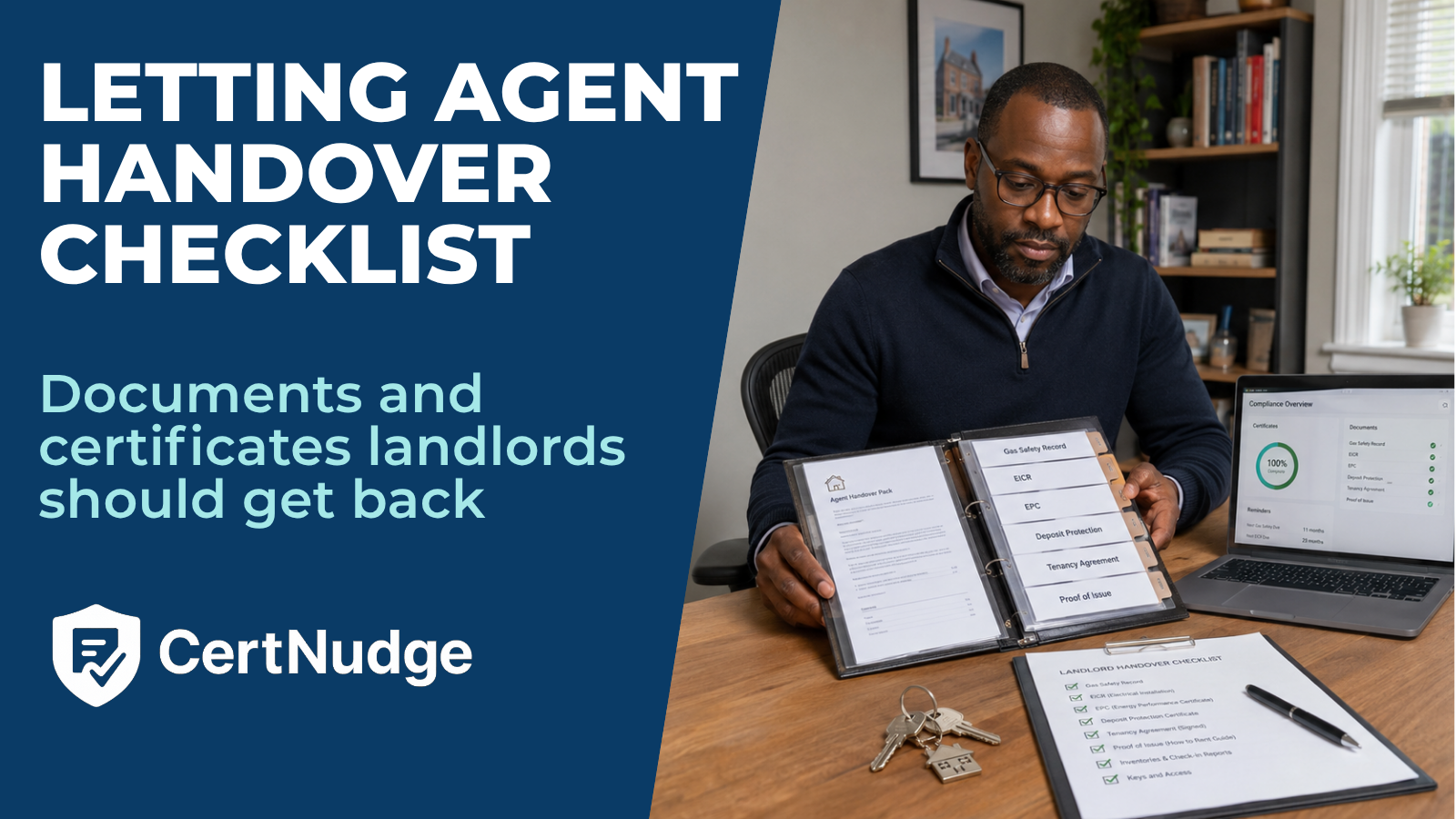
Letting Agent Handover Checklist: Documents and Certificates Landlords Should Get Back
Switching letting agent or taking back management? Use this practical landlord checklist to recover certificates, proof of issue, deposit records, repairs, keys and compliance evidence before portal access disappears.
Switching letting agents or taking back management yourself? The letting agent handover checklist most landlords receive is often incomplete. Getting the keys back is step one. Getting back gas safety records, EICRs, proof of issue, deposit evidence and repair history before portal access disappears is the part that actually protects you.
This guide gives landlords in England a practical checklist of the documents and records to request before the agent relationship ends, whether you are switching agents, moving to self-management, buying a tenanted property, or taking over a property that was previously agent-managed.
Key takeaways
- A handover is not complete when the agent gives back the keys. It is complete when you have the evidence file.
- Asking for certificates is not enough. You also need proof that the right documents were given to the tenant.
- Agent portals can close after termination. Download the documents before the relationship ends.
- The landlord can remain exposed even if the agent arranged the certificates.
- A handover is the ideal moment to rebuild one clean, inspection-ready property record.
Picture this: you terminate your letting agent, collect the keys, and feel like the transition is done. Three months later, a council officer asks for the EICR and proof it was given to the tenant. You call your former agent. The portal has been archived. The email address bounces. The PDF you have is not the version the tenant received.
That situation is avoidable. The problem is usually that the landlord accepted an incomplete handover: certificates without the evidence that surrounds them.
CertNudge’s free check shows you, property by property, which certificates are current, missing or expiring — so you know what to ask the agent for while they are still answering the phone.
Run the free compliance check — see where your evidence gaps are
This article is general information for landlords in England, with some UK-wide safety points where relevant. It is not legal advice. Your rights to receive documents from an agent may depend on your agency agreement, the agent's terms of business, redress scheme rules and the facts of the handover. Some document-service requirements also vary by tenancy type and date. Always verify the current legal position on GOV.UK before relying on any specific obligation or deadline.
Quick answer: what should landlords ask a letting agent for before handover?
If you are changing letting agent or taking back management yourself, ask for the full property file before the relationship ends. That means current safety certificates, tenancy and deposit records, proof that required documents were given to the tenant, repair and remedial evidence, licence documents, rent and account statements, keys, and any open issues. Do not settle for “everything is on the portal” unless you have downloaded and saved the evidence yourself.
Why a letting agent handover is a compliance risk
While the relationship works, the agent often instructs the contractor, books the inspection, uploads the certificate and serves documents on the tenant. That is convenient until the management agreement ends and the paper trail becomes harder to access.
Three things make letting agent handovers a compliance risk:
- Safety certificates may sit inside the agent’s portal, not your own records, and access can disappear after termination.
- Proof of issue is often stored separately from the certificate, and agents do not always transfer both.
- The landlord can remain responsible for the underlying compliance duty even where the agent arranged the inspection, upload or tenant communication.
The bigger issue is that proof of issue can be more valuable than the certificate alone. A gas safety record, EICR or deposit document is much less useful in an enforcement context if you cannot show when, how and to whom it was supplied.
Consider a landlord with two flats in Manchester whose agent retires and sells the business. The incoming firm has the current gas safety certificates, but no record of when those certificates were given to each tenant or which version of the How to Rent guide was handed over at the start of each tenancy. Every compliance item looks present, but the evidence chain is broken.
Gaps like that tend to surface at the worst possible time: when a tenant raises a disrepair complaint, when a council officer makes a licensing inspection, or when an insurer asks for evidence before paying a claim.
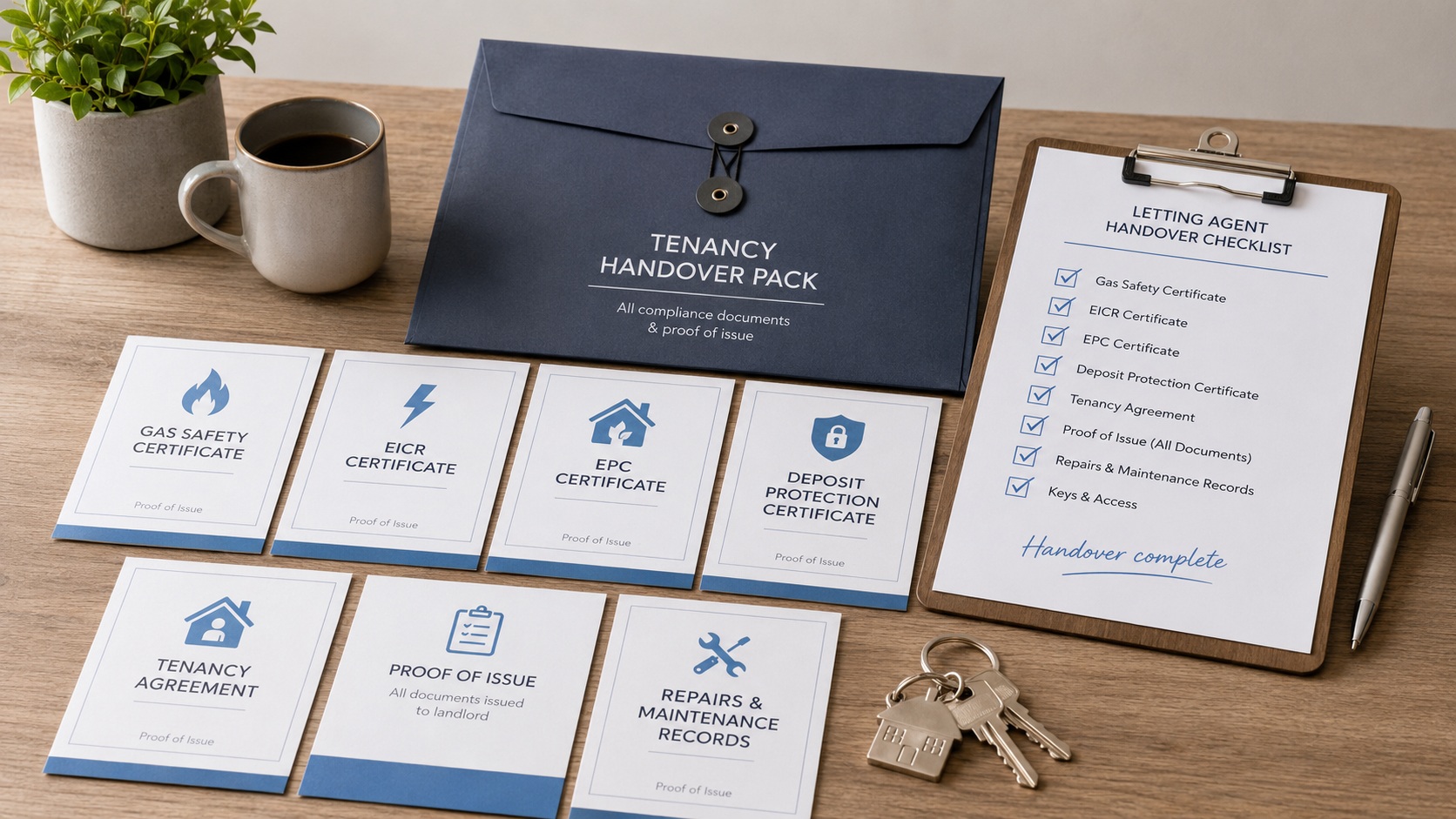
When to use this letting agent handover checklist
Use this checklist whenever the management relationship changes. That includes switching agents, moving to self-management, buying a tenanted property, dealing with an agent that is closing or merging, or centralising records across several properties that were previously managed separately.
If you are becoming a self-managing landlord for the first time, this checklist also becomes the baseline record you need before you can manage compliance renewals independently.
If you are buying a tenanted property, request the full compliance file as part of the conveyancing process rather than waiting until completion. The seller’s solicitor should be able to help confirm or provide key records such as tenancy documents, deposit protection status and current safety certificates.
The key point is the same in every case: act before the agent’s portal closes, not after.
There is also a forward-looking reason to do this properly now. The PRS database for landlords in England will require per-property compliance records — gas safety, EICR and EPC among them — as registration rolls out from late 2026. Records you fail to recover from an outgoing agent are records you will have to reconstruct before you can register.
When to start: send your handover document request before the management agreement notice period expires. Once the portal closes and the agent has no live reason to respond, recovering missing files can become significantly harder.
The full letting agent handover checklist
For a landlord with two or three properties, the recovery order matters. Start with current safety certificates because those have live legal and enforcement implications. Then move to proof of issue, because having the document without evidence of service is one of the most common weaknesses in a handover file. After that, review remedials, repairs and open issues. Financial records and historic correspondence can follow once the urgent compliance items are confirmed.
If the agent portal has already closed: do not rely on memory or screenshots. Send a written request for a full file export, contact contractors directly for safety records, check the deposit scheme yourself, and retrieve the EPC from the official register where needed.
Property basics
What to request: Full address, tenant names, tenancy start date, rent amount, rent due date and managing contact history.
Why it matters: Anchors every compliance deadline and future tenant communication.
Tenancy documents
What to request: Tenancy agreement, written variations, guarantor agreement if applicable, and any written tenancy information.
Why it matters: Helps you understand current tenancy terms and any duties under the Renters’ Rights Act 2025 regime.
Gas safety
What to request: Current gas safety record, previous records, check dates, engineer details and proof the record was given to tenants.
Why it matters: HSE guidance says existing tenants must receive the gas safety record within 28 days of the check; new tenants before occupation.
EICR
What to request: Current EICR, next inspection date and previous reports if relevant.
Why it matters: GOV.UK electrical safety guidance explains the EICR supply rules for tenants and local authorities.
EICR remedials
What to request: Unsatisfactory reports, remedial invoices, completion certificates and written confirmation of remedial work.
Why it matters: The evidence chain matters if an earlier report included C1, C2 or Further Investigation observations, because you may need to prove what remedial action was taken and when.
EPC
What to request: Current EPC, expiry date, EPC rating and any exemption evidence if relevant.
Why it matters: Evidence may be needed for letting, enforcement or sale. You can also check EPCs using the official GOV.UK energy certificate service.
Asbestos records
What to request: Any asbestos management survey, asbestos register, asbestos management plan, contractor reports, or agent-held notes about asbestos risks, especially for pre-2000 buildings, converted properties, HMOs or shared/common parts.
Why it matters: HSE guidance says the duty to manage asbestos can apply to common parts of multi-occupancy domestic premises. If the agent held asbestos records, they should be included in the handover file.
Legionella risk assessment
What to request: Any legionella risk assessment, water hygiene notes, contractor reports, flushing records, or evidence of action taken where a risk was identified.
Why it matters: HSE guidance says landlords have responsibilities to assess and manage legionella risk. The handover should include any existing assessment or water safety record held by the agent.
Deposit
What to request: Scheme certificate, prescribed information, date protected, date served and proof prescribed information was given to the tenant and any relevant person.
Why it matters: GOV.UK deposit guidance explains the information landlords must give tenants after receiving a deposit.
Renters’ Rights Act Information Sheet
What to request: The government-produced Information Sheet, proof it was given to each eligible existing tenant by 31 May 2026, the date served, recipient details, method of service and exact version used.
Why it matters: Ask for proof that the exact GOV.UK PDF was given as a printed copy or sent as an attachment, not merely linked to in an email, text message or portal message.
Written tenancy information
What to request: Written tenancy information for any tenancy created on or after 1 May 2026, with proof it was provided before the tenancy agreement was signed or otherwise agreed.
Why it matters: Helps prove the tenant received the required written tenancy information under the new Renters’ Rights Act regime.
How to Rent guide and historic tenant documents
What to request: Proof of service for the How to Rent guide where the tenancy began before 1 May 2026, plus any other historic tenant-issued documents or notices held by the agent.
Why it matters: Section 21 was abolished on 1 May 2026, but historic proof of service may remain useful for older disputes or transitional matters.
Right to Rent
What to request: Check evidence, check date and any follow-up date if the tenant has time-limited status.
Why it matters: Applies in England. If the agent accepted Right to Rent responsibility in writing, keep that agreement in the handover file.
Smoke and CO alarms
What to request: Check-in evidence, alarm test records and any repair or replacement logs.
Why it matters: Useful if challenged by a tenant, council or insurer.
Repairs and maintenance
What to request: Repair logs, contractor invoices, inspection photos, tenant complaints, access attempts and no-access records.
Why it matters: Protects against disrepair claims, deposit disputes and incomplete remedial evidence.
Inventory and check-in/out
What to request: Inventory report, check-in report, check-out report, condition photographs and any signed tenant acknowledgements.
Why it matters: Critical for deposit dispute resolution.
Licensing
What to request: HMO licence, selective licensing or additional licensing documentation, licence conditions and council correspondence.
Why it matters: Licence conditions can be property-specific. Missing them can cause problems at renewal or inspection.
Rent and accounts
What to request: Rent statement, arrears position, float or client account balance and management fee invoices.
Why it matters: Required to reconcile finances and understand any arrears position.
Keys and access
What to request: Key list, fobs, entry codes, meter locations and alarm codes where relevant.
Why it matters: Prevents practical handover failures on day one.
Service and correspondence addresses
What to request: Agent’s registered service address, any correspondence address used for the tenancy, and confirmation of how notices were served during the management period.
Why it matters: If the agent’s address was used for formal notices, you need to update records and ensure future correspondence reaches you directly.
Open issues
What to request: Outstanding repairs, unresolved tenant complaints, council enquiries and insurance claims.
Why it matters: Avoids hidden problems surfacing after the agent has exited.
Safety certificates: what to ask for and why the detail matters
Many agents will provide a current certificate and consider the job done. That is not enough. For each major safety document, ask for the certificate, the relevant dates, any remedial history, and proof it was supplied to the tenant where required.
Gas safety records
For gas safety, ask for the last two records, not just the most recent one. Also request the engineer’s Gas Safe registration number and evidence the record was given to the tenant. HSE guidance says landlords must keep records for at least two years. The Gas Safety (Installation and Use) Regulations 1998 place duties on landlords, so the obligation does not disappear just because an agent arranged the check. If the agent used the early-renewal flexibility to retain the original annual check date, ask for enough previous records to prove the renewal chain.
For more detail on gas safety timing, see CertNudge’s guide to gas safety certificate grace periods.
EICRs and electrical remedials
For the EICR, check whether any previous report was unsatisfactory. If it was, ask for the original report, remedial invoices and written confirmation that the work was completed satisfactorily. Electrical safety standards are based on British Standard 7671, also known as the 18th Edition Wiring Regulations, so the report and any remedial evidence should be kept together. Without that chain, the electrical safety history is incomplete even if the current report is satisfactory.
Also ask for proof that any required remedial confirmation was sent to the tenant and, where required, the local authority. CertNudge’s EICR guide for landlords in England explains the key deadlines and evidence to keep.
EPCs and exemptions
For the EPC, confirm the rating and ask for any exemption evidence if relevant. PRS Exemptions Register entries have varying validity periods. Many last five years, but some are shorter or end when the relevant circumstances change. A consent-based exemption can end when the relevant tenant leaves rather than running for a fixed term.
Always check the specific expiry date on any inherited exemption. If the agent cannot locate the EPC, use the official GOV.UK energy certificate service to retrieve it.
PAT testing, licensing, smoke and CO alarm records
If the agent arranged PAT testing for a furnished property, ask for those records too. PAT testing is not a blanket statutory requirement for all rented homes, though HMO or local licensing conditions may require it. If portable electrical equipment is provided, you should keep evidence of a reasonable inspection and testing regime. Licensing documents, smoke alarm checks and carbon monoxide alarm records should also be separated by property and saved with the rest of the handover file.
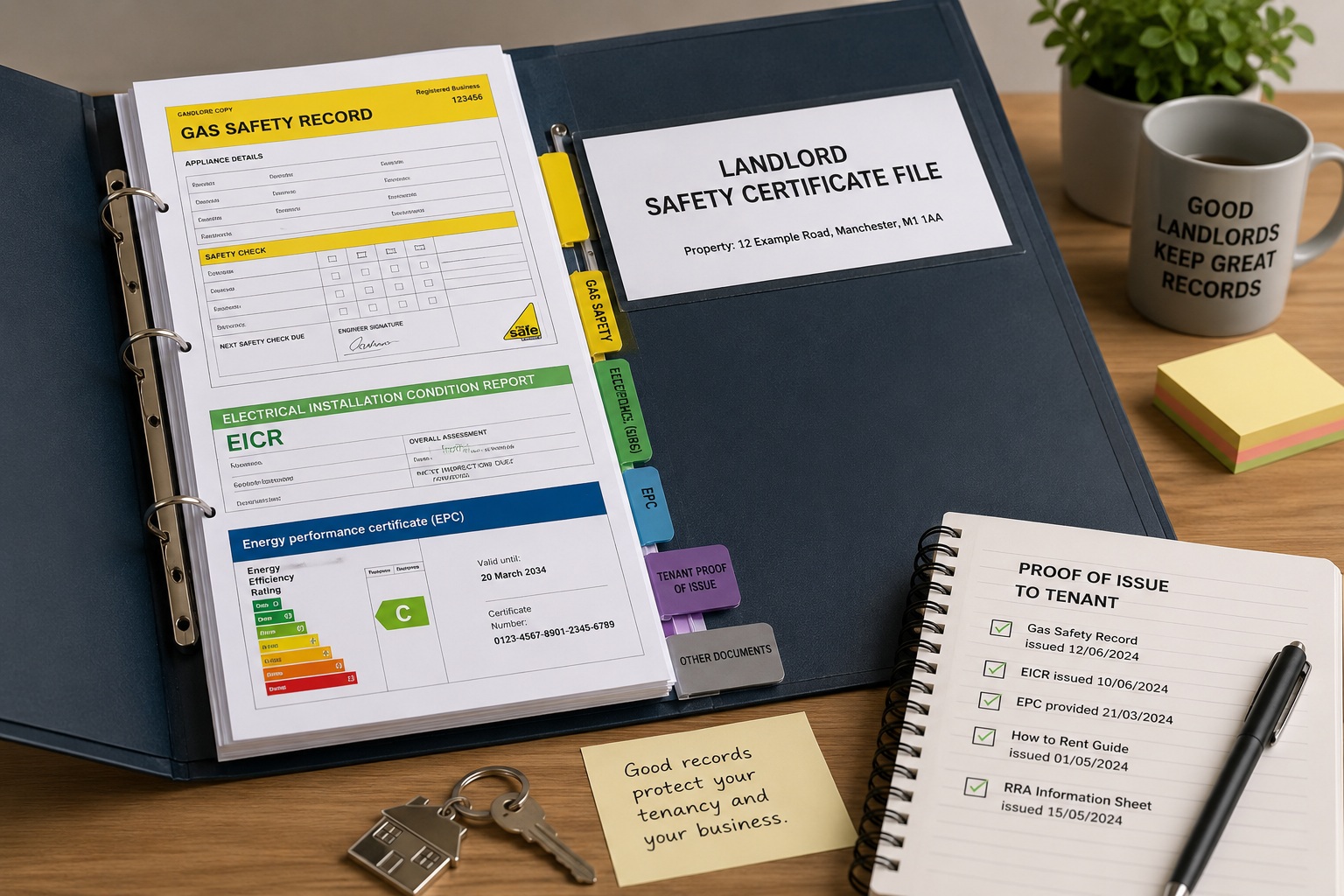
Proof of issue: the part most landlords miss
The difference: A gas safety record proves the check was done. Proof of issue proves the tenant received a copy. In practice, landlords should keep both the document and the service evidence together.
For each of the following, ask the agent not just for the document, but for evidence of when it was given to the tenant, how it was given, and whether there is an acknowledgement, read receipt, signed record or other delivery evidence:
- Gas safety record.
- EICR.
- EPC.
- Deposit prescribed information.
- How to Rent guide where applicable.
- Renters’ Rights Act Information Sheet.
- Written tenancy information for tenancies from 1 May 2026.
- Any property-specific notices.
Important: “The agent sent it” is not the same as “you can prove it was sent”. A portal upload is not useful evidence if your access disappears after termination. Download the proof before the relationship ends.
Deposit handover: a checklist within the checklist
Deposit records deserve their own section because the compliance chain is specific and easy to disrupt when an agent changes.
Ask the agent for all of the following before handover:
- The name of the tenancy deposit scheme.
- The deposit reference or certificate number.
- The amount received and the date it was received.
- The date it was protected.
- The full prescribed information pack as it was issued to the tenant.
- Evidence that prescribed information was served on the tenant and any relevant person.
- Details of any deductions taken or disputes raised.
- Whether the scheme is custodial or insured.
- Whether any transfer or notification to the scheme is needed because of the agent change.
If the deposit is held under a custodial scheme, check directly with the scheme how transfer of control should be handled. The mechanics vary by scheme, and the landlord will often need to take an active step rather than waiting for the agent to arrange everything.
GOV.UK deposit guidance confirms that deposits must usually be protected within 30 days of receipt and the prescribed information must also be given to the tenant. For a practical step-by-step version, see CertNudge’s tenancy deposit protection checklist for landlords in England.
If agent details or scheme details have changed during the tenancy and the prescribed information is now inaccurate, it may need to be reissued. This can be fact-specific, so if you are unsure, take legal advice rather than assume.
A landlord in Bristol taking back management of a two-bedroom flat after three years of agent management should check the deposit scheme directly, not rely only on the agent’s records. The scheme can confirm current protection status, which gives you an independent starting point before the handover paperwork arrives.
Renters’ Rights Act 2025: new documents to request at handover
The Renters’ Rights Act 2025 received Royal Assent on 27 October 2025 and is being implemented in phases. The main tenancy reforms, including the tenant information obligations, took effect on 1 May 2026, with further phases — including the PRS database, the ombudsman, Awaab’s Law and the Decent Homes Standard — expected from late 2026 onwards.. Any handover happening now should account for the May 2026 obligations and should be checked against the latest GOV.UK Renters’ Rights Act overview for landlords, published by the Ministry of Housing, Communities and Local Government (MHCLG).
Ask the agent for evidence of the following:
- Whether the government-produced Renters’ Rights Act Information Sheet was given to existing tenants by 31 May 2026 where required.
- The date it was given, the recipient details and the exact version used.
- Written tenancy information for any tenancy created on or after 1 May 2026, with proof it was provided before the tenancy agreement was signed or otherwise agreed.
- Written information for any pre-1 May 2026 wholly verbal tenancy, due by 31 May 2026, where applicable.
- Any notices or rent increase documents issued under the new rules since they came into force.
The written tenancy information duty and the Information Sheet obligation can involve either the landlord or the agent depending on how the arrangement was structured. The point is not to assign blame. It is to ensure the evidence exists and that you hold a copy.
Important for handovers: where a letting agent manages the property, GOV.UK guidance is that the agent must give the Information Sheet to the tenant even if the landlord has already done so, and the landlord’s duty is not discharged simply because the agent may have handled it. In a handover, that means asking the agent directly for their own proof of service — not assuming your copy covers it, and not assuming theirs does either.
If the agent cannot confirm whether these were completed, treat them as unresolved until you can independently verify completion or service. Missing records and actual non-compliance are different problems, but both need to be investigated before the handover is closed.
Practical tip: Ask for proof that the exact GOV.UK PDF was given as a printed copy or sent as an attachment. A link in an email, text message or portal message may not be enough for your evidence file.
Repairs, remedials and the evidence chain
This is where many agent handovers are weakest. Certificates are relatively easy to locate and transfer. The history of repairs is not.
Ask for the following as a separate package:
- An outstanding repairs list with current status.
- Any open tenant complaints or notices, including the dates raised.
- Contractor quotes and invoices for work completed in the last two years.
- Before and after photos for any significant remedial or maintenance work.
- No-access notes and access attempt records.
- Any EICR remedial confirmations and completion evidence.
- Damp or mould survey reports, responses and evidence of works.
- Correspondence with the council, including any HHSRS notices or improvement notices.
- Insurance claim correspondence if any claims were made.
A clean property file should link the problem, the action taken and the evidence of completion. Gaps in that chain are precisely what can become an issue in a disrepair claim or deposit dispute. The time to close those gaps is before handover, not after.
What if the letting agent cannot or will not provide the documents?
Some agents do not maintain organised records. Others become unresponsive when the relationship ends. Neither situation is ideal, but it needs a methodical response rather than a confrontational one.
- Review your agency agreement and portal access. Download everything you can before access is removed. Store personal documents securely, restrict access and do not keep identity or Right to Rent evidence longer than required.
- Send a written request with a deadline. List exactly what you need and ask for a final dated index or export of all files held, not just the documents themselves.
- Separate certificates from proof of issue. Some agents conflate the two. Ask for each item separately.
- Contact contractors directly. This is particularly useful for gas safety, EICR work, remedials and invoices you paid for.
- Contact the deposit scheme directly. This gives you independent confirmation of the current protection status.
- Retrieve the EPC from the official register if needed. EPCs are publicly searchable by address.
- Use the agent’s complaints route if needed. If the agent refuses reasonable requests or does not respond, make a formal complaint and, if unresolved, escalate to their property redress scheme.
Letting agents and property managers in England and Wales must belong to an approved redress scheme. GOV.UK lists the approved schemes as The Property Ombudsman Limited and the Property Redress Scheme.
Redress schemes can help resolve complaints and may award compensation, but they are not a guaranteed way to recover documents that no longer exist. If there are live legal or enforcement risks, such as an outstanding council improvement notice or a pending deposit dispute, get legal advice before assuming the records cannot be recovered.
What not to accept as a proper handover
A handover is incomplete if it leaves you with:
- “It’s all on the portal” but no downloaded copies.
- A certificate list but no actual documents.
- Current certificates with no proof they were served on the tenant.
- Deposit protection evidence without prescribed information and proof of service.
- Repair history without invoices, completion evidence or photos.
- Missing council, complaint or insurance correspondence.
- Links that require the old agent’s login.
- Mixed files that are not separated by property.
The test is simple: if a council officer, new agent, tenant’s solicitor or insurer asked for the document and its proof of issue today, could you provide it? If the answer is no, the handover is not finished.
How to rebuild an inspection-ready file after handover
Once you have everything from the agent, or as much as you can reasonably obtain, organise it into a single property file. The structure does not need to be complicated.
Build the file around eight areas:
- Property summary: tenants, tenancy dates, rent and contact history.
- Current certificates with issue dates and expiry dates.
- Tenant-issued documents with service evidence.
- Deposit records.
- Proof-of-issue log.
- Repairs and remedials with the evidence chain.
- Licensing and council correspondence.
- Rent and account records.
Start with one property. Do not try to tidy every historic file at once. First, identify what is current, what is missing, what is expiring soon and what proof you would need if someone asked today. That prioritisation makes the task manageable.
Once rebuilt, store the file by property and by category: certificates, proof of issue, deposit records, repairs and licensing. The aim is that any single document can be located within seconds if someone asks for it unexpectedly.
A landlord taking back management of a three-property portfolio in the East Midlands might find they have complete certificates across all three properties, but proof of issue only for two of them. That is a workable starting point. The gap is identified, it can be addressed with the tenant directly, and everything else can be logged cleanly from that point forward.
Also notify existing tenants of your current contact details and any new correspondence or service address once the agent relationship ends, so they are not left using the old agent as their point of contact.
After handover, put everything in one inspection-ready record
CertNudge helps landlords rebuild a clean property record after agent handover. Upload certificates, track expiry dates, attach remedial evidence, record what was served on the tenant, and generate a compliance pack when a new agent, tenant, insurer or council asks for proof.
Use CertNudge to store your handover pack, track certificate expiry dates and keep proof of issue linked to the right property.
Frequently asked questions
What documents should my letting agent have given me during the tenancy?
Your letting agent should usually have kept or supplied key tenancy and compliance records, including gas safety records, EICRs, EPC details, deposit prescribed information, rent statements, repair records and proof that required documents were given to the tenant. From 1 May 2026, written tenancy information may also be relevant depending on the tenancy.
Do I have the right to get all my compliance documents back from a letting agent?
Your right to receive documents will depend on your agency agreement, the agent’s terms of business and the applicable redress scheme rules. In practice, most professional agents will comply with a written request for the property file. If they do not, their redress scheme is the appropriate escalation route: either The Property Ombudsman or the Property Redress Scheme.
What should I do if the agent’s portal is closed before I download the documents?
Contact the agent in writing and ask for copies of the specific documents you need. For gas safety and electrical records, you can also contact the engineer or contractor directly. For the EPC, use the official register. For the deposit, contact the scheme directly. Reconstruct what you can from email threads, bank records and tenant correspondence.
Does changing letting agent affect the tenancy deposit?
It can, depending on whether the deposit is custodial or insured and how the agent’s name appears on the prescribed information. If the prescribed information is now inaccurate because of the change, you may need to reissue it. This is fact-specific, so check with the scheme and take legal advice if you are unsure.
What is the Renters’ Rights Act Information Sheet and do I need evidence it was given?
The government produced a Renters’ Rights Act Information Sheet for tenants affected by the Renters’ Rights Act 2025 changes. If your agent was managing the property during the relevant period, ask for confirmation it was sent, the date it was sent, the recipient details and the exact version used. For the latest position, check GOV.UK guidance.
Can I ask the new agent to chase the old agent’s documents on my behalf?
Yes. A professional agent will often assist with this. However, do not treat the new agent’s involvement as a substitute for your own record. The landlord should still know what documents exist, where they are stored and what evidence is missing.
About this article
Information only: This article is for general information only and is not legal advice. Regulations change, and the correct position may depend on tenancy type, dates and the facts of the handover.
Last reviewed: July 2026. Next review recommended: February 2027