
How Long Should Landlords Keep Records in the UK?
A practical UK landlord record keeping guide covering gas safety, EICRs, EPCs, deposits, Right to Rent, GDPR and the 6-year evidence rule.
Quick answer: landlord record retention periods
How long should landlords keep records in the UK? The answer depends on the record type. Gas safety records have a legal minimum of at least 2 years, EICRs in England must usually be kept until the next inspection and test is required or carried out, and Right to Rent copies should normally be kept for the tenancy plus at least one year.
This guide sets out the legal position and the practical 6-year evidence rule for key tenancy, safety, deposit and compliance records.
The practical rule
For landlords in England, keep compliance records for as long as the specific legal duty requires. Where no fixed retention rule exists, consider how long the record may reasonably be needed for a tenancy, contract, deposit, repair, insurance or dispute issue. For simple-contract claims, the normal limitation period is 6 years from the date the cause of action accrued, which makes six years a useful practical reference point for some records — but it is not a blanket rule to keep every landlord document for six years after a tenancy ends. Securely delete personal data when there is no longer a lawful reason to keep it.
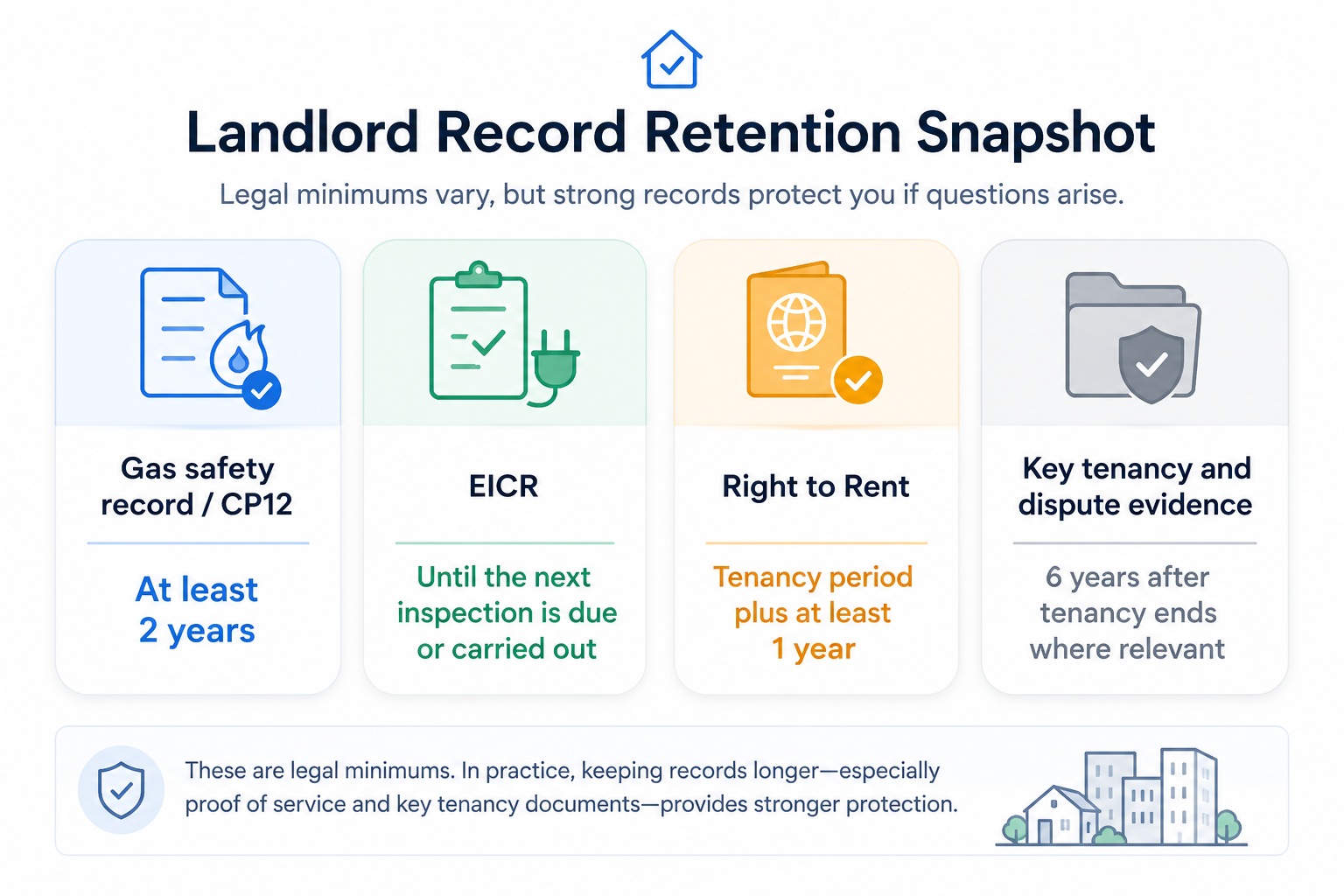
At a glance
- Gas safety records: keep for at least 2 years.
- EICRs: keep until the next inspection and test is required or carried out.
- Right to Rent records: keep during the tenancy and for at least 1 year after it ends.
- Key tenancy and dispute evidence: where no specific retention rule applies, six years can be a useful reference point for some contract-related evidence, but the correct period depends on the record, the relevant event and the reason for keeping it.
Good landlord record keeping is not the same as keeping every file forever. Keep the evidence you may need, but avoid retaining sensitive personal data, such as old Right to Rent identity documents, after the lawful reason to keep it has expired.
If you rent property in Wales, Scotland or Northern Ireland, check the local rules because some duties and retention expectations differ.
Key takeaways
- Some landlord records have clear legal retention rules, but many do not.
- A blanket “keep everything forever” approach is weak record keeping and can create UK GDPR problems.
- For England landlords, Right to Rent evidence should normally be kept for the tenancy and at least one year after it ends, not indefinitely.
- Gas safety records have a legal minimum of at least 2 years, but historic copies and proof of issue may still be useful evidence.
- The safest practical approach is to keep key safety and tenancy evidence by property, with dates, documents and proof of issue stored together.
Important: This article is for general information only and is not legal advice. Regulations change, so always check the latest guidance at GOV.UK or speak to a qualified professional.
Scope note: England first
This article focuses mainly on England private rented sector records, including gas safety, EICR, EPC, Right to Rent, smoke and carbon monoxide alarms, tenancy deposits and written tenant information. Rules differ in Wales, Scotland and Northern Ireland, so check the local position if your property is outside England.
If there is an active dispute, claim, enforcement notice, insurance issue, disrepair allegation or possession case, keep the relevant records until the matter is fully resolved. Do not delete evidence just because a normal retention period has passed.
Landlord record retention guide
A landlord with a small portfolio needs something more useful than “keep everything”. The guide below separates the legal or minimum position from the practical CertNudge recommendation.
Gas safety record / CP12
Minimum / legal position: Keep for at least 2 years. Where the 2-month early-renewal flexibility is used, HSE says the record must be kept until two further gas safety checks have been carried out.
Practical CertNudge recommendation: Keep current and historic CP12s for at least 6 years after the tenancy ends where relevant, plus proof of issue to the tenant.
EICR
Minimum / legal position: In England, retain the report until the next inspection and test is required or carried out, unless replaced by a more recent report.
Practical CertNudge recommendation: Keep current and previous EICRs, remedial evidence and proof of supply for at least 6 years after the tenancy ends where relevant.
EICR remedial works
Minimum / legal position: Where remedial or further investigative work is needed, GOV.UK says landlords must complete it within 28 days, or sooner if the report specifies a shorter period.
Practical CertNudge recommendation: Keep the unsatisfactory report, remedial invoice, completion certificate or confirmation, tenant/council confirmation and proof of sending together.
EPC
Minimum / legal position: EPCs are generally valid for 10 years. For domestic private rented property in England and Wales, MEES currently means landlords should not let a property below EPC rating E unless a valid exemption applies.
September 2026 position: EPC E remains the current legal minimum for covered domestic private rented properties in England and Wales unless a valid exemption applies. Government has announced a higher private-rented standard with a single compliance date of 1 October 2030, but that future standard should not be confused with the legal minimum that applies today.
Practical CertNudge recommendation: Keep the current EPC, any replaced EPC relevant to the tenancy, proof it was made available, and any exemption evidence.
Deposit protection and prescribed information
Minimum / legal position: In England, a deposit taken for an assured periodic tenancy must be protected in a government-approved tenancy deposit protection scheme within 30 days of receipt. The required prescribed information must also be given to the tenant within 30 days. Wales has a separate tenancy-law framework, so landlords there should check the applicable Welsh rules.
Practical CertNudge recommendation: Keep scheme certificate, prescribed information, proof of service, inventory, check-in/check-out records, deduction evidence and dispute correspondence for at least 6 years after tenancy end where relevant.
Right to Rent records
Minimum / legal position: In England, keep copies securely for the time the person is your tenant and for at least one year after the tenancy ends.
Practical CertNudge recommendation: Follow the legal rule, then securely delete unless there is an active dispute or another lawful reason to retain.
Smoke and carbon monoxide alarm checks
Minimum / legal position: GOV.UK guidance says one possible record is a signed inventory confirming required alarms were tested on the first day of the tenancy.
Practical CertNudge recommendation: Keep signed check-in records, alarm test logs, photos where useful, and repair/replacement evidence.
How to Rent / Renters’ Rights information / written tenancy information
Minimum / legal position: GOV.UK provides the latest How to Rent guide and says written tenancy information duties apply from 1 May 2026.
Practical CertNudge recommendation: Keep the exact version sent, date sent, method, recipient and proof of issue.
Repairs, maintenance and safety reports
Minimum / legal position: There is no single universal retention rule for all repair records.
Practical CertNudge recommendation: Keep records for at least 6 years where they may support safety, deposit, insurance or disrepair issues.
Legionella risk assessment records
Minimum / legal position: HSE says landlords are not necessarily required to record the findings unless they are employers with 5 or more employees, but they may find it wise to keep a record of what has been done.
Practical CertNudge recommendation: Keep the risk assessment, review date and any control actions, especially where the property has stored water, has been vacant, or has had water-system changes.
Asbestos records, where relevant
Minimum / legal position: There is no single landlord retention period for every residential property. HSE’s duty to manage asbestos applies to non-domestic premises and common parts of multi-occupancy domestic premises, such as purpose-built flats.
Practical CertNudge recommendation: Where asbestos surveys, registers, re-inspection records or management plans are relevant, keep them with the property compliance file and review them when works, inspections or risk changes occur.
Tax and income records
Minimum / legal position: For an individual landlord carrying on a UK property business, HMRC says rental-income and expense records must generally be kept for at least 5 years after the 31 January tax-return deadline for the relevant tax year. Limited companies have different rules: company accounting records generally need to be kept for 6 years from the end of the financial year they relate to, and sometimes longer.
Practical CertNudge recommendation: Apply the HMRC rule that matches your ownership and tax structure, and keep tax/accounting records separate from tenant-sensitive compliance evidence where practical.
The 6-year period is not a universal landlord-document retention rule. Section 5 of the Limitation Act 1980 provides that an action founded on simple contract normally cannot be brought more than 6 years after the cause of action accrued. That makes six years a useful reference point when setting retention periods for some tenancy, deposit, damage, rent-arrears and repair evidence, but the relevant date is not automatically the end of the tenancy. Retention should still be proportionate to the purpose of the record and any applicable data-protection duties.
Gas safety note: where the 2-month early-renewal window is used, do not rely only on the basic 2-year rule. HSE says the relevant record must be kept until two further gas safety checks have been carried out.
Gas safety records: why 2 years is not always enough
How long should landlords keep gas safety certificates? HSE says landlords must keep gas safety records for at least 2 years, but where the 2-month early-renewal flexibility is used, the record must be kept until two further gas safety checks have been carried out.
The key issue is not only whether the CP12 exists. Landlords should also be able to prove what was issued, when, and to whom.
The obligation to arrange annual gas safety checks and retain records comes from the Gas Safety (Installation and Use) Regulations 1998, which HSE enforces. Existing tenants must receive a copy within 28 days of the check, and new tenants must receive one before they move in.
Where the landlord uses the 2-month early-renewal flexibility, the retention position is more specific. HSE says the record must be kept until two further gas safety checks have been carried out. This matters because a landlord who deletes the record after exactly 2 years could lose evidence that is still needed under the early-renewal system.
HSE also confirms that electronic gas safety records are acceptable if they can be reproduced in hard copy, are secure from loss or interference, and identify the Gas Safe registered engineer.
For practical evidence, keep:
- The CP12 or gas safety record.
- Date of inspection and expiry or renewal date.
- Gas Safe engineer details.
- Proof the record was given to the tenant.
- Any follow-up evidence if defects or remedial work were identified.
- Renewal reminders and service notes.
This is where a landlord compliance file becomes more than a folder of PDFs. With CertNudge, the stronger workflow is to store the gas record against the property, attach supporting evidence, record the issue or service event, and keep the document available for an inspection-ready compliance pack.
For a fuller breakdown of landlord gas safety duties, see the Landlord Gas Safety Certificate Guide.
EICR records: keep the report, the remedials and the proof of supply
How long should landlords keep EICR records? In England, GOV.UK says landlords must retain the EICR until the next inspection and test is required or carried out, unless it is superseded by a more recent report.
If an EICR is unsatisfactory, keep the original report as well as the remedial evidence. Deleting the failed report can weaken the audit trail if a council later asks what happened.
The Electrical Safety Standards in the Private Rented Sector (England) Regulations 2020 require landlords to have electrical installations inspected and tested by a qualified person at least every 5 years. GOV.UK guidance also explains that electrical safety standards are set out in the 18th Edition of the Wiring Regulations, published as British Standard 7671.
The report must be supplied to an existing tenant within 28 days, to a new tenant before occupation, to a prospective tenant within 28 days of request, and to the local council within 7 days of request. The landlord must also retain a copy until the next inspection and test is required or carried out, unless superseded by a more recent report.
If the report requires remedial work or further investigation, GOV.UK says the work must be completed within 28 days, or sooner if the report specifies a shorter period.
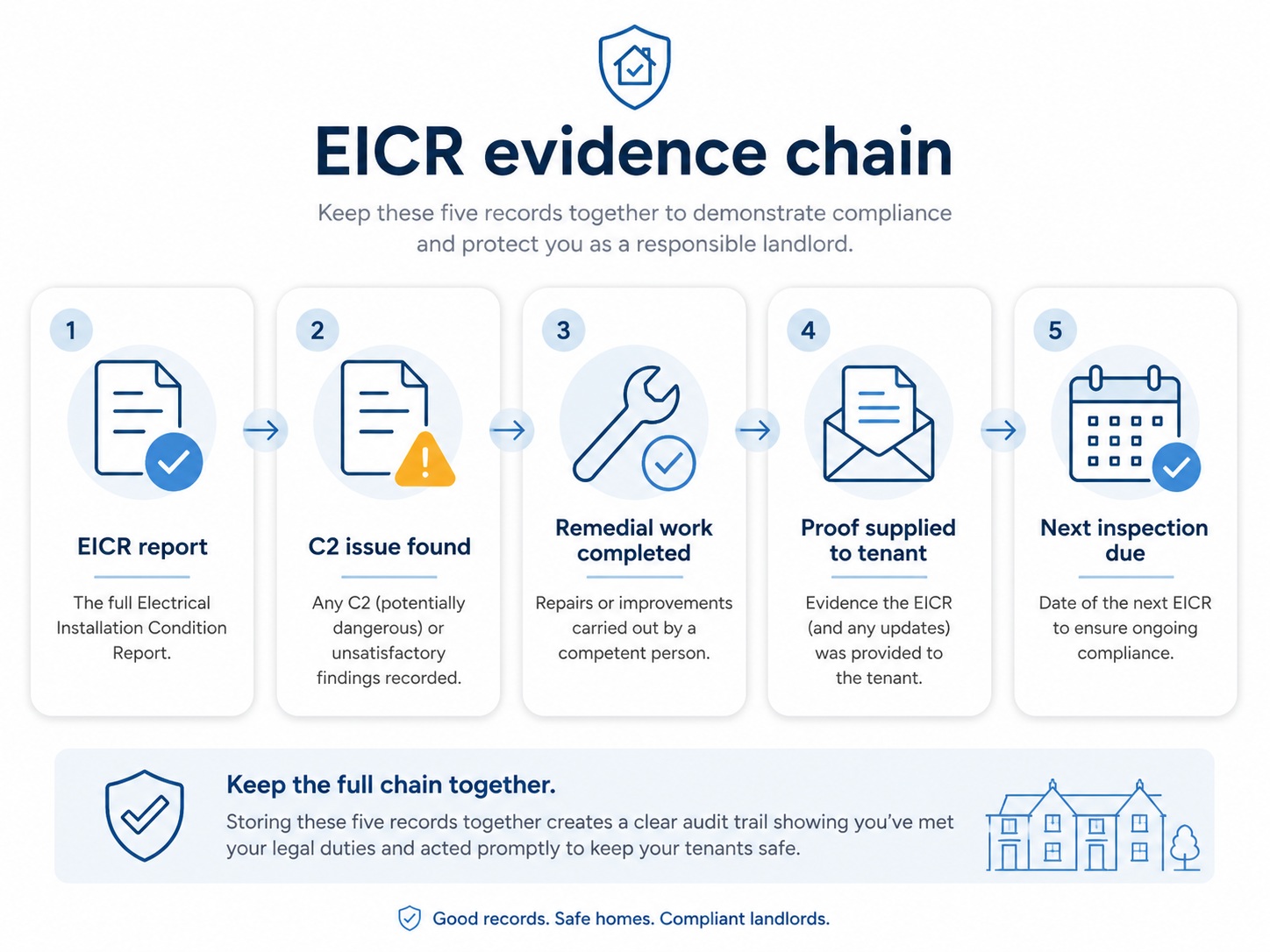
Do not just keep the final satisfactory version. Keep the full chain:
- Original EICR.
- Unsatisfactory report, if applicable.
- Electrician quote or remedial invoice.
- Confirmation from the qualified person that work was completed.
- Written confirmation sent to tenant and, where required, the local council.
- Proof of sending.
A landlord with several properties should be able to open one property record and see the full EICR story: report, remedial action, confirmation and next due date.
For more detail on tenant and council supply deadlines, see EICR Deadlines for Landlords.
Right to Rent records: do not keep identity documents forever
Right to Rent is different from gas safety or EICR evidence because it involves identity and immigration-status documents. Keeping old passport copies indefinitely, especially in shared folders, creates unnecessary data risk.
The Right to Rent code of practice says landlords must make a clear copy of each document in a format that cannot later be altered, record the date the check was made, and retain copies securely for at least one year after the tenancy agreement ends.
For online checks, keep the response or evidence generated by the online checking service, along with the date of the check. Do not treat this as a permanent archive item.
Practical Right to Rent rule
- Keep Right to Rent evidence securely during the tenancy.
- Retain it for at least one year after the tenancy ends.
- Delete it securely after that unless there is a live dispute, investigation or another lawful reason to retain it.
- Do not include passport copies or immigration evidence in routine compliance packs sent to contractors, agents or insurers unless there is a clear need.
This is where “keep everything forever” fails. UK GDPR does not say landlords can keep identifiable personal data indefinitely just because it might one day be useful.
Right to Rent failures can also carry significant civil penalty risk, separate from an ordinary tenancy dispute. If you are unsure about a specific check, follow-up check or deletion decision, consult the full Right to Rent code of practice on GOV.UK or take specialist advice.
Deposit protection records: keep the evidence, not just the scheme email
Deposit disputes often turn on evidence. A landlord may remember serving the prescribed information or completing an inventory, but the question is whether they can prove it later.
GOV.UK says a landlord or letting agent must protect a tenant’s deposit in an approved scheme within 30 days of receiving it. GOV.UK also says that within 30 days of receiving the deposit, the landlord must give tenants the required information about the property, deposit amount, scheme, dispute process and related details.
The deposit records worth keeping include:
- Deposit protection certificate.
- Prescribed information.
- Proof the prescribed information was served.
- Tenancy agreement.
- Inventory and check-in report.
- Check-out report.
- Photos and dated evidence.
- Deduction calculations.
- Tenant correspondence.
- Dispute outcome or adjudication result.
There is not a simple GOV.UK rule saying “keep deposit records for 6 years”. Do not invent one. The reason 6 years is a practical recommendation is that deposit issues often overlap with contract, damage, rent arrears, correspondence and dispute evidence.
For a small portfolio landlord, the best approach is to keep deposit evidence linked to the tenancy and property, not buried in an email inbox. If a tenant disputes a deduction months later, you need the full evidence trail quickly.
For a practical checklist of what to keep, see the Tenancy Deposit Checklist for Landlords.
EPC records: keep the certificate and proof it was available
How long should landlords keep EPC records? EPCs are generally valid for 10 years, but landlords should still keep the current EPC, proof it was made available, and any exemption or improvement evidence relevant to the tenancy.
GOV.UK’s landlord responsibilities guidance includes providing an Energy Performance Certificate as part of renting out a property. Even where the EPC is valid, landlords should keep proof it was made available and any exemption evidence that applied during the tenancy.
For covered domestic private rented property in England and Wales, the current Minimum Energy Efficiency Standard remains EPC band E unless a valid exemption applies. Government has announced a higher private-rented energy-efficiency standard with a compliance date of 1 October 2030; until the relevant future requirements take effect, landlords should not describe EPC C as the current legal minimum.
For EPC record keeping, landlords should keep:
- Current EPC.
- Expiry date.
- Date the EPC was made available or provided.
- Copy of any older EPC relevant to the tenancy.
- MEES exemption evidence, if applicable.
- Evidence of improvement works where relevant.
Do not overcomplicate this section. EPCs are usually simpler than gas safety or electrical safety records, but they still belong in the property compliance pack. This is especially true as minimum energy efficiency standards remain a major regulatory and commercial pressure point for landlords.
For a wider overview of rental compliance evidence, see What Certificates Do Landlords Need?.
Smoke and carbon monoxide alarm records: simple checks need clear evidence
A landlord in York checks the smoke alarms on the day a new tenancy starts. The tenant is present, everything works, and the landlord moves on. Two years later, there is a disagreement about whether alarms were working at move-in. A signed check-in record would be much stronger than a memory.
In England, GOV.UK guidance explains that one possible way to evidence alarm testing is to include it in the inventory on the first day of the tenancy and have the tenant sign to confirm the required alarms were tested and working.
Keep:
- Check-in inventory.
- Signed alarm test confirmation.
- Alarm photos where useful.
- Dates of repair or replacement.
- Tenant reports of faults.
- Contractor or purchase evidence for replacements.
This does not need to be complicated. A one-page smoke and carbon monoxide alarm log can be enough if it records the property, tenancy start date, alarms checked, result, signature and any follow-up action.
Renters’ Rights written tenancy information and transition records
The old GOV.UK How to Rent checklist was withdrawn on 1 May 2026 when the new assured periodic tenancy regime took effect in England. It should not now be treated as the current document landlords need to give when creating a new assured tenancy.
For a tenancy created on or after 1 May 2026, landlords must give tenants prescribed written information about the key terms of the tenancy before the tenancy agreement is signed or the tenancy is otherwise agreed. The required information can be included in a written tenancy agreement or provided separately. A failure to provide the required information can result in a financial penalty of up to £7,000.
For most assured or assured shorthold tenancies created before 1 May 2026 that already had a wholly or partly written record of their terms, landlords were instead required to give every named tenant the official Renters’ Rights Act Information Sheet 2026 by 31 May 2026.
Where a pre-1-May-2026 tenancy was based entirely on an oral agreement, the Information Sheet was not the correct document. The landlord had to provide the prescribed written information about the key tenancy terms by 31 May 2026 instead.
September 2026 position: the 31 May deadline has now passed, so this is historic compliance evidence rather than an upcoming task. Keep the exact document supplied, the date, delivery method, recipient and proof of delivery. For the Renters’ Rights Act Information Sheet 2026, GOV.UK required the exact official PDF to be given as a printed copy or electronic attachment. Sending a link to the PDF was not valid.
For record keeping, store:
- The exact tenancy agreement, written information or Information Sheet version supplied.
- Date supplied.
- Delivery method, such as email attachment, printed copy or hand delivery.
- Recipient name or email address.
- Proof of sending or delivery.
- Any acknowledgement, where available.
Section 21 notices can no longer be served in England from 1 May 2026. Under the current assured periodic tenancy regime, landlords seeking possession must rely on an applicable ground for possession and the Section 8 process. Historic notices and transitional proceedings can have separate rules, so landlords with a live possession case should check the current GOV.UK guidance for their circumstances.
That makes organised evidence particularly important for rent, breach, repair, inspection and possession-related records.
For related guidance, see What Certificates Do Landlords Need? and the PRS Database registration guide.

GDPR and landlord records: what not to keep forever
A landlord prepares a compliance pack for a contractor and accidentally includes an old tenant’s passport scan, deposit dispute correspondence and bank details. That is not “being thorough”. It is poor document control.
The ICO says UK GDPR does not dictate one fixed retention period for personal data. Instead, organisations must justify how long they keep personal data based on their purposes, and must be able to justify why they need to keep data in a form that identifies individuals. This applies to tenant referencing documents, guarantor details and other personal data as well as Right to Rent evidence.
For landlords, this means:
- Keep compliance evidence where there is a valid reason.
- Avoid collecting unnecessary tenant personal data.
- Do not keep Right to Rent documents forever.
- Redact sensitive information before sharing packs externally.
- Separate tax records from tenant-sensitive compliance documents where possible.
- Set retention rules by document type.
Good compliance software should encourage structured, purposeful record keeping not a permanent data hoard. The stronger approach is organised compliance evidence: property, certificate, issue date, expiry date, supporting document, proof of issue and service history.
How should landlords store compliance records?
Landlord records can be stored digitally, but they should be organised, backed up and easy to retrieve. A file is only useful if you can quickly show what it relates to, when it applied, and whether it was given to the tenant, council, agent or contractor.
For each property, keep a clear record of:
- The current CP12, EICR and EPC.
- Deposit protection and prescribed information evidence.
- Right to Rent evidence, kept only for the proper retention period.
- Renters’ Rights written tenancy information, the Information Sheet where applicable, and other tenant notices.
- Smoke and carbon monoxide alarm check evidence.
- Repair, inspection, service and proof-of-issue records.
If a letting agent manages the property, the landlord should still make sure they can obtain copies of key compliance records quickly. Do not assume that an agent’s system will always give you the evidence you need for a council query, insurance issue, deposit dispute or possession case.
A simple rule of thumb for landlord record keeping
A landlord with one flat can sometimes survive with a careful folder structure. A landlord with 8 or 12 properties usually cannot. Records multiply quickly, and when a council, tenant, insurer or agent asks for evidence, speed and clarity matter.
The practical takeaway is simple: use the legal minimum where one exists, use the 6-year limitation window as a sensible evidence guide for tenancy and contract-related records, and delete sensitive personal data when the lawful reason to keep it has expired.
That gives landlords a balanced approach:
- Not too casual.
- Not a permanent data hoard.
- Practical enough for real disputes and inspections.
- More credible than a folder full of unexplained files.
Build an inspection-ready compliance record with CertNudge
If your records are split across email, WhatsApp, contractor invoices, cloud folders and spreadsheets, evidence becomes harder to prove when it matters. CertNudge helps landlords keep certificate dates, supporting documents, reminders, service notes and inspection-ready compliance packs organised by property.
Landlord record keeping: frequently asked questions
How long should landlords keep gas safety certificates?
Landlords must keep gas safety records for at least 2 years. If the 2-month early-renewal flexibility is used, HSE says the record must be kept until two further gas safety checks have been carried out.
A landlord may still choose to keep historic gas safety records for longer as practical evidence, especially where the record relates to a tenancy, repair issue, possession question or insurance matter. The key is to describe this as a practical retention recommendation, not a blanket legal rule.
How long should landlords keep EICR records?
In England, GOV.UK says landlords must retain a copy of the EICR until the next inspection and test is required or carried out, unless it is superseded by a more recent report.
For practical evidence, keep previous EICRs and remedial documents where they may help explain the property’s safety history. For example, if a 2024 report was unsatisfactory and a 2025 follow-up confirmed remedial work, both records may be useful.
How long should landlords keep Right to Rent records?
For England Right to Rent checks, the Right to Rent code of practice says landlords must keep copies securely for at least one year after the tenancy agreement ends.
After that, securely delete the records unless there is a live dispute, investigation or another lawful reason to retain them.
Should landlords keep tenant ID documents forever?
No. Tenant identity documents should not be kept indefinitely just in case. The ICO says personal data should not be kept longer than necessary, and organisations must be able to justify their retention periods.
A landlord in Newcastle who still holds passport copies for tenants who left 7 years ago should review whether there is any lawful reason to keep them.
What is the safest practical retention period for landlord compliance evidence?
Where no precise legal retention rule applies, at least 6 years after the tenancy ends is a sensible practical evidence period for key records that may support contract, deposit, repair, possession, insurance or enforcement issues.
That does not mean every document should be kept for 6 years. Sensitive personal data, especially Right to Rent material, needs a more careful approach.
Should landlords keep Legionella or HMO records?
Yes, where they are relevant. For standard single-family lets, HSE says landlords may find it wise to keep a record of Legionella risk assessment activity even where recording is not always mandatory.
For HMOs, check your licence conditions carefully because councils may require additional evidence such as fire safety records, alarm servicing logs, management inspection notes or documents supplied on request.
Final practical takeaway
The best landlord record system is not the biggest folder. It is the clearest one.
For each property, keep the current compliance position obvious, the historic evidence easy to find, and the proof-of-issue trail attached to the right document. Delete sensitive personal data when the proper retention period has passed.
That is what “inspection-ready” really means.
Not sure which certificates are current across your properties?
Run a free compliance check – enter your properties and see at a glance which certificates are missing or expiring, and where your exposure sits. No account, no upload, takes under a minute.
Official sources and further reading
- HSE: Gas safety records and what to keep
- GOV.UK: Electrical safety standards guidance
- GOV.UK: Private renting document checks and Right to Rent
- GOV.UK: Deposit information landlords must give tenants
- GOV.UK: Smoke and carbon monoxide alarm guidance for landlords
- GOV.UK: Renters’ Rights Act Information Sheet 2026
- GOV.UK: Written tenancy information landlords must give tenants
- HSE: Legionella and landlords’ responsibilities
- ICO: Storage limitation under UK GDPR
- GOV.UK: Rental income and landlord record keeping
- GOV.UK: Limited company accounting records
Last reviewed: 7 September 2026
Next review recommended: 1 October 2026