
Landlord Compliance Spreadsheet Template: What to Track and When to Move On
A practical landlord compliance spreadsheet guide for England, covering gas safety, EICRs, EPCs, deposits, Right to Rent, alarms, proof of issue and when spreadsheets stop working.
Landlord compliance spreadsheet: what it needs to track and prove
A landlord compliance spreadsheet needs to do more than list certificate dates. It should show what each rental property needs, when key documents expire, where the evidence is stored, and whether you can prove the right information was issued to the tenant.
This guide explains what columns to include, how to structure a landlord compliance tracker across multiple properties in England, and where spreadsheets typically fail so you can build one that holds together under pressure.
Key takeaways
- A landlord compliance spreadsheet should track each property, certificate type, expiry date, document location, proof of issue, and next action — not just dates.
- For a small portfolio of one or two properties, a well-structured spreadsheet can work well as a starting point.
- The most common failure point is not the spreadsheet itself. It is that the actual documents and proof of issue end up stored somewhere else entirely.
- A five-property portfolio can easily generate 40–60 individual evidence items; that is where manual tracking becomes genuinely unreliable.
- England-specific rules around EICRs, Right to Rent, and the Renters’ Rights Act Information Sheet apply throughout this guide. Landlords in Wales, Scotland and Northern Ireland should check the guidance relevant to their nation.
Get the free landlord compliance spreadsheet template
Use the CertNudge spreadsheet template to track rental property certificates, expiry dates, document locations, proof of issue, access attempts, remedials and monthly reviews.
Best for: landlords with one or two properties who want a practical starting point before moving to dedicated compliance tracking.
Already finding spreadsheets hard to maintain? Start a free CertNudge trial instead.
Template provided for general information only and supplied as-is. CertNudge accepts no responsibility for inaccuracies, omissions, misuse, or losses arising from reliance on the spreadsheet. Always check current legislation and official guidance.
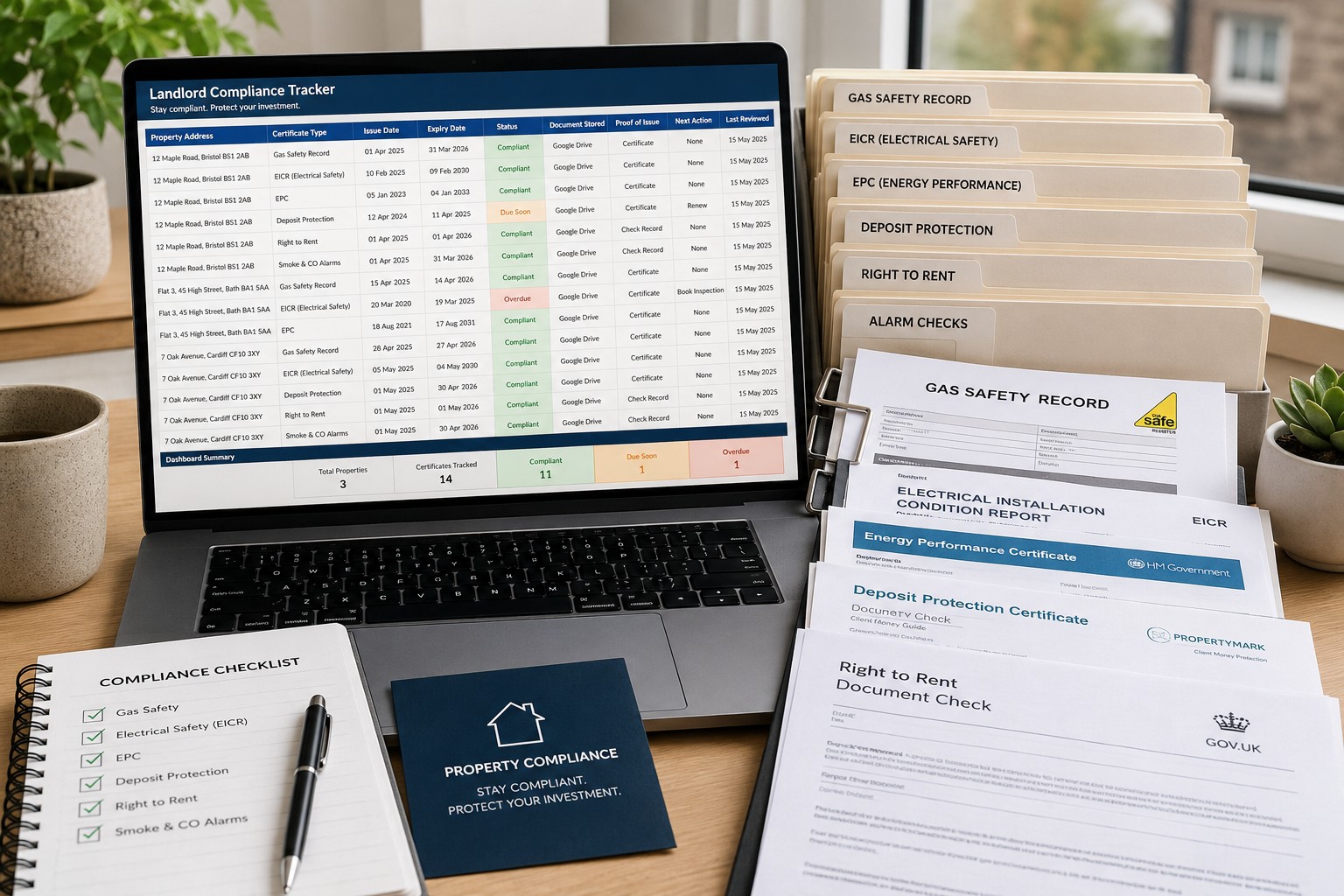
Throughout this guide, proof of issue means evidence that a certificate or document was sent, served or supplied to the correct person by an appropriate method. That might be a sent email with the document attached, postal proof, a portal message export, a hand-delivery note, or a signed acknowledgement. Actual confirmation of receipt is ideal, but it is not always required.
That is also the point that matters most when a council, insurer, agent or solicitor asks questions.
Who this landlord compliance tracker is for
This guide is aimed at self-managing landlords with between one and ten standard buy-to-let properties in England. It assumes you are not using a full property management platform, that your documents are not all in one place, and that you want a practical way to bring them together without overcomplicating it.
If your property is in Wales, Scotland or Northern Ireland, most of the core principles apply, but some of the specific rules differ particularly around electrical safety, deposit protection and tenancy-served documents. This guide flags England-specific requirements throughout.
If you manage licensed HMOs, you will need additional fields for licence conditions, fire safety management evidence and council correspondence. That is beyond the scope of this guide, but the core structure below still applies.
What if a letting agent manages the property?
If a letting agent manages the property, your spreadsheet still needs to show who holds the evidence and who is responsible for the next action. Do not assume that “agent-managed” means every certificate, proof of issue record and remedial invoice will be easy to find when needed.
Use the managing party and action owner columns to make this clear. For example, the agent may be responsible for arranging the gas safety check, but you may still want your own copy of the certificate, proof it was issued to the tenant, and a record of where that evidence is stored. If you want oversight without duplicating your agent’s processes, see how CertNudge helps keep compliance evidence organised by property.
The minimum fields every landlord compliance spreadsheet needs
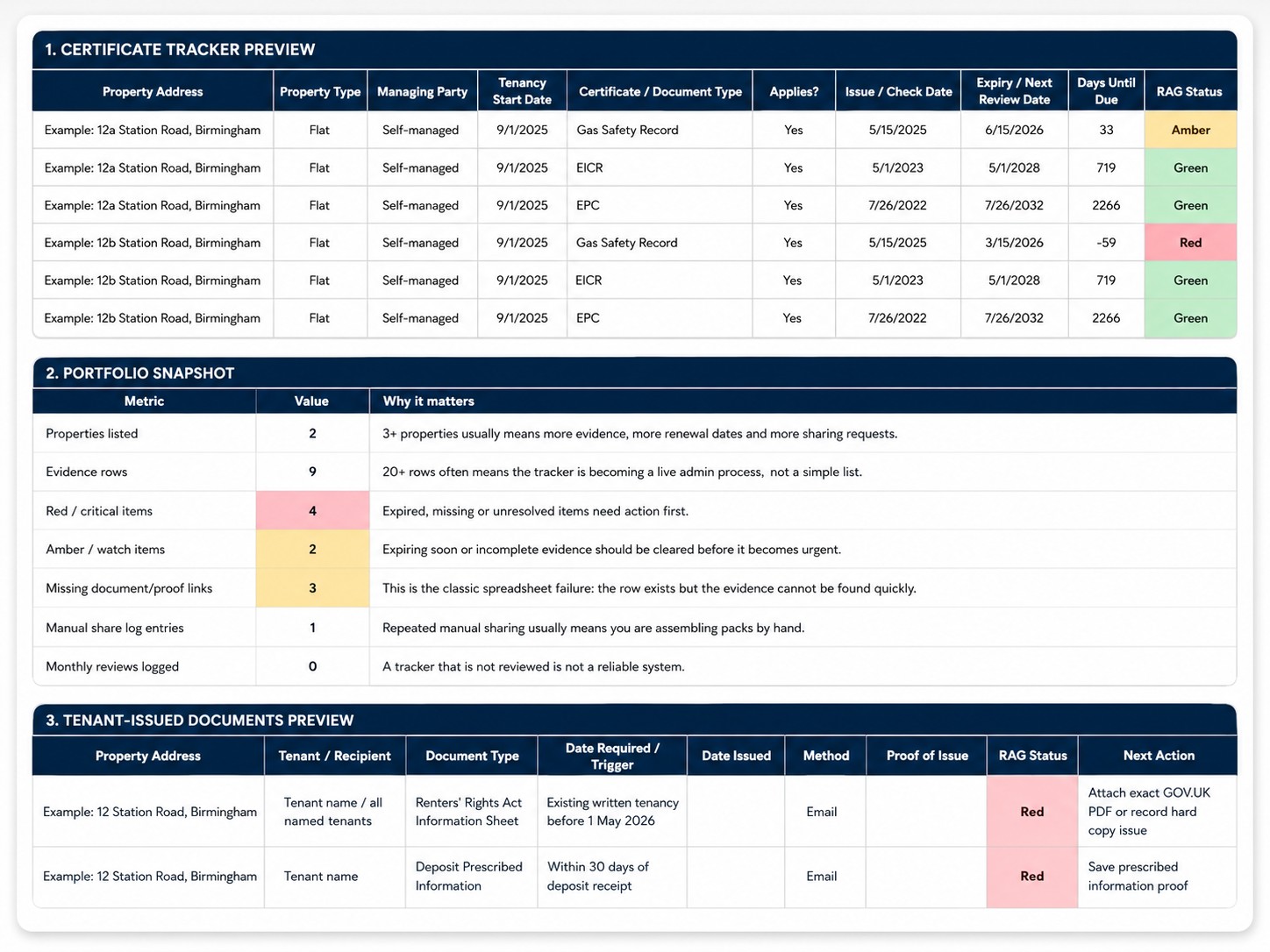
The columns below represent the minimum viable setup for a rental property compliance spreadsheet. You can add to them, but removing any of these tends to create evidence gaps.
Property address
Prevents certificates from being filed against the wrong property — a surprisingly common error across portfolios.
Property type
House, flat, furnished or unfurnished. This affects which documents apply.
Managing party
Self-managed or agent-managed. If an agent holds documents, you need to know who to chase.
Tenancy start date
Anchors the timeline for what should have been issued and when.
Certificate / document type
Gas safety, EICR, EPC, deposit protection, alarms, Right to Rent and other key compliance evidence.
Applies?
Not every item applies to every property. A gas safety record is irrelevant if there is no gas supply.
Issue or check date
The date the certificate was produced or the check was completed.
Expiry or next review date
The date that drives your next action. This is what the RAG status should be based on.
RAG status
Green, amber or red. This should reflect the true position, not just whether a date has been entered.
Document stored?
Yes or no and crucially, where. Use a link or folder path, not just a tick.
Proof of issue stored?
Records whether you have evidence the certificate or document was sent, served or supplied to the tenant, and where that proof is stored.
Supporting evidence
Remedial invoices, photos, access attempt records and contractor notes. Especially important for EICRs.
Next action
Book engineer, upload certificate, chase agent, save proof of issue. Make this specific, not vague.
Action owner
Landlord, agent or contractor.
Last reviewed
Shows whether the tracker is actually being maintained.
Practical example: a landlord with one two-bed flat in Birmingham might still have 12–15 rows once gas, EICR, EPC, deposit paperwork, Right to Rent records, alarm evidence and tenant-issued documents are included. That is not excessive, that is what full compliance evidence looks like.
What to track by compliance area
The sections below cover the most common compliance areas for standard buy-to-let properties in England. This is not an exhaustive list of every legal obligation. It is a practical property compliance tracker for the records landlords are most commonly asked to evidence by agents, insurers, councils and solicitors.
Where timing differs between a new tenancy and a mid-tenancy renewal, record both the due date and the evidence that the document was issued at the right point. For example, a gas safety record may need tracking as both a renewal item and a tenant-issued document, depending on when the tenancy starts and when the check is completed.
For a broader overview of common certificates, see the CertNudge guide to what certificates landlords need.
Gas safety record
Track: check date, next due date, Gas Safe engineer details, certificate location and proof sent to tenant.
A landlord certificate spreadsheet is most useful when it tracks gas safety, EICR and EPC dates together, so expiry gaps are easier to spot across the same property. HSE guidance states existing tenants must receive the gas safety record within 28 days of the check, and new tenants must receive it before they move in. If the check is completed during a void period, keep the record with the property file and make sure it is issued to the incoming tenant before move-in. The check and report should be completed in time, not just booked. HSE landlord gas safety guidance.
EICR
Track: inspection date, next due date, satisfactory or unsatisfactory outcome, report location and proof of issue.
England: inspection at least every 5 years. The report must be supplied to existing tenants within 28 days and to the local council within 7 days of a request. See GOV.UK electrical safety guidance and the CertNudge EICR rules for landlords guide.
EICR remedials
Track: C1, C2 and FI items listed, contractor, completion date and completion evidence.
Where remedial or further investigative work is required, the landlord must ensure it is carried out by a qualified person within 28 days of the inspection, or sooner if the report specifies a shorter period. C1 items indicate danger present and should be treated as urgent; they should not be left simply because the general remedial window is 28 days. Written confirmation, together with the report requiring the work, must then be supplied to the tenant and local council within 28 days of completion.
EPC / MEES
Track: EPC rating, expiry date, certificate location and exemption evidence if relevant.
Where the property is covered by the MEES Regulations, broadly, a relevant domestic private rented property legally required to have an EPC — it must have a rating of E or above unless a valid exemption applies. See GOV.UK domestic MEES guidance.
Deposit protection
Track: date received, scheme name, protection date, prescribed information sent date and proof of issue method.
In England and Wales, the deposit must be protected and prescribed information provided within 30 days of receipt. See GOV.UK tenancy deposit protection and the CertNudge deposit protection checklist.
Right to Rent
Track: check date, check type, all tenants aged 18 or over who will live at the property, including those not named on the tenancy agreement, and follow-up date if time-limited.
England only. Records should include which document was checked, the date of the check, and the immigration status evidenced. They should be kept for the duration of the tenancy and at least one year after it ends. See GOV.UK Right to Rent guidance.
Smoke and carbon monoxide alarms
Track: alarm locations, check/test date, and any repair or replacement evidence.
England rules require at least one smoke alarm on each storey used as living accommodation, and a carbon monoxide alarm in any room used wholly or partly as living accommodation that contains a fixed combustion appliance, except gas cookers. Track CO alarm locations separately, note whether a fixed combustion appliance is present, and retain start-of-tenancy test evidence and repair or replacement records. See GOV.UK smoke and carbon monoxide alarm guidance.
Renters’ Rights Act Information Sheet
Track: date issued, method, copy sent to each named tenant, exact GOV.UK PDF confirmed and proof of issue.
In England, landlords of existing written or part-written tenancies created before 1 May 2026 must provide the exact GOV.UK PDF to every named tenant by 31 May 2026. Sending a link only is not valid; the PDF must be attached or a hard copy given. New tenancies and pre-1 May verbal tenancies require different written information. See the official GOV.UK Information Sheet page and the CertNudge Renters’ Rights Act Information Sheet guide.
Licensing
Track: licence type, licence number, expiry date, conditions summary and council correspondence.
Selective, additional and HMO licensing conditions vary by council. Track the conditions, not just the licence.
Insurance
Track: policy renewal date, insurer and any compliance conditions noted in the policy.
Policy wording varies. Check what your insurer requires rather than assuming certificates automatically satisfy their conditions.
Renters’ Rights Act tracking note: use separate spreadsheet rows for the three scenarios: existing written or part-written tenancies created before 1 May 2026, existing wholly verbal tenancies before 1 May 2026, and new tenancies from 1 May 2026. They do not all require the same document in the same way.
How to structure your landlord certificate tracker spreadsheet
One long sheet with 50+ rows quickly becomes difficult to use. A tab-based structure keeps related evidence grouped logically and makes it easier to share only what is needed with a specific person.
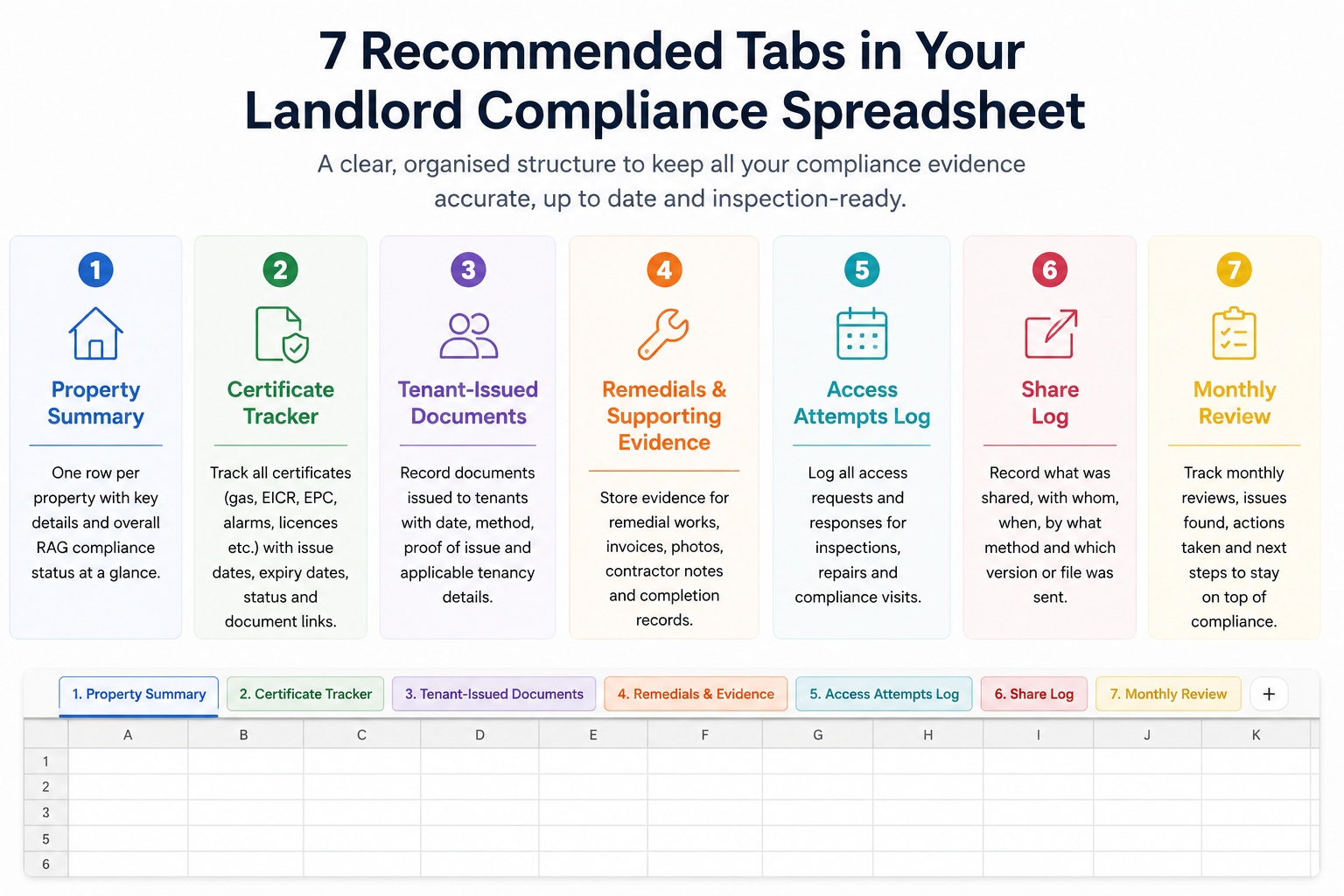
Tab 1 — Property Summary
One row per property. Address, owner entity, managing agent, tenancy start date and overall RAG status. This is the page you glance at first.
Tab 2 — Certificate Tracker
Gas, EICR, EPC, PAT testing where relevant, alarms and licences. Include issue dates, expiry dates, status and document location for each item.
Tab 3 — Tenant-Issued Documents
Track the Renters’ Rights Act Information Sheet, written tenancy information, prescribed information for deposits, EPC given to tenant, gas safety record and EICR. If you have a pre-1 May 2026 tenancy where a section 21 notice was served before that date, retain historic How to Rent guide evidence as part of that record.
Tab 4 — Remedials and Supporting Evidence
Failed EICRs and follow-up work. Repair invoices. Before-and-after photos. Contractor notes. This is the tab that turns a certificate into a full evidence chain.
Tab 5 — Access Attempts Log
Particularly important for gas safety inspections and EICRs. If a tenant refuses access, the log of contact attempts, letters sent and responses becomes critical evidence. The CertNudge guide on what to do when a tenant refuses a gas safety check covers what that log should contain.
Tab 6 — Share Log
Record what was shared, with whom, on what date, by what method, and which version or file was sent. Simple, but valuable if a dispute ever arises over what was provided.
Tab 7 — Monthly Review
Record the date reviewed, issues found and next actions. This one tab shows whether the whole system is being maintained or left to drift.
The RAG status system
Colour-coding a landlord expiry date tracker only works if the categories mean the same thing every time you look at it. These definitions keep it consistent:
Green — Valid. Current certificate, proof of issue saved, and no action needed imminently.
Amber — Expiring soon or evidence incomplete. Due within 60–90 days, or the certificate exists but proof of issue has not been saved, or the agent needs to be chased for a copy.
Red — Expired, missing or unresolved. Expired certificate, missing proof of issue, a failed EICR where remedials have not been completed and evidenced, or a council or insurer has already made contact about the item.
A landlord reviewing their sheet at 9pm before a council inspection the next morning needs these categories to be reliable. If “green” has ever meant “probably fine”, the whole system loses its value.
A practical example: five rental properties
It is easy to underestimate how many individual evidence items a modest portfolio generates. Consider a landlord with five standard buy-to-let properties in England.
They have five EPCs with different expiry dates, four gas safety records because one property has no gas, five EICRs, two unsatisfactory EICRs requiring remedial work with supporting invoices and completion evidence, five sets of deposit paperwork including prescribed information and proof of issue, and five full sets of tenant-issued documents, Renters’ Rights Act Information Sheet, written tenancy information and alarm check evidence for each property.
Portfolio reality: that is 40–60 individual evidence items before accounting for repairs, licence correspondence or access attempt logs. Each item has a date, a document location, and ideally proof of issue.
None of those things are automatically connected in a spreadsheet. They only stay connected if the landlord keeps them connected. This is the point at which a well-structured spreadsheet starts to require real discipline to maintain. It does not become impossible, but it does become the kind of thing that slips when life gets busy.
Where landlord compliance spreadsheets tend to break
It is worth being direct about this, because the failure mode is almost never carelessness. Spreadsheets break in predictable, structural ways.
The status-evidence gap
The sheet says “valid”, but the PDF lives in an email from 14 months ago and has never been linked to the row. The certificate exists; you just cannot locate it under pressure.
The proof-of-issue gap
The gas safety record was sent to the tenant, but there is no saved email, read receipt, note of service or record of the date. The certificate is there. The proof that it was served is not.
Version drift
Three copies of the same EICR with slightly different filenames are spread across a shared Drive folder, a contractor email and a letting agent portal. Which one is current? Under pressure, that becomes hard to answer.
The reminder problem
Spreadsheets do not send reminders. They surface expiring items only when someone opens them and checks the right columns. A landlord who checks the sheet monthly will catch things in time. One who checks it quarterly probably will not.
The sharing problem
When an agent, insurer or council asks for documents, the landlord either sends the whole folder, which may contain sensitive tenant data, or has to manually pull together what is relevant. Neither option is clean. The spreadsheet usually does not fail because the landlord is careless. It fails because the spreadsheet only tracks the admin — it does not hold the evidence.
Data protection and what not to store
Because compliance spreadsheets often end up linked to sensitive documents, Right to Rent checks, tenancy agreements, identity documents and deposit paperwork — it is worth thinking about data protection from the start.
Under UK GDPR, personal data should not be kept for longer than necessary. The ICO storage limitation guidance explains the principle. In practice, for landlords, Right to Rent records should be retained for the tenancy period and at least one year after it ends but not indefinitely.
It also means that when you share a compliance pack with an agent or insurer, you should share only what is relevant to the request, not the full tenancy file.
Do not over-share: avoid including full tenancy agreements, tenant ID documents or bank details in a compliance pack unless they have specifically been requested and are genuinely needed. If an agent asks for deposit protection evidence, send the prescribed information and protection confirmation — not the full tenancy file.
Digital evidence still needs structure. Whether you use local folders, cloud storage, email exports or a dedicated platform, make sure each document can be traced back to the correct property, certificate type, issue date and proof of issue. A folder full of PDFs is not the same as an organised compliance record.
The monthly maintenance routine
A spreadsheet is only useful if it is reviewed. Monthly is the right cadence for most portfolios frequent enough to catch expiries before they become urgent, but not so frequent that it becomes a burden.
A practical monthly routine takes 20–30 minutes for a five-property portfolio:
- Check all red and amber items first.
- For each one, confirm the underlying document is actually uploaded and linked not just marked as present.
- Chase the agent or contractor for any missing certificates.
- Save any outstanding proof of issue from the previous month.
- Update the next action column and assign an owner.
- Export or share documents only where specifically requested, and log what was shared and to whom.
- Record the review date in the Monthly Review tab.
This routine only works if the “last reviewed” date is updated every time. That single field tells you and anyone else looking at the sheet whether the tracker is live or abandoned.
Do not pause the tracker during void periods. If a property is empty between tenancies, certificate expiry dates, remedial evidence and re-letting documents still need attention. A void period is often when landlords discover that an EPC, EICR, gas safety record or alarm check needs updating before the next tenancy starts. Under the MEES Regulations, for example, a covered property with an EPC rating of F or G generally needs to be improved to E or have a valid exemption before it is let again.
When to move from a spreadsheet to a dedicated tool
A spreadsheet is a reasonable starting point. It becomes the wrong tool when the volume and complexity of evidence outgrows what a manually maintained sheet can reliably hold together.
Some clear trigger points include:
- You manage three or more properties and the monthly review is taking longer than an hour.
- You have had a moment where you could not quickly locate a certificate under pressure.
- Agents, insurers or councils regularly ask for documents and you assemble them manually each time.
- You need to share a clean compliance pack without also sharing tenant personal data.
- You want automated reminders rather than having to check spreadsheet columns.
CertNudge is built around the same logic as this spreadsheet properties, certificates, expiry dates, status and evidence, but adds the layer the spreadsheet cannot provide: documents stored with the correct property record, expiry reminders, supporting evidence attached to the certificate it relates to, and shareable compliance packs that can be generated without manually assembling files.
If your spreadsheet already has more than 20 rows and is starting to feel like a second job, it may be worth comparing the two approaches before the next renewal cycle.
The spreadsheet shows what needs tracking. CertNudge helps you manage it properly.
The comparison below shows the main difference between managing compliance in a spreadsheet and using a dedicated tool like CertNudge.
If your spreadsheet already has missing links, unclear proof of issue, scattered files or expiry dates you have to check manually, the problem is not effort — it is the system.
CertNudge helps landlords keep certificates, supporting evidence, expiry dates and shareable compliance records organised by property, so you are not relying on inbox searches, folder names or memory when someone asks for proof.
Expiry tracking
Spreadsheet: you type dates into rows.
CertNudge: certificates are tracked against the correct property with expiry-aware status and reminders.
Evidence storage
Spreadsheet: you link to documents stored elsewhere.
CertNudge: you keep evidence attached to the relevant compliance record.
Reminders
Spreadsheet: you remember to check expiry dates.
CertNudge: you get expiry-aware reminders.
Sharing evidence
Spreadsheet: you manually assemble documents when asked.
CertNudge: you generate shareable compliance packs.
No credit card required. 14-day free trial.
Start Your Free CertNudge Trial Or download the spreadsheet first
Frequently asked questions
What should a landlord compliance spreadsheet include?
A landlord compliance spreadsheet should include property address, property type, certificate or document type, issue date, expiry or next review date, RAG status, document location, proof of issue location, supporting evidence, next action, action owner and last reviewed date. The two columns most landlords miss are document location and proof of issue location. Dates alone are not enough. Used properly, it can also act as a landlord document tracker and a rental property document checklist, keeping key evidence in one accessible place.
Can a spreadsheet make me legally compliant?
No. A spreadsheet is an organisational tool, not a compliance guarantee. What makes you compliant is having the correct certificates in place, serving the relevant documents to tenants within the required timeframes, and being able to evidence both. The spreadsheet helps you track and locate that evidence; it does not create it.
How many tabs should a landlord compliance spreadsheet have?
Seven is a practical number for most portfolios: Property Summary, Certificate Tracker, Tenant-Issued Documents, Remedials and Supporting Evidence, Access Attempts Log, Share Log, and Monthly Review. You can merge some of these for a very small portfolio, but separating them makes it easier to share only relevant sections with agents or insurers.
Do I need a different spreadsheet for each property?
Not necessarily. A well-structured multi-property spreadsheet with clear property address columns and separate tabs can work across a portfolio. The risk with separate sheets per property is that you end up with multiple files to maintain and no single view of what is expiring across the whole portfolio.
When should I stop using a spreadsheet and use software instead?
There is no hard rule, but many landlords find the spreadsheet approach starts to strain at around three to five properties particularly when EICRs with remedials, multiple tenant changes, and regular agent or insurer requests are involved. The deciding factor is usually whether you can locate any specific piece of evidence within two minutes under pressure. If you cannot, the system is not working reliably. At that point, it may be worth comparing the spreadsheet with CertNudge plans.
What should I do if I cannot locate a certificate or proof of issue?
If you have a valid certificate but cannot find the original document, contact the engineer or issuing body directly; many can reissue a copy using the certificate reference number. For proof of issue, a dated email, WhatsApp screenshot or signed acknowledgement from the tenant can be useful. If you genuinely have nothing, a dated note on the file stating what was sent, how, and when is better than no record at all. For Right to Rent specifically, if the original check record has been lost, repeat the check and document it from that point forward.
Can I use this as a landlord expiry date tracker?
Yes. The expiry or next review date column is what turns the sheet into a landlord expiry date tracker. The key is to track the evidence as well as the date, so you know not only what is expiring but where the supporting document is stored.
Start with the spreadsheet, move on when it starts to strain
A landlord compliance spreadsheet is a useful starting point. If it helps you see what needs tracking, it has done its job. If it starts becoming another admin task to maintain, CertNudge is designed to help you keep certificates, expiry dates, evidence and shareable compliance records organised by property.
Start a free CertNudge trial or get the spreadsheet template.
Important: This article is for general information only and is not legal advice. It is written primarily from an England landlord perspective because rules differ in Wales, Scotland and Northern Ireland. Regulations change, so always check the latest GOV.UK guidance or speak to a qualified professional.
About this guide
Prepared by CertNudge, a landlord compliance platform focused on certificate tracking, expiry reminders, evidence records and inspection-ready compliance packs. This guide is written for general information and should be checked against current official guidance before use.
Last reviewed: 10 May 2026
Next review recommended: 10 November 2026