Tenancy Deposit Protection Checklist for Landlords in England
A practical checklist for landlords in England on tenancy deposit protection, prescribed information and the 30-day deadline, with what to send, what proof to keep, and what happens if you are late.
Key takeaways
If you take a tenancy deposit in England, protect it in an approved scheme and send the prescribed information within 30 days of receiving the money, then keep all proof together for future disputes.
- In England, a landlord must comply with the initial requirements of an authorised tenancy deposit scheme within 30 calendar days beginning with the date the deposit is received.
- The landlord must also give the tenant, and any relevant person who paid the deposit, the prescribed information within the same 30-day period.
- Missing the deadline can lead to a court claim and a penalty of between 1 and 3 times the deposit.
- Before 1 May 2026, deposit failures can affect Section 21. From 1 May 2026, landlords can no longer serve new Section 21 notices, but deposit compliance still matters because, under the new framework, the court will only make a possession order if the deposit was protected and the prescribed information given, the deposit has been returned, or any related court challenge has been resolved.
- The safest approach is to treat deposit protection as an audit trail: protect it, serve the paperwork, and keep proof in one place.
Tenancy deposit protection rules in England: what landlords must do in the first 30 days
If you take a tenancy deposit in England, you normally have 30 days from the date you receive the money to do two things: protect it in an authorised tenancy deposit scheme and give the tenant the prescribed information. GOV.UK’s tenancy deposit protection guidance explains the rule and the approved schemes. Miss the deadline and you can face a court claim, a financial penalty, and problems later if you need possession.
That is why this is not just a paperwork task. It is an evidence task. A landlord needs to be able to show when the deposit was received, which scheme was used, what information was served, who it was served on, and what proof was kept.
From 1 May 2026, landlords in England can no longer use Section 21 for new possession action. Deposit compliance still matters after that date because, for most possession grounds, the court will expect the deposit issue to have been dealt with in one of the permitted ways, such as the deposit having been properly protected and the correct information given, or the deposit having been returned. For the current position, see GOV.UK’s guidance on repossessing property from 1 May 2026.
This guide shows the practical side of the job: what landlords must do within 30 days, what to include in the deposit information pack, what evidence to keep, and what to do if the deadline has already been missed.
If you want the wider picture beyond deposits, read our guide to what certificates landlords need and how to build an inspection-ready compliance pack.
Keep deposit protection and proof in one place
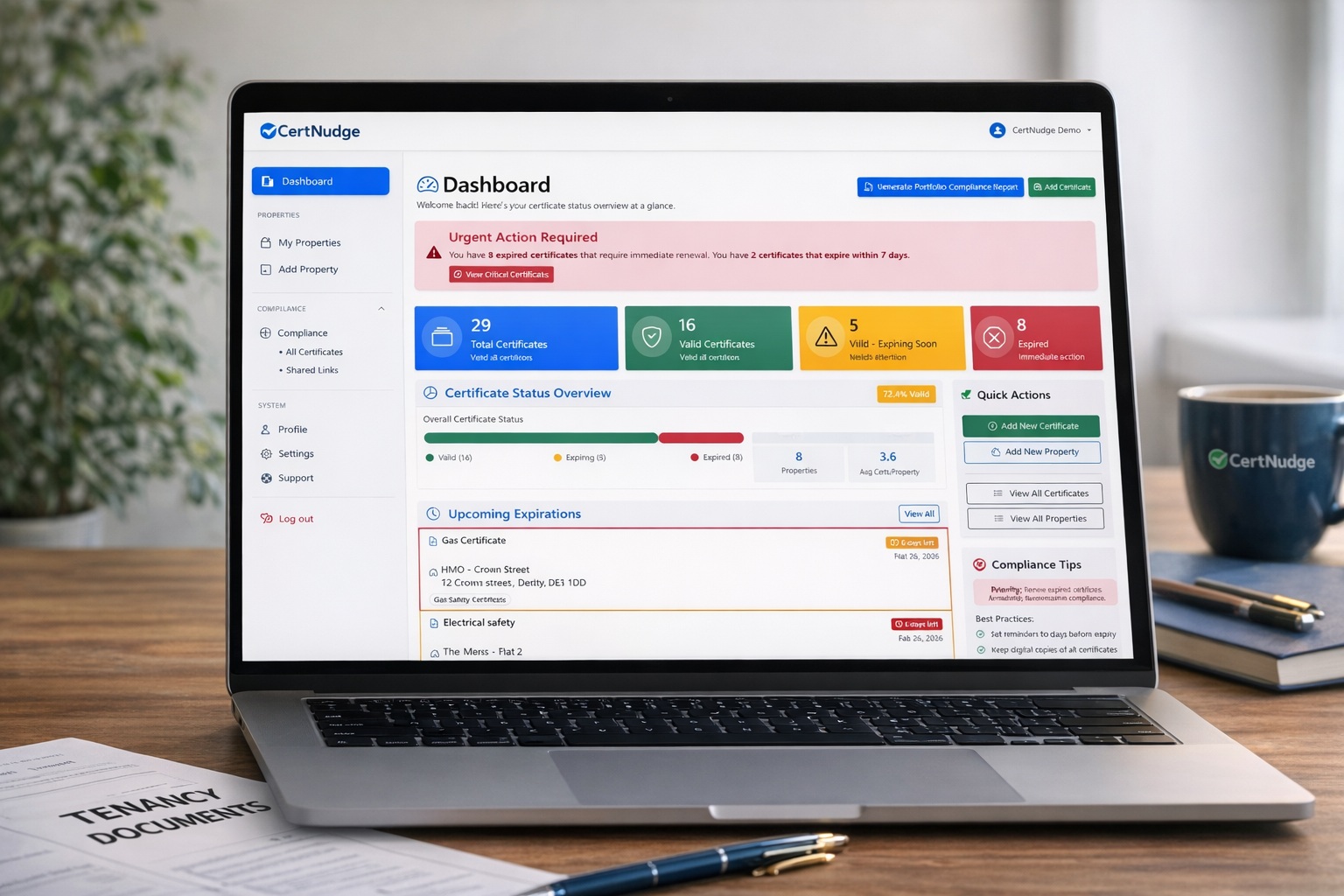
CertNudge helps landlords track deposit dates, scheme records, prescribed information service and supporting evidence per property.

⚠️ Critical compliance window
Effective 1 May 2026: The Renters' Rights Act 2025
From this date, Section 21 "no-fault" evictions are abolished for all tenancies in England. For more background on how possession grounds are changing, see Shelter England’s overview of Renters’ Rights Act changes.
- Existing Section 21 notices: If you served a valid notice before 1 May 2026, it may still be enforceable for a limited period.
- New possession claims: For any claim started after this date, you must use the new "Grounds for Possession".
- The deposit bar: Deposit failures can block possession in most cases unless the deposit issue has been resolved.
How possession rules are changing
The following summary clarifies the shift for your "two-bed flat in Leeds" example. For a fuller breakdown of the deadline, transition, and what landlords should do before May 2026, read our Section 21 Ban 2026 guide for landlords.
Eviction method
Until 30 April 2026: Section 21 (no-fault) or Section 8
From 1 May 2026: Section 8 only (strengthened grounds)
Deposit penalty
Until 30 April 2026: 1x - 3x the deposit amount
From 1 May 2026: 1x - 3x the deposit amount
Possession bar
Until 30 April 2026: Cannot serve Section 21 if unprotected
From 1 May 2026: For most possession grounds from 1 May 2026, the court will expect you to show the deposit was protected and the prescribed information was given.
Prescribed information
Until 30 April 2026: Must be served within 30 days
From 1 May 2026: Must be served within 30 days
What landlords must do within 30 days
The law creates two duties, and both run on the same deadline. First, the landlord must comply with the initial requirements of an authorised scheme within 30 days beginning with the date the deposit is received. Second, the landlord must give the tenant and any relevant person the prescribed information within the same 30-day period. A relevant person is usually someone who paid the deposit on the tenant's behalf, such as a parent or partner in accordance with arrangements made with the tenant.
For a landlord with a two-bed flat in Leeds, that means the deadline runs from the day the money lands, not from move-in day, not from the first rent payment, and not from the date the agreement is signed. That is the point many landlords get wrong.
The simplest way to think about it is this:
- Protect the money
- Serve the information
- Keep proof of both
If one part is missing, the job is not complete. A deposit can be protected on time but still create a problem if the prescribed information is late, incomplete or impossible to prove later.
What to include in the deposit information pack
This is where many articles get lost in legal wording. For most landlords, the practical answer is straightforward: use the deposit scheme's own prescribed information pack or template and make sure it is actually served.
GOV.UK’s tenancy deposit protection guidance says the tenant must be told, within 30 days, the property address, the amount of deposit paid, how the deposit is protected, the name and contact details of the scheme and its dispute service, the landlord's or agent's contact details, the details of any third party who paid the deposit, why deductions might be made, how to apply to get the deposit back, what happens if the tenant cannot contact the landlord at the end of the tenancy, and what happens if there is a dispute.
The underlying legal framework for that prescribed information sits in the Housing Act 2004 and The Housing (Tenancy Deposits) (Prescribed Information) Order 2007 on legislation.gov.uk.
For a landlord with a one-bed flat in Nottingham, that means an email saying “your deposit is protected with DPS” is not enough on its own. The safer approach is to send a proper pack generated through the scheme, plus any standard leaflet or explanatory material the scheme provides, and keep a copy of the exact version sent.
A good rule is: do not build this pack manually unless you have to. Use the scheme's paperwork, because it is designed around the required information and is easier to evidence later.
Day-one deposit checklist
For a landlord with three properties in Reading, the safest process is the same every time. Do not leave deposit protection sitting on a to-do list. Run a short checklist as soon as the deposit is received. The 30-day rule and the information duty are fixed, but your admin process can make compliance either easy or messy.
Use this workflow:
1. Record the date, amount and payer
When to do it: Same day
Evidence to keep: Payment confirmation, bank record, internal note
2. Check if a third party paid
When to do it: Same day
Evidence to keep: Name and contact details of the payer
3. Protect the deposit in DPS, MyDeposits or TDS
When to do it: As soon as possible
Evidence to keep: Scheme confirmation, certificate, reference
4. Prepare the prescribed information pack
When to do it: Immediately after protection
Evidence to keep: Final pack as PDF
5. Serve the pack to the tenant and any relevant person
When to do it: Within 30 days
Evidence to keep: Email copy, letter copy, delivery proof
6. Save everything in one property file
When to do it: Same day you send it
Evidence to keep: Folder with all documents together
Tip: That is the whole operational spine of the article. The legal rule itself is short. The value comes from doing it in a way you can prove later.
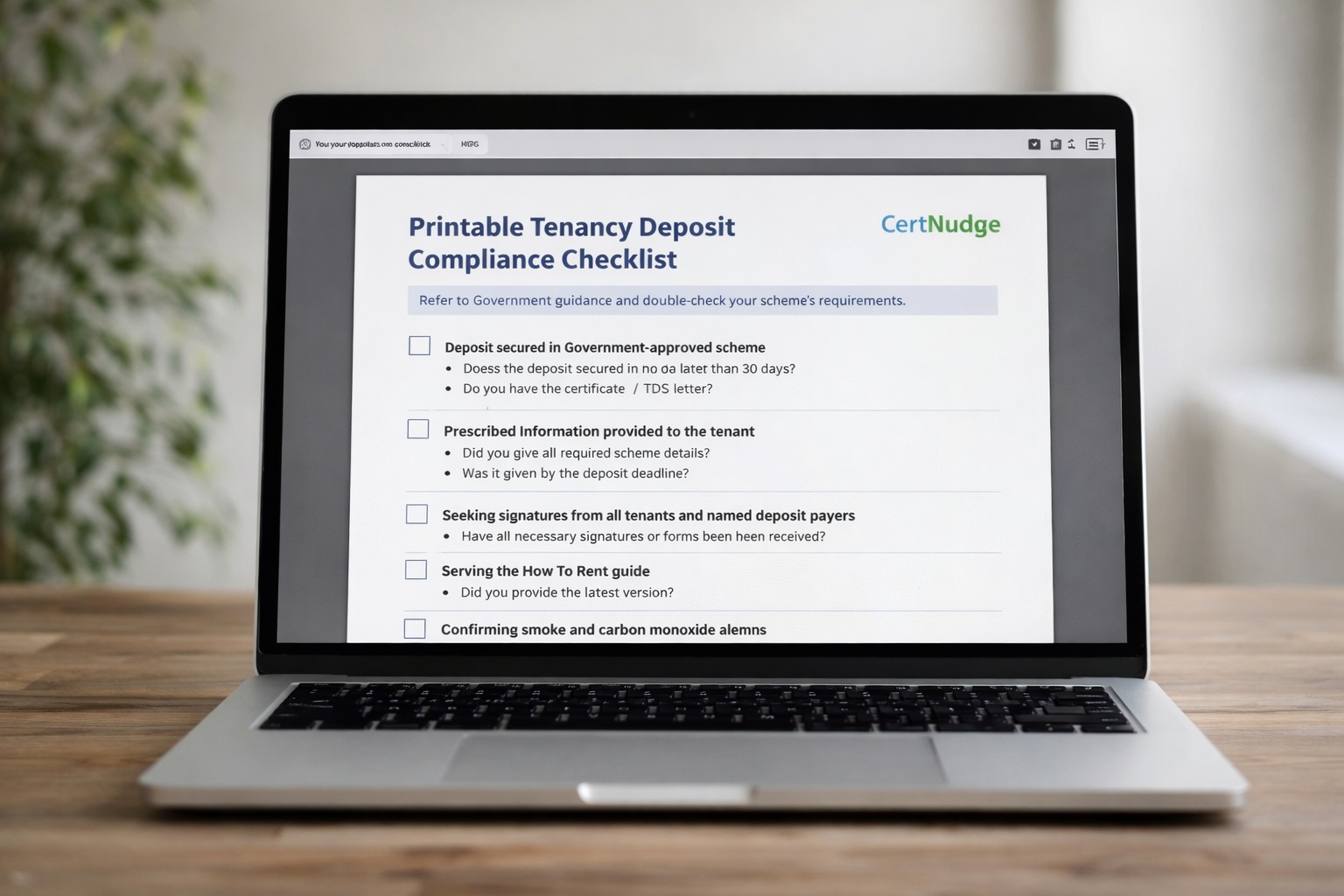
Download the checklist
Want a version you can actually use at check-in or onboarding? Download our free Tenancy Deposit Compliance Checklist (PDF) to record the deposit date, scheme used, prescribed information service, and the evidence you have stored for each tenancy.
Two practical points matter more than they seem.
First, log who actually paid the deposit. If it came from the tenant's father, partner or employer, do not assume that only the tenant needs the paperwork. The legislation refers to the tenant and any relevant person, so that third-party payer may need the prescribed information too.
Second, keep a short internal completion note. Something as simple as “Deposit of £1,250 received on 3 April; protected with TDS on 4 April; PI served to tenant and relevant person on 4 April by email” makes later checking far easier. That note is not the law. It is just good operational discipline.
What evidence landlords should keep
Keep five records: payment proof, scheme proof, the full information pack, delivery proof, and end-of-tenancy evidence.
A landlord with a terraced house in Leicester might protect the deposit on time and still struggle later if the tenant says the paperwork was never received or disputes deductions at the end of the tenancy. That is why the evidence file matters. Deposit schemes resolve disputes by looking at evidence from both sides. Shelter England’s guidance on tenancy deposit protection rules and GOV.UK both stress that the deposit scheme will ask for evidence and make a decision on that basis. If you are thinking beyond deposit disputes and towards possession, read our guide to the evidence UK landlords need for Section 8.
The core file should contain five things.
1. Proof the deposit was received
Keep the payment confirmation or bank record showing:
- the amount
- the date received
- who paid it
This is what anchors the 30-day deadline. If the payer was not the tenant, that record also supports your decision on who needed the prescribed information.
2. Proof the deposit was protected
Keep the scheme confirmation, certificate and reference number. Do not rely on being able to log into the dashboard later and reconstruct the trail from memory. A saved PDF with a date on it is much stronger.
3. A complete copy of the prescribed information pack
Do not just save the certificate on its own. Save the full pack you actually sent, including the scheme paperwork and any covering email or letter. If the point is challenged later, that lets you show exactly what the tenant received.
4. Delivery evidence
This is the part landlords most often miss. Keep:
- the email or letter used
- the date sent
- the recipient details
- any delivery or read evidence you have
For a landlord with a flat in Croydon, the difference between “I definitely sent it” and “here is the email, the attachments and the timestamp” is huge if the issue ends up disputed.
5. The tenancy documents that support any later deduction
Deposit protection is partly about the start of the tenancy, but disputes usually happen at the end. So keep the signed tenancy agreement, check-in inventory, check-out report, dated photos, invoices and key tenant communications in the same property file. GOV.UK says landlords need evidence if they want to keep some or all of a deposit, and the dispute process is evidence-led.
Tip: The useful test is simple: could you produce the full file in under two minutes? If not, the process is too loose.
If you are already late
If you are already outside the 30-day deadline, the position is not clean. But doing nothing is worse.
Start by protecting the deposit immediately if that has not been done yet. Then serve the prescribed information straight away and keep proof of what you sent and when. Late compliance does not erase the original breach, so the court ordered penalty risk remains, but it is still the sensible next step.
The penalty risk remains. Under the Housing Act 2004, the court can order the landlord to repay the deposit or pay it into a scheme, and order a payment of not less than the amount of the deposit and not more than three times the amount of the deposit. GOV.UK's tenant guidance also states that the court may order the landlord to pay up to three times the deposit.
For a landlord with a flat in Milton Keynes, that means a late-protected £1,000 deposit can still become a £1,000 to £3,000 penalty issue. Protecting it on day 43 is still better than leaving it unprotected, but it does not rewind the clock.
There is also a possession angle, and this is where the timing matters.
Before 1 May 2026, Section 21 still matters for notices served under the old system, and section 215 of the Housing Act 2004 says no Section 21 notice may be given at a time when the deposit requirements have not been complied with.
From 1 May 2026, Section 21 ends under the Renters' Rights Act framework. But deposit compliance still matters because GOV.UK says that, where a tenant paid a deposit, the court will only make a possession order if one of a small number of conditions is met, such as the deposit having been protected and the correct information given, the deposit being returned, or any related court challenge having already been resolved.
The practical advice is:
- protect the deposit now
- serve the prescribed information now
- organise the file now
- get legal advice quickly if possession is likely or the tenancy is already contentious
A short checklist article should not try to be a full possession law explainer. The important point for readers is simpler: late compliance may reduce future problems, but it does not guarantee the problem disappears.
Final checklist for staying inspection-ready
For a landlord with two properties in Coventry, the practical standard is not perfection. It is repeatability.
If you receive a deposit, do the same six things every time: log it, identify the payer, protect it, send the pack, save the proof, and store the file. That approach reduces the risk of penalties, makes disputes easier to defend, and leaves you in a stronger position if the tenancy later becomes difficult.
A short end-of-process checklist looks like this:
- deposit received date recorded
- payer identified
- scheme used recorded
- prescribed information pack served
- tenant and any relevant person covered
- delivery evidence saved
- tenancy agreement and inventory stored in the same file
That is not flashy, but it is exactly the kind of admin that saves time and money later.
Compliance notice
This article is for general information only and is not legal advice. Regulations change — always check the latest guidance at GOV.UK or speak to a qualified professional.
Tenancy deposit protection FAQ
When does the 30-day tenancy deposit deadline start?
The 30-day deadline starts on the day the landlord or agent receives the deposit money. It does not start from move-in day, the tenancy start date, or the date the agreement is signed.
Do I need to send prescribed information to a parent or other third party who paid the deposit?
Yes, if someone else paid the deposit on the tenant’s behalf, they may count as a relevant person. In that case, the prescribed information should usually be given to them as well, not just to the tenant.
What should I do if I protected the deposit late?
Protect it immediately, serve the prescribed information straight away, and keep proof of what you did and when. Late protection does not erase the original breach, but doing nothing leaves you in a worse position.
Does deposit protection still matter after Section 21 ends on 1 May 2026?
Yes. From 1 May 2026, landlords in England can no longer use Section 21 for new possession action, but deposit compliance still matters. For most possession grounds, the court will expect the deposit issue to have been dealt with properly before making a possession order.
Tenancy deposit protection checklist: what to do next
Deposit protection is one of those jobs that feels small until it goes wrong. Then it becomes expensive, time-sensitive and document-heavy very quickly.
The simplest way to stay out of trouble is to treat the deposit as an audit trail task, not a memory task. Record the payment date, protect the deposit promptly, send the prescribed information pack, and keep the proof in one place. That is the difference between “I'm sure I dealt with it” and “here is the file”.
Want this tracked digitally instead?
CertNudge helps landlords keep deposit records, supporting documents and evidence organised per property, with reminders and inspection-ready PDF packs.
Last reviewed: 11 March 2026
Next review recommended: 6 May 2026