
EICR deadlines for landlords in England: 7-day and 28-day rules
Searching “EICR give to tenant within 28 days”? In England, you must give existing tenants the latest EICR within 28 days of the inspection and test. This guide also covers council requests (7 days), new tenancies (before occupation), and proof to save.
Who must receive the EICR, and by when
If you came here after searching for “EICR give to tenant within 28 days”, you are not the first and the key deadline in England is this: existing tenants must be given the most recent EICR within 28 days of the inspection and test. The other triggers are just as important: give it to new tenants before they move in, respond to prospective tenant requests within 28 days, and respond to council/local authority requests within 7 days (keep the written request as proof).
- Existing tenants: you must supply the EICR (electrical safety report) within 28 days of the inspection and test.
- New tenants: you must supply the EICR before they occupy the property.
- Prospective tenants: if they request a copy, you must supply it within 28 days of receiving the request.
- Local council/local housing authority: if they request a copy, you must supply it within 7 days of receiving the request (requests are usually in writing, so keep the message).
- You must retain a copy of the EICR until the next inspection and test is required (or later, if it happens later), unless it is replaced by a newer report.
- You must supply a copy of the EICR to the inspector and tester who will carry out the next inspection and test.
- “Compliance” isn’t just sending the PDF — it’s being able to prove you sent the right report to the right person on time.
If you’ve had an EICR done (or you’ve inherited one from a previous landlord/agent), the next question is usually the stressful one: who exactly has to receive it and by when?
EICR for landlords in England - rules, deadlines and proof to keep
Important: This article is for general information only and is not legal advice. Regulations change and circumstances vary. If you need advice on your situation, speak to a qualified professional.
The EICR deadlines at a glance (England)
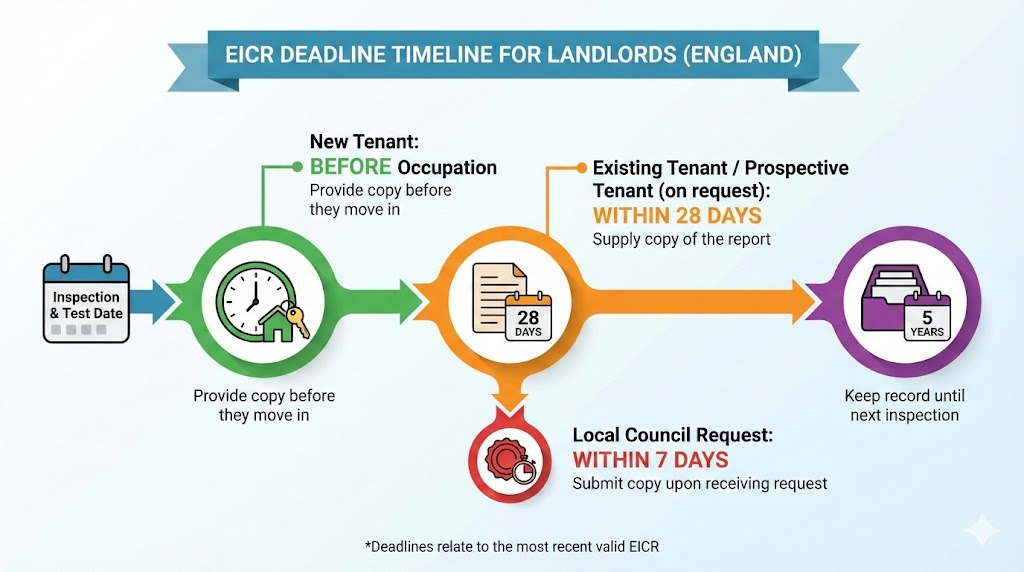
Deadlines table - who gets the report and when
If the inspection and test happened on (say) 10 March, you should treat 7 April as the “no-later-than” date for giving it to existing tenants (28 days later). The GOV.UK guidance states the duty is within 28 days of the inspection and test.
Simple timeline
Think of it like six triggers:
- EICR completed → clock starts for existing tenants (28 days).
- New tenancy starts → EICR must be supplied before occupation.
- Prospective tenant requests a copy → supply within 28 days of the request.
- Council/local housing authority requests a copy → supply within 7 days of the request.
- File it properly → retain a copy until the next inspection and test is required (or later, if it happens later).
- Next EICR booked → send the latest EICR to the inspector/tester before they attend.
That’s it. Most landlord mistakes happen when you mix up the triggers (for example: assuming the tenant’s 28-day window applies to a council request it doesn’t).
This article is about the Electrical Safety Standards in the Private Rented Sector (England) Regulations and associated GOV.UK guidance. Other UK nations have different rules, and even within England the practical process can vary by council but the deadlines above are the core statutory ones.
Existing tenants, new tenants, prospective tenants
Existing tenants: the “within 28 days” rule (what it really means)
If you already have tenants living in the property, the GOV.UK guidance says you must supply a copy of the electrical safety report to each existing tenant within 28 days of the inspection and test.
Shelter also summarises landlord/tenant electrical safety responsibilities here
In practice, landlords usually get caught on three points:
- The 28 days runs from the inspection/test date, not the day you remember to forward the PDF. If the electrician carried out the inspection on 10 March, treat the deadline as 7 April (28 days later).
- It’s not just “the tenant” it’s the tenant(s). If you have joint tenants, make sure all named tenants receive it (or the household receives it in a way you can evidence).
- If you use an agent or portal, you still want your own proof that it was supplied (more on proof in the next main section).
You don’t need a fancy process. You need a repeatable one. A simple approach many landlords use is:
- Save the EICR into the property folder (named clearly), then
- Email it to the tenant(s) with a short message, and
- Save the sent email (or screenshots) into the same folder.
That gives you a clean trail if you ever need to show compliance.
Alternatively use a system like CertNudges Secure Sharing that allows you to easily share secure links to documents via email or WhatsApp instead of emailing PDFs and also record service logs for your records.
New tenants - you must supply it before they occupy
GOV.UK: How to rent checklist (England)
For new tenancies, the GOV.UK guidance states the most recent report must be given to new tenants before they occupy the premises.
This is where landlords can accidentally fall short, because “before they occupy” is earlier than most people think:
- If the tenant collects keys on Monday and moves belongings in that afternoon, Monday morning is already late if the report hasn’t been supplied.
- If your agent sends it after the move-in inventory, that’s risky as the rule is about occupation, not paperwork milestones.
Practical ways landlords handle this cleanly:
- Send it with the tenancy paperwork pack (welcome email / move-in email) and keep the sent email as evidence.
- If you use a signing platform, include the EICR as an attachment in the pre-move documents, then export the audit log or confirmation screen.
- For short lead times, send it by email or text link before key handover, and keep proof.
If you need a sanity check: ask yourself, “Could I show, with dates, that the tenant had the report before they moved in?” If the answer is yes, you’re doing it right.
Prospective tenants - “within 28 days of request”
If a prospective tenant makes a written request for the report, you must supply it within 28 days of receiving the request.
A few real-life notes that help avoid confusion:
- This is about prospective tenants (people considering renting), not only tenants already in occupation.
- The clock starts when you receive the request, so keep the request itself (email, message screenshot, or portal message). If the request is verbal, ask them to put it in an email so you have a dated record.
- It’s safest to supply the most recent EICR for that property, clearly labelled.
What landlords typically do:
- If the request comes via email: reply with the PDF attached, then archive the thread to the property folder.
- If the request comes via a letting portal: upload the report, then screenshot the upload confirmation or message log.
If you’re marketing multiple similar flats, make sure you send the correct report for the correct address. “Close enough” is how mistakes happen.
Local authority requests - the 7-day rule
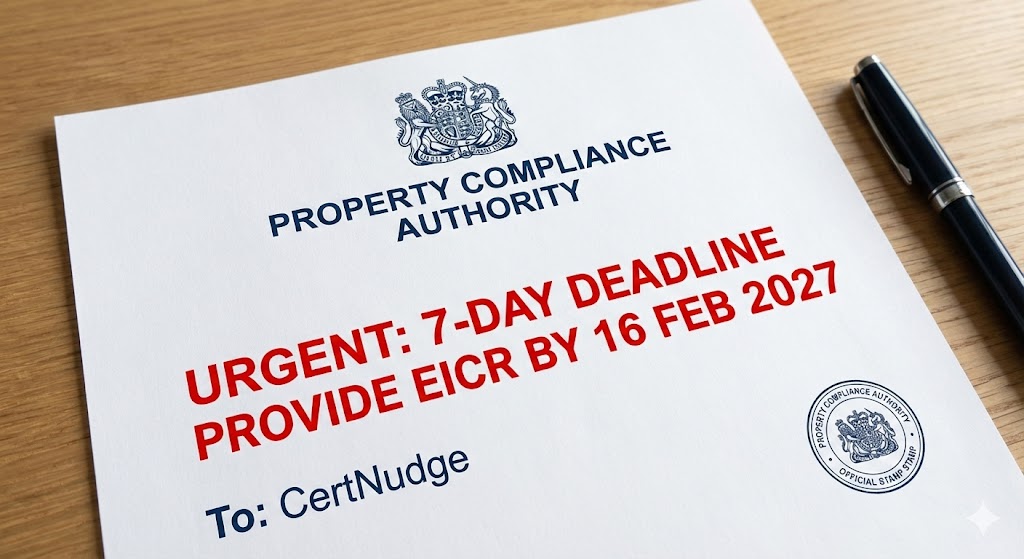
When councils ask for it
The guidance is clear: where a local authority requests the report in writing, you must supply it within 7 days of receiving the request.
Common triggers in England include:
- a complaint leading to an inspection/enquiry,
- selective licensing or broader housing enforcement checks,
- follow-up where the council is monitoring compliance.
You don’t need to guess why they asked, the key is responding within the deadline, with the right document, and keeping proof you complied.
What to send (and what not to send)
Send:
- The EICR / electrical safety report that relates to the property, typically the most recent one.
Avoid sending:
- An older report for a previous test when a newer one exists,
- A report for the wrong address (common if you manage multiple properties),
- A draft / incomplete copy if your electrician issued a revised final version later.
If you’re responding by email, attach the PDF and keep the sent email. If you’re uploading to a portal, keep a screenshot of the upload screen and any submission confirmation.
Proof of supply: what to save (so you can show compliance)
The legal duty isn’t only to have an EICR it’s also to supply a copy to the right people within the deadlines (28 days / before occupation / 7 days on request).
In the real world, the problem is rarely “I didn’t send it”. It’s usually:
- “I think I sent it… but I can’t prove it,” or
- “I sent an EICR… but it wasn’t the latest one / wrong address / wrong file.”
The deadline is short because councils expect you to already have the report to hand. CertNudge’s free check shows you, property by property, which certificates are current, missing or expiring, no upload, no card, just your dates.
Run the free compliance check — see where your evidence gaps are
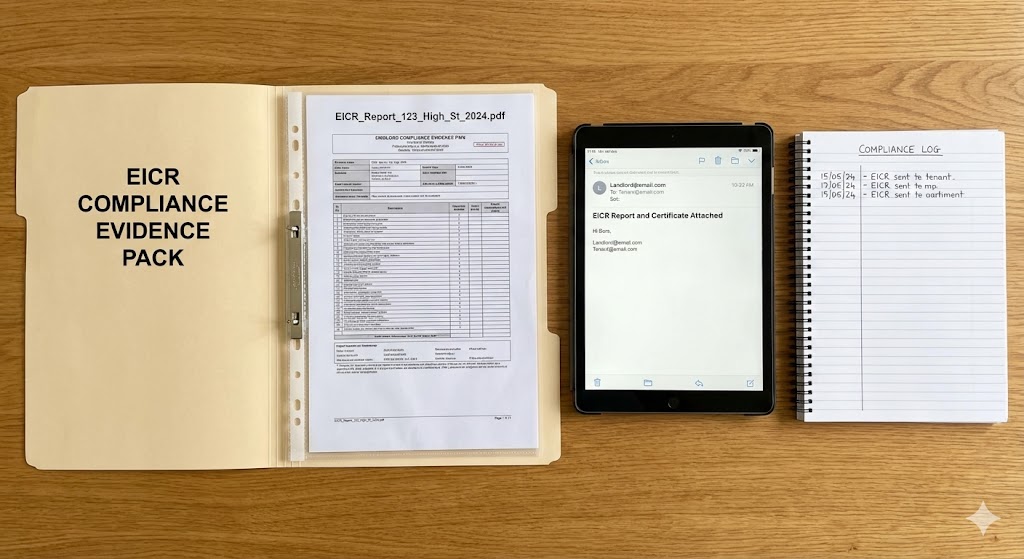
Checklist — evidence that usually works in real life
Aim to keep one clear proof trail per property, per report. Typical items landlords save:
1) The report itself (correctly named and retained)
- Save the PDF in a property folder with a consistent name, for example:
EICR_12-14HighStreet_SW1A1AA_2026-02-01.pdf - Retain a copy until the next inspection and test is required (or later, if it happens later), unless it is superseded by a more recent report.
2) The “sent to tenant” evidence (28-day duty for existing tenants)
- A copy of the sent email (PDF attached) or a screenshot showing:
- tenant email address(es),
- date/time sent,
- attachment name.
- If you used a letting portal: screenshot the message thread or upload confirmation.
- If a tenant doesn’t use email, keep a note of how you supplied it (for example, hand-delivered printed copy with date noted, or certificate of posting).
3) The “sent before occupation” evidence (new tenants)
- Email chain or portal audit log showing the report was supplied before key handover / move-in.
- Keep the tenancy start date handy (even a screenshot of the signed tenancy agreement date can help you demonstrate timing if questioned).
4) The “prospective tenant request” evidence (28 days from request)
- Screenshot or saved message of the request (date visible), plus your reply with the report.
5) The “council request” evidence (7 days from request)
- Save the council’s written request (email/letter).
- Save your response showing the report attached or the upload receipt.
6) A simple “proof log” (optional but powerful)
- One line per action: date, who, how sent, which file.
This turns “I think I did” into “Here’s the trail”.
7) Evidence you supplied it to the next inspector/tester
- When you book the next EICR, email the latest EICR to the inspector/tester (or upload it to their portal) and keep the sent email or upload confirmation.
If you want to avoid hunting through old inboxes, a single place to store EICRs per property and share them quickly helps. CertNudge allows you to store all your certificates and get reminders when they are due.
Mini template, EICR cover email / message (tenant, council, prospective tenant)
Use this as a copy/paste template. Keep it short, factual, and traceable.
Subject: Electrical Safety Report (EICR) — [Property address]
Hello [Name],
Please find attached the Electrical Installation Condition Report (EICR) for [full property address], dated [inspection date].
If you have any questions about access for future inspections, please let me know.
Kind regards,
[Your name]
[Best contact number]
Tip (for proof): leave the attachment name visible (don’t rename to “Report.pdf”). Save the sent email as a PDF or screenshot.
Simple “proof log” format (copy/paste)
You can keep this as a note in the property folder, a spreadsheet, or in your compliance system.
This is not a legal requirement by itself — it’s simply a practical way to evidence that you met the 28-day and 7-day supply duties.
If you manage multiple properties, a shareable Compliance Pack can make it easier to show what was sent, when, and to whom.
Common mistakes that create risk (and how to avoid them)
Most compliance headaches come from small admin slips rather than anything electrical. Here are the issues councils and agents repeatedly flag in day-to-day enforcement and the simple fixes.
Sending the wrong report (or the right report for the wrong address)
This is more common than people admit, especially if you manage multiple flats or have a block with similar addresses.
How it happens
- You forward an older PDF from your inbox without checking it’s the latest.
- You pick the wrong attachment from a “Property A / Property B” email thread.
- You store everything as “EICR.pdf”, so you can’t tell which is which later.
How to avoid it
- Use a consistent file name format including address + date (even if it’s just your own system).
- Before sending, do a 10-second check: does the report show the correct address and the inspection/test date?
- Keep one “current EICR” per property in a clearly labelled folder.
GOV.UK guidance focuses on supplying a copy of the most recent report to the relevant people, so accuracy matters here.
Missing the “before occupation” requirement for new tenants
Landlords often treat EICR supply like any other “move-in document” and assume it’s fine if it’s sent around the tenancy start.
But the guidance is clear: new tenants must receive the report before they occupy the premises.
Low-friction fix
- Make the EICR part of your “pre-keys” checklist.
- If an agent handles move-in, request the portal log/audit confirmation and keep it in your folder.
Confusing the 28-day tenant rule with the 7-day council rule
These are two separate triggers:
- Existing tenants: within 28 days of inspection and test.
- Council request (in writing): within 7 days of receiving the request.
How people get caught
A council email arrives and it’s added to the “admin later” pile. Seven days goes quickly.
Low-friction fix
- Treat council requests as “urgent admin” and respond within 24–48 hours where possible.
- Save the request and your response together so it’s easy to evidence.
Why the 7-day deadline matters: local councils can impose financial penalties on landlords in breach of specified duties under the electrical safety regulations. For offences committed before 1 May 2026 the maximum is £30,000; for offences committed from 1 May 2026 the maximum rises to £40,000 (regulation 11 of the 2020 Regulations, as amended by S.I. 2025/1043). These are maximums, not standard fines — the council decides the amount, and multiple breaches can attract multiple penalties.
Not proving supply (the “I’m sure I sent it” problem)
A common enforcement pain point is when the landlord can’t demonstrate the report was actually supplied within the deadline.
What “proof” usually looks like
- Sent email with attachment visible (or screenshot).
- Portal upload confirmation or message log.
- A short internal proof log entry.
The GOV.UK deadlines are about supplying copies to tenants/prospective tenants/councils, so evidence is your safety net if challenged.
Mixing up “supplying the report” with “fixing issues”
This spoke is intentionally focused on deadlines and who gets the report.
If your EICR shows observations (often coded C1/C2/C3/FI), there can be separate duties around remedial work and confirmation. Those details vary depending on what the report says, and we cover them separately to keep this guide simple.
Forgetting to keep the report and pass it to the next inspector/tester
It’s easy to focus only on tenant/council supply and forget the admin duty to retain the report and provide it to the inspector/tester doing the next EICR.
Low-friction fix:
- Keep one “current EICR” per property in a single folder.
- When booking the next EICR, attach the current EICR in the booking email and save the sent message.
- Find a registered electrician (NICEIC)
Related guides (for the full picture)
- Main guide (Hub): EICR for landlords in England — rules, deadlines and proof to keep
EICR for landlords in england rules deadlines and proof to keep
Conclusion: a simple way to stay on the right side of the deadlines
For most landlords, EICR “deadlines” boil down to four triggers you can keep in your head:
- Existing tenants: give the EICR within 28 days of the inspection and test.
- New tenants: give the EICR before they occupy.
- Prospective tenants (on request): give it within 28 days of the request.
- Local authority (on written request): give it within 7 days of the request.
Source: GOV.UK guidance on electrical safety standards in the PRS (England):
Electrical safety standards in the private and social rented sectors guidance
Save proof of supply (sent email, portal log, screenshots) alongside the report in your property folder. That’s what turns “I sent it” into “I can evidence it”.
If you’re juggling multiple properties, it’s easier when each property has a single place for the current EICR and a shareable record of when it was supplied. CertNudge’s Certificate Storage and Reminders and Compliance Packs are designed for exactly that.
Last reviewed: 17 July 2026
Next review recommended: 17 January 2027