CP12 Gas Safety Certificate: Costs & What's Included
The CP12 gas safety certificate is one of the simplest but most important parts of a landlord’s legal duties. This guide explains what a CP12 includes, how much a gas safety check costs, and what a Gas Safe engineer actually does during the inspection.
If you're a landlord in Great Britain, the landlord gas safety record, often called a CP12 or gas safety certificate is one of the most important gas-safety records you’ll deal with each year. It records the results of the annual safety checks carried out on the gas appliances and flues you provide for your tenants. But many landlords still aren’t entirely sure what a CP12 includes, how much it should cost, or what the engineer is actually checking.
This short guide explains everything you need to know in plain English, including typical costs and a step-by-step breakdown of the inspection.
Scope: The legal references in this guide relate to Great Britain. Northern Ireland has separate gas-safety legislation and official guidance.
Key takeaways
- A CP12 costs £60–£120 for a standard single-boiler check, plus £15–£35 per extra appliance. Combined with a boiler service: £110–£160.
- Many gas safety checks take around 30–60 minutes, although the time varies with the property, the number and type of appliances, and any issues found. There is no statutory minimum inspection time.
- The gas safety check is annual, with no post-deadline grace period. In qualifying circumstances, it can be carried out up to two months early without changing the existing renewal deadline.
- A CP12 is not a boiler service — it records the annual safety check; servicing is a separate maintenance task.
- Do not choose an engineer on price alone. Check that they are Gas Safe registered and qualified for the type of gas work involved, and confirm what the quoted price includes.
- Remedial work is extra. The certificate price covers the inspection, not the repairs.
For a wider view of fines, grace periods and eviction rules, see our main guide: Gas Safety Certificates: Fines, Grace Periods and CP12 Explained
What Is a CP12 Gas Safety Certificate?
A CP12 — more formally referred to by HSE as a landlord gas safety record, records the results of the annual safety checks carried out by a Gas Safe registered engineer on the gas appliances and flues that you provide for your tenants. Installation pipework is subject to a separate maintenance duty; HSE recommends asking the engineer to test the gas system for soundness and visually examine accessible pipework when the safety check is carried out.
A landlord gas safety record must include, as a minimum:
- A description and location of each appliance or flue checked
- The name, Gas Safe registration number and signature of the person carrying out the check
- The date on which each appliance or flue was checked
- The address of the property
- The name and address of the landlord, or their agent where appropriate
- Any safety-related defect identified and any remedial action taken
- Confirmation that the safety check included an examination of the matters required by regulation 26(9) of the Gas Safety (Installation and Use) Regulations 1998
Landlord responsibilities for gas safety are set out in the official HSE guidance for landlords , which requires annual checks by a Gas Safe registered engineer.
How long is a CP12 valid?
The annual gas safety check must be completed every 12 months. There is no grace period after the deadline. However, this should not be confused with the early-renewal flexibility in regulation 36A: in qualifying circumstances, you can have the check carried out up to two months before it is due and still retain the existing renewal deadline.
If you’re unsure what happens when a certificate expires, read our guide on Gas Safety Certificate “Grace Periods” for a full breakdown of the rules.
Not sure when your CP12s expire?
Run a free compliance check, enter your dates and see which properties are current, expiring, or already lapsed. No upload, no card, just your dates.
Run the free compliance check →How Much Does a Gas Safety Check Cost?
Prices vary depending on location, appliance count, and whether you combine the check with a boiler service. Across the UK, you can expect:
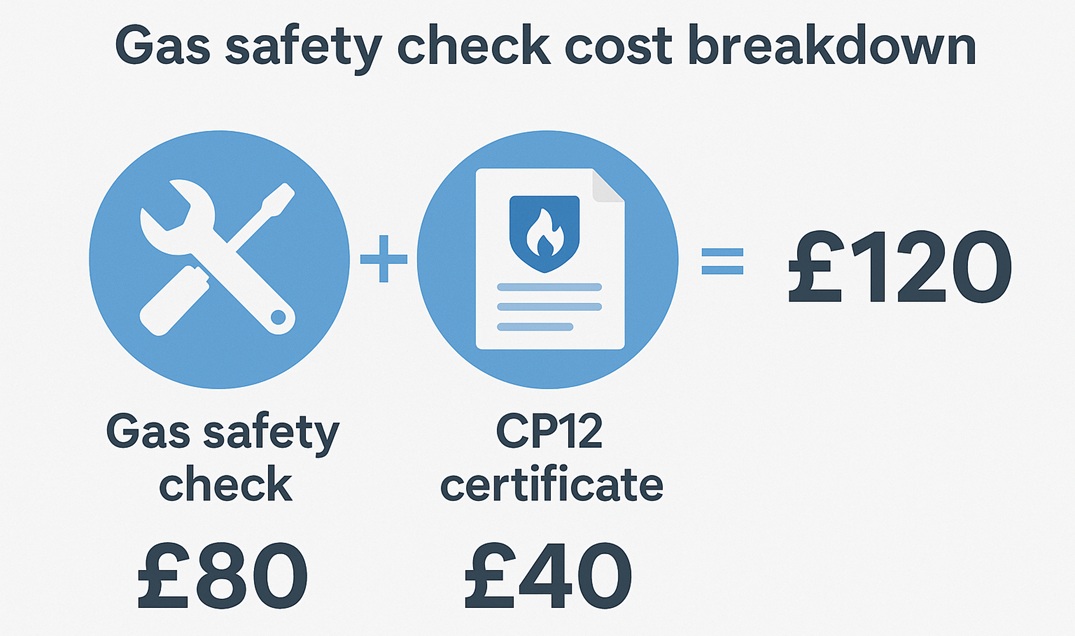
£60–£120 for a standard check on a single boiler (most landlords will fall in this range).
Typical appliance add-ons:
- + £15–£25 for a gas hob
- + £20–£35 for a gas fire
- + £20–£30 for a second boiler or heater
If you combine the gas safety check with a boiler service, £110–£160 is the normal range (with London at the higher end).
Why the range is so wide
Two landlords can pay £60 and £120 for what looks like the same certificate. Four things explain most of the gap:
- Appliance count. Each landlord-provided gas appliance covered by the annual check adds time. A property with only a gas boiler will usually be quicker to check than one with several gas appliances such as a boiler, hob and fire.
- Region. London and the South East run highest, partly because engineers are absorbing ULEZ, congestion and parking costs. Northern England and Scotland tend to sit at the lower end.
- Who you book. Prices vary between independent engineers and larger providers because their overheads, service models and included services differ. Whoever you use, check that the engineer is Gas Safe registered and qualified for the work involved.
- Call-out and admin fees. Some quotes are inclusive; others add these on top. Ask what the headline price actually covers before you book.
Two legitimate ways to pay less: bundle the check with a boiler service, or block-book several properties with one engineer. Neither compromises the inspection.
Budget separately for remedial work. The CP12 price covers the inspection and the certificate — not fixing anything the engineer finds. If a defect is flagged, repairs are a separate cost and can run from around £50 to several hundred depending on severity.
Don’t judge a gas safety check by price alone
A low quote does not automatically mean a poor inspection, just as a higher price does not guarantee a better one.
Before booking, check that the engineer is Gas Safe registered and qualified for the type of gas work involved, and ask whether the quoted price covers all relevant appliances, the safety check and issue of the landlord gas safety record.
If you’re wondering what happens when a certificate is missing or invalid, our guide Gas Safety Fines explains the penalties councils and HSE can issue for non-compliance.
What Actually Happens During a Gas Safety Check? (Step-by-Step)
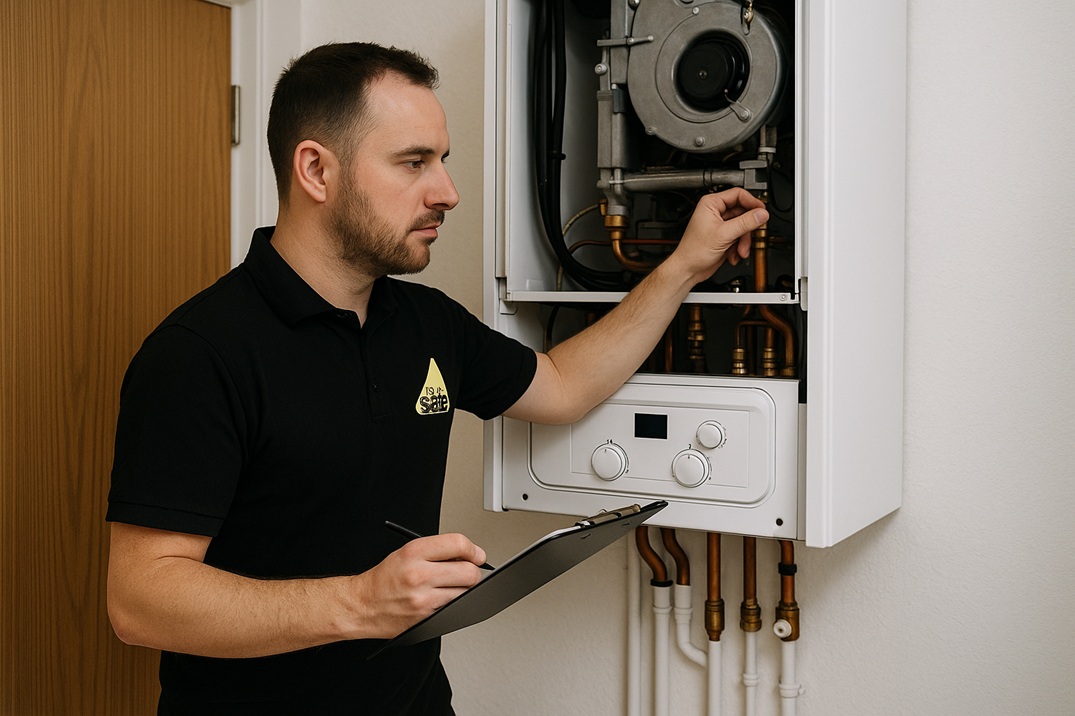
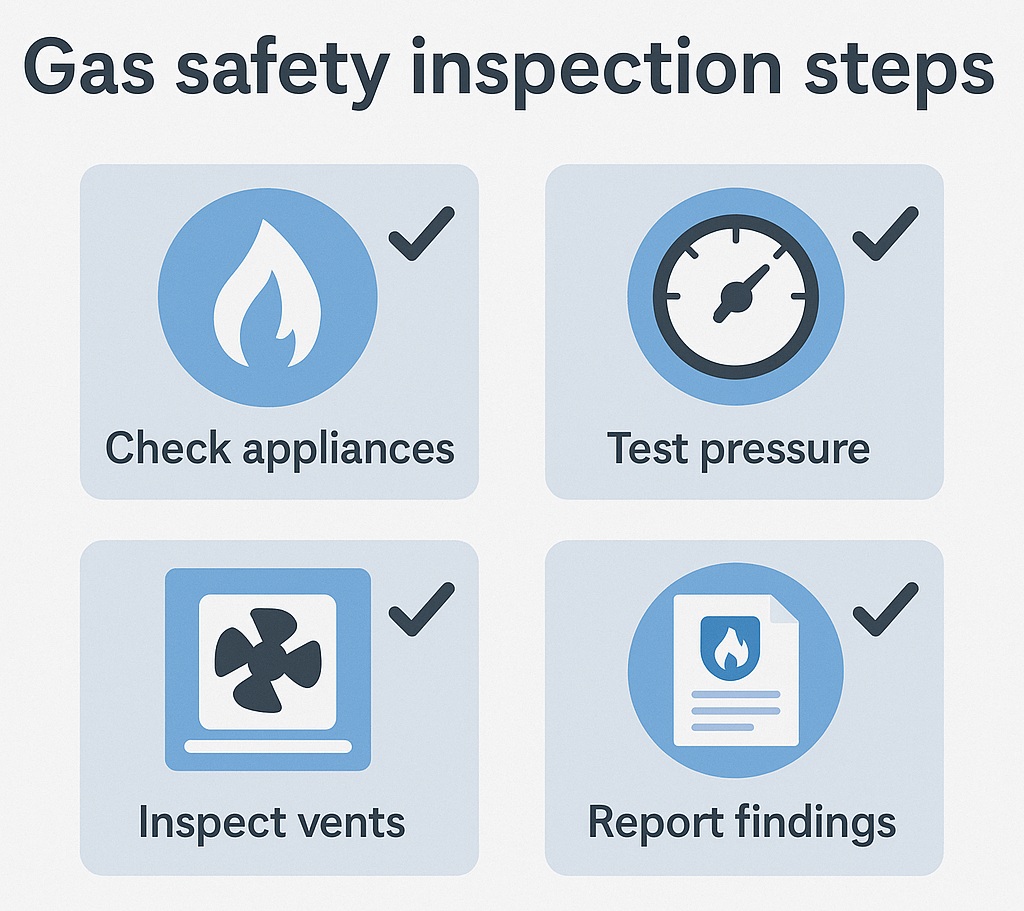
During the annual gas safety check, a Gas Safe registered engineer examines the relevant gas appliances and flues against the required safety matters. Installation pipework is covered by the landlord’s separate maintenance duty, although HSE recommends asking the engineer to test the gas system for soundness and visually inspect accessible pipework. The Gas Safe Register also provides guidance on gas-appliance safety checks.
1. Visual inspection of all gas appliances
The engineer checks the general condition of each appliance, looking for unsafe modifications, signs of leaks, correct installation and adequate ventilation. This includes boilers, hobs, gas fires and water heaters.
2. Flue and chimney checks
The flue and chimney are inspected for integrity, routing, termination, blockages, cracks and any signs of spillage. Unsafe flues are a significant carbon monoxide risk.
3. Operating pressure, heat input or combustion-performance checks
Depending on the appliance and what is reasonably practicable, the engineer checks operating pressure or heat input, or examines combustion performance, as part of confirming safe operation. Installation pipework is maintained under a separate landlord duty; HSE recommends asking the engineer to test the overall gas system for soundness and visually inspect accessible pipework.
4. Burner and flame analysis
Burner pressure, flame colour and shape, combustion performance and safety devices are checked. More complex boilers may also require flue gas analysis.
5. Appliance safety controls
Built-in safety devices such as flame-failure devices, overheat stats, thermocouples, interlocks and cut-offs are tested to make sure they operate correctly.
6. Ventilation and combustion-safety assessment
The engineer checks that any ventilation required for the safe operation of the appliance is adequate and examines relevant flue and combustion-safety matters, including signs that combustion products may not be dispersing safely. Carbon monoxide alarm requirements are a separate landlord obligation rather than part of the CP12 itself.
7. Identifying and classifying unsafe situations
If an engineer identifies an unsafe gas situation, the current gas-industry procedure uses two principal classifications:
- At Risk (AR) – an appliance or installation presents a potential danger.
- Immediately Dangerous (ID) – an appliance or installation presents an immediate danger to life or property.
Follow the Gas Safe registered engineer’s safety instructions and do not use equipment that has been identified as unsafe until the problem has been properly rectified. An engineer may separately advise that something does not meet current standards, but “Not to Current Standards” is not one of the current IGEM/G/11 unsafe-situation classifications.
8. Recording the results and issuing the gas safety record
Once the required checks are complete, the engineer issues the landlord gas safety record. It must identify the appliances or flues checked, the engineer and property details, the date of the checks, any safety-related defects and remedial action, and confirmation that the required safety matters were examined. The record may be kept and supplied electronically where the relevant requirements are met.
How Long Does a Gas Safety Check Take?
A straightforward gas safety check often takes around 30–60 minutes, but there is no fixed statutory duration. The time required depends on factors such as the number and type of appliances, access, the condition of the installation and whether any safety concerns are identified.
Time alone does not determine whether a check has been carried out correctly. The important point is that a suitably qualified Gas Safe registered engineer completes all of the safety checks required for the appliances and flues concerned.
What Does a CP12 Not Include?
A CP12 is not a boiler service.
A gas safety check and a boiler service have different purposes. The annual landlord check is concerned with the required safety checks on relevant gas appliances and flues; a boiler service is a maintenance procedure carried out in accordance with the appliance manufacturer’s instructions.
Depending on the appliance and service specification, servicing may involve additional maintenance work such as cleaning components, examining internal parts, replacing worn service items or carrying out broader condition checks.
Many landlords arrange the annual gas safety check and boiler service during the same visit, but they should confirm exactly what is included in the engineer’s quote.
How to Prepare for a Smooth Gas Safety Check
- ✔ Ensure easy access to the boiler
- ✔ Clear access to gas fires or hobs
- ✔ Make sure tenants are aware of the appointment and if a tenant refuses access, start documenting your attempts straight away
- ✔ Provide engineer access instructions (keys, codes, concierge, etc.)
- ✔ Keep previous CP12s on file
Summary: The CP12 Is a Simple but Crucial Part of Your Legal Duties
The landlord gas safety record documents the annual safety checks carried out on the gas appliances and flues that you provide for your tenants. Keeping those checks up to date, dealing promptly with defects and retaining the records are important parts of a landlord’s gas-safety duties.
- A straightforward check often takes around 30–60 minutes, but the time required varies
- The gas safety check must be completed every 12 months
- There is no post-deadline grace period, although qualifying checks can be carried out up to two months early while retaining the existing renewal deadline
- Give existing tenants a copy of the gas safety record within 28 days of the check and give new tenants a current copy before they move in
- Keep gas safety records for at least two years; if you use the regulation 36A early-renewal flexibility, keep the relevant record until two further gas safety checks have been carried out
With good organisation and a trusted Gas Safe engineer, gas safety compliance becomes one of the simplest parts of managing a rental property.
For related guidance, you may also find these useful:
• Gas Safety Certificate Grace Periods: The Truth Landlords Need to Know
• Gas Safety Fines: Penalties for Missing or Expired CP12s
• What to Do When a Tenant Refuses a Gas Safety Check
• How Gas Safety Affects Possession in England
• Can I Evict a Tenant Without a Gas Safety Certificate? (historic Section 21 guidance for qualifying proceedings started by 31 July 2026)
Important: This article is for general information only and is not legal advice.
Always seek independent legal advice or consult a specialist with regards to any legal matters regarding gas safety.
Information reviewed and updated September 2026.