Landlord Gas Safety Fines: Penalties for Missing CP12
A missing or expired gas safety certificate is one of the most expensive mistakes a landlord can make. This guide explains the real fines, HSE prosecutions, insurance problems and possession risks facing UK landlords who fall behind on their CP12 checks.
A missing or expired gas safety certificate is one of the most expensive mistakes a landlord can make. Councils and the Health and Safety Executive (HSE) are issuing more penalties than ever, and the legal consequences can go far beyond a simple fine.
This article explains the exact penalties for no gas safety certificate, what landlords can expect in an investigation, and how enforcement actually works in real life.
The Health and Safety Executive (HSE) sets out the core legal duties for landlords, including annual checks and proper record-keeping. You can read their full guidance here on the HSE website .
For a complete overview of your legal duties, renewal rules and possession requirements, see the Landlord Gas Safety Certificates: Fines, Grace Periods, Section 21 and CP12 Explained .
Important May 2026 update for England
From 1 May 2026, landlords in England can no longer serve new Section 21 notices. Gas safety duties still apply, and a missing or expired CP12 can still create enforcement risk, insurance problems, possession complications, and serious financial penalties. This article has been updated to reflect the post-Section 21 position. For the current possession process, see the GOV.UK guidance on repossessing your property on or after 1 May 2026.
The Short Answer: Missing or Expired CP12s Can Lead to Serious Financial Penalties
There is no single fixed fine for a missing or expired gas safety certificate. The risk depends on the breach, the enforcement route, the evidence available, and whether tenants were put at risk.
- Local authority civil penalties under the Housing Act 2004 can reach up to £30,000 per offence
- HSE criminal prosecutions for severe gas safety failures can result in unlimited fines and, in serious cases, imprisonment
Penalties usually become more serious where there are:
- Long gaps with no valid CP12
- Unsafe appliances or carbon monoxide risk
- Repeated failures across multiple properties
- No evidence of tenant service or access attempts
See your own exposure
How much are your properties exposed to right now?
A lapsed gas certificate carries an unlimited fine, and EICR, EPC and alarm breaches stack on top. Run a free check to see, per property, what's current, what's expiring, and your maximum penalty exposure across the portfolio. No signup, no documents to upload, just your dates.
Free self-assessment. No account, no card, no upload, takes under a minute.
1. Council Civil Penalties (Housing Act 2004)
Most penalties for missing gas safety certificates are issued by local councils, not the HSE.
Under the Housing Act 2004, councils can issue:
- Civil penalties up to £30,000 per offence
This is commonly used when a landlord has:
- Failed to renew a CP12 on time
- Failed to provide the certificate during a licensing visit
- Ignored reminders from tenants or agents
- Provided no evidence of attempts to gain access
- Let multiple properties without valid certificates
Council enforcement follows national guidance on civil penalties, which sets out how fines up to £30,000 can be issued. Official guidance is available on GOV.UK .
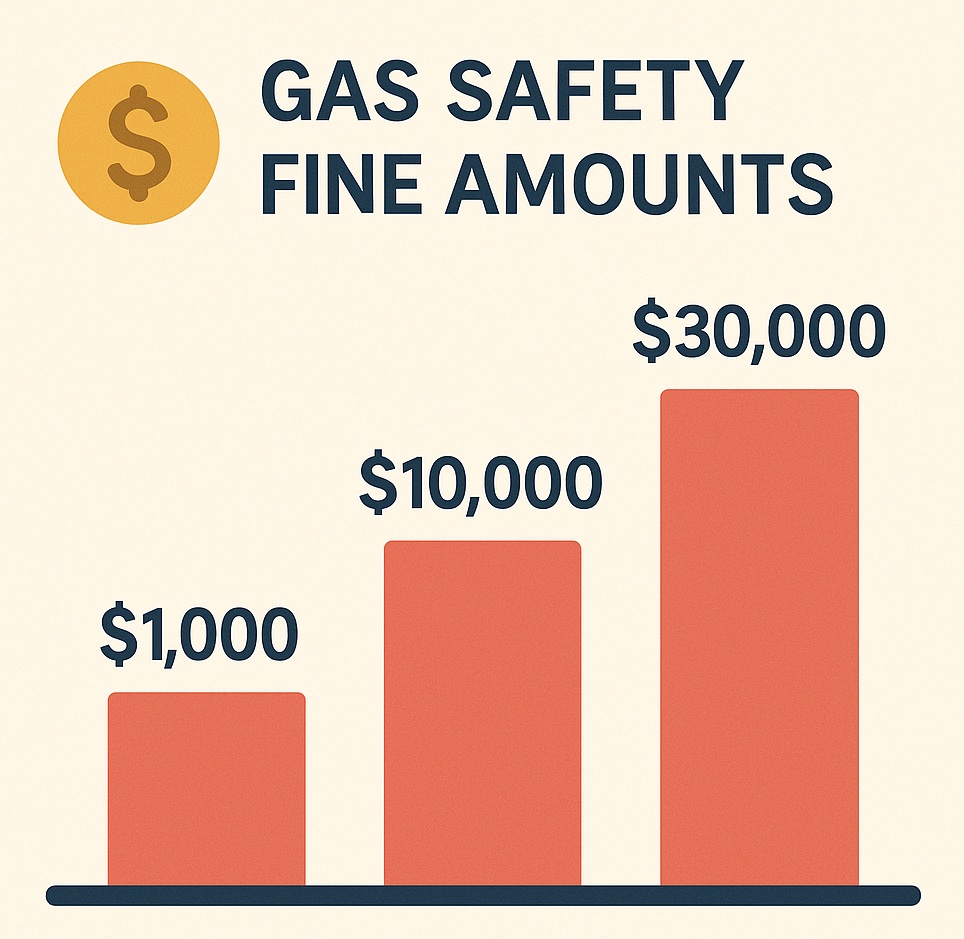
Typical gas safety fine amounts for UK landlords under council enforcement.
Typical fine amounts seen in UK councils include:
- £2,000–£7,500 for a first offence
- £10,000–£25,000 for repeated failures or multiple properties
- £30,000 for serious “reckless” breaches
Councils have become far more proactive due to:
- Selective licensing
- HMO licensing
- Tenant complaints
- Safety inspections
- Increased funding for enforcement teams
From late 2026 this goes national: the new PRS Database landlords must register with adds another layer where missing safety records become visible to enforcement.
2. HSE Prosecution: Unlimited Fines and Criminal Records
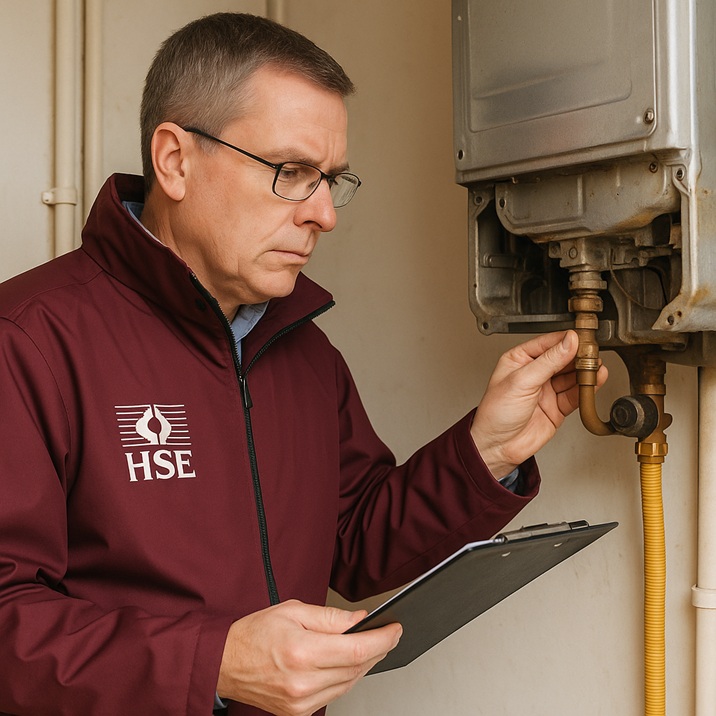
Health and Safety Executive inspector examining gas equipment during an investigation.
The Health and Safety Executive becomes involved when:
- Tenants are put at real risk
- There is a gas leak, unsafe appliance or faulty flue
- A landlord ignores warnings
- An engineer reports dangerous conditions
- There are multiple properties with long-term non-compliance
HSE penalties can include:
- Unlimited fines
- Up to 6 months imprisonment (Magistrates’ Court)
- Up to 2 years imprisonment (Crown Court for serious cases)
- A criminal record
- Your name published on the HSE public register
HSE prosecutions are public, highly damaging, and often reported in the press.
3. Real Examples of Landlords Fined for Gas Safety Failures
Here are the types of cases regularly seen:
- £10,000+ fine – A landlord who allowed a CP12 to lapse and ignored council requests for documentation.
- £20,000 fine – A portfolio landlord with several properties lacking valid certificates during a licensing check.
- £6,000 fine – A landlord whose boiler was found “Immediately Dangerous” after a tenant complaint.
- Unlimited fine + criminal record – Cases where carbon monoxide risk or unsafe appliances created immediate danger to life.
These are not rare incidents. Councils and the HSE publish dozens of cases each year.
Free landlord template
Tenant refused access? Log every attempt before it becomes a compliance problem.
If a gas safety check is delayed because the tenant will not give access, you need a clear paper trail showing the steps you took.
- Record appointment dates offered
- Log emails, calls, texts, WhatsApp messages, and letters
- Track tenant replies, cancellations, or refusals
- Keep engineer “no access” notes together with your CP12 records
- Show you took reasonable steps if your paperwork is questioned later
Use the access attempt log template to document delays properly, then keep the final certificate and evidence organised against the right property.
4. Insurance Problems if the CP12 Is Missing or Expired
This is the hidden cost many landlords overlook.
Most landlord insurance policies require:
- A valid, in-date gas safety certificate
- Proof you carried out the check properly
- Disclosure of any enforcement action
If you make a claim (fire, explosion, carbon monoxide event, property damage), insurers may:
- Refuse the claim entirely
- Reduce the payout
- Cancel the policy
- Refuse to renew your cover
Gas safety is classed as a material fact. If you were not compliant, you may not be covered.
5. Possession Problems: Fines Are Not the Only Risk
If you do not have an in-date gas safety certificate, or you cannot prove you gave it to the tenant, your ability to regain possession is at risk.
You must be able to show:
- A valid CP12 was given to the tenant before or at the start of the tenancy
- Each renewal was provided within 28 days
- There is a continuous chain of certificates
If not, possession proceedings can become harder, slower, or more vulnerable to challenge — even if your CP12 is now up to date. From 1 May 2026, landlords in England can no longer serve new Section 21 notices, so possession now usually requires the updated Section 8 process and a valid possession ground. Clean gas safety records still matter because landlords may need to produce evidence if their paperwork, property management, or tenant communications are challenged.
Gas safety obligations come from the Gas Safety (Installation and Use) Regulations 1998 , which require landlords to ensure gas appliances and flues are safe at all times.
To find out in more detail how a missed or expired gas safety certificate can impact your ability to evict a tenant check out our article Can I evict a tenant without a gas safety certificate (Section 21 Before 1 May 2026)
6. When Councils Investigate: What Actually Happens
A missing CP12 can trigger an inspection during:
- HMO licensing
- Selective licensing
- Tenant complaints
- Routine property visits
- Suspected unsafe conditions
During an investigation, the council may:
- Request all gas safety records
- Ask for proof of tenant service
- Review previous years of certificates
- Interview the landlord, agent or engineer
Failure to produce the certificate is treated as evidence of breach.
7. How Long Can You Be Without a Gas Safety Certificate?
Legally:
Zero days.
There is no grace period. Once the certificate expires, you are out of compliance.
For a detailed explanation of why there is no formal “grace period” after expiry, see Gas Safety Certificate Grace Period: The Truth Landlords Need to Know.
Even a short gap can lead to enforcement, especially if:
- A tenant complains
- An inspection occurs
- There is an incident
- You cannot show “reasonable steps”
8. How to Avoid Gas Safety Fines (Simple Checklist)
Follow this simple checklist to minimise your risk of gas safety fines:
- Renew at least 1–2 months before the expiry date
- Keep digital copies of every CP12
- Use the same Gas Safe engineer each year
- Provide the certificate to the tenant and keep evidence
- Log all attempts if there are access issues
- Maintain a continuous chain of certificates
- Book early if you manage multiple properties
If you manage more than one rental property, a structured compliance record helps you track renewal dates, store certificates, record tenant sharing, and prove what happened if your gas safety paperwork is ever questioned.
Only Gas Safe registered engineers can legally carry out a CP12 check. You can confirm an engineer’s registration on the Gas Safe Register .
Most fines come from poor record-keeping and missed dates — not from malicious landlords.
Gas is the highest-risk certificate, but not the only one councils check — see our guide to PAT testing rules for landlords in England for where portable-appliance testing does and doesn't create a legal duty.
If you want to know exactly what the engineer checks during that visit (and what a fair price looks like), see our guide to CP12 Costs and Gas Safety Check Steps.
Final Thoughts: The Cost of Non-Compliance Isn’t Worth the Risk
A gas safety check usually costs far less than the consequences of getting compliance wrong. A missing or expired certificate can lead to enforcement action, insurance problems, possession delays, and serious financial penalties.
Gas safety compliance is simple but the consequences of ignoring it are not.
If you’re unsure about your current certificates, the safest time to check is right now.
For a full step-by-step routine to stay compliant all year, see the Landlord Gas Safety Certificates: Fines, Grace Periods and CP12 Explained
Important: This article is for general information only and is not legal advice.
Always seek independent legal advice or consult a specialist around fines and penalties for non-compliance.
Information reviewed and updated in May 2026.