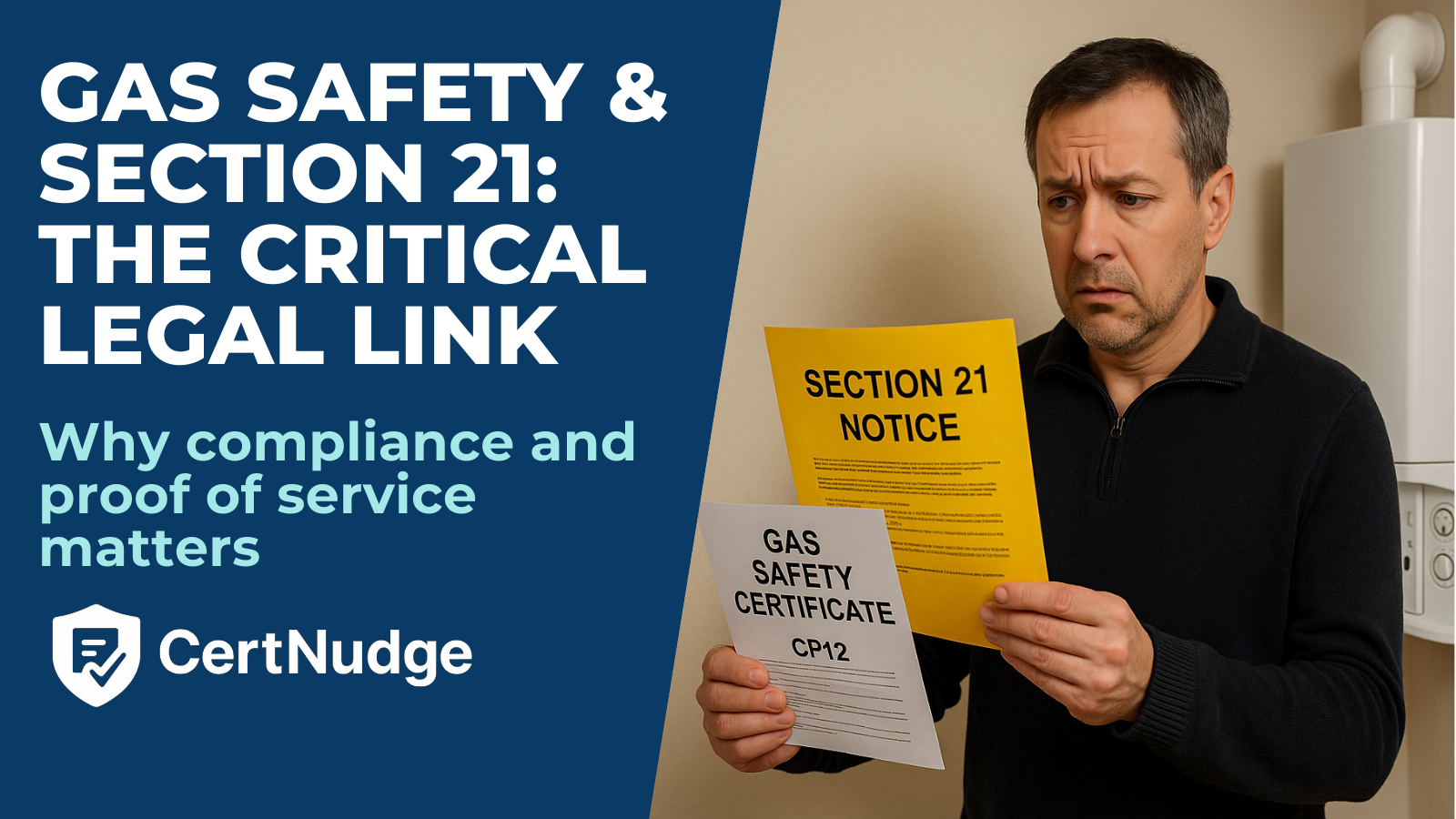
Can I Evict a Tenant Without a Gas Safety Certificate? | Section 21 Before 1 May 2026
Gas safety compliance is tightly linked to Section 21. This guide explains when a missing, late or expired CP12 gas safety certificate can invalidate your notice -and how to protect your right to evict.
Important May 2026 update for England
From 1 May 2026, landlords in England can no longer serve a new Section 21 notice. This article now applies mainly to Section 21 notices served before 1 May 2026 and to disputes about whether gas safety compliance affects those transitional cases. If your notice was served on or after 1 May 2026, this is not the guide you need, read how gas safety affects possession in England now instead, or see the current GOV.UK possession guidance.
For landlords in England, gas safety compliance has long been one of the key issues that can affect whether a Section 21 notice is valid. A missing, late or badly evidenced CP12 gas safety certificate can create serious possession risk.
However, the law changed on 1 May 2026. Landlords in England can no longer serve a new Section 21 notice from that date. This guide is therefore mainly about transitional Section 21 cases: notices served before 1 May 2026, and disputes about whether gas safety failures can still undermine those notices.
If you already served a Section 21 notice before 1 May 2026, this article explains when a missing, expired or late gas safety certificate may still put your claim at risk. For a complete overview of landlord gas safety rules, see the full Gas Safety Compliance Guide.
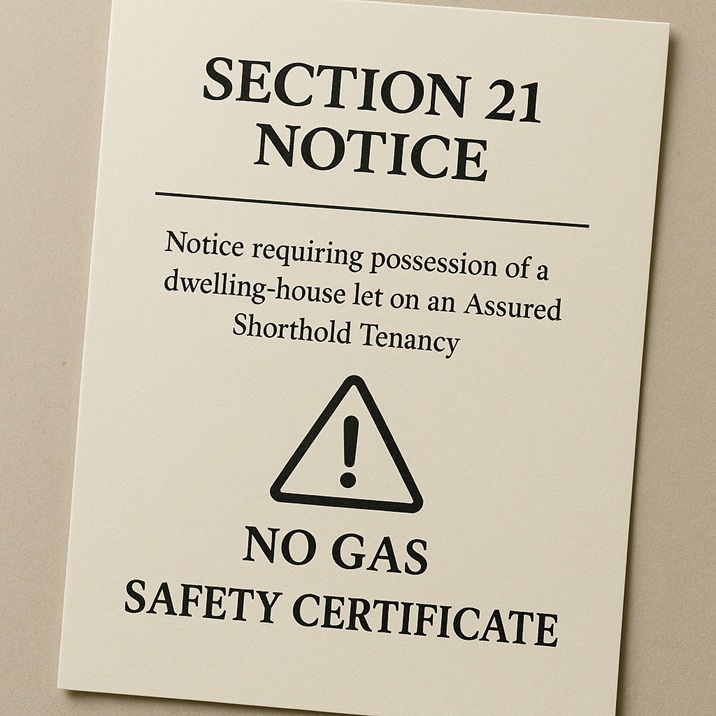
Quick Answer: Before 1 May 2026, Gas Safety Could Still Invalidate Section 21
If you served a Section 21 notice before 1 May 2026, gas safety compliance may still affect whether that notice can be relied on in court.
Here is the short version:
- If you NEVER had a gas safety check done: ❌ your Section 21 claim is in serious difficulty.
- If you HAD a CP12 but gave it to the tenant late: ⚠️ the notice may still be usable, but the timing and evidence matter.
- If the CP12 expired during the tenancy: ⚠️ it does not automatically kill the claim, but it increases risk.
- If you cannot prove you gave the certificate to the tenant: ❌ your possession claim is vulnerable.
- If you have not yet served notice and it is now on or after 1 May 2026: ❌ you cannot start with a new Section 21 at all.
If you're also concerned about the financial penalties for missing or late CP12 certificates, read our guide on Gas Safety Fines and Penalties.
Not sure which category you're in? Run a free Compliance Check to see, per property, what's current, what's expiring, and where your gas, EICR and EPC evidence gaps are. No signup, no upload, just your dates.
Section 21 after 1 May 2026: what changed?
From 1 May 2026, landlords in England can no longer serve a new Section 21 notice. This article therefore matters mainly if you:
- served a Section 21 notice before 1 May 2026, and
- need to know whether gas safety problems could still affect that notice or the court claim.
If you gave the notice before 1 May 2026, there is only a limited window to start possession proceedings. GOV.UK says you can only use a pre-1 May 2026 Section 21 notice up to the earlier of the time left on the notice or 31 July 2026. If the earliest date that possession proceedings can begin in the notice is on or after 1 August 2026, it is invalid for issuing possession proceedings.
Why Gas Safety Affects Section 21 at All
For Section 21 cases served before 1 May 2026, landlords needed to show that key prescribed requirements had been met. GOV.UK guidance for England includes providing a valid gas safety certificate where there is a gas supply, along with the EPC and the correct How to Rent guide.
- A valid in-date CP12 gas safety certificate
- Given at the start of the tenancy where required
- And each renewal record supplied within 28 days of the annual check
This was never a minor technicality. In transitional Section 21 cases, gas safety paperwork can still be one of the core issues that affects whether the notice survives challenge.
If you cannot prove compliance or cannot show when the certificate was given, the Section 21 claim is at risk.
For the official rules on landlord gas safety duties, see the HSE guidance for landlords.
Electrical safety sits alongside these duties - see our guide to EICR requirements for landlords in England.
The Confusion Comes From 2 Key Court Cases
Most landlord confusion comes from two major cases:

1. Caridon v Shooltz (2018) – very strict interpretation
This case caused panic because it suggested:
If you didn’t give the tenant a valid CP12 before move-in, you could NEVER rely on Section 21. It was a very landlord-unfriendly interpretation — but not the final word.
2. Trecarrell House Ltd v Rouncefield (2020) – the more balanced position
The Court of Appeal softened the earlier approach:
A late gas safety certificate does NOT automatically invalidate Section 21.
Trecarrell remains the key Court of Appeal authority on late service of a gas safety certificate in Section 21 cases. In practice, the timing of service and the quality of your evidence still matter hugely.
Trecarrell is not a free pass. Fact-specific disputes still arise, especially where the initial certificate may never have existed before move-in. If there were any early certificate gaps in the tenancy, get specialist legal advice before relying on a transitional Section 21 notice.
You can read the legal framework behind these decisions in the Gas Safety (Installation and Use) Regulations 1998.
What This Means for Landlords in Practice
Below is the real-world interpretation for transitional Section 21 claims in England.
Scenario 1: You NEVER had a gas safety certificate
This is the worst-case scenario.
❌ A transitional Section 21 claim is at very high risk.
Courts are unlikely to look favourably on a possession claim where the landlord never complied with gas safety law at all.
Scenario 2: You had a CP12 but didn’t give it to the tenant before move-in
This is where Trecarrell matters most.
⚠️ The claim may still be arguable — but only if the certificate issue was later corrected and your evidence is strong.
Judges still scrutinise these cases closely. Large gaps in service history, weak records or inconsistent timelines can undermine credibility fast.
Scenario 3: Your CP12 expired for a short period during the tenancy
There is some good news here:
⚠️ A temporary lapse does NOT automatically invalidate Section 21.
But it is still a legal breach. It weakens your position if the tenant challenges the notice, and courts may question your professionalism and record-keeping. If there were access issues, be ready to show all reasonable steps were taken.
If you want a full breakdown of how the law treats short gaps and missed renewal dates, including why there is no formal “grace period” after expiry, see our guide Gas Safety Certificate Grace Period: The Truth Landlords Need to Know.
Scenario 4: You cannot prove the tenant ever received the CP12
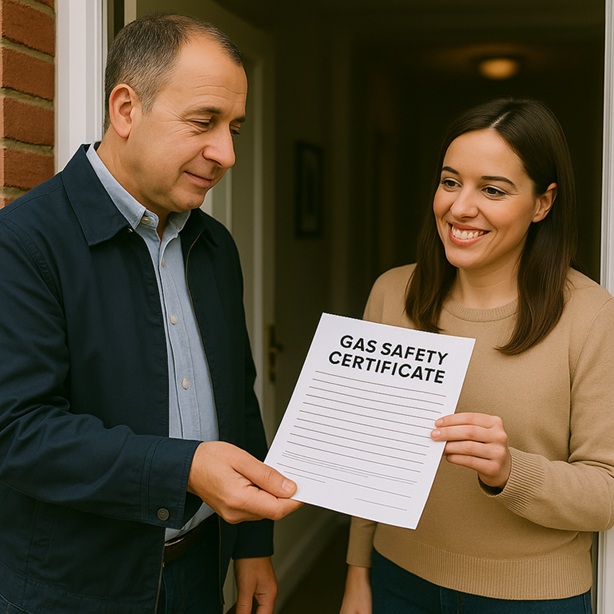
Courts care about proof of service, not assumptions.
If you cannot demonstrate:
- Email delivery
- WhatsApp message
- Signed tenancy pack
- Agent confirmation
- Digital copy shared through a platform
Then ❌ your Section 21 claim is vulnerable to challenge, delay, or dismissal. Weak proof of service can make a possession claim much harder to rely on.
Before you rely on that notice
Find the gaps in your compliance evidence before a tenant's solicitor does.
A missing, expired or late-served gas certificate is exactly what weakens a possession claim. Run a free check across your properties and see, per property, what's current, what's expiring, and where your evidence gaps are. No signup, no documents to upload, just your dates.
Free self-assessment. No account, no card, no upload — takes under a minute.
How Courts Approach Transitional Section 21 Cases and Gas Safety
Judges generally ask:
- Did the landlord actually have a valid CP12 at the relevant times?
- Did the landlord give the certificate to the tenant?
- Can the landlord prove they gave it?
- Has the landlord shown consistent compliance overall?
- Is the notice still within the transitional court-use window?
A landlord who:
- Keeps good digital records
- Tracks expiries
- Shares certificates promptly
- Uses the same engineer each year
- Has a continuous chain of CP12s
…is far more likely to be seen as acting responsibly.
A landlord who:
- Has gaps
- Cannot find certificates
- Can’t prove service
- Replaces a missing CP12 only at eviction time
- Leaves the claim too late under the transition rules
…is far more likely to have their Section 21 claim rejected or delayed.
The government’s guidance for pre-May 2026 possession also makes clear that landlords should be ready to show the court that notice was served correctly and keep records for the claim. In practice, that same evidence-minded approach helps when proving that documents such as the gas safety certificate were actually given to the tenant.
Best Practices to Protect Your Position
To reduce possession risk, follow these rules:
- Give the initial CP12 before or at move-in where required
- Send each renewal within 28 days of the check
- Keep certificates digitally and backed up
- Keep a continuous chain of CP12s
- Store proof you gave the certificate to the tenant
- Document “reasonable steps” if access is refused
- Book checks 1–2 months before expiry
- Do not leave a transitional Section 21 claim until the deadline is close
If you’re not sure what a CP12 actually covers or what the engineer checks during the visit, our guide to CP12 Costs and Gas Safety Check Steps walks through the process in detail.
For official guidance on pre-1 May 2026 notices and transitional time limits, see GOV.UK: Giving notice of possession before 1 May 2026. For the new process after that date, see GOV.UK: Repossessing your property after 1 May 2026, or our guide to gas safety and possession under the current rules.
Evidence checklist
Before relying on a possession claim, check you can prove the paperwork trail.
For gas safety evidence, make sure you can quickly find:
- The original CP12 certificate for the tenancy
- Each annual renewal certificate
- Proof the tenant received each certificate
- Any emails, WhatsApp messages, agent confirmations, or signed tenancy pack records
- Evidence of access attempts if the tenant delayed or refused entry
CertNudge keeps this evidence organised by property and turns it into an inspection-ready pack you can produce on demand — so you're not rebuilding the timeline after a dispute has already started.
Free 14-day trial. No card required.
Common Myths About Gas Safety and Section 21 (Debunked)
❌ “If the certificate is late, Section 21 is dead forever.”
Not necessarily. Trecarrell rejected that absolute approach, although late service can still create real litigation risk.
❌ “If the tenant already lives there, the initial CP12 doesn’t matter.”
Incorrect — the initial certificate can be one of the most important issues in the whole case.
❌ “As long as I show the certificate now, I’m fine.”
Not necessarily. Timing, proof of service and the wider paperwork trail still matter.
❌ “Section 21 is still available after 1 May 2026.”
No. In England, landlords can no longer serve a new Section 21 notice on or after that date.
❌ “Digital CP12s aren’t accepted.”
They can be perfectly valid — provided you can prove what was sent, when, and to whom.
May 2026 FAQ
Can I still serve a new Section 21 notice after 1 May 2026?
No. In England, landlords can no longer serve a new Section 21 notice on or after 1 May 2026. Possession now usually starts with a section 8 notice using the updated process and grounds.
What if I served my Section 21 notice before 1 May 2026?
You may still be able to rely on it, but only within the transition rules. GOV.UK says court proceedings must start by the earlier of the time left on the notice or 31 July 2026. If the earliest date that possession proceedings can begin in the notice is on or after 1 August 2026, the notice is invalid for issuing proceedings.
Does gas safety still matter after Section 21 ends?
Yes. Gas safety duties still apply. What changed on 1 May 2026 is the possession route: landlords can no longer rely on a new Section 21 and must instead use the Section 8 process, usually with Form 3A, and prove a valid possession ground. Our guide to how gas safety affects possession in England now covers that in full.
Final Reminder for Transitional Cases: This Is About Proof, Timing and Evidence
In transitional Section 21 cases, landlords often run into trouble not only because of the gas safety record itself, but because they cannot prove when it was given, whether the notice timing still works, or whether the paperwork is consistent enough to survive challenge.
For full legal context on possession claims, refer to the Housing Act 1988.
Keep clean digital records. Share certificates promptly. Maintain a continuous chain of CP12s.
Doing these three things protects:
- Your tenants’ safety
- Your legal compliance
- Your ability to pursue possession effectively where the law allows it
You can also learn what happens when checks are missed in our detailed guide to Gas Safety Fines and Penalties for Landlords.
Important: This article is for general information only and is not legal advice.
Always seek independent legal advice or consult a specialist before starting a possession claim or relying on a Section 21 notice.
Updated for the Section 21 changes that took effect on 1 May 2026. in England.