
Section 13 Rent Increases After 1 May 2026: Guide for Landlords in England
How section 13 rent increases work in England after 1 May 2026, including Form 4A, the 52-week and 53-week timing rules, 2 months’ notice, transitional Form 4 cases, and the evidence landlords should keep.
Note for readers before 1 May 2026: The rules explained below take effect on 1 May 2026. If you are reading before that date, Form 4A is not yet a live form and the post-1 May 2026 section 13 process described here is not yet in force.
Key takeaways
- From 1 May 2026, private rented tenancies in England move onto the new assured periodic model, and post-commencement rent increases in scope must use the section 13 process with Form 4A.
- A landlord can usually increase rent only after at least 52 weeks, with a 53-week edge case in some cases to stop dates drifting earlier each year. The first increase cannot start until 52 weeks after the tenancy began, and the notice must give at least 2 months’ notice.
- Treat a rent increase as an evidence workflow, not just a form-filling task: keep the dated notice, proof of service, market comparables, and a record of the lawful start date.
- If a Form 4 notice was served before 1 May 2026, that notice can still remain effective after that date, so landlords need to keep post-1 May notices separate from pre-1 May transitional notices.
- For post-1 May 2026 Form 4A cases, tribunal risk is different from the old regime: the final rent should not exceed the amount proposed, and any increase should run from the tribunal’s decision date rather than being backdated. Transitional Form 4 notices served before 1 May 2026 keep the older tribunal risk.
From 1 May 2026, landlords in England’s private rented sector must use the statutory section 13 process and Form 4A for rent increases in scope. That means checking the lawful date, giving at least 2 months’ notice, and keeping evidence of the figure and service.
This guide explains how section 13 rent increases work after 1 May 2026, including the timing rules, Form 4A, market-rent evidence, transitional Form 4 notices, and tribunal risk if a tenant challenges the increase.

Who the section 13 rent increase rules apply to in England
This article is for landlords and letting agents dealing with private rented sector tenancies in England on or after 1 May 2026. These rules are England-only; Wales, Scotland and Northern Ireland have different rent increase rules. On that date, existing tenancy agreements that had an end date move into the new assured periodic structure, so the old fixed-term framing no longer works in the same way. If you want a wider overview of the reform package, see our Renters’ Rights Act 2026 compliance audit and our guide to the Renters’ Rights Act Information Sheet 2026.
The key practical point is this: for new rent increases after 1 May 2026, landlords should not default to old rent review wording in the tenancy agreement. Under the post-1 May 2026 regime, rent increases in scope must instead use the statutory section 13 process under the Housing Act 1988, as amended by the Renters’ Rights Act 2025, and the prescribed form for England’s private rented sector is Form 4A.
Not in scope? If you are dealing with social housing or another specialist regime, stop and check the separate process before serving anything. Form 4A is the private rented sector form for England, not a universal rent increase notice.
What changed on 1 May 2026
For post-1 May 2026 private rented cases in England, the core rule set is clearer than before, but only if landlords follow it in the right order.
- Rent increases are limited to once a year.
- Rent cannot be increased in the first year of the tenancy.
- The landlord must use Form 4A.
- The notice must give at least 2 months’ notice.
- Landlords must use the section 13 process every time, even if the tenant has already agreed the increase in conversation or by message.
The other change that matters is the market-rent focus. The figure should reflect what the property could reasonably achieve on the open market. For a landlord with one terrace in Sheffield, this is no longer just an admin step. It is a compliance step with an evidence file attached.
Tip: The stronger your market-rent file, the stronger your position if the tenant challenges the increase. A weak figure creates avoidable tribunal risk.
Section 13 notice workflow after 1 May 2026
1) Check the tenancy and jurisdiction are actually in scope
Start with the basics. Confirm the property is in England and you are dealing with the private rented sector. If you manage a standard buy-to-let flat in Birmingham, this article is likely on point. If you are dealing with a social tenancy, pause and check the correct route before drafting any notice.
2) Calculate the earliest lawful new-rent date before you touch the form
The timing rule is not just “12 calendar months”. Form 4A makes clear that the first increase cannot start until 52 weeks after the tenancy began. In most cases, any further increase must also be at least 52 weeks after the previous increase. There is then a 53-week edge case where the landlord must wait an extra week if the proposed date would otherwise fall more than 6 days before the anniversary of the earlier increase date.
That catches landlords out. A landlord who raised the rent on 1 November 2025 does not get a fresh start on 1 May 2026. The annual interval still looks back to the last increase that took effect, including an increase before 1 May 2026 or one made under a rent review clause.
Worked example: if a monthly tenancy began on 15 August 2025 and each tenancy period runs from the 15th of the month, the first increase cannot start until at least 52 weeks later. The first usable tenancy-period start date is therefore 15 August 2026. To start the new rent on that date, the landlord would need to serve Form 4A at least 2 months earlier.
3) Check whether you are still inside the first year of the tenancy
Government guidance and the Form 4A notes point the same way: a landlord cannot increase rent in the first year of the tenancy. In practical terms, the proposed start date for the new rent must be at least 52 weeks after the tenancy began.
If a tenancy began on 15 August 2025, the first lawful post-commencement increase is not simply “any time after 1 May 2026”. You still need to count forward and check the exact date.
4) Build your market-rent file before you fill in Form 4A
The proposed rent should be in line with the open-market rent. In landlord terms, you should be able to explain why the figure reflects what a new letting would realistically achieve in that area for a similar property.
A sensible file for a landlord with a two-bed flat in Nottingham would usually include:
- 3 to 5 comparable listings from nearby properties of similar size, condition and location
- notes on differences such as parking, furnishing, refurbishment level, or garden access
- any stronger local evidence you have of recently agreed rents
- a short note explaining why your proposed figure sits where it does in the range
Focus on genuinely similar nearby properties. GOV.UK’s tribunal guidance says information from letting agents or websites such as Rightmove and Zoopla can help, but evidence from actual agreed lettings is stronger.
Do this before service. If the number is weak, the notice is weak.
5) Use the correct form: Form 4A for post-1 May 2026 private rented cases
For post-1 May 2026 rent increases in the England private rented sector, the correct statutory notice is Form 4A. The form notes make clear that the proposed start date must satisfy three tests: it must give at least 2 months’ notice, it must comply with the 52-week or 53-week timing rule, and it must fall at the start of a tenancy period.
Before you start, have these details ready:
- the tenant’s name and the property address
- the current rent, the tenancy start date, and the date the most recent increase took effect
- the proposed new rent and proposed start date
- the landlord or agent contact details
- the service method you will use and the evidence you will keep
Warning: This article explains the post-1 May 2026 process. If you are reading before that date, Form 4A is not yet a usable live form. GOV.UK says preview versions should not be filled in or sent, and usable versions are published on the assured tenancy forms page on and after 1 May 2026.
If you get the form, start date or notice period wrong, do not treat it as a minor admin issue. Form 4A itself says tenants can refer the notice to the tribunal if they believe there is another problem with it, including too little notice. In practice, a date error can create delay and re-service risk.
6) Serve the section 13 notice in a permitted way
Current guidance says landlords can give notice in person, by post, or by email if email service is allowed by the tenancy agreement. If your tenancy terms do not allow email service, do not assume email alone is enough.
If the agreement is silent on email, default to personal service or first class post and keep your proof of posting.
7) Log proof of service immediately
Do not leave the evidence trail until later. Keep:
- the final dated Form 4A that was served
- proof of posting, hand delivery note, or email record
- the email attachments if email service was used
- a short note recording who served it, when, and by which method
- the tenancy clause permitting email service, if email was your method
This is the kind of routine admin step that becomes valuable very quickly if a tenant later says they never received the notice.
8) Monitor the tenant challenge window
A tenant can apply to the First-tier Tribunal (Property Chamber) if they think the proposed rent is above market. The tribunal application must be made before the new-rent start date given in the notice. That period between service and the proposed start date is not dead time. It is the challenge window.
9) Implement the increase only from the lawful start date
The notice is not permission to charge the new rent early. The increase should only be applied from the lawful start date in the notice, subject to any challenge or tribunal outcome. This is a common admin slip where standing orders, rent ledgers, or software settings are changed too soon.
10) Record the next eligible review date now
Once the increase takes effect, record the next date when a further increase could even be considered. In practice, that means tracking the 52-week rule and checking for the 53-week edge case so you do not drift too far ahead of the annual anniversary.
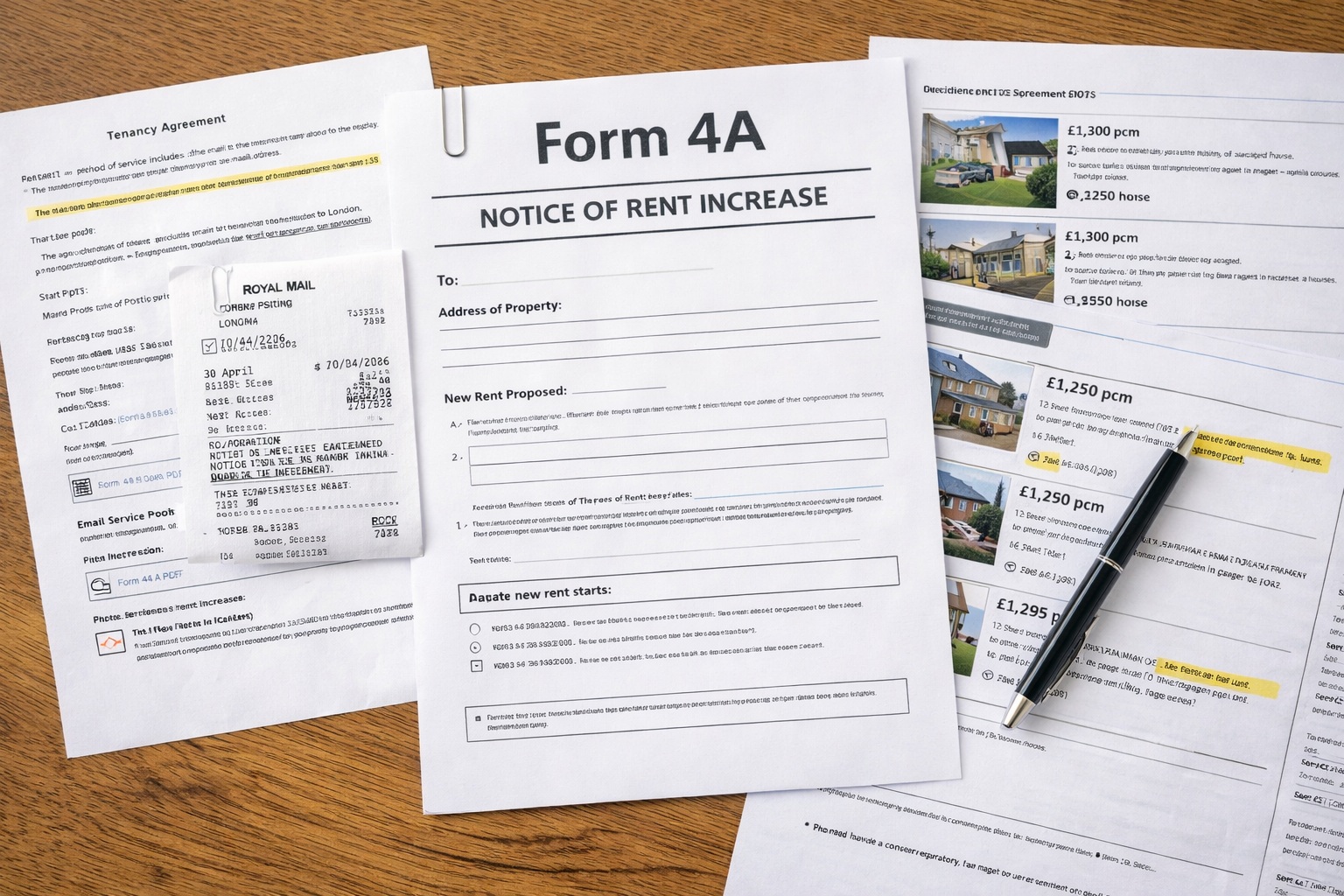
Evidence checklist: what landlords should keep
The legal rule is the notice. The practical protection is the file behind it. For a wider property-level evidence routine, see our guide to what certificates landlords need.
A sensible rent increase evidence pack would usually contain:
- the tenancy agreement and any clause permitting email service
- a dated copy of the completed Form 4A
- proof of post, hand delivery note, or sent email record
- market evidence collected before service
- a note of the last increase effective date
- a rent ledger or diary note showing the new-rent start date
- any later correspondence about the notice or a challenge
Practical tip: Keep the date logic in the file as well, not just the final notice. A short internal note showing how you calculated the earliest lawful start date can save time if the increase is ever challenged.
Rent increase notice before 1 May 2026: transitional Form 4 cases
Transitional warning: If you served Form 4 before 1 May 2026, do not automatically treat that case as a normal post-1 May Form 4A increase. The old notice can still remain effective after commencement, and the tribunal risk is different.
If you gave your tenant notice of a rent increase using Form 4 before 1 May 2026, government guidance says the increase can still apply even if the new rent starts after that date. The minimum notice periods in Form 4 still apply. This is why landlords should keep post-1 May Form 4A cases separate from pre-1 May Form 4 transitional notices.
Two further transitional points matter:
- You still cannot increase the rent until at least a year after the last increase took effect, including where that earlier increase was made using Form 4 or under a term in the tenancy agreement.
- If a rent increase was agreed before 1 May 2026 under a rent review clause but would only take effect after 1 May 2026, that increase will not apply.
So if a landlord relied on a tenancy rent review clause in April 2026 and expected the increase to bite in June 2026, that is exactly the kind of scenario that needs careful checking rather than assumption.
Tenant challenge and tribunal risk after 1 May 2026
At a high level, the tenant challenge route is simple. If a tenant thinks the proposed increase is above market, they can ask the tribunal to determine the open-market rent. The safest landlord assumption is that the number in your notice should already be one you can defend calmly with comparables and clear date logic.
For post-1 May 2026 Form 4A cases, the form notes say the tribunal may decide that the market rent is higher or lower than the amount the landlord proposed. However, the tenant cannot be required to pay more than the rent first proposed, and does not have to pay the new rent until the tribunal has made its decision.
That protection is specific to post-1 May 2026 Form 4A cases. Do not carry it across to older Form 4 notices served before 1 May 2026, because the transitional tribunal position is different.
For transitional Form 4 notices served before 1 May 2026, the older position still matters. Government guidance says the tribunal can set a rent that is the same, higher, or lower than the amount proposed in Form 4, and can require the new rent to be paid from the date in the section 13 notice, subject to hardship delay.
Why this matters operationally: in a post-1 May Form 4A case, the landlord should not assume the tribunal will rescue an aggressive figure. In a transitional Form 4 case, the older downside risk still sits there. Keep the two routes separate in your records and workflow.
Common landlord mistakes after 1 May 2026
A common mistake is using the right legal label but the wrong practical process. A landlord says “this is a section 13 increase” but sends only an informal email, never uses Form 4A, and keeps no proof of service.
Another is missing the annual interval. The 1 May 2026 reform date does not restart the clock. The timing still looks back to the last increase taking effect.
The third is weak market evidence. “My costs have gone up” may explain the commercial pressure, but it does not by itself prove the proposed rent matches the open market.
A fourth is treating transitional Form 4 notices and post-1 May Form 4A notices as if they carry the same tribunal risk. They do not.
FAQs
How often can a landlord increase rent after 1 May 2026?
Usually once a year. More precisely, the first increase cannot start until 52 weeks after the tenancy began, and later increases must normally be at least 52 weeks apart, subject to the 53-week edge case built into Form 4A.
Does section 13 require 2 months’ notice?
Yes. For post-1 May 2026 private rented cases in England, the landlord must give at least 2 months’ notice using the prescribed process and form.
Can I increase the rent if the tenant agrees?
For post-1 May 2026 cases in scope, you should still use the section 13 process. Agreement does not remove the need to follow the formal notice route.
What if I already served notice in April 2026?
If you served Form 4 before 1 May 2026, that notice can still remain effective after 1 May 2026. Treat it as a transitional case, not as an ordinary Form 4A increase.
Can the tribunal set a different rent?
Yes. In a post-1 May 2026 Form 4A case, the tribunal can decide the market rent is higher or lower than the figure proposed, but the tenant cannot be required to pay more than the amount first proposed and does not pay the new rent until the tribunal has decided. The tenant's application must be made before the new-rent start date given in the notice. After that date, the right to refer lapses. In a transitional Form 4 case, the older risk remains: the tribunal can set the rent higher, the same, or lower and may require it from the notice date, subject to hardship delay.
What proof should I keep for a Form 4A rent increase?
Keep the completed notice, proof of service, the tenancy clause you relied on for service, your market comparables, and a dated record of the last increase taking effect. If challenged, that file matters more than memory.
Keep the rent increase file, not just the rent increase number
If you want one place to keep the notice, service proof, comparables, and key compliance records together, CertNudge helps landlords stay organised and evidence-ready.
This article is for general information only and is not legal advice. Regulations change, and individual facts matter. Always check the latest guidance on GOV.UK or speak to a qualified professional.
Last reviewed: 21 April 2026
Next review recommended: 31 May 2026