Selling a Tenanted Property: Documents to Prepare Before Sale
Selling a tenanted property in England? Learn which compliance documents the buyer’s solicitor may request, when to gather them, and what commonly delays completion.
Selling a tenanted property in England means the buyer takes over the existing tenancy, so your compliance documents and tenancy paperwork need to be in order before exchange. A buyer’s solicitor will usually ask for the tenancy agreement, deposit paperwork, gas safety record, EICR, EPC and post-May 2026 Renters’ Rights Act service evidence as part of the conveyancing pack.
This guide shows what to gather, when to gather it, and how to avoid document-related completion delays when selling property with sitting tenants.
Direct answer: Yes — you can sell a tenanted property in England. If you sell with the tenant in situ, the existing tenancy transfers to the buyer on completion. Since 1 May 2026, that tenancy will usually be an assured periodic tenancy under the Renters’ Rights Act 2025. The buyer’s solicitor will typically request compliance and tenancy evidence before exchange.
This article focuses on compliance documents, tenancy paperwork and conveyancing evidence only. For decisions about possession routes, sale price impact, tax or contract negotiation, speak to a solicitor, conveyancer or accountant.
England only: This guide covers private rented property in England. Scotland, Wales and Northern Ireland have separate tenancy and compliance regimes.
Key takeaways
- The buyer’s solicitor will usually request a bundle of compliance records, but the exact list varies by transaction.
- Since 1 May 2026, most existing private assured and assured shorthold tenancies in England have moved into the new assured periodic tenancy regime.
- Deposit transfer should be agreed through the relevant scheme and conveyancers before completion.
- Gas safety renewals can be quick, but an EICR with remedial work can take several weeks.
- This guide covers compliance documents only, not legal strategy on possession or sale negotiation.
Important: This article is for general information only and is not legal advice. Regulations change and individual circumstances vary, always check the latest guidance at GOV.UK or speak to a qualified housing professional or solicitor.

What’s different when selling property with sitting tenants?
Selling with a tenant in situ means the existing tenancy transfers to the buyer on completion. The buyer steps into your shoes as landlord. The tenancy, the deposit, the obligations and the paperwork all carry over. That changes what the buyer’s solicitor wants to see, and it changes what good record-keeping looks like.
The May 2026 reforms changed the shape of what the buyer is taking on. Since 1 May 2026, almost all existing assured and assured shorthold tenancies in England have converted to assured periodic tenancies under the Renters’ Rights Act 2025. The buyer is not inheriting a fixed-term AST that ends in nine months. They are inheriting a periodic tenancy with no fixed end date.
If the buyer later wants landlord-led possession, they will usually need to rely on the updated Section 8 grounds, unless the tenant leaves by notice or agreement. New Section 21 notices can no longer be served, although a small number of transitional cases may still exist where a valid Section 21 notice was served before 1 May 2026 and court proceedings are started within the permitted deadline, no later than 31 July 2026. For the wider picture, see our Section 21 ban guide.
This is not bad news for the sale. It is information the buyer’s solicitor will want documented. The cleaner your tenancy record, agreement, deposit, rent history, notices served then the smaller the perceived risk and the smoother the exchange.
Example: A Sheffield landlord with five properties is selling one to fund renovations on the others. The buyer’s solicitor asks for full compliance history. The gas safety certificate is in an old email; the EICR is somewhere on a laptop that was replaced last year. By the time he tracks everything down and chases a fresh copy from the electrician, ten days have come off the completion timeline.
That ten-day slip is the everyday cost of disorganised records. Avoidable, but only if you start before the buyer’s solicitor sends the enquiry list.
What the buyer’s solicitor is actually looking for
The buyer’s solicitor’s job is to confirm three things: the property is lawful to let, compliance is current, and the tenancy is properly documented. Most of that is established through the common conveyancing forms used in residential transactions: TA6 for property information, TA7 for leasehold information where applicable, and TA10 for fittings and contents. When a tenant is in situ, those forms are joined by a request for the underlying compliance evidence.
In practical terms, the solicitor will want to see that gas safety, electrical safety and energy performance are documented and current. They will want the tenancy agreement and any variations. They will want the deposit paperwork, protection certificate, prescribed information and scheme reference and they will want it to match the current tenant and the current landlord. For more on this, see our tenancy deposit protection checklist.
They will also want evidence that the tenant received the prescribed documents, including the relevant How to Rent guide and deposit information at the correct time.
Where the tenancy pre-dates the Renters’ Rights Act and was wholly or partly in writing, they may also want evidence that the Renters’ Rights Act Information Sheet 2026 was served by 31 May 2026. For any pre-1 May 2026 tenancy based entirely on a verbal agreement, written information about the key tenancy terms should have been provided by the same deadline instead.
Section 13 rent increases are another area of enquiry where applicable. If you have increased the rent since 1 May 2026, or are part-way through a Section 13 process, the solicitor will typically want the notice, the date served and any tribunal correspondence. Where the rent has not been varied since the tenancy began, this part of the file may be very short. Our Section 13 rent increases guide covers the paperwork in more detail.
Rent records can also matter. If completion does not fall exactly on a rent payment date, the conveyancers may need to account for rent apportionment on the completion statement. If the tenant is in arrears, the buyer’s solicitor may ask for a clear rent ledger and confirmation of how any arrears will be treated as part of the sale. This is a conveyancing point, not something CertNudge can decide for you.
Deposit transfer is the area where small paperwork problems become big delays. The deposit does not automatically move just because the property has changed hands. Under GOV.UK deposit protection rules, a landlord who receives a tenancy deposit must protect it in an authorised scheme within 30 days and give the tenant the required prescribed information. In a sale, the buyer’s conveyancer, the seller’s conveyancer and the deposit scheme should agree how the deposit will be transferred, re-protected or otherwise dealt with before completion.
The mechanism varies by scheme; DPS, MyDeposits or TDS and may involve transfer between scheme accounts, refund and re-take, release with tenant consent, or another scheme-specific route. If the buyer uses a different deposit scheme to you, do not assume the funds can be moved directly. Confirm the route with the scheme before exchange.
Example: A Birmingham landlord assumed her deposit paperwork was fine. Her buyer’s solicitor flagged that the prescribed information had last been reissued in 2019 and did not name the current tenant. The defect was technical; the delay was real. Exchange slipped by two weeks while she liaised with the scheme to correct it.
None of this is a comment on whether you should sell with a tenant in place, take possession first, or negotiate something else with the buyer. Those decisions need a solicitor and depend on your circumstances. What this section describes is the compliance evidence any of those routes will eventually require.
When to start gathering documents
The single biggest predictor of a smooth completion is how early you audit your compliance records. The window that works best for most portfolio landlords runs from twelve weeks before listing to the day exchange is confirmed. Earlier than that and the records can drift again; later than that and there may be no time to renew anything that has expired.
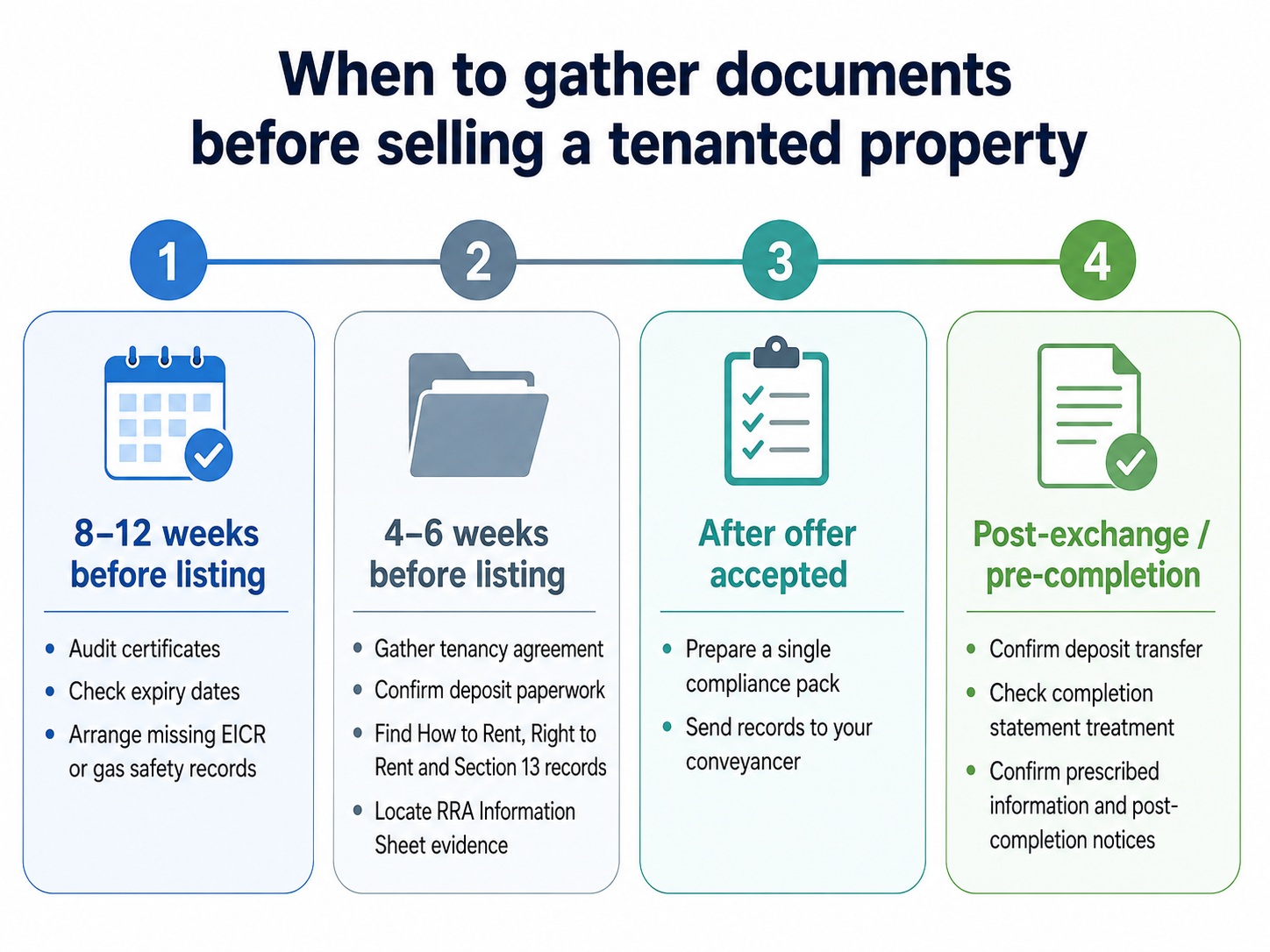
8 to 12 weeks before listing
Pull every compliance record for the property into one place and check the expiry dates. The legal requirement on gas safety is the annual landlord check; “in date at exchange” is not a statutory trigger, but it is a common buyer’s-solicitor expectation. As a practical preference, most buyer’s solicitors would rather not see a certificate that expires within weeks of completion, so a fresh check close to exchange is usually worth considering.
EICRs run on a five-year cycle and are the records most likely to surprise you. Arranging a fresh inspection plus any remedial work can take three to four weeks. EPCs are valid for ten years, but the band matters. If the property is below band C, you may want to flag the 2030 MEES horizon proactively rather than wait for the buyer’s solicitor to raise it. Recover any documents still held by a letting agent at this stage; our letting agent handover checklist sets out what to ask for.
4 to 6 weeks before listing
Pull together the tenancy paperwork: the original tenancy agreement, any deeds of variation, deposit protection certificate, prescribed information, the version of the How to Rent guide in force when the tenant moved in, Right to Rent check records, and any Section 13 rent increase notices. If the tenancy pre-dates 1 May 2026, locate your evidence that the RRA Information Sheet 2026 was served. Email, signed receipt, recorded delivery, in-app log, whichever form your evidence takes, surface it now.
After an offer is accepted
Build a single bundle for your conveyancer covering everything the buyer’s solicitor is likely to request. One PDF, one upload, one email. The point is that when the enquiry list arrives, your conveyancer can respond the same day rather than coming back to you for documents.
Post-exchange, pre-completion
Confirm the deposit transfer arrangements with the buyer’s solicitor and the relevant scheme. Agree the date, the mechanism, and who serves the new prescribed information on the tenant. Agree who will handle the post-completion tenant notices: under section 3 of the Landlord and Tenant Act 1985 the tenant must be given written notice of the new landlord’s name and address, and an address for service of notices needs to be in place under section 48 of the Landlord and Tenant Act 1987.
This is also the moment to check that the gas safety certificate will still be current at completion. If it expires within a few weeks of the planned date, book a fresh check now rather than discovering the gap on completion day.
Example: A Bristol landlord with three properties started her sale process with a Saturday-morning audit. She found one property’s EICR had expired six months earlier, booked an electrician for the following week, arranged the remedial work, and had the evidence ready before the buyer’s solicitor sent enquiries. The sale completed on the original target date.
The pattern that works is simple: do the audit before the market sees the property, not after.
The exact documents to assemble
This is the practical checklist a buyer’s solicitor in England will typically want when the property is being sold with a tenant in situ. Treat it as a strong baseline rather than an exhaustive list. Every transaction throws up its own particular enquiries, and your conveyancer may add to it.
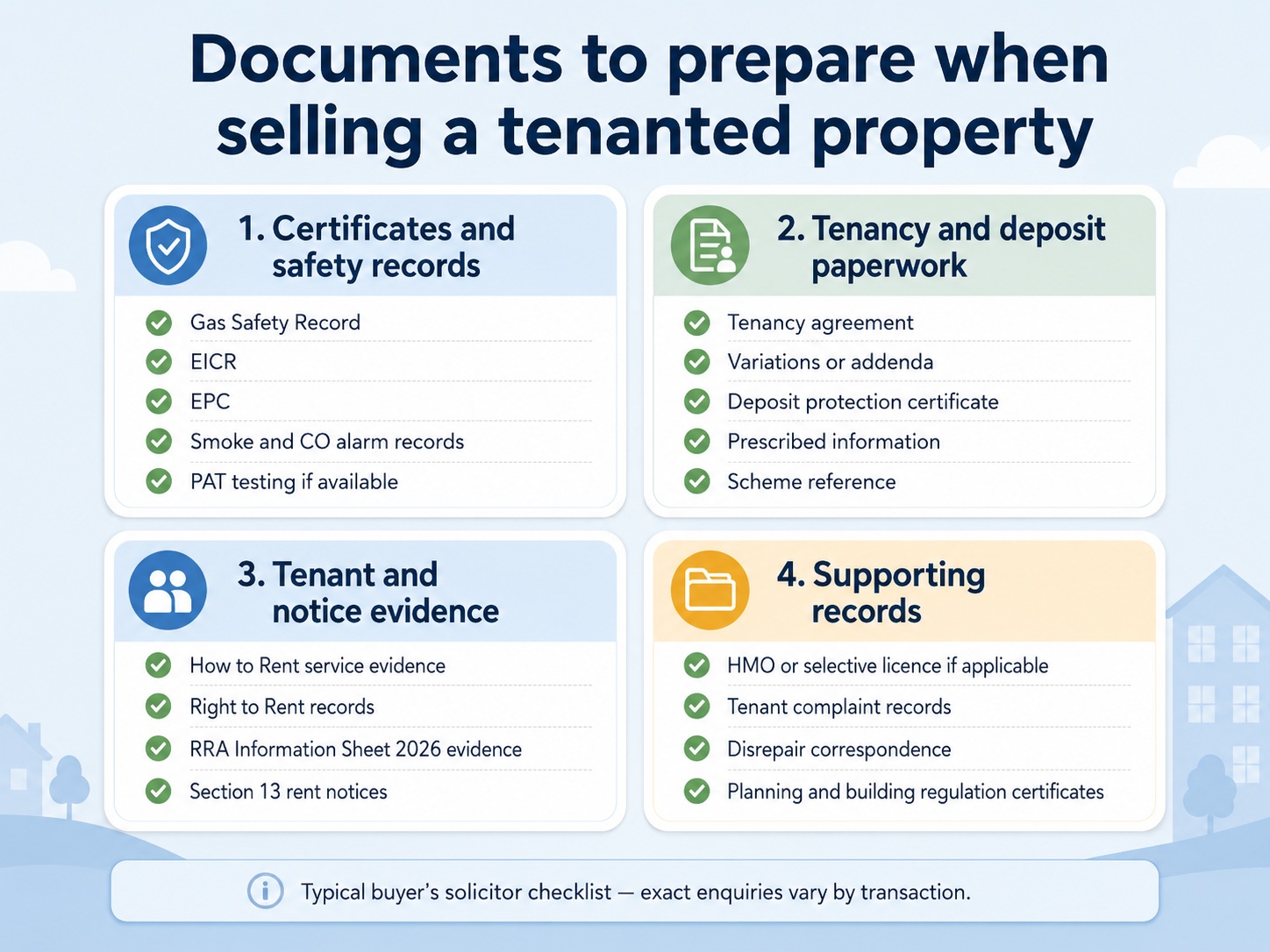
Certificates and inspection records
- Current Landlord Gas Safety Record — commonly known as a CP12. It should be current for the sale; buyer’s solicitors typically query certificates that are close to expiry, although there is no statutory requirement for the record to be in date “at exchange”.
- Current EICR — the Electrical Installation Condition Report, plus evidence of any remedial work and the contractor’s invoice.
- Current EPC — the Energy Performance Certificate and an honest view of the band, given the forthcoming minimum-energy-efficiency rules due to tighten by 2030. See our EPC C 2030 guide.
EPC note: A low EPC rating may become a pricing or due-diligence issue for the buyer, especially with the government’s proposed pathway towards EPC C or equivalent for privately rented properties by 2030. Keep the EPC and any improvement evidence with the sale pack.
- Smoke and carbon monoxide alarm records — installation and test records, ideally supported by a signed tenancy-start inventory.
- PAT testing records, where you have them — PAT testing is not a universal statutory requirement for private lets, but many landlords commission it for furnished properties as a matter of good practice.
- Planning permissions or building regulation certificates for past works.
If a certificate is missing:
- Check whether your letting agent, contractor or previous managing agent holds a copy.
- If it has expired, arrange a renewal before the buyer’s solicitor raises it.
- If remedial work was completed, collect the follow-up report, invoice and any confirmation that the issue was resolved.
- Tell your conveyancer what is missing and what you are doing about it, rather than waiting for the buyer’s solicitor to discover the gap.
Certificates are usually the easiest part of the bundle. They have clear expiry dates, you know whether you have them, and replacing them is a known process. The harder section is the tenancy paperwork, where small defects cause disproportionate delays.
Tenancy and deposit paperwork
- Signed and dated tenancy agreement, plus any variations or addenda.
- Deposit protection certificate, scheme reference number and prescribed information served on the tenant. See our deposit protection checklist.
- How to Rent position on transfer — whether anything further is needed on change of landlord can depend on the tenancy history and transaction details, so ask your conveyancer to confirm.
- Right to Rent check records — the buyer needs to confirm checks were carried out, retain evidence of them, and identify any follow-up checks needed to maintain a statutory excuse against Home Office civil penalties.
- RRA Information Sheet 2026 service evidence — for pre-1 May 2026 tenancies that were wholly or partly in writing. For pre-1 May 2026 tenancies based entirely on a verbal agreement, include evidence that written information about the key tenancy terms was provided by 31 May 2026 instead. See our RRA Information Sheet 2026 guide.
- Any Section 13 rent increase notices and Form 4A documentation. GOV.UK’s assured tenancy forms page provides the latest official forms.
- Council tax and utility correspondence, where you have been the named account holder.
Situational and supporting records
- Any HMO licence, where applicable - see the note on transferability below.
- Any selective licence, where applicable - see the note on transferability below.
- Record of tenant complaints, including damp and mould reports, and how they were handled.
- Disrepair correspondence, where any has arisen.
- Records of how long you have retained the above. See our guide on how long landlords should keep records.
Licensing note: Under section 68(6) of the Housing Act 2004, an HMO licence “may not be transferred to another person”, and the same non-transferability applies to selective licences. If the property is HMO-licensed or sits in a selective licensing area, the buyer’s solicitor needs your current licence to verify the property was being operated lawfully but the buyer cannot inherit it. Whether licensing applies depends on property type and the specific local authority area, so confirm this with the buyer’s conveyancer early.
Want to see what a conveyancer-ready pack can look like?
View a sample compliance pack to see how certificates, tenancy paperwork and supporting records can be organised before the buyer’s solicitor asks for them.
Sample only — not legal advice, certificate verification or a guarantee that a particular conveyancer will accept every document.
Example: A four-property landlord receives the buyer’s enquiry list on a Wednesday afternoon. Every property’s compliance evidence is already stored together, so his pack is assembled and emailed to his conveyancer within an hour. In this illustrative case, the buyer’s solicitor came back the following Monday with no follow-up questions. Outcomes vary by transaction, but the speed of producing the pack is the controllable part.
The compliance pack is not magic. It is the same evidence you would otherwise hunt through email, WhatsApp, Drive folders and a filing cabinet to assemble. The difference is the speed of producing it on demand.
What delays completions?
Most completion delays on tenanted sales come from a small set of recurring problems. Recognising them in advance is the cheapest way to avoid them.
Mistake 1: Assuming the conveyancer will assemble the compliance pack
They will not. The conveyancer’s job is to respond to the buyer’s solicitor’s enquiries with the evidence you provide. If you do not provide it quickly, the response is slow, and the timetable slips.
Mistake 2: Finding an expired certificate during the sale
A new gas safety certificate can usually be arranged within a week. An EICR can be quicker, but if the inspection finds C1 or C2 issues that need remedial work, you may be looking at three to four weeks before you have a satisfactory report. Discovering this after the buyer’s enquiries arrive is one of the most avoidable causes of delay.
Mistake 3: Deposit protection paperwork that does not match reality
The prescribed information must accurately reflect the current tenant and the current landlord. A prescribed information document that names a previous tenant, an old address or an old company structure is a defect the buyer’s solicitor will flag. Correcting it mid-sale takes time and sometimes scheme intervention.
Mistake 4: No evidence of RRA Information Sheet service
For tenancies pre-dating 1 May 2026, the RRA Information Sheet 2026 should have been served by 31 May 2026 where the tenancy was wholly or partly in writing. The buyer’s solicitor may treat absence of service evidence as a transitional-compliance risk. The fix may be straightforward; explaining the gap to a cautious solicitor can take longer.
Mistake 5: Treating the sale and the tenancy as separate
The buyer is purchasing both. The cleaner the tenancy record, fewer ambiguities about notices, rent history, deposit, complaints the smoother the sale. A messy tenancy file is the single biggest brake on a transaction the buyer otherwise wants to complete. For the post-Section 21 landscape your buyer is inheriting, see our Section 21 ban guide.
Example: Three days from exchange, a Manchester landlord was told by her buyer’s solicitor that the gas safety certificate would expire two weeks before completion. She scrambled a new inspection, but the renewal pushed completion back by five days and cost her a removal-deposit chargeback. The certificate itself was not the problem; the timing was.
The pattern across all five mistakes is the same. None of them is hard to fix in isolation. All of them are expensive to fix under transaction time pressure.
Reminder: This article is general information about compliance records, not legal advice on the sale itself. Decisions about possession routes, contract terms or specific solicitor enquiries should go through a qualified conveyancer or housing solicitor.
FAQs about selling a tenanted property in England
Can you sell a tenanted property in England?
Yes. A residential property with a tenant in situ can be sold; the existing tenancy transfers to the new owner on completion. Since 1 May 2026, that tenancy will usually be an assured periodic tenancy under the Renters’ Rights Act 2025 rather than a fixed-term AST. The legal basis sits in the Housing Act 1988 as amended. Whether selling with a tenant in situ or vacant possession is the right approach for you is a question for your solicitor and your circumstances.
Do I need to tell the tenant before I list the property?
There is no statutory requirement to notify the tenant before listing, but practical and contractual obligations apply, quiet enjoyment, the conduct of viewings, and any specific terms in the tenancy agreement. Most landlords notify tenants early to maintain the relationship and to make viewings workable. Approach this as a communication question, not a compliance shortcut.
What if the tenant refuses viewings?
Viewings need to be handled carefully because the tenant still has the right to quiet enjoyment. Check the tenancy agreement, give reasonable notice, and try to agree practical viewing times with the tenant. If access becomes difficult, speak to your conveyancer or solicitor rather than assuming you can enter simply because the property is being sold.
What happens to the deposit when the property is sold?
The new landlord must ensure the deposit remains properly protected and that fresh prescribed information is served on the tenant within the applicable statutory timeframe. Exact transfer mechanics vary by scheme: DPS, MyDeposits and TDS each handle transfers slightly differently, so the buyer’s conveyancer, the seller’s conveyancer and the deposit scheme should agree the mechanism before completion. The money itself is usually accounted for on the conveyancer’s completion statement as a deduction, rather than the seller sending cash directly to the buyer. See GOV.UK deposit protection guidance for the underlying prescribed information rules.
Does the buyer have to honour the existing tenancy?
Yes. When a tenanted property is sold with the tenant in situ, the buyer steps into the landlord position and inherits the tenancy on its existing terms.
Since 1 May 2026, landlord-led possession generally relies on the updated Section 8 grounds under the Housing Act 1988, because Section 21 has been abolished for existing and new private tenancies in England. The tenant can still end the tenancy by giving notice. This is part of why due diligence on the tenancy record matters to the buyer’s solicitor.
How does the May 2026 Renters’ Rights Act affect selling a tenanted property?
There are three practical effects. First, the tenancy the buyer inherits is usually an assured periodic tenancy with no fixed end date, not a fixed-term AST. Second, new Section 21 notices can no longer be served, so future landlord-led possession will generally need to rely on Section 8 grounds. Third, for pre-1 May 2026 tenancies that were wholly or partly in writing, the RRA Information Sheet 2026 should have been served by 31 May 2026 — and for pre-1 May 2026 verbal-only tenancies, written information about the key tenancy terms should have been served by the same deadline. The buyer’s solicitor may request evidence of service. None of these changes makes selling impossible; they raise the value of having clean records.
Inspection-ready records make selling easier to manage
The compliance evidence the buyer’s solicitor will request is the same evidence that helps you respond to council inspections, insurance enquiries, contractor disputes and tenant complaints. An inspection-ready record system pays for itself not because compliance shows up once a year, but because it shows up at every moment of friction in a tenancy or sale.
Landlords who can produce a compliance pack the day the buyer’s enquiries arrive are better placed to avoid document-related delays. Those who cannot — through no fault other than scattered storage — can lose days or weeks chasing certificates that already exist somewhere.
Create your own compliance pack before the buyer’s solicitor asks
CertNudge helps you organise certificates, tenancy evidence and supporting records by property, then generate an inspection-ready PDF pack when you need to share documents with a conveyancer, agent, insurer or council.
Start with one property and build your first pack during the free 14-day trial. No card required.
Last reviewed: 23 May 2026
Next review recommended: 23 September 2026 — the Renters’ Rights Act 2025 transitional period continues through 2026, and detail on deposit transfer mechanics, RRA Information Sheet service evidence and transitional Section 21 cases concluding 31 July 2026 may need refinement as guidance settles. Once the transitional period closes, cadence can drop to six-monthly.