HHSRS Inspection: A Landlord’s Guide for England (2026)
A practical guide to HHSRS inspections in England, covering the 21 hazards, council powers, document checklists and what can happen after inspection.
Key takeaways
- An HHSRS inspection is a risk assessment of housing hazards, not a simple pass or fail.
- From 23 June 2026, councils assess 21 categories of hazard (reduced from 29), including damp and mould, excess cold, fire, electrical hazards and falls.
- A landlord can have current certificates and still face HHSRS action if the property has serious physical hazards.
- The best preparation is a property-specific evidence pack with certificates, repairs, complaint history, photos and tenant communications.
- If you receive an Improvement Notice or formal enforcement notice, get specialist advice quickly because appeal windows are short.
If you have received a council letter about an HHSRS inspection, this guide explains what happens and what you need to have ready. An HHSRS inspection is not a simple pass or fail, it is a risk-based assessment of housing hazards carried out under the Housing Act 2004.
This article is for general information only and is not legal advice. Regulations change and individual circumstances vary. Always check the latest guidance at GOV.UK or speak to a qualified housing professional or solicitor.
A tenant emails about damp in the bedroom. Two weeks later, a letter arrives from the council’s environmental health team saying they want to inspect the property under HHSRS.
That letter can feel serious. It is serious but it is manageable if you understand what the council is assessing and you have your evidence in order.
The Housing Health and Safety Rating System, usually shortened to HHSRS, is the method councils use to assess health and safety risks in residential properties. It is not a certificate. It is not a landlord “pass/fail” test. It looks at hazards in the dwelling and how likely they are to cause harm. GOV.UK describes HHSRS as a risk-based evaluation tool introduced under the Housing Act 2004 to help local authorities identify potential risks and hazards in dwellings.
This guide explains what inspectors look for, how a housing Improvement Notice works, what documents landlords in England should have ready, and what can happen after the inspection.
What is an HHSRS inspection?
What is an HHSRS inspection? An HHSRS (Housing Health and Safety Rating System) inspection is a risk-based assessment a local council carries out under the Housing Act 2004 to identify health and safety hazards in a home. It is not a pass or fail test and not a certificate: an officer assesses how likely each hazard is to cause harm and how serious that harm could be, then scores it as High (Category 1) or Medium/Low (Category 2). Since 23 June 2026, councils assess 21 hazard categories using High, Medium and Low bands.
An HHSRS inspection is usually carried out by an Environmental Health Officer (EHO) or housing standards officer from the local authority. The officer inspects the property, identifies defects or deficiencies, and considers whether those issues could create one or more housing hazards.
A self-managing landlord in Leeds, for example, might receive a letter after a tenant complains about damp around a bedroom window. The landlord may think: “But the gas safety certificate is current, the EICR is current and the EPC exists.” Those records matter, but they do not answer the full HHSRS question. The council is asking whether the property itself presents a risk to health or safety.
HHSRS sits under Part 1 of the Housing Act 2004. GOV.UK guidance says local authority officers look for risks of harm to an actual or potential occupier caused by a deficiency that can give rise to a hazard. The assessment looks at how likely harm is over the next 12 months and how serious that harm could be.
Plain English version: certificates show that specific checks have been done. HHSRS looks more widely at whether the home contains hazards that could harm the occupier.
HMOs are not the focus of this guide, but HHSRS can apply to shared accommodation and common parts. Shared kitchens, bathrooms, stairs, escape routes and overcrowding can affect the likelihood and seriousness of hazards, so HMO landlords should also check the relevant licensing and management rules.
When does an HHSRS inspection happen?
An HHSRS inspection often starts because something has put the property on the council’s radar.
- A tenant complaint about damp, mould, cold, electrical safety, fire safety or disrepair.
- A council inspection linked to selective licensing or property licensing, which may also involve separate compliance checks.
- A wider local authority programme targeting poor housing conditions.
- A complaint from another agency, adviser or third party.
- Evidence that a property may have serious hazards.
Local housing authorities also have investigatory powers under the Renters’ Rights Act 2025 to support investigations into private rented housing where the relevant legislation applies. Current GOV.UK investigatory powers guidance says these can include asking for information, requiring documents and, in some circumstances, entering business or residential premises with the correct authorisation.
Not every power applies to every HHSRS inspection, so landlords should check what statutory power the council is relying on in the letter.
That does not mean every HHSRS visit will be heavy-handed. In many cases, the council will write, arrange access, inspect, and then ask for remedial works or evidence. But it does mean landlords should treat council letters and document requests as formal, time-sensitive correspondence.
For landlords with 3–20 buy-to-let properties, the practical risk is not only the inspection itself. It is the admin gap. If your certificates are in one inbox, repair photos are in WhatsApp, and the tenant complaint history is buried in messages, you may look less organised than you really are.

The 21 HHSRS hazards councils assess
HHSRS covers 21 categories of housing hazard. For inspections commenced on or after 23 June 2026, GOV.UK’s HHSRS operating guidance confirms the system assesses 21 hazard categories (reduced from 29 under the previous rules) and uses weighting to determine whether a property has a Category 1 serious hazard or a Category 2 other hazard.
The hazards sit under four broad groups.
What changed in June 2026: The revised HHSRS reduced the number of hazard categories from 29 to 21 by combining several related hazards and introduced three descriptive score bands: High, Medium and Low. Fire and Explosions are now one combined hazard, but Structural Collapse and Falling Elements remains a separate hazard. The four broad HHSRS groups remain in use.
Protection against accidents
- Falls on the level
- Falling on stairs etc.
- Falling between levels
- Fire and explosions
- Flames, hot surfaces, etc.
- Collisions, entrapment and ergonomics
- Structural collapse and falling elements
- Electrical hazards
Physiological requirements
- Excess cold
- Radiation
- Damp and mould growth
- Lead
- Indoor air pollutants
- Excess heat
- Asbestos and manufactured mineral fibres (MMF)
Protection against infection
- Domestic hygiene
- Water supply
Psychological requirements
- Crowding and space
- Entry by intruders
- Noise
- Lighting and obstructed views
A 1960s mid-terrace with old single glazing, limited insulation and one poorly heated bedroom could score badly for excess cold, even if the gas safety certificate is current. GOV.UK’s HHSRS guidance links excess cold to issues such as low energy efficiency, poor insulation, inefficient heating systems and dampness that reduces thermal insulation.
That is why energy performance and HHSRS exposure are increasingly connected. The government’s 2026 response on PRS energy performance sets out a planned route towards higher minimum energy efficiency standards by 1 October 2030, using new EPC metrics and subject to the necessary legislative process.
Category 1 and Category 2 hazards
The practical distinction is simple.
Category 1 hazard
What it means: A serious hazard — a hazard score of 1,000 or above, which falls in the new "High" band.
Council action: The council must take appropriate enforcement action.
Category 2 hazard
What it means: A lower-scoring hazard — a score under 1,000, which falls in the new "Medium" (100–999) or "Low" (under 100) bands.
Council action: The council may take enforcement action if it considers it necessary.
The Housing Act 2004 says that where a local housing authority considers a Category 1 hazard exists, it must take the appropriate enforcement action. For inspections on or after 23 June 2026, GOV.UK’s HHSRS guidance replaced the old A–J letter bands with three bands: High (score 1,000 or above), Medium (100–999) and Low (under 100). The Category 1 threshold is unchanged at 1,000, so a High-band hazard is Category 1, while Medium and Low band hazards are Category 2.
Do not get too hung up on the maths. The landlord’s job is not to calculate the HHSRS score. The landlord’s job is to understand the risk, fix genuine hazards, and keep evidence of what has been inspected, repaired, tested and communicated.
Important: HHSRS is not a “certificate compliance” system. A current gas safety certificate, EICR and EPC are essential records, but they do not automatically remove risks from damp, cold, trip hazards, defective stairs, poor ventilation or inadequate fire escape routes.
Received an HHSRS inspection letter? What to do next
The first rule is calm: do not ignore the letter, but do not assume the worst.
A landlord with three flats in Newcastle might receive seven days’ notice of an inspection after a damp complaint. In those seven days, the useful work is not arguing with the tenant or writing long defensive emails. The useful work is to understand the council’s request, arrange access properly, check obvious issues and prepare the evidence.
Day 1: read the letter properly
Check:
- which council department has written to you
- the property address
- the inspection date and time
- what powers or legislation are mentioned
- whether they are asking for documents before or after the visit
- whether the tenant, landlord or agent is expected to provide access
If the letter is unclear, ask the council to confirm what they need. Keep the tone cooperative and factual.
The notice rules depend on the statutory power being used. Under section 239 of the Housing Act 2004 as amended by the Renters’ Rights Act 2025, occupiers of qualifying residential premises will generally be entitled to at least 24 hours’ prior notice unless that right is validly waived. The owner no longer necessarily receives 24 hours’ prior notice under that route and may instead have to be notified within a reasonable period after entry. Separate Renters’ Rights Act investigatory powers have their own authorisation, notice and warrant rules, so check the council’s letter and the specific power being used.
Days 2–3: arrange access and notify the tenant
Most HHSRS inspections involve the tenant’s home, so access needs handling carefully. Confirm the appointment with the tenant and council. If you cannot attend, nominate someone sensible who understands the property and can take notes.
Do not pressure the tenant. Do not suggest they should hide issues. If the tenant has raised a genuine concern, the best response is to show that it is being investigated and dealt with.
Note: This is an illustrative example only. Adapt it to the tenancy, the issue and the inspection request, and take professional advice where the situation is contentious.
Example tenant message
“The council has asked to inspect the property on [date] at [time] following the concern raised. Please confirm whether this appointment is suitable. I will cooperate with the council and will keep a record of any works or follow-up actions needed after the visit.”
If the tenant refuses access, do not force entry, threaten the tenant or let yourself in unless you have a clear legal right to do so. Keep a written record of access requests, offer reasonable alternative times, and tell the council promptly if access is being blocked. The council has its own statutory routes where inspection is justified, but a landlord should not try to solve a council access issue by taking shortcuts with the tenant.
Day 4: gather your records
Pull together the property file before the visit. That includes safety certificates, recent repair records, evidence of contractor visits, complaint history and photos.
If a letting agent previously managed the property and you are missing records, request them immediately. This is where a structured handover matters. Read the CertNudge guide to letting agent handover documents and certificates.
Days 5–7: deal with obvious gaps
If there is visible mould, a leaking gutter, a broken extractor fan, missing alarm evidence or a loose stair rail, act quickly. Do not dress it up. Fix what can be fixed, book what needs a contractor, and keep written evidence.
That evidence might include:
- contractor booking confirmations
- invoices
- dated photos before and after
- tenant messages confirming access
- notes of phone calls
- emails to the council explaining what is already in hand
GOV.UK’s HHSRS landlord guidance suggests a practical process of inspecting the property, recording deficiencies, deciding remedial action, recording the programme of works, recording completion dates and reviewing whether hazards have been removed or minimised.
Day of inspection: be organised and factual
Have the records ready. Walk the officer through what has been done and what is booked. If you disagree with something, make a note and ask for clarification rather than debating on the doorstep.
For the Newcastle landlord, a good outcome is not “convincing the inspector everything is fine”. A good outcome is being able to say: “Here are the current certificates, here is the repair history, here are the damp reports, here is the contractor booking, and here is what we have told the tenant.”
HHSRS inspection documents landlords should have ready
An HHSRS inspection is about hazards, not paperwork alone. But paperwork helps you show what has been maintained, tested, investigated and communicated.
A five-property landlord might have gas safety certificates in email, EICRs in Dropbox, EPCs in a desk drawer and repair photos in WhatsApp. When the council asks for documents within 14 days, the records may exist — but the landlord still loses a Saturday trying to find them.
Not sure your certificates are all current before a council asks? Run CertNudge’s free compliance check to see which of your properties have missing or expiring certificates — no upload, just your dates.
Use this checklist as your starting point.
Current gas safety certificate / CP12
Helps evidence annual gas safety checks for landlord-provided gas appliances and flues where the statutory gas-safety duty applies.
Current EICR
Supports electrical safety evidence. See the CertNudge guide to EICR rules for landlords in England.
Evidence of EICR remedial works
Shows that C1, C2 or FI outcomes were acted on where relevant.
Current EPC
Helps evidence the property’s energy position, especially where excess cold is raised.
Boiler service records
Useful where heating performance, carbon monoxide or excess cold is relevant.
Smoke alarm and CO alarm records
Shows installation and testing history.
Signed inventory or check-in report
Can evidence alarms, property condition and visible issues at tenancy start.
Tenancy agreement
Helps establish responsibilities, parties and tenancy dates.
Damp and mould complaint records
Shows when the issue was reported, what was investigated and what action followed.
Contractor invoices and repair notes
Shows practical action, not just promises.
Dated photos before and after works
Helps evidence condition, investigation and completion.
Tenant communications
Shows access requests, updates and response times.
For record retention, read the CertNudge guide to how long landlords should keep records.
The distinction matters: some documents are legal requirements, such as gas safety certificates where gas is installed and EICRs for private rented sector electrical safety. Others are best-practice evidence, such as dated photos, service logs, repair notes and complaint timelines. Both matter during a council inspection, but they do different jobs.
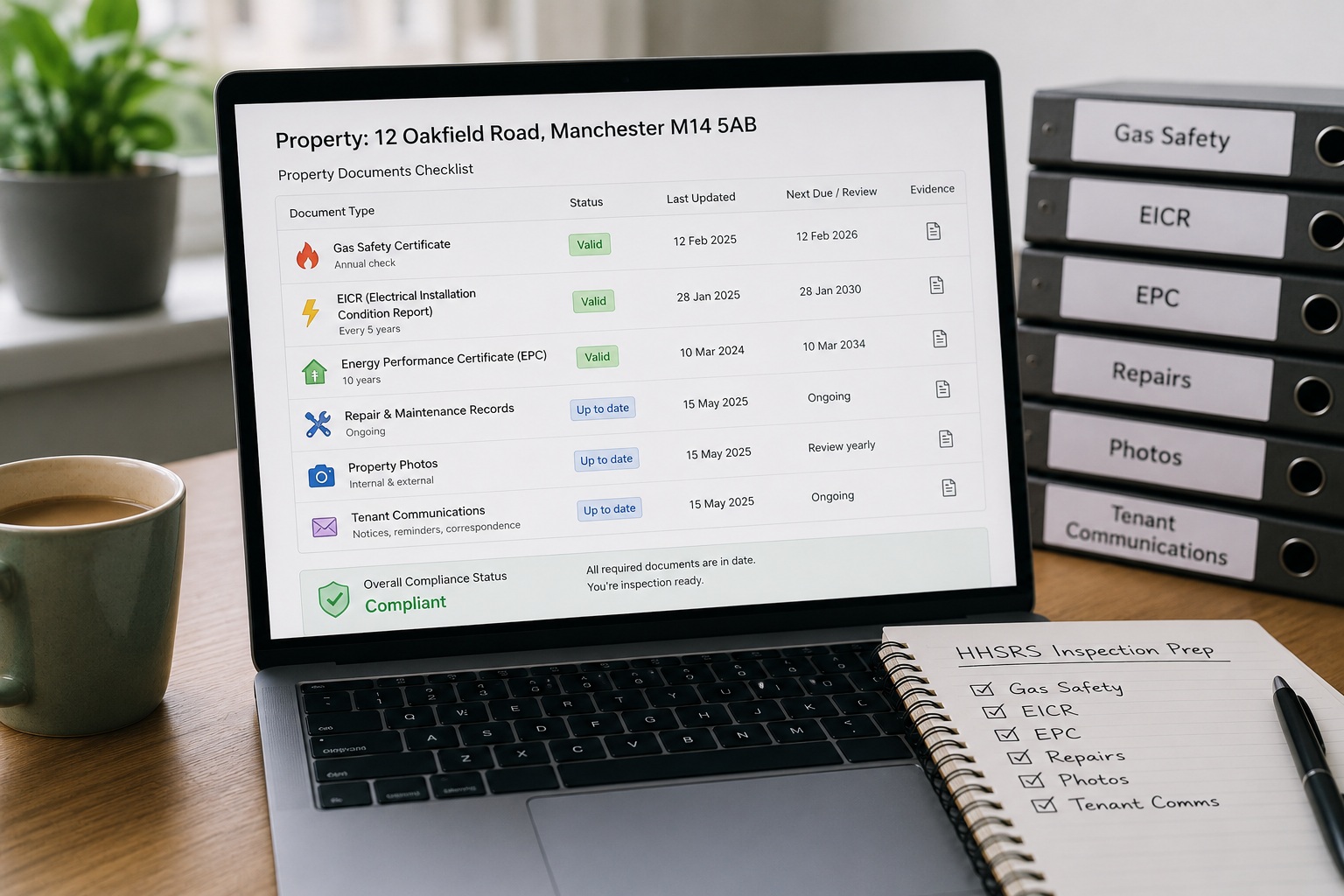
Keep your HHSRS inspection records organised by property
When a council asks questions, scattered folders, inboxes and document trails make everything harder. CertNudge helps landlords keep property certificates, supporting evidence, reminder dates and compliance-pack records organised by property, so they are easier to find, review and share when needed.
What landlords get wrong about HHSRS inspections
Mistake 1: Treating HHSRS as pass or fail
HHSRS is a risk assessment. A council officer is considering hazards, likelihood, harm outcomes and the vulnerability of potential occupiers. The guidance says cost is not taken into account when scoring a hazard; the scoring focuses on danger to health or safety.
A landlord who asks, “Did I pass?” is asking the wrong question. The better question is: “Were any hazards identified, how serious are they, and what evidence or works are needed next?”
Mistake 2: Assuming certificates protect you from HHSRS findings
A landlord with a current gas safety certificate, current EICR and current EPC can still face a serious HHSRS finding.
Example: a fully certificated flat has no live electrical issue and the boiler is safe, but one bedroom is persistently cold because the radiator is undersized, the window is draughty and the wall has recurring damp. The certificates are not the issue. The risk of excess cold and damp may be.
The practical point for landlords is simple: compliance records are necessary, but they are not a substitute for property condition.
Mistake 3: Having no complaint history
If a tenant complained about mould in January, chased in February, and the first recorded landlord action is in April, the timeline matters.
Keep a record of:
- the date reported
- the issue described
- photos supplied
- inspection date
- contractor instructed
- access attempts
- tenant updates
- works completed
- follow-up check
This is not about creating a defensive file. It is about showing a reasonable, chronological response. If you currently rely on spreadsheets, read the CertNudge guide to building a landlord compliance spreadsheet and knowing when spreadsheets stop working.
Mistake 4: Refusing access or ignoring council correspondence
If you think the council has made an error, respond in writing and ask for clarification. Do not simply refuse access or ignore letters.
The Renters’ Rights Act investigatory powers guidance confirms that local authorities may, in relevant circumstances, enter business premises, request information, take photographs, make recordings and use wider evidence-gathering powers. For residential premises, the guidance sets out specific authorisation, notice and warrant rules, including circumstances where entry can be sought with a warrant.
For a landlord, the practical lesson is simple: cooperate, keep records, and get advice if you believe the process is wrong.
Mistake 5: Handling a housing improvement notice casually
For a landlord, a housing Improvement Notice is not a casual repair request. It is a formal enforcement notice that can be served under section 11 or section 12 of the Housing Act 2004 where the council requires works to remove or reduce Category 1 or Category 2 hazards.
GOV.UK’s HHSRS enforcement guidance says an Improvement Notice can require remedial action to remove or reduce a hazard. For a Category 1 hazard, the required action must at least reduce the risk so that the Category 1 hazard no longer remains. Failure to comply with the notice within the required timeframe is a criminal offence.
An appeal against an Improvement Notice must usually be made within 21 days from service of the notice. The First-tier Tribunal (Property Chamber) may allow a late appeal only where there is a good reason for the delay, so landlords should not assume an extension will be granted. If you intend to challenge a notice, diarise the deadline immediately and get specialist advice.
Do this immediately: if you receive an Improvement Notice, read it in full, diarise every date, preserve the envelope/email, and speak to a qualified housing solicitor or specialist adviser if you intend to challenge it.
What can happen after an HHSRS inspection?
After an HHSRS inspection, the council’s response depends on what it finds, the seriousness of the hazards, the evidence available, and the council’s enforcement policy.
A landlord with one damp patch caused by a blocked gutter may receive informal advice and a request for works. A landlord with serious excess cold, dangerous electrics and repeated ignored complaints may face formal enforcement.
Possible outcomes include:
No further action
The council does not identify hazards requiring action, or the issue has been resolved.
Informal advice or schedule of works
The council asks the landlord to carry out works without immediately serving a formal notice.
Hazard Awareness Notice
The council formally draws attention to a hazard. It is advisory, does not itself require works, and has no appeal route.
Improvement Notice
The council requires works to remove or reduce hazards within a specified timescale.
Prohibition Order
The council restricts use of all or part of the property.
Emergency remedial action or Emergency Prohibition Order
Used where there is a Category 1 hazard and an imminent risk of serious harm.
Civil penalty or prosecution
Possible where an offence is committed, such as failing to comply with an Improvement Notice.
What a housing Improvement Notice means for landlords
A housing Improvement Notice is a formal enforcement notice issued by a local council under Part 1 of the Housing Act 2004. It requires a landlord to carry out specified remedial works to remove or reduce a Category 1 or Category 2 hazard within a set timeframe.
The notice should identify the hazard, the deficiency causing it, the remedial action required, when the works must start, the period for completion, and the right of appeal. Where a Category 1 hazard is involved, the specified works must at least reduce the risk sufficiently for the Category 1 hazard no longer to remain.
Plain English version: an Improvement Notice is a legal instruction to fix specific hazards. You usually have 21 days to appeal, and ignoring it can become a criminal offence.
A Hazard Awareness Notice is commonly associated with less serious hazards, but GOV.UK guidance says it can be a possible, though unusual, response to a Category 1 hazard. It is advisory, and it does not prevent the council taking stronger action later if the hazard remains or is not resolved.
For Category 1 hazards, the local authority has a duty to act. For Category 2 hazards, it has a power to act. GOV.UK guidance also explains that councils may carry out remedial work themselves and reclaim costs in some cases.
An Improvement Notice will set out when works must start and the period for completion. HHSRS enforcement guidance says an Improvement Notice cannot require remedial works to start within 28 days of service, although completion deadlines can vary depending on the hazards and works involved.
Civil penalties and rent repayment order risks
For relevant breaches and offences, current GOV.UK civil penalties guidance uses careful “up to” wording: a breach may carry a civil penalty of up to £7,000, while an offence may carry a civil penalty of up to £40,000. Failure to comply with an Improvement Notice is one of the Housing Act 2004 offences that should be treated as a serious escalation point. Landlords should check the latest GOV.UK guidance before relying on any penalty figure.
There is also a rent repayment order risk where a landlord commits certain housing-related offences. GOV.UK guidance lists failure to comply with an Improvement Notice as an offence that can support a rent repayment order. A rent repayment order can require a landlord to repay rent where the legal tests are met, so non-compliance with formal enforcement action should not be treated as a paperwork issue.
New from 22 June 2026: up to £7,000 for a Category 1 hazard
Section 6A of the Housing Act 2004, inserted by the Renters’ Rights Act 2025, gives local housing authorities a new power to impose a civil penalty of up to £7,000 where a Category 1 hazard exists in qualifying residential premises and the authority considers that it would have been reasonably practicable for the responsible person to secure its removal. The power applies to Category 1 hazards, not Category 2 hazards.
The council does not need to wait for the landlord to breach an Improvement Notice before using this power. However, it is not an instant or automatic “on-the-spot” fine. Before imposing a penalty, the authority must issue a notice of intent explaining the proposed penalty and reasons. The recipient then has 28 days, beginning with the day after the notice is given, to make written representations.
If the council subsequently issues a final notice, the recipient can appeal the penalty or its amount to the First-tier Tribunal (Property Chamber) within 28 days beginning with the day after the final notice is given. The final notice is suspended while a valid appeal is determined.
The June 2026 statutory enforcement guidance says that, where a council decides to impose a section 6A penalty, the national starting point should be £6,000, with the final amount adjusted according to factors such as harm, culpability, previous compliance, steps taken to remove the hazard and financial circumstances. The statutory maximum remains £7,000.
What this means in practice:
- A council can consider a section 6A penalty when it first takes enforcement action; a previous Improvement Notice breach is not required.
- The council must consider whether it would have been reasonably practicable for the responsible person to remove the hazard.
- The authority may impose separate penalties for separate Category 1 hazards, or one penalty covering several hazards where that is appropriate.
- Evidence of when you became aware of a problem, access attempts, contractor bookings and steps taken to remedy it can therefore be important.
The final HHSRS enforcement guidance was published on 23 June 2026. Local authorities must also have their own civil penalty policies, so the precise decision-making approach should be checked against both the statutory guidance and the relevant council’s current policy.
What is changing next: PRS Database, Awaab’s Law and Decent Homes
The wider direction of travel is clear. The PRS Database is planned to begin rolling out from late 2026, starting with landlords and local councils, with key details to be set through regulations. It is intended to help landlords demonstrate compliance while supporting councils in targeting enforcement.
The government has also said the updated Decent Homes Standard will apply to both the social and private rented sectors from 2035. That is a planning milestone, not a reason to delay dealing with Category 1 hazards now.
The Renters’ Rights Act provides powers to extend Awaab’s Law-style repair requirements to the private rented sector. As of 7 September 2026, no PRS commencement date has been set and the government has said it will consult on the approach before the detailed requirements are introduced.
HHSRS inspection FAQs
How long does an HHSRS inspection take?
There is no fixed statutory duration for an HHSRS inspection. The time required depends on the size and complexity of the property, the deficiencies identified and whether communal areas, grounds or further investigation need to be considered.
HHSRS is a whole-dwelling assessment, and the officer may also request documents, measurements or further investigation after the visit. The assessment is therefore not necessarily complete when the physical inspection ends.
Can I refuse a council HHSRS inspection?
Do not simply refuse. If you receive a request from the council, ask what power they are using, what access is needed, and what notice has been given.
Councils have statutory housing enforcement and investigatory powers. The exact route depends on the purpose of entry and the legislation being used. If you believe the council has not followed the correct process, get advice quickly and respond in writing. Ignoring the council is usually the worst option.
Who pays for HHSRS-required works?
In most landlord enforcement cases, the landlord is responsible for arranging and funding works required to remove or reduce hazards within the landlord’s responsibility.
If an Improvement Notice is served, it should specify the hazards, the remedial action and the timescales. Failure to comply can become a criminal offence.
Does an HHSRS inspection affect possession proceedings?
It can affect the wider evidence picture.
From 1 May 2026, GOV.UK’s Renters’ Rights Act roadmap says the abolition of Section 21 and the introduction of the new tenancy regime apply to new and existing private rented sector tenancies in England. Possession now depends on valid grounds rather than the old Section 21 route.
If there is a history of unresolved hazards, ignored complaints or council enforcement, that may become relevant background in a dispute. Do not rely on this article for possession strategy. If possession proceedings are live or likely, check the current GOV.UK guidance and speak to a qualified housing solicitor.
Can I appeal a housing Improvement Notice?
Yes. An appeal must usually be made to the First-tier Tribunal (Property Chamber) within 21 days of service of the notice. The tribunal may allow a late appeal only where there is a good reason for the delay, so landlords should not assume an extension will be granted. If you intend to challenge a notice, get specialist advice immediately and diarise the deadline.
Possible grounds may include that someone else should take the action or pay the costs, or that an Improvement Notice was not the most appropriate enforcement option. If you are considering an appeal, take specialist advice quickly because the deadline is short.
Being HHSRS inspection-ready is the workflow that wins
The private rented sector is moving from “trust me, I’m compliant” to “show me the record”.
HHSRS inspections, damp and mould complaints, future Awaab’s Law duties, the Decent Homes Standard, PRS Database registration and higher energy standards all point in the same direction: landlords need organised, property-specific evidence.
A landlord with a clean compliance pack can respond to a council email calmly. A landlord with scattered records may spend hours reconstructing what happened while the inspection clock is ticking.
The practical takeaway is simple: do not wait for the council letter before building the file.
Make compliance evidence easier to find before it is urgent
CertNudge helps UK landlords organise property certificates, supporting evidence, reminder dates and shareable compliance packs in one place.
It does not replace legal advice, contractors, tenant complaint handling or your own response to a council investigation. Its role is to keep the compliance records and supporting evidence you already hold clearer, structured and easier to access when questions are asked.
Last reviewed: 7 September 2026
Next review recommended: 1 December 2026, or sooner if new PRS Awaab’s Law or HHSRS enforcement guidance is published.
Reason: the revised 21-hazard HHSRS framework and final enforcement guidance are now in force, but PRS Database rollout, private-sector Awaab’s Law requirements, MEES implementation and related Renters’ Rights Act reforms continue to develop.