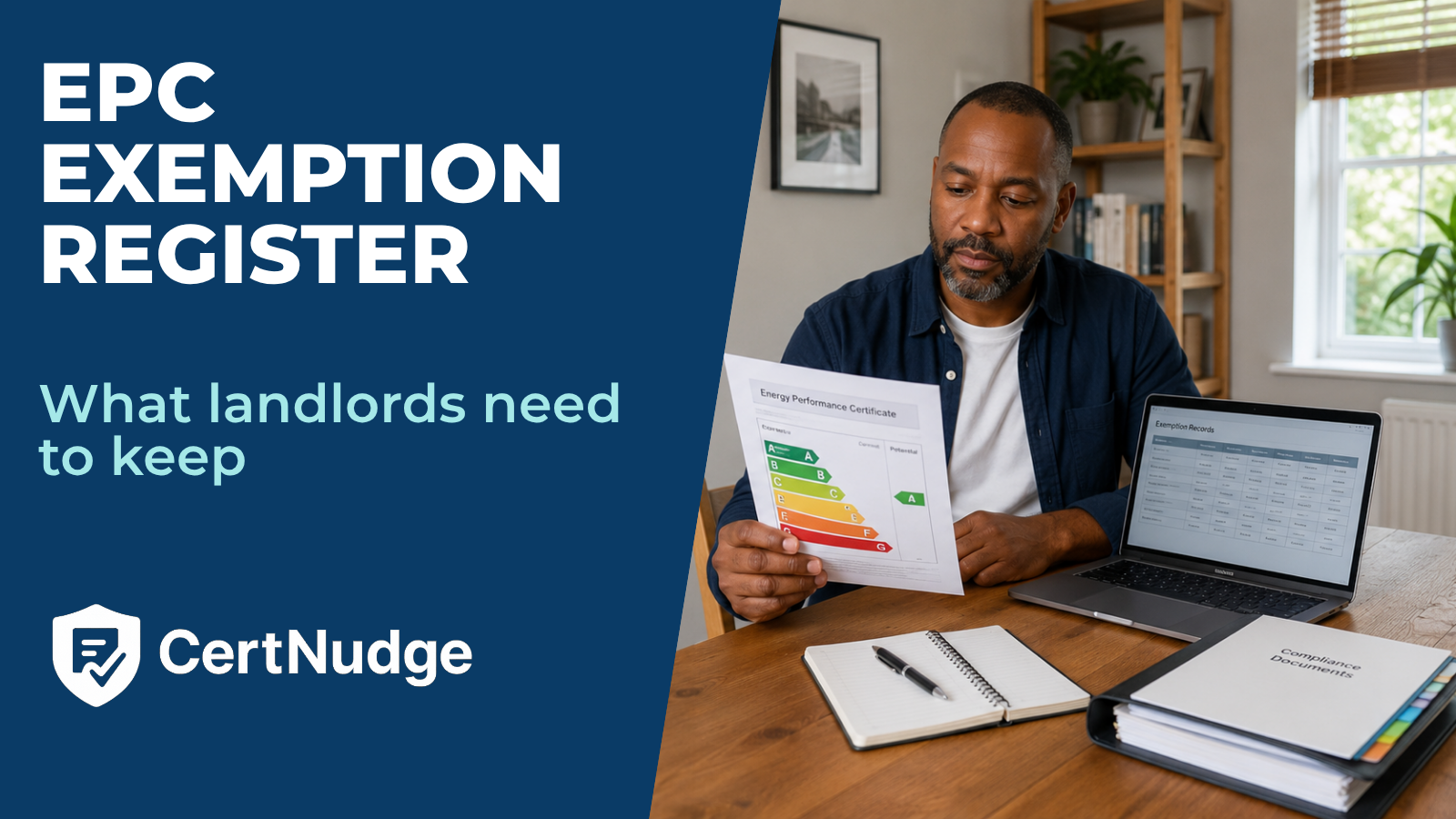
What certificates do landlords need?
Unsure what certificates you need as a UK landlord? This guide covers the common documents agents and insurers ask for, explains UK nation differences, and shows how to build an inspection-ready compliance pack you can update and share fast.
How to keep an inspection-ready compliance pack (so you can prove it fast)
If you’ve ever had an agent ask for “all the paperwork”, needed to renew insurance, or realised a certificate is due the week before a tenancy starts, you’ll know the feeling: the documents exist… just not in one place.
This guide covers:
- the common certificates and compliance documents landlords are often expected to have to hand (UK context, with England-specific notes where the rules are clearest), and
- how to organise them into a single, shareable “inspection-ready” compliance pack per property.
Key takeaways (60 seconds)
- What you need depends on UK nation and property type (gas present, licensable, etc.).
- For almost every document, keep the certificate + supporting evidence (remedials, invoices, photos, proof of issue).
- A good “pack” is best-practice organisation — it helps when agents, insurers or councils ask for proof quickly.
This article is for general information only and is not legal advice. Regulations change and circumstances vary. If you need advice, speak to a qualified professional.

The quick answer: common landlord certificates and documents (UK)
The exact requirements depend on which UK nation the property is in and the property type (for example, whether it has gas, whether it’s licensable, etc.). But in practice, landlords are most often asked for evidence covering the areas below.
At a glance: what you’re most likely to be asked for
- Safety: gas (if applicable), electrics (nation-specific), alarms (nation-specific)
- Energy: EPC
- Admin (where relevant): deposit paperwork, Right to Rent (England), proof of issue
- Licensing (where relevant): HMO / selective / additional licensing paperwork
Safety and energy (commonly requested)
- Gas safety record (if there are gas appliances/flues) — generally involves an annual safety check and providing the record to tenants within set timeframes. (HSE guidance on gas safety records for landlords)
- Electrical safety evidence (England has specific private rented sector rules; elsewhere differs) — typically an inspection/report and proof provided to tenants/council on request. (Electrical safety standards guidance for rented property)
- EPC (Energy Performance Certificate) — EPCs are generally valid up to 10 years (unless a newer one replaces it). (EPC validity and technical notes)
- Smoke and carbon monoxide alarms compliance notes (England has specific regulations/guidance; other nations differ) — at least one smoke alarm per storey used as living accommodation is a key part of the England guidance. (Smoke and carbon monoxide alarms rules (England) – landlord Q&A)
Tenancy admin evidence (often requested by agents; some are legal duties in specific circumstances)
- Deposit paperwork (if you took a deposit): proof of protection and prescribed information (rules vary by nation/scheme). (We’ll cover what to file in the pack, not “how to serve” it.)
- Right to Rent records (England only) if applicable. (Again, we’ll cover what to file as evidence.)
Licensing (only if your property is in scope)
- HMO / selective / additional licensing paperwork if your property is licensable (this is council-specific). (Start point: check if you need an HMO licence)
The principle to remember
Keep the certificate AND the evidence around it (for example, remedial works, invoices, photos, “issued to tenant on date X” note). That’s what turns a folder of PDFs into an “inspection-ready” pack.
What an “inspection-ready compliance pack” is (and isn’t)
It is
A single, organised bundle for one property that lets you answer, quickly:
- What’s currently valid?
- What’s due soon?
- Where’s the latest version?
- What supporting evidence exists (repairs, follow-up works, proof of issue)?
It isn’t
- A claim that “the council requires a compliance pack” in this exact format.
- A substitute for understanding your responsibilities in your UK nation.
Think of it as best-practice organisation that saves time and stress when someone asks for documents at short notice.
In practice: what makes a pack “inspection-ready”
- One place per property (no hunting across email/Drive/WhatsApp)
- Clear “latest version” naming
- Supporting evidence attached behind the thing it supports
- A simple “proof of issue” record where relevant
If you’re using a system like CertNudge, this maps neatly to generating a single Compliance Pack PDF from the certificates you’ve stored, with supporting documents attached (useful for sharing with an agent or keeping your own evidence tidy). (Export a single PDF compliance pack)
Quick next step (optional)
If you don’t want to manage folders, you can use a compliance tool like CertNudge to store documents per property, track expiry dates, and generate a shareable pack when you need it.
England vs the rest of the UK: why the answer depends (and how to label your pack)
Before you build a “one-size-fits-all” compliance pack, it’s worth being clear about jurisdiction. A lot of landlord guidance online is England-centric, and some duties (and terminology) change across Wales, Scotland and Northern Ireland.
Quick win: label every pack clearly
If you have more than one property (or manage across borders), this prevents mix-ups later.
Start with a simple rule: label the pack by nation and property type
On the very first page (or the first section of your folder), add a short “property summary”:
- Property address
- Nation: England / Wales / Scotland / Northern Ireland
- Property type: flat/house; single let/HMO; furnished/unfurnished
- Fuel notes: gas present? solid fuel appliance? (affects what evidence you need)
- Managing party: self-managed / agent-managed
- Pack “as of” date: when you last checked everything
This one-minute admin saves you from accidental mix-ups later (especially if you manage a portfolio across borders).
England-specific items you’ll often want in the pack
These are common “gotchas” for landlords who read generic UK advice:
What to file (England): keep proof, not just the document
For anything you “issued” or “checked”, save a dated record so you can show when it happened.
Right to Rent (England only)
The Right to Rent scheme is an England requirement, and GOV.UK guidance explains record-keeping. (Landlord’s guide to Right to Rent checks; also see Right to Rent: document checks overview)
What to file in your pack: a dated PDF/screenshot of the online check (or scanned copies where applicable), plus a short note: “Check completed on DD/MM/YYYY”.
“How to Rent” guide (England)
GOV.UK publishes the current version of the guide. (How to Rent guide)
What to file: the version you sent (PDF), plus a “proof of issue” (sent email / acknowledgement).
Electrical safety standards (England private rented sector)
GOV.UK guidance explains inspection/testing expectations (typically at least every 5 years, or sooner if the report says). (Electrical safety standards: guidance for rented homes)
What to file: the EICR, any remedial work evidence, and proof you provided the report where required.
Smoke and carbon monoxide alarms (England)
The GOV.UK Q&A for landlords includes the “at least one smoke alarm on every storey used as living accommodation” point. (Smoke & CO alarms rules explained for landlords (England))
What to file: a simple dated note showing alarms present and tested at the start of the tenancy, plus any repair/replacement record.
Items that are common across the UK, but still need “nation-aware” handling
Gas safety records (commonly GB-focused guidance)
HSE guidance is clear on record handling: provide existing tenants a copy within 28 days of the check being completed, and new tenants before they move in. (Gas safety record: what landlords must do)
What to file: the latest record and a “proof of issue” note (for example, email sent date).
If your property is in Northern Ireland, check NI-specific guidance too, as arrangements can differ.
EPC (Energy Performance Certificate)
GOV.UK technical notes state EPCs are valid for up to 10 years. (EPC validity: technical notes)
What to file: the current EPC PDF and the expiry date (even if you’re not planning to re-let soon).
Tenancy deposits
In England and Wales, GOV.UK states landlords have 30 days from receiving the deposit to give tenants the required information. (Deposit protection: information landlords must give tenants)
What to file: scheme confirmation, prescribed information, and proof it was provided.
Scotland and Northern Ireland have different schemes and rules—so treat this as a “nation-specific” pack section.
How this affects your pack structure (practical approach)
To avoid confusion, build your pack with these fixed sections:
- Property summary (nation + property type + “as of” date)
- Safety & energy (gas / electrics / alarms / EPC)
- Tenancy served documents & proof of issue (England-only items clearly labelled)
- Licensing (if applicable) (HMO/selective/additional)
- Repairs & remedials evidence (invoices, photos, completion notes)
- Share log (optional): who you shared with and when
That structure works whether you’re sharing with an agent, answering an insurer query, or just keeping yourself organised.
What to include in your inspection-ready compliance pack (the checklist)
Your goal isn’t to create the world’s biggest folder. It’s to create a clear, shareable bundle that answers: “Is this property compliant right now, and where’s the proof?”
How to use this section
- Always = almost every landlord will want this in the pack
- Sometimes = depends on property features (gas, appliances, etc.)
- Depends = depends on nation, licensing, or how you let the property
The “front page” (Always)
This is what makes the pack feel “inspection-ready”, because it lets someone scan it in seconds.
Property summary sheet
- Property address + unique ID (if you use one)
- UK nation (England/Wales/Scotland/NI)
- Let type (single let / HMO / holiday let etc.)
- Managing party (self/agent)
- “Pack updated on” date
- A quick status list (Valid / Due soon / Missing) for each key item
Contents page (index)
- A numbered list of sections + document names
- Optional: expiry dates next to each certificate
Why this matters (especially for portfolios)
If you manage multiple properties, a one-page index prevents the “scroll forever through PDFs” problem when someone asks for documents at short notice.
Safety & energy evidence (Always/Sometimes)
These are usually the first things agents/insurers/councils ask about.
Gas safety record (Sometimes — if gas present)
- Latest gas safety record (often referred to as CP12)
- Proof of issue: note/email confirmation of when you provided it to the tenant
HSE guidance explains the timing expectations for giving tenants a copy (existing tenants within 28 days; new tenants before they move in). (Gas safety record: landlord guidance)
Electrical safety evidence (Always in England; varies elsewhere)
- Latest EICR (or equivalent evidence appropriate to your nation/property)
- Any remedial work evidence (invoice, contractor note, photos)
- Proof of issue: a record of when it was provided (where relevant)
England’s guidance covers inspection and testing expectations (typically at least every 5 years, or sooner if the report says). (Electrical safety standards guidance)
EPC (Usually Always when letting/marketing)
- Current EPC PDF
- Expiry date (EPCs are generally valid up to 10 years)
Reference: EPC validity and technical notes
Smoke & carbon monoxide alarms (Always in practice; rules vary by nation)
- A simple “alarms checklist” showing what’s installed and tested at the start of tenancy
- Any replacements/repairs record
For England, the landlord Q&A explains the smoke alarm expectation (at least one per storey used as living accommodation). (Smoke and carbon monoxide alarms rules (England))
Tenancy “served documents” + proof of issue (Depends by nation, but extremely useful)
Even when something can be emailed, you’ll save yourself stress later if you keep a simple record of what you sent and when.
Deposit paperwork (Depends — only if you took a deposit; rules vary)
For England/Wales, GOV.UK explains what information landlords must give tenants (including timing). (Deposit protection: information landlords must give tenants)
What to file
- Deposit protection confirmation/certificate
- Prescribed information document
- Proof of issue (email, signed receipt, portal message)
Right to Rent evidence (England only)
GOV.UK sets out how checks work and that landlords must keep records. (Right to Rent: document checks)
What to file
- PDF/screenshot of online check result (or copied documents where applicable)
- Dated note: “Check completed on DD/MM/YYYY”
“How to Rent” guide (England)
GOV.UK publishes the current version of the guide. (How to Rent guide)
What to file
- The version you sent (PDF)
- Proof of issue (email/acknowledgement)
Licensing and property-specific compliance (Depends)
This is where packs often fall apart because landlords don’t keep the conditions alongside the licence.
HMO / selective / additional licensing (Depends — council specific)
- Licence document
- Licence conditions checklist (1 page, plain English)
- Inspection correspondence (if any)
- Fire safety / management evidence required by your conditions (where relevant)
Start point: Check if you need an HMO licence. Always use your local council’s guidance for the specific conditions.
Repairs, remedials and “supporting evidence” (Always if you want the pack to be credible)
This is what turns “we have a certificate” into “we actually dealt with issues”.
Include a simple log (spreadsheet, note, or exported report) with:
- Date reported
- Issue
- Contractor
- Work completed date
- Evidence: invoice / photos / email confirmation
Tip
If an inspection report includes actions (for example, “urgent remedial”), keep the before/after evidence right behind that report in the pack.
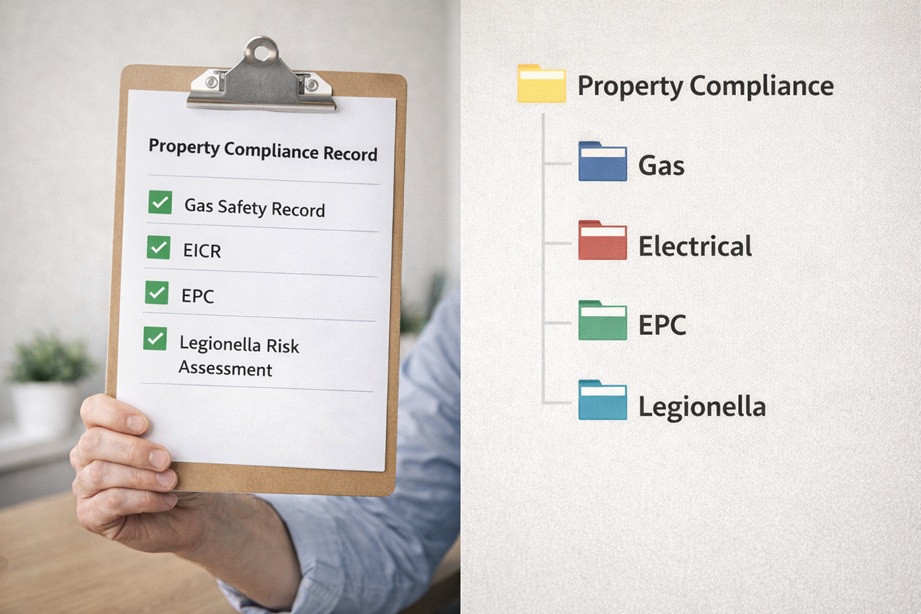
Example pack index (optional)
Property Compliance Pack — [Address]
Nation: [England/Wales/Scotland/NI]
Pack updated: [DD/MM/YYYY]
- Property summary + status index
- Gas safety record (if applicable) + proof of issue
- Electrical safety (EICR) + remedials evidence + proof of issue
- EPC certificate
- Smoke/CO alarms checklist + repair/replacement notes
- Deposit protection + prescribed info + proof of issue (if deposit taken)
- Right to Rent evidence (England only, if applicable)
- How to Rent guide proof of issue (England)
- Licensing (HMO/selective/additional) + conditions checklist (if applicable)
- Repairs & maintenance log + invoices/photos
- Share log (optional)
How to keep your compliance pack up to date (a 15-minute monthly routine)
An “inspection-ready” pack isn’t about doing more admin — it’s about doing small, regular checks so nothing becomes a last-minute scramble.
Best habit for busy landlords
Pick one recurring date each month (e.g., first Monday) and treat it like a mini “compliance MOT” for each property.
The minimum viable routine (once a month)
Pick a recurring date (for example, first Monday of the month) and do this per property:
- Open the pack index
- Check the “Pack updated on” date.
- Scan the expiry dates you track (gas/electrical/EPC etc.).
- Update the status line
- Mark each item as Valid / Due soon / Missing.
- If something is “Due soon”, add a next action: “Book engineer” / “Request latest EPC PDF” etc.
- Attach the newest evidence
- Any new contractor invoices, completion notes, or “before/after” photos go behind the relevant item.
- If you emailed a document to a tenant/agent, save the email PDF (or screenshot) into the “proof of issue” section.
- Export/share only if you need to
- Don’t keep blasting new PDFs to everyone. Keep your pack ready so you can share it when asked.
If you’re using CertNudge, this maps neatly to per-property statuses (Active/Expiring/Expired/Missing) plus reminders, so “monthly checks” become a quick scan rather than a hunt through folders. (Compliance reminders)
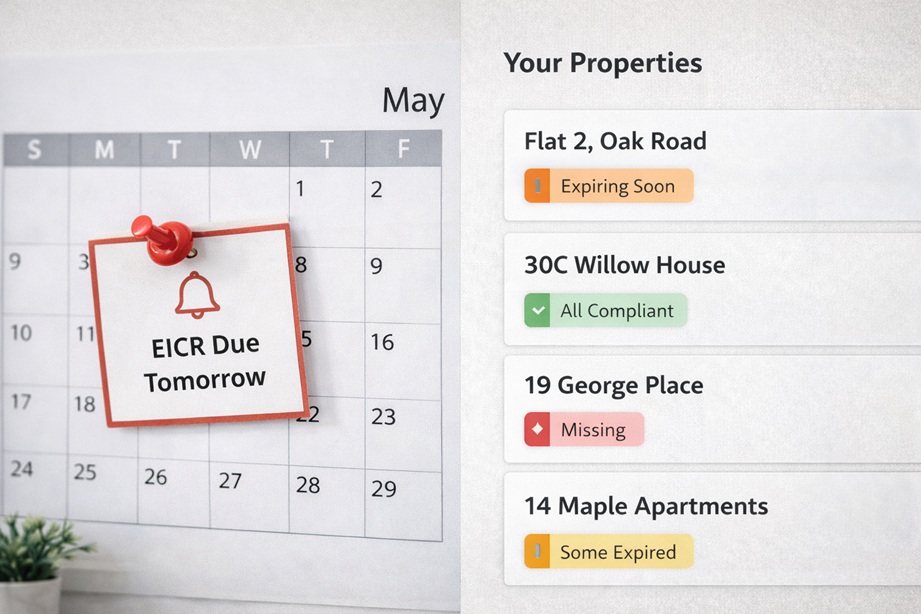
A simple folder structure that scales (especially for portfolios)
Whether you use Drive/Dropbox/OneDrive or a platform, consistency matters more than perfection.
Recommended structure
- /Properties/
- /01 – 1 High Street/
- /00 Pack Index & Summary/
- /01 Gas Safety/
- /02 Electrical Safety/
- /03 EPC/
- /04 Alarms/
- /05 Tenancy Served Docs/
- /06 Licensing/
- /07 Repairs & Evidence/
- /99 Shared Exports/
If you keep this structure the same across every property, you’ll be able to find anything instantly — even months later.
Naming conventions (so you never open the wrong file)
Use a consistent naming pattern:
[Property] – [Document] – [Date] – [Status/Notes].pdf
Examples:
- 1 High St – Gas Safety Record – 2026-01-12.pdf
- 1 High St – EICR – 2025-08-03 – Satisfactory.pdf
- 1 High St – EICR Remedials – 2025-08-20 – Invoice+Photos.pdf
- 1 High St – EPC – 2022-06-15 – Expires 2032-06-14.pdf
This also makes it easy to see “latest version” at a glance.
Keep “supporting evidence” attached to the thing it supports
A common failure mode is having certificates in one place and evidence in another (emails, WhatsApp, contractor portals).
A quick rule
- Inspection report → immediate next file should be remedials evidence
- Certificate → next file should be proof it was issued/served (where relevant)
For example:
EICR → remedial invoice → completion photo → “sent to tenant” email PDF
“Pack updated” dates (small detail, big trust signal)
On the summary sheet, add:
- Pack updated: DD/MM/YYYY
- Next review due: DD/MM/YYYY (one month later)
Agents and insurers often respond well to “this is current” signals — it reduces back-and-forth.
How to share your pack safely (agents, insurers, councils)
You want to share what’s needed without oversharing personal data.
Choose a sharing method that matches the situation
Option A: Share a single PDF export (best for quick requests)
- A single file is easy for agents/insurers to forward internally.
- It’s also easier to evidence “what you shared” later.
Option B: Share a read-only folder link (best for ongoing relationships)
- Keep it read-only.
- Use a dedicated “Shared” folder so you control what’s visible.
Option C: Share only the requested section
- If someone asks for “EICR + remedials”, don’t send everything by default.
CertNudge’s Compliance Pack PDF concept is designed for exactly this: one export per property that bundles the relevant certificates and supporting docs for sharing. (How to export a compliance pack PDF)

Avoid accidental data leaks (practical checklist)
Before sharing, scan for:
- Tenant phone numbers, emails, ID documents (only share if strictly necessary)
- Bank details on invoices
- Full tenancy agreements (usually not needed for “compliance evidence” requests)
- Anything you wouldn’t be happy forwarding to a third party
If you need to share something sensitive, consider redacting or sharing a limited extract.
Keep a simple share log (so you can prove what you sent)
In your pack (or a separate note), keep:
- Date shared
- Who with (agent/insurer/council contact)
- What you shared (for example, “Full pack PDF v2026-01-12”)
- How (email / link)
This is especially helpful if there’s ever a dispute or confusion about versions.
Common mistakes (and quick fixes)
Most “compliance pack panic” isn’t because landlords don’t have the documents — it’s because the evidence is scattered, out of date, or missing the small details that make it usable under pressure.
Mistake 1: You have the certificate, but not the supporting evidence
What it looks like: You’ve got an EICR, but you can’t easily show what happened next (remedials, follow-up work, receipts, photos).
Quick fix: Save a simple “evidence chain” directly behind the report:
- report → remedial invoice → completion note → dated photos (if useful)
Mistake 2: No “proof of issue” (what you gave the tenant and when)
What it looks like: An agent or council asks, “When did you provide this to the tenant?” and you only have the PDF.
Quick fix: Add a “Proof of issue” note under each relevant item and save one of:
- email PDF/screenshot
- tenant portal message export
- signed acknowledgement (where used)
Reference: HSE guidance on issuing gas safety records to tenants
Mistake 3: Multiple “latest versions” in different places
What it looks like: “EICR-final.pdf”, “EICR-final-final.pdf”, and “EICR-2025.pdf” spread across email and Drive.
Quick fix: Use one source-of-truth folder per property and a dated filename pattern:
- [Property] – [Document] – YYYY-MM-DD – Notes.pdf
Mistake 4: You track dates in your head (until you don’t)
What it looks like: Everything’s fine… until you realise something expired last month or is due next week.
Quick fix: Put expiry dates on the pack front page and do a monthly 10–15 minute review.
Mistake 5: Sharing the wrong thing (or oversharing)
What it looks like: You send a full folder that includes tenant personal information or unnecessary documents.
Quick fix: Share only what’s needed (or a single PDF export). Before you send, do a quick scan for:
- tenant ID documents / personal details
- bank details on invoices
- full tenancy agreements (often not needed for compliance evidence)
Mistake 6: No “pack updated” date (so nobody trusts it’s current)
What it looks like: You send documents, but the recipient keeps asking “Is that the latest?”
Quick fix: Add two lines to the front sheet:
- Pack updated: DD/MM/YYYY
- Next review due: DD/MM/YYYY
A simple way to stay “inspection-ready”
An inspection-ready compliance pack is really just two habits:
- Keep your key certificates and compliance documents together per property, with clear, dated filenames.
- Attach the supporting evidence and proof-of-issue so you can answer questions quickly when an agent, insurer, or council asks.
Want to make this easier?
If you’d rather not manage folders and expiry dates manually, CertNudge can store your documents per property, track expiries and generate a shareable compliance pack when you need it.
Start a free trial — no card required
Or see how the Compliance Pack PDF export works.
FAQ
Q: How often is a gas safety check?
A: If your property has gas appliances/flues that fall under landlord duties, the check is annual (every 12 months) by a Gas Safe registered engineer, and you should keep and provide the gas safety record to tenants within the required timeframes. (HSE guidance)
Q: How often is an EICR in England?
A: In England’s private rented sector, guidance says electrical installations must be inspected and tested at least every 5 years by a properly qualified person (or sooner if the report says). (Electrical safety standards guidance)
Q: How long does an EPC last?
A: An EPC is generally valid for up to 10 years (and a newer EPC can replace an older one). (EPC technical notes)
Q: What alarms are required (England)?
A: For England, the landlord Q&A explains smoke alarms (at least one on each storey used as living accommodation) and carbon monoxide alarm requirements depending on fixed combustion appliances (excluding gas cookers). (Smoke and carbon monoxide alarms rules (England))
Q: What should a compliance pack include?
A: As best practice (not a single “legal pack” requirement), a landlord compliance pack usually includes: the latest safety/energy certificates relevant to the property (for example, gas safety record if applicable, EICR where relevant, EPC), alarm compliance notes, any licence/conditions paperwork if applicable, plus supporting evidence (remedial works, invoices, dated photos) and proof of issue where you’ve provided documents to tenants/agents. Exact requirements vary by UK nation and property type.
Q: Can I keep records digitally?
A: Yes—many landlords keep compliance documents as PDFs/scans in cloud storage or a platform. If the records include personal data (tenant contact details, ID checks, emails), make sure you store and share them securely (access control, strong passwords, and sensible sharing permissions). (Right to Rent overview: GOV.UK)
Last reviewed: 14 January 2026
Review again by: 14 April 2026