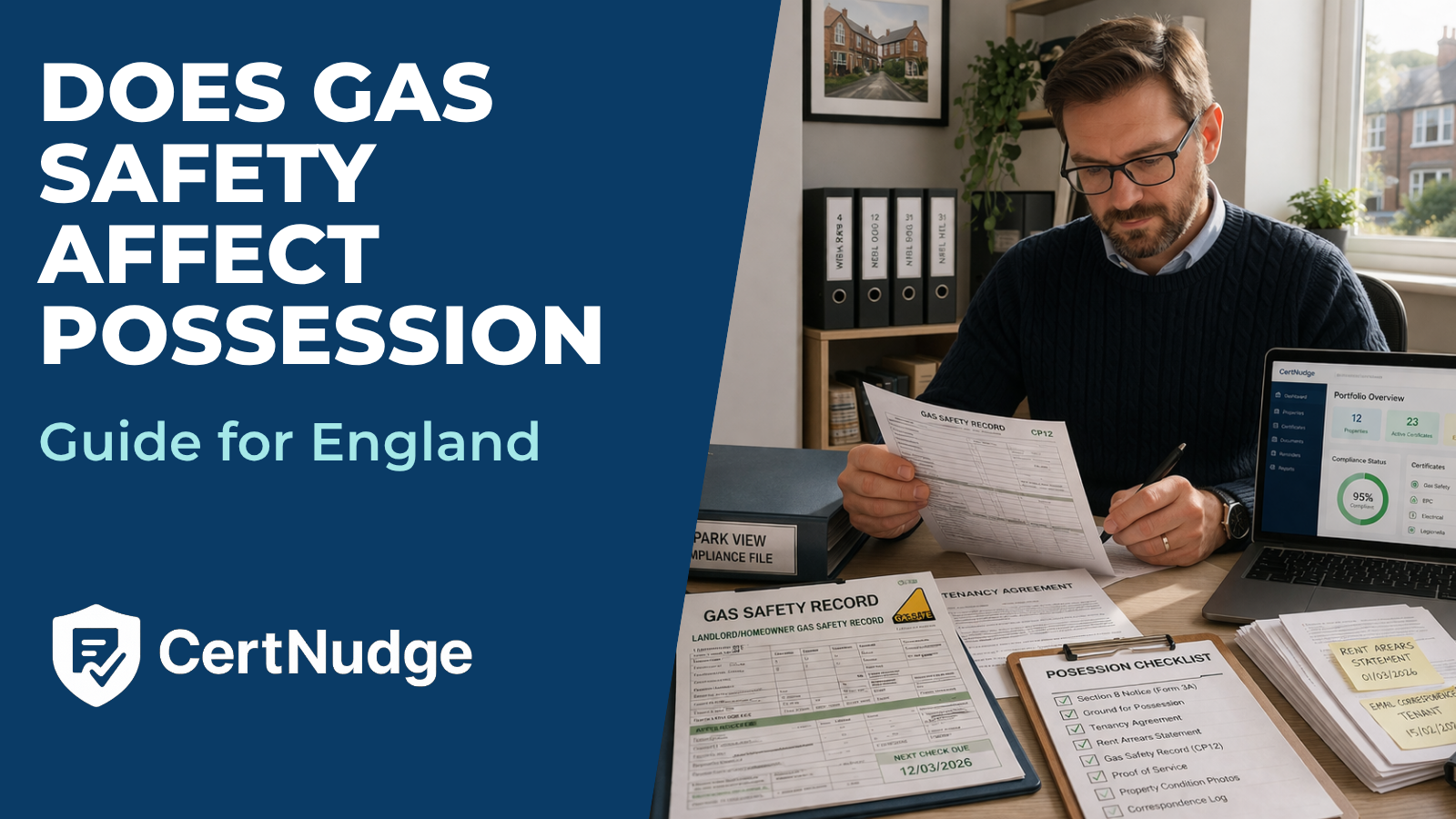
Does Gas Safety Affect Possession in England?
Gas safety still matters in England, but not in the old Section 21 way. This guide explains how gas safety now fits into section 8 possession cases, what records landlords still need, and where compliance gaps can still create risk.
Gas safety can still affect possession in England after 1 May 2026, but not as an old Section 21 problem. For new cases, landlords will usually need the right Section 8 ground, the correct Form 3A notice, and clear gas safety records that support the wider evidence behind the claim.
Quick Answer: Gas Safety Still Matters for Possession
What changed on 1 May 2026 is the possession route, not the landlord’s gas safety duties. Landlords still need to comply with the gas safety rules, but the main question is now whether the correct possession ground, notice period and supporting evidence are in place.
This article is written for private landlords in England dealing with post-1 May 2026 possession rules.

At a glance
- You still need annual gas safety checks where gas appliances or flues are supplied.
- You still need to give tenants the gas safety record on time.
- New possession cases use Section 8, and landlords will usually need Form 3A.
- Bad gas safety records can still weaken your position if your paperwork is challenged.
- Clean compliance records still help because possession is now more evidence-led.
Why This Question Still Matters
A lot of landlords still ask whether a missing gas safety certificate can stop them getting possession. That is understandable, but the answer now needs updating. The issue is no longer mainly about whether Section 21 is valid. It is about whether your wider possession case is strong, credible and properly evidenced.
In other words, gas safety still matters not because it sits inside a no-fault Section 21 checklist for new notices, but because it remains part of basic landlord compliance and record quality.
The practical shift: the old question was often, “Will gas safety invalidate my Section 21?” The better question now is, “Do I have the right possession ground, and are my records strong enough to support the case?”
What Changed on 1 May 2026?
From 1 May 2026, under the Renters’ Rights Act 2025, private landlords in England can no longer serve a new Section 21 notice. On and after that date, landlords will only be able to give a Section 8 notice, and will usually need the new Form 3A, if they want to seek possession.
That means landlords now need to think much more carefully about the actual reason for possession, the notice period for that ground and the evidence behind it.
Official position: GOV.UK says that on and after 1 May 2026, private landlords in England will only be able to give a Section 8 notice and will usually need the new Form 3A. The court process then depends on the ground used, the correct notice period and the evidence supporting it. See GOV.UK possession guidance.
On and after 1 May 2026, private landlords in England will usually need to use the new Section 8 notice, Form 3A, if they want the tenant to leave and intend to seek possession. GOV.UK warns that if the notice is incomplete or inaccurate, any court claim may be delayed or dismissed.
What Gas Safety Duties Still Apply?
The end of Section 21 did not remove landlord gas safety duties. These duties sit under the Gas Safety (Installation and Use) Regulations 1998. If you provide gas appliances or flues, you still need to make sure the gas installation is checked annually. The record produced after each check is commonly called a CP12, although the formal term is a Gas Safety Record.
- Arrange an annual gas safety check by a Gas Safe registered engineer
- Keep the gas safety record
- Give existing tenants a copy within 28 days of the check
- Give new tenants a copy before they move in
HSE also says landlords must keep the gas safety record for at least 2 years — and where the 2-month early-renewal flexibility is used, until two further checks have been carried out. See our guide on how long landlords should keep records for the full retention position. In practice, it is sensible to keep the certificate, proof of delivery to the tenant, and any follow-up remedial notes together in the same property file. If the tenant is happy and can access it, the record can also be provided electronically.
For the broader compliance position, see our full Gas Safety Compliance Guide.
What Gas Safety No Longer Does
For new cases, gas safety no longer operates as an old Section 21 gateway issue in the same way. Landlords cannot now start with a new Section 21 notice, so the classic argument about whether a late or missing CP12 invalidates Section 21 is no longer the centre of most fresh possession claims.
That older issue still matters for transition cases tied to notices served before 1 May 2026, but it is not the core question for normal possession work going forward.
Gas Safety Is Still Relevant: Just Not a Section 8 Barrier
Important practical point
Gas safety still matters after 1 May 2026 because landlords must continue meeting their statutory gas safety duties. A gas safety failure can still create risk, weaken your evidence file and complicate a disputed possession claim. But it is more accurate to describe this as a compliance and litigation risk, not as a universal formal Section 8 gateway in every case.
That distinction matters. GOV.UK expressly identifies deposit protection and prescribed information as affecting use of most possession grounds. Gas safety should therefore be framed more carefully: it remains a continuing legal duty and can still weaken your overall position, especially where the court is considering reasonableness on discretionary grounds or where your evidence file already has wider problems.
What Matters More in Possession Cases Now?
After 1 May 2026, the main question is usually whether you have a valid possession ground and the evidence to support it.
Common examples include landlord sale, landlord or family occupation, serious rent arrears, repeated rent delay or anti-social behaviour. Each ground has its own rules, notice period and evidence needs.
Worth knowing if you are relying on rent arrears: Ground 8 (the mandatory arrears ground) now needs at least 3 months’ rent owed where rent is paid monthly, or 13 weeks’ where it is paid weekly or fortnightly. The arrears must be at that level both on the day you give notice and at the hearing, so a tenant who pays down below the threshold before court cannot be evicted on this ground. Arrears caused by a tenant not receiving Universal Credit do not count. The notice period is 4 weeks. See the GOV.UK grounds for possession guidance for the full list.
Different possession grounds have different notice periods, evidence requirements and court tests, so landlords should always check the specific ground they plan to use.
- Are you using the correct possession ground?
- Have you used the correct form and notice period?
- Can you prove the facts behind the ground?
- Does the rest of your compliance record make you look organised and credible?
Grounds are either mandatory (the court must grant possession if you prove the ground applies) or discretionary (the court decides whether eviction is reasonable on the facts). Mandatory grounds give more certainty; discretionary grounds give the judge more flexibility to adjourn or refuse. Your compliance record can matter more in discretionary cases.
That last point is where gas safety still comes back into the picture.
Unlike the old accelerated Section 21 route, post-1 May 2026 possession claims in the private rented sector follow the current Section 8 court process. If you are evicting only for rent arrears, you may be able to use PCOL; otherwise landlords will usually need the standard county court process.
How Gas Safety Can Still Affect Possession
1. Poor records can weaken credibility
A possession case is easier to defend when your paperwork is organised, dated and consistent. If you cannot find the gas safety record, cannot show when it was shared, or have obvious gaps, the wider file looks weaker.
Could you evidence your gas safety compliance today?
Not sure whether your records would stand up if a possession claim were challenged? Run a free compliance check, enter your dates and see which properties have gaps. No upload, no card, just your dates.
Run the free compliance check →2. Gas safety issues can become part of a wider dispute
Where the tenancy relationship has already broken down, compliance failures rarely stay isolated. Missing or expired gas safety records can become part of the wider argument about how the property was managed.
3. Delay is more expensive in a ground-based system
When possession depends on the right ground, the right notice period and the right evidence, avoidable compliance gaps only create more friction. A messy file makes every next step harder.
4. Good compliance records still strengthen your position
Clean gas safety records are not a guarantee of success, but they do help show that you manage the property properly and respond to legal duties in a timely way.

What Landlords Should Check Before Starting Possession
Use this checklist before serving notice:
- Confirm the correct possession ground for your situation
- Use the correct notice form
- Check the correct notice period. Depending on the ground, this can range from no notice period at all to 4 months.
- Make sure the gas safety record is current where gas is supplied
- Check deposit protection and prescribed information records if a deposit was taken
- Keep proof of when the gas safety record was shared with the tenant
- Store all supporting evidence in one place before the matter becomes urgent — the same records the new landlord database for England is expected to draw on
- Get legal advice early if your compliance history is messy
What Evidence Should You Keep?
Because post-1 May 2026 possession claims are evidence-led, landlords should be ready to pull together a clean file before serving notice. In most cases that should include:
- the latest gas safety record
- proof of when it was given to the tenant
- engineer and inspection details
- the tenancy timeline and key tenancy documents
- the notice served and service evidence
- ground-specific supporting evidence, such as arrears records or sale evidence
Where possible, keep the gas safety record, proof of service, any follow-up remedial notes and the notice documents together in the same property file.
What counts as proof of service?
Useful proof of service can include a dated email with the gas safety record attached, a signed handover note, a portal upload log, or another clear dated record showing when the tenant was given the document. The aim is to show what was sent, when it was sent, and how it was provided.
If your main problem is that the certificate itself is late or missing, our guide on Gas Safety Certificate Grace Period: The Truth Landlords Need to Know explains that side in more detail.
Get your possession file organised before notice is served
CertNudge helps landlords keep gas safety records, notice documents, proof of service and supporting evidence organised by property, so the possession file is easier to assemble before notice is served or court action becomes urgent.
No card required. Downgrade to Landlord Pro (£11.99) at any time.
Common Myths
❌ “Gas safety no longer matters now Section 21 has gone.”
No. The legal duty still exists.
❌ “Possession is now just about one new form.”
No. The form matters, but so do the ground, notice period and evidence.
❌ “Compliance records are separate from possession strategy.”
Not in practice. Bad records often make possession cases harder.
❌ “If I have the right ground, paperwork quality does not matter.”
It still matters. Weak paperwork can slow you down or weaken the overall case.
Final Answer
Yes, gas safety can still affect possession in England.
What changed is how it affects possession. For new cases, it is no longer mainly about Section 21 validity. It is now more about whether your records are current, your compliance is defensible and your wider possession case is supported by solid evidence.
In practice, landlords should think less about old Section 21 technicalities and more about whether their Section 8 ground, notice and evidence file are strong enough to support the claim.
If your case involves a notice served before 1 May 2026, note that the court process for those notices cannot be started after 31 July 2026, even where the notice would otherwise still be valid. Our legacy guide on gas safety and Section 21 under the old framework covers that transition period.
Important: This article is for general information only and is not legal advice.
Always seek independent legal advice or consult a specialist before serving notice or starting possession proceedings.
Written for the private rented sector in England after the move to the post-1 May 2026 possession process.