Rental Property Maintenance Log: Recording Tenant Repairs
A practical England landlord guide to recording tenant repair requests from first report to closure, including priority, access, contractor actions, tenant updates and completion evidence. Includes a free downloadable maintenance log template.
A rental property maintenance log is a dated record of a repair or maintenance issue from first report to closure, covering what was reported, acknowledgement, access, contractor action, completion evidence and the reason the case was closed. In England, there is no single universal statutory completion deadline for every private rented repair; the appropriate response depends on the problem and circumstances.
This guide focuses on actual repair and maintenance cases during an active tenancy in standard private rented houses and flats in England. It is not a preventive-maintenance calendar, inventory, building survey or specialist HMO procedure.
Rental property maintenance log: key takeaways
- Start with the first report: a useful rental property maintenance log starts when the issue is first reported, not when a contractor is booked or sends an invoice.
- Record the whole chain: report, acknowledgement, risk assessment, access, contractor action, tenant updates, evidence, monitoring and closure.
- There is no universal repair deadline: there is no single 24-hour, 7-day or 28-day statutory completion deadline covering every private rented repair in England; the appropriate response depends on the problem and circumstances.
- Twenty-four hours normally concerns access: GOV.UK says landlords must give tenants at least 24 hours’ notice before entering to inspect the property or carry out repairs, although immediate access may be possible in an emergency. This is an access rule, not a universal repair-completion deadline.
- A log supports the chronology: a detailed log can support the chronology of what happened, but it does not by itself prove that a repair was adequate, legally timely or compliant.
A tenant reports a bathroom leak by WhatsApp. You reply, call a plumber and move on. Six weeks later, the tenant says the damp has returned — but the original message, access date, plumber’s findings and completion photo are now in four different places.
A rental property maintenance log prevents that. It gives each repair one record from first report to evidence-backed closure.

Who should use a rental property maintenance log?
A maintenance log is particularly useful for self-managing landlords and small letting or property-management teams looking after ordinary rented houses and flats in England.
Take a landlord with six properties. One tenant phones about a sticking window, another sends a WhatsApp photo of a leak, an agent emails about a broken extractor fan and a contractor mentions a loose handrail while attending for another job. Without a consistent process, four repair cases can quickly become four unrelated conversations.
Give each issue its own reference instead:
That repair ID can follow the job through the tenant’s original report, appointment messages, contractor findings, photographs, invoice and closure note.
A repair log can also start when a problem is:
- reported by the tenant;
- noticed during a routine inspection;
- raised by a letting agent;
- identified by a contractor attending for something else; or
- brought to the landlord’s attention by the council.
The important boundary is that this is a case record for an actual repair or maintenance issue. It is not a preventive maintenance calendar, inventory, check-out report, building survey or specialist HMO procedure.
For routine visits, keep the inspection process separate and create a repair record when an actionable defect is identified. For wider portfolio-level certificate and evidence tracking, see the Landlord Compliance Spreadsheet Template. The two records answer different questions: the compliance tracker tells you what documents and deadlines exist across the portfolio; the repair log tells you exactly what happened to one reported problem.
That distinction matters if a repair history is challenged later. A properly maintained record can show when you became aware, what information you had at each stage and what you did next. It cannot turn poor work into good work or automatically establish that every legal duty was met.
Councils also use the Housing Health and Safety Rating System (HHSRS) under Part 1 of the Housing Act 2004 to assess housing hazards. Since 23 June 2026, the revised HHSRS covers 21 hazards. Councils must take action where a Category 1 hazard is found and have discretion to act on Category 2 hazards. Separately, since 22 June 2026, section 6A of the Housing Act 2004 allows councils to impose a financial penalty of up to £7,000 where a Category 1 hazard is present in qualifying residential premises and the statutory conditions are met, including where it would have been reasonably practicable for the responsible person to secure its removal. For more detail on that process, see CertNudge’s HHSRS Inspection: Landlord Guide for England.
The regulatory backdrop is changing too. The government’s Renters’ Rights Act roadmap says regional rollout of the PRS Database will begin from late 2026, with registration becoming mandatory for PRS landlords. Mandatory membership of the PRS Landlord Ombudsman is expected in 2028, while implementation of Awaab’s Law in the PRS remains TBC and subject to consultation. The currently expected minimum Database information focuses on landlord and property details plus safety records such as gas, electrical and EPC information; a maintenance log is not currently listed as a required field.
These reforms strengthen the case for organised property records, but the repair log in this article is an operational evidence tool — not a currently announced PRS Database requirement.
Landlord repair responsibilities and timescales in plain English
Start with the legal position, then design the log around it. When considering landlord repair obligations in England, two central statutory provisions are section 11 and section 9A of the Landlord and Tenant Act 1985, subject to their statutory scope and exceptions.
Section 11 of the Landlord and Tenant Act 1985 implies repairing obligations into relevant leases. These include keeping the structure and exterior in repair, installations supplying water, gas and electricity and sanitation in repair and proper working order, and installations for space heating and heating water in repair and proper working order.
Section 9A of the same Act, inserted by the Homes (Fitness for Human Habitation) Act 2018, creates an implied covenant for qualifying dwellings in England that the property is fit for human habitation when the lease begins and remains fit during the tenancy, subject to the statutory scope and exceptions.
Those rules do not mean that every item a tenant reports is automatically the landlord’s responsibility.
Responsibility can depend on what has failed, the tenancy terms, the cause, whether the issue falls within the statutory obligations, and particularly in flats whether a freeholder, superior landlord or management company controls the relevant part of the building.
That is why a new case should usually begin with:
Responsibility: to be assessed
rather than:
Tenant damage - recharge
A photograph rarely answers the entire causation question.
There is no universal private-landlord repair deadline
Suppose two reports arrive at 08:20 on the same Monday:
- the boiler has stopped working during cold weather; and
- a kitchen cupboard hinge has come loose.
Both should be logged immediately. They plainly should not receive identical operational treatment.
Shelter’s current England guidance says private-landlord repairs should be completed within a reasonable time after the problem is reported and that what is reasonable depends on factors including the seriousness or urgency of the problem and the vulnerability of the people living in the property. The law does not set one fixed period that applies to every repair.
Do not hard-code these as legal deadlines
“Emergency = 24 hours”
“Urgent = seven days”
“Routine = 28 days”
Those can be useful internal priority labels, but they are not universal statutory deadlines.
That general rule does not override a deadline imposed by a specific safety regime, licence condition or formal enforcement notice. For example, where an electrical safety report requires further investigative or remedial work, the Electrical Safety Standards in the Private Rented Sector and Social Rented Sector (England) Regulations 2020 generally require it to be completed within 28 days, or sooner if the report specifies a shorter period.
Use emergency, urgent and routine as operational priorities
Emergency / immediate risk
Potential threat to life, serious injury or major property damage. Record the report, appropriate emergency advice, competent help contacted, interim measures and frequent updates.
Urgent
A serious loss of essential service, worsening leak, significant damp or mould, or another problem materially affecting safe use of the property. Set actions and review points based on the actual risk.
Routine
A lower-risk defect requiring a planned appointment, communication and proper closure. Routine does not mean optional or indefinitely postponed.
Do not ask a tenant to investigate something unsafe merely to improve your log. A photograph of water staining can help. Asking somebody to remove an electrical cover, climb onto a roof or dismantle a boiler cannot.
What the 24-hour rule actually relates to
GOV.UK says landlords must give tenants at least 24 hours’ notice before entering to inspect the property or carry out repairs, with immediate access potentially possible in an emergency. For the statutory inspection right under section 11(6) of the Landlord and Tenant Act 1985, the Act specifies entry at reasonable times of the day and at least 24 hours’ notice in writing.
That is an access rule, not a promise that every repair has 24 hours in which to be completed.
Sending notice also should not be treated in the repair log as automatic permission to let yourself in. Record the proposed appointment, tenant response, agreed time, any rescheduling and what happens next.
As of August 2026, Awaab’s Law does not impose the social-housing timetable on ordinary private landlords
As of August 2026, Awaab’s Law applies to social housing, not ordinary private landlords. Phase 1 has applied in the social rented sector since 27 October 2025, and Phase 2 is scheduled for 30 November 2026, subject to Parliamentary approval of the amending regulations. The Renters’ Rights Act 2025 allows Awaab’s Law to be extended to the private rented sector, but the government’s implementation roadmap still lists PRS implementation as “TBC – subject to consultation”.
The social-housing timeframes are therefore not current statutory repair deadlines for ordinary private landlords in England. Do not copy them into a private-landlord maintenance log and label them as PRS law.
For the current position and what records are sensible to build now, see Awaab’s Law for Private Landlords.
Keep every repair in one clear record
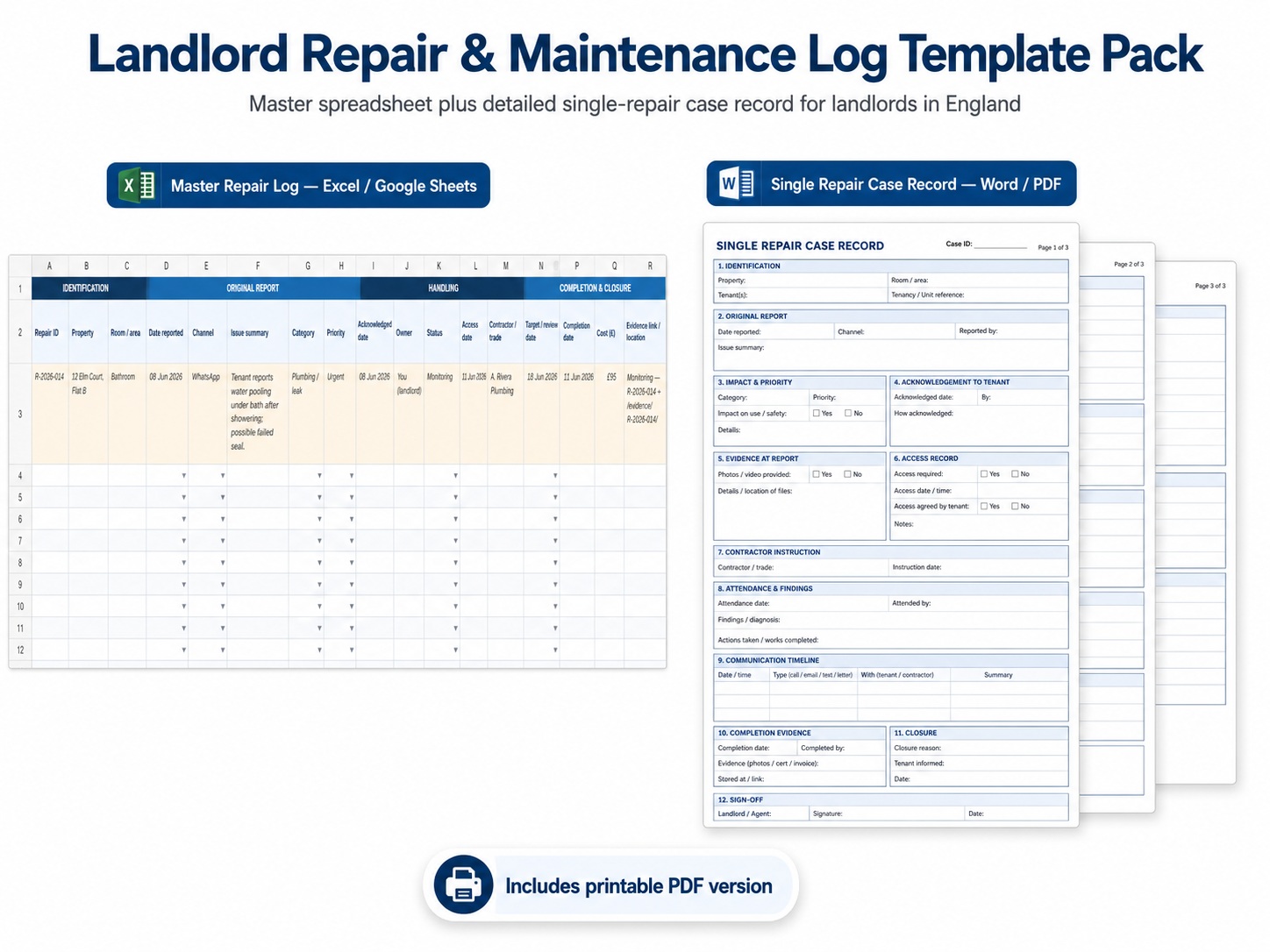
The free Landlord Repair and Maintenance Log Template Pack includes an Excel/Google Sheets-compatible master log, editable Word repair record, printable PDF and tenant repair request template.
Download the free landlord repair and maintenance log template
Free template pack for landlords managing properties in England.
How to use a rental property maintenance log: 12 steps
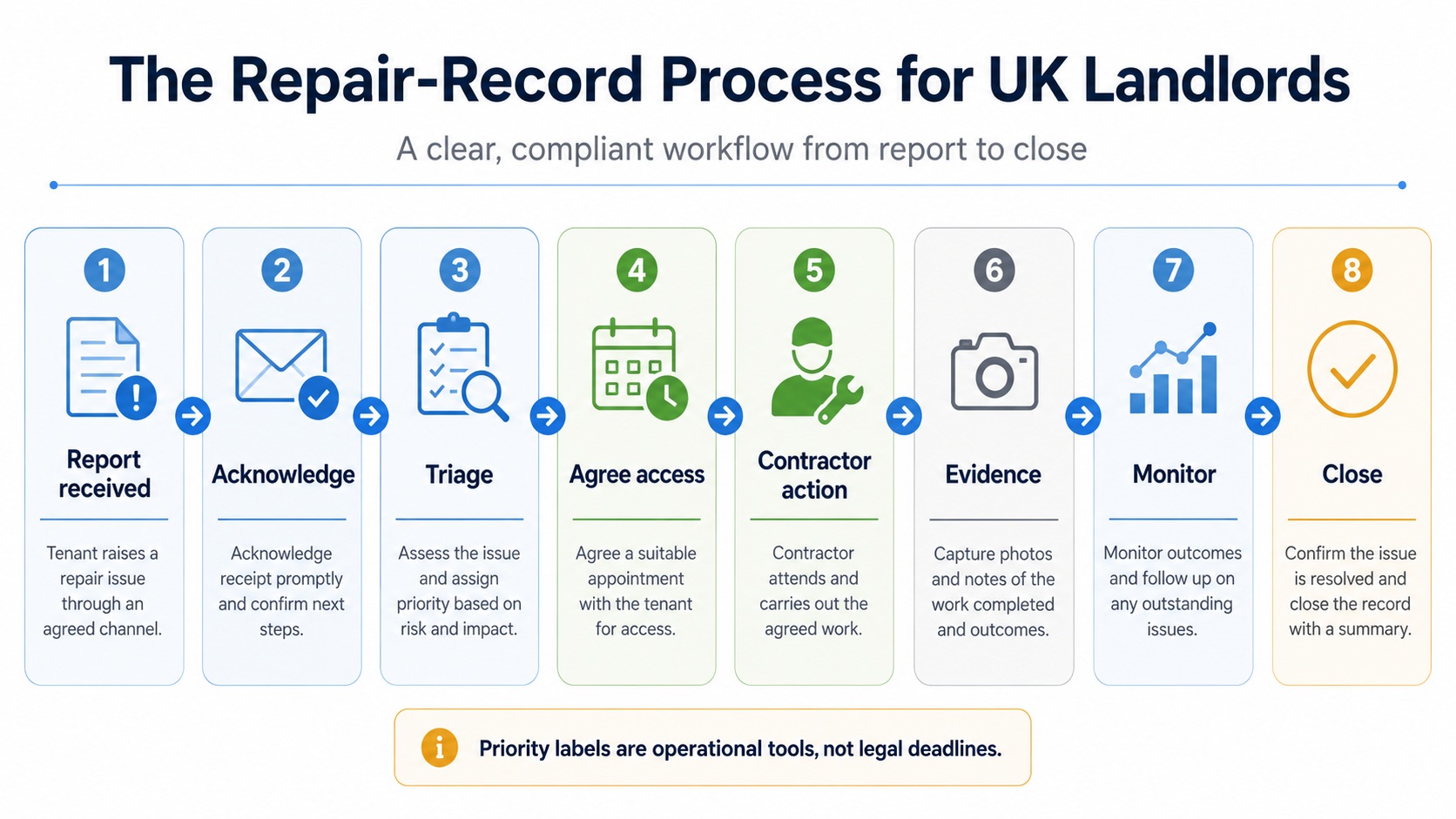
A good repair record follows the job chronologically. For this workflow, a tenant maintenance request or tenant repair request is the tenant’s original report of a defect or maintenance issue. That first report should start the log, even before responsibility is established or a contractor is booked.
The record for a bathroom leak reported on Monday should make sense to somebody opening it months later without needing access to your memory or message history.
If you do nothing else, record these five things
If the full workflow feels excessive for a straightforward repair, do not abandon the record altogether. At minimum, capture:
- when and how the issue was reported;
- what was reported and which property or room it affects;
- your acknowledgement and next action;
- access, contractor attendance and what was found; and
- the evidence and reason used to close the case.
For anything safety-related, recurring, disputed or still unresolved, use the fuller case record below.
1. Create the repair record when the report arrives
Do not wait until you have decided who is responsible or found a contractor.
Record:
- repair ID;
- property and room;
- date and time received;
- reporting channel;
- who reported it;
- neutral summary; and
- link or reference to the original message, email or photograph.
For a phone call, make a dated call note. You do not need to reproduce a ten-minute conversation word for word.
2. Acknowledge the tenant repair request
Tell the tenant what you understand the issue to be and what happens next.
14/07/2026 09:05 — acknowledged bathroom leak. Told tenant plumber would be contacted this morning and asked tenant to report immediately if water spread towards electrical fittings.
That is more useful than:
Replied to tenant.
3. Triage the risk without pretending to diagnose it
Record what has actually been reported:
Then record your operational priority and why.
Do not turn the tenant’s description into a contractor diagnosis. “Tenant reports burning smell from socket” and “electrical fault confirmed” are very different statements.
4. Ask only necessary follow-up questions
Useful questions might establish:
- when the problem first appeared;
- exact room or location;
- whether an essential service is affected;
- whether the problem is getting worse;
- whether there is visible water, mould, damage or another symptom; and
- whether a safe photograph or video is available.
The tenant should not be asked to perform specialist investigation.
5. Leave responsibility open until the evidence supports a conclusion
Record the initial responsibility as:
If the contractor later records that a bath seal has failed, attribute that finding:
Plumber found failed silicone seal to rear bath edge.
Avoid rewriting it as:
Landlord confirms structural leak
unless that is genuinely what has been established.
6. Record landlord access for repairs properly
Store:
- date the access request or notice was sent;
- proposed appointment;
- tenant response;
- agreed appointment;
- who will attend;
- rescheduling;
- failed or no access;
- stated reason, if known; and
- next action.
If an occupier needs an appointment adjusted for a mobility, communication or other access need, record only the practical information necessary to organise the work. Health or disability information can be special-category personal data, which requires additional justification under UK data-protection law, so avoid recording diagnoses or medical history unless that information is genuinely necessary and lawfully processed.
7. Record the contractor instruction before attendance
A simple instruction record could read:
Also capture the contractor/trade, instruction date, quotation or approved limit where relevant, appointment and work-order reference.
8. Record meaningful tenant updates
If the plumber moves the appointment from Thursday to Friday, that belongs in the timeline.
An automated “message delivered” notification usually does not.
The test is simple: would this entry help explain what the tenant had been told and what the landlord intended to happen next?
9. Separate attendance, findings and completed work
“Plumber attended” is not the same status as “repair complete”.
If another trade is needed, the job remains open.
An intermittent electrical fault is a good example. An electrician attending does not justify closing the record if the finding, test result or recommended follow-on work is still outstanding.
10. Collect the completion evidence
Depending on the job, that could include:
- invoice;
- job sheet;
- before and after photographs;
- relevant test or remedial certificate;
- parts or warranty information; and
- contractor recommendations.
Name files so that they remain connected to the repair:
REP-2026-041_Plumber-Invoice_2026-07-16.pdf
is far stronger than:
invoice-new-final2.pdf
11. Confirm the result or monitor it
For the bathroom leak, you might not close the record immediately.
Instead:
Review date: 23/07/2026
Ask whether further water has appeared after normal use.
On 23 July:
Now the record has a defensible reason for moving towards closure.
If the repair fails or the same symptom returns, reopen the case or link the new report to the earlier repair ID. Record any contractor warranty or call-back terms that apply rather than assuming a standard period.
12. Close the case with a reason
Possible administrative closure reasons, where no unresolved repair or safety action remains untracked, include:
- completed and outcome checked;
- transferred or escalated to another responsible party, with any action that remains the landlord’s responsibility still tracked;
- no defect found after reasonable investigation;
- request withdrawn, after checking that there is no unresolved repair, safety issue or statutory duty requiring further action;
- linked to a replacement or larger works case, with outstanding action actively tracked under the successor case; or
- another clearly recorded outcome.
Do not use “closed” as a substitute for explaining what happened.
A practical set of statuses is:
“Contractor booked” and “complete” should never mean the same thing.
Rental property maintenance log evidence checklist: what to keep
For a more complex job, one spreadsheet row will not hold the whole story. Use the rental property maintenance spreadsheet as the master index and connect each row to a detailed repair case record and evidence folder. Across several properties, the problem is usually not creating the row; it is keeping photographs, access notes, invoices, certificates and contractor findings attached to the right case and easy to retrieve later.
An intermittent electrical fault illustrates why. The spreadsheet might say:
The supporting case should explain whether the tenant reported loss of power, tripping, heat or a smell; when the electrician attended; what was tested; what was found; whether anything was isolated; and whether follow-up work remains.
A useful repair record contains these areas.
Identification
Record the repair ID, property, room or area, issue category and status.
Avoid turning the master spreadsheet into a tenant database. The property and repair reference are usually more useful than unnecessary personal identifiers.
Original report
Keep the date and time received, channel, reporter, exact description or a neutral summary, and a stable reference to the original evidence.
Impact and priority
Record the reported effect on safety, essential services, property damage and normal use of the home.
If you assign “urgent”, add five words explaining why.
Urgent — active leak continuing into flooring
is useful.
Urgent
on its own is not.
Acknowledgement
Record when and how you responded, what you understood, any immediate safety advice and the next promised action.
Evidence at report stage
Store photographs and video only where useful. A wide photograph showing location plus a closer photograph showing the defect is often more useful than ten near-identical images.
Access history
Record requests, notice, responses, agreed appointments, rescheduling and failed access.
If access becomes a recurring problem, keep the chronology rather than repeatedly overwriting the previous appointment.
Contractor instruction and findings
Keep the contractor or trade, scope, instruction date, quote, attendance and work-order reference.
Attribute technical conclusions properly:
- Tenant reported: socket intermittently loses power.
- Landlord observed: no visible heat damage.
- Electrician found: loose termination at socket.
Those are three separate pieces of evidence.
Communication timeline
Keep messages that alter the plan, appointment, promised action or understanding of the problem.
Do not paste the entire WhatsApp conversation into every record.
Completion and monitoring
Store the invoice or job sheet, completion date, photographs where useful, certificates or test evidence where relevant, warranties, recommendations and any review date.
Closure
Record the outcome, why the case was closed, any tenant confirmation and links to related repeat issues.
A recurring leak should not disappear into six unrelated spreadsheet rows. Link the previous repair IDs so the pattern is visible.
Keep personal information proportionate
Repair messages and photographs can contain personal data. ICO guidance says organisations should limit personal data to what they need, keep it secure and not retain identifiable information for longer than necessary for the purpose.
may be all the contractor-planning record requires.
A lengthy description of somebody’s medical history probably is not.
Common rental property maintenance log mistakes
The weakest maintenance logs do not usually fail because they lack columns. They fail because the entries are made too late, use vague language or treat activity as completion.
Starting the log when the contractor is booked
If a tenant reported a leak on 2 June and the plumber was instructed on 6 June, starting the record on 6 June loses four days of the chronology.
Start with the first report.
Treating 24 hours as a repair deadline
The 24-hour figure relates to access notice, not a universal repair-completion deadline. Set the repair priority and review date from the actual risk and circumstances.
Closing the job because somebody attended
A contractor attending at 14:00 does not prove the defect was fixed at 14:01.
Record the finding, work, remaining action and evidence first.
Writing “boiler sorted”
Three months later, that entry tells you almost nothing.
Prefer:
Blaming the tenant before the evidence exists
Suppose a tenant sends one photograph of mould beside a bedroom window.
Do not immediately write:
Tenant caused mould through condensation.
Record what is actually known:
Tenant reports black mould around bedroom window reveal. Photograph received 04/08/2026. Heating/ventilation conditions not yet assessed. Inspection required.
Causation can follow the evidence.
Ignoring failed access
An appointment that could not proceed is still part of the repair record.
Record what was proposed, the tenant’s response, what happened and the next attempt. Do not convert “24 hours’ notice sent” into “permission obtained”.
Collecting too much personal information
A repairs spreadsheet should not become a repository for health histories, family disputes or unrelated tenant information.
Keep what is necessary for the repair, access and communication process.
Leaving the evidence in disconnected folders
The invoice in email, photographs on your phone and tenant update in WhatsApp are not yet an organised repair record.
Connect them through the repair ID and stable evidence references.
Treating repeated defects as unrelated jobs
If REP-2026-014, REP-2026-029 and REP-2026-061 all concern water appearing below the same bathroom, link them.
Recurrence is itself useful property information.
Treating the log as proof that everything was legally correct
A beautiful spreadsheet can accurately show that a repair took six weeks.
It cannot decide whether those six weeks were reasonable.
The log records the evidence. It does not replace competent contractors, professional assessment or legal advice.
Frequently asked questions about landlord repair logs
Is a landlord legally required to keep a maintenance log?
No — there is no general England-wide rule requiring private landlords to use one prescribed maintenance-log format. The underlying repair and fitness duties still apply.
A log is useful operationally and evidentially because it can preserve when the problem was reported, what was communicated, access attempts, contractor findings and completion evidence. Those duties apply regardless of whether the landlord uses Excel, software, paper files or another system.
How quickly must a landlord respond to a tenant repair request?
There is no single statutory completion period covering every private rented repair.
Shelter describes the requirement in terms of a reasonable time, depending on matters such as seriousness, urgency and the vulnerability of the occupants.
A sensible log therefore separates the date reported, acknowledgement, emergency or interim action, contractor target, review date and actual completion rather than relying on one generic deadline.
What should a rental property maintenance log include?
At minimum, record:
- repair ID and property;
- date and method reported;
- issue and reported impact;
- acknowledgement;
- operational priority;
- access history;
- contractor instruction and findings;
- meaningful tenant updates;
- completion evidence;
- monitoring or review date; and
- closure reason.
For evidence-heavy cases, link the spreadsheet row to a detailed single-repair record rather than trying to fit everything into one cell.
What should a landlord record if a tenant refuses access for repairs?
Record the access request or notice, proposed appointment, tenant response, alternatives offered, any relevant risk explained and the next action.
Do not simply write “tenant refused” if what actually happened was that the tenant could not make one proposed appointment.
GOV.UK says landlords normally need to give at least 24 hours’ notice for repair or inspection access, with immediate access potentially possible in emergencies. The practical and legal response to persistent access problems can depend on the circumstances, so seek appropriate housing legal advice where necessary rather than forcing entry.
Can a landlord ask a tenant to send photographs of a repair problem?
Yes, where photographs are a safe, useful and proportionate way to clarify what has been reported.
Do not ask a tenant to dismantle equipment, climb, enter an unsafe area or investigate a gas, electrical, structural or other specialist fault.
Treat photographs as part of the property record and potentially as personal data: store and share them securely, collect only what you need and review how long they need to be retained.
Download the free Landlord Repair and Maintenance Log Template
The most useful repair record shows the chain from first report to evidence-backed closure.
A landlord with several properties should be able to open REP-2026-041 and see the original bathroom-leak report, acknowledgement, access date, plumber’s finding, invoice, after-photo, seven-day monitoring period and final tenant confirmation without searching four different systems.
Download the free repair-log pack
The pack is designed for use without CertNudge and includes the master spreadsheet, detailed case record, printable version and tenant repair request template.
Download the free landlord repair and maintenance log template
Excel/Google Sheets-compatible master log, editable Word record, printable PDF and tenant repair request template.
For safety-related remedial work, the resulting invoice, certificate, report or supporting evidence may also belong with the property’s wider compliance record.
CertNudge helps landlords keep compliance certificates and supporting evidence organised by property, with expiry tracking, reminders, secure sharing and inspection-ready compliance packs. It is not a maintenance-ticketing system, contractor-dispatch platform or 24-hour emergency repair service.
A practical action for this week: take the next repair report you receive, assign it a repair ID immediately and keep that ID attached to every access note, contractor document and completion record until the case is genuinely closed.
This article is for general information only and is not legal advice. Regulations and official guidance change, and individual repair responsibilities depend on the property, tenancy and circumstances. Always check current GOV.UK guidance and use a suitably qualified contractor or other competent professional for the work involved. Where responsibility, access rights, disrepair liability or a dispute requires legal interpretation, speak to a housing solicitor or qualified housing professional.
Last reviewed: 18 August 2026
Next review recommended: October 2026, then every six months, or sooner if the PRS Database/Ombudsman timetable changes, PRS Awaab’s Law regulations or consultation are published, HHSRS guidance changes, or relevant ICO guidance is materially updated.