
Awaab's Law for Private Landlords: What to Record Now
Awaab's Law does not yet apply to private landlords in the same way as social landlords, but PRS rules are coming. Here is what landlords should record now.
Awaab's Law does not yet apply to private landlords in England in the same form as it applies to social landlords. It came into force for social landlords on 27 October 2025. The Government has confirmed that Awaab's Law will be extended to the private rented sector under the Renters' Rights Act 2025, but the detailed PRS rules and implementation date are still subject to consultation. For now, private landlords should focus on building clear, dated repair and evidence records by property.
Key takeaways
- Awaab's Law is currently in force for social landlords only, from 27 October 2025. It does not yet apply in the same form to private landlords.
- The Government has committed to extending Awaab's Law to the private rented sector, but the detailed rules and implementation date are still subject to consultation.
- Headlines suggesting private landlords now have 24-hour mould deadlines are misleading. The social-housing timescales are not yet PRS law.
- The sensible move now is to keep a clear, dated record of damp, mould and repair issues by property, so you are not building evidence under pressure later.
- Clear documentation also helps with HHSRS-related complaints, council inspections and disrepair disputes, not just future Awaab's Law obligations.
This article is for general information only and is not legal advice. Regulations change and individual circumstances vary — always check the latest guidance at GOV.UK or speak to a qualified housing professional or solicitor.
A Birmingham landlord opens WhatsApp on a Tuesday evening. Her tenant has sent photos of black spots on the bathroom ceiling. She remembers seeing something similar back in February, when a contractor came round and said something about the extractor fan. She acted on it then. But she would struggle to prove exactly what was reported, when she replied, or what the contractor actually found.
That is the problem Awaab's Law exposes for private landlords. The law is already live for social landlords. For the private rented sector, the Government has said the rules are coming, but the detail is still being consulted on. Do not panic. Start keeping cleaner, more organised records now, while there is still time to build the habit without enforcement pressure.

Important: Awaab's Law is already in force for social landlords. For private landlords in England, the Government has confirmed its intention to extend it to the private rented sector, but the detailed PRS rules and implementation date are still subject to consultation. This article explains what is known now and what landlords can sensibly prepare for.
Does Awaab's Law apply to private landlords?
Not yet, at least not in the form that now applies to social landlords.
Awaab's Law sits within the Hazards in Social Housing (Prescribed Requirements) (England) Regulations 2025, which came into force on 27 October 2025. The regulations apply to social landlords — local authorities and registered providers such as housing associations — and not yet to private landlords in England.
Separately, the Government has committed to extending Awaab's Law to the private rented sector. That commitment sits inside the Renters' Rights Act 2025 implementation roadmap, published in November 2025. The roadmap currently places the PRS extension in Phase 3 and says the timescales for implementing Awaab's Law in the private rented sector will be subject to consultation.
In practice, private landlords today are not subject to the specific 24-hour, 10-working-day and 5-working-day deadlines that apply in social housing. The direction of travel is settled even if the timetable is not, and a landlord planning to hold property into 2027 and beyond would be unwise to ignore where things are heading. For wider context on the reforms rolling out from late 2026, see our guide to the new PRS Database and how landlords in England can prepare.
Example: A landlord in Sheffield sees a Facebook post claiming "all landlords now have 24 hours to deal with mould". She has two flats and panics. The post is misleading. The 24-hour rule applies to social landlords, the PRS extension is still subject to consultation, and overpromising response times to tenants now risks creating commitments that do not match whatever the final PRS rules require.
What Awaab's Law currently does in social housing
It helps to understand the source law, because the PRS version is likely to be influenced by the same policy model, even if the details remain subject to consultation.
Awaab's Law is named in memory of 2-year-old Awaab Ishak, who died in 2020 following prolonged exposure to mould in his social rented home. The social-housing regime is intended to make sure serious hazards are investigated and made safe within fixed timeframes.
Phase 1 of Awaab's Law, in force from 27 October 2025, focuses on two categories: emergency hazards, and significant damp and mould hazards. Under the regulations and the GOV.UK guidance for social landlords, social landlords must:
- investigate potential emergency hazards within 24 hours of becoming aware, and complete relevant safety works within the same 24-hour window where an emergency hazard is confirmed
- investigate potential significant hazards, including damp and mould, within 10 working days
- provide a written summary of investigation findings to the tenant within 3 working days of completing the investigation
- undertake relevant safety work within 5 working days of the investigation concluding, where a significant hazard is confirmed, and begin or take steps to begin any supplementary preventative work to stop the hazard recurring within the same period
- physically start supplementary preventative work within 12 weeks where it cannot reasonably begin sooner
Where relevant safety work cannot be completed within the required timeframe, social landlords must also secure suitable alternative accommodation for the household, at the landlord's expense, until the hazard is resolved. These duties are not optional for social landlords from 27 October 2025, and the next social-housing phases are expected in 2026 and 2027, widening the regime to more HHSRS hazards.
Do not copy these deadlines across blindly. These Phase 1 timescales apply to social landlords from 27 October 2025. They are not yet confirmed as PRS law. Treat them as a useful reference point for preparation, not as current private-landlord deadlines.
A landlord with two terraced houses might read the guidance and assume "10 working days" is now her legal deadline. It is not. But adopting that as an internal target is reasonable preparation for whatever the PRS version eventually requires.
What is expected to change for private landlords?
The Renters' Rights Act 2025 received Royal Assent on 27 October 2025 and is being implemented in phases. The Government's roadmap puts the security of tenure reforms first, followed by the PRS Database and PRS Landlord Ombudsman, then the standards work, which includes Awaab's Law and a modernised Decent Homes Standard.
For private landlords, the practical points are:
- Awaab's Law is expected to be extended to the private rented sector in Phase 3.
- The Government says it will set clear legally enforceable timeframes for PRS landlords to make homes safe where they contain serious hazards.
- The exact deadlines, covered hazards, enforcement route and start date are not yet fixed because implementation timescales remain subject to consultation.
- Once PRS regulations are in force, tenants may be able to challenge non-compliance through the courts, and complaints may also be escalated through the new Private Rented Sector Landlord Ombudsman route. This will be separate from the Housing Ombudsman route that currently applies in the social housing sector.
For portfolio landlords, this is the useful framing. The Government has signalled that legally enforceable repair timescales for serious hazards will be part of the PRS regime. The detail is not yet fixed, but the direction of travel is clear: landlords will need to show not only that they acted, but when they acted and what evidence they kept.
Scotland, Wales and Northern Ireland have their own housing regimes and are not covered by the PRS extension of Awaab's Law in England. Landlords in those nations should check the relevant devolved guidance.
Note: Regulatory timelines are based on the Government roadmap and published guidance available in May 2026. Implementation dates and detailed PRS requirements may change as consultation and secondary regulations progress.
Example: A portfolio landlord with five Victorian terraces in Leeds — three with a history of condensation issues — has a choice to make. Waiting for final rules is risky on two fronts. Those properties are already exposed to HHSRS complaints under current law. And when the PRS version of Awaab's Law lands, response times will need to be evidenced, not just intended.
Why private landlords should prepare now
Even without Awaab's Law extending to the PRS, damp and mould complaints already carry real operational risk under current law. Councils can already assess damp and mould under the Housing Health and Safety Rating System, known as HHSRS, and use Housing Act 2004 enforcement powers, including improvement notices and, in serious cases, prosecution where the legal tests are met. Tenants can already claim disrepair. None of that is new.
HHSRS is the risk-based system councils use to assess housing hazards. GOV.UK guidance says privately rented homes must be free from the most serious category 1 hazards, and that this includes mould and all types of dampness. Local councils have a duty to take enforcement action if they identify a category 1 damp and mould hazard, and they have power to act where they identify a category 2 hazard. For what a council visit actually involves, see our guide to HHSRS inspections for landlords in England.
Damp and mould may also engage repairing obligations where the cause is structural disrepair, a leak, defective guttering, faulty plumbing, inadequate heating installations or another repair issue. In those cases, Section 11 of the Landlord and Tenant Act 1985 may be relevant, alongside wider duties under the Homes (Fitness for Human Habitation) Act 2018 where the condition is serious enough.
GOV.UK's Understanding and addressing the health risks of damp and mould in the home guidance says landlords should take damp and mould concerns seriously, assess them with urgency, tackle the underlying causes promptly, and avoid blaming damp and mould on "lifestyle choices".
What is shifting is the expectation around speed and around the quality of the paper trail. The Awaab's Law model, even in its social-housing form, runs on dates, timestamps and written communication. It is reasonable to expect the eventual PRS version to emphasise the same kind of dated record-keeping, though the final rules are not yet published.
Most private landlords operate in good faith. The weak point usually is not willingness to act. It is the inability to reconstruct what was done, when, by whom, and with what follow-up. A landlord who replied quickly to a damp report, sent a contractor, authorised remedial work and followed up afterwards is in a strong position substantively. If that whole sequence only lives in a WhatsApp thread, an email folder and a kitchen drawer, defending it six months later becomes much harder than it needs to be.
Say a tenant reports mould by WhatsApp in January. The landlord acknowledges it, arranges a contractor for the following week, sends ventilation advice and authorises remedial work. By July, the tenant has moved out and complained to the council. The landlord has the messages somewhere, but the timeline is fragmented across his personal phone, a Gmail account and a contractor invoice in a separate inbox. The work was done; the evidence cannot be produced cleanly.
For how repair documentation fits into the wider compliance picture, see our essential landlord compliance audit for England.
What evidence should private landlords start keeping?
Think of this as the file you would want to hand to a council officer, an insurer or a solicitor if a damp complaint escalated. The aim is not to over-document. It is to make the timeline reconstructable later.
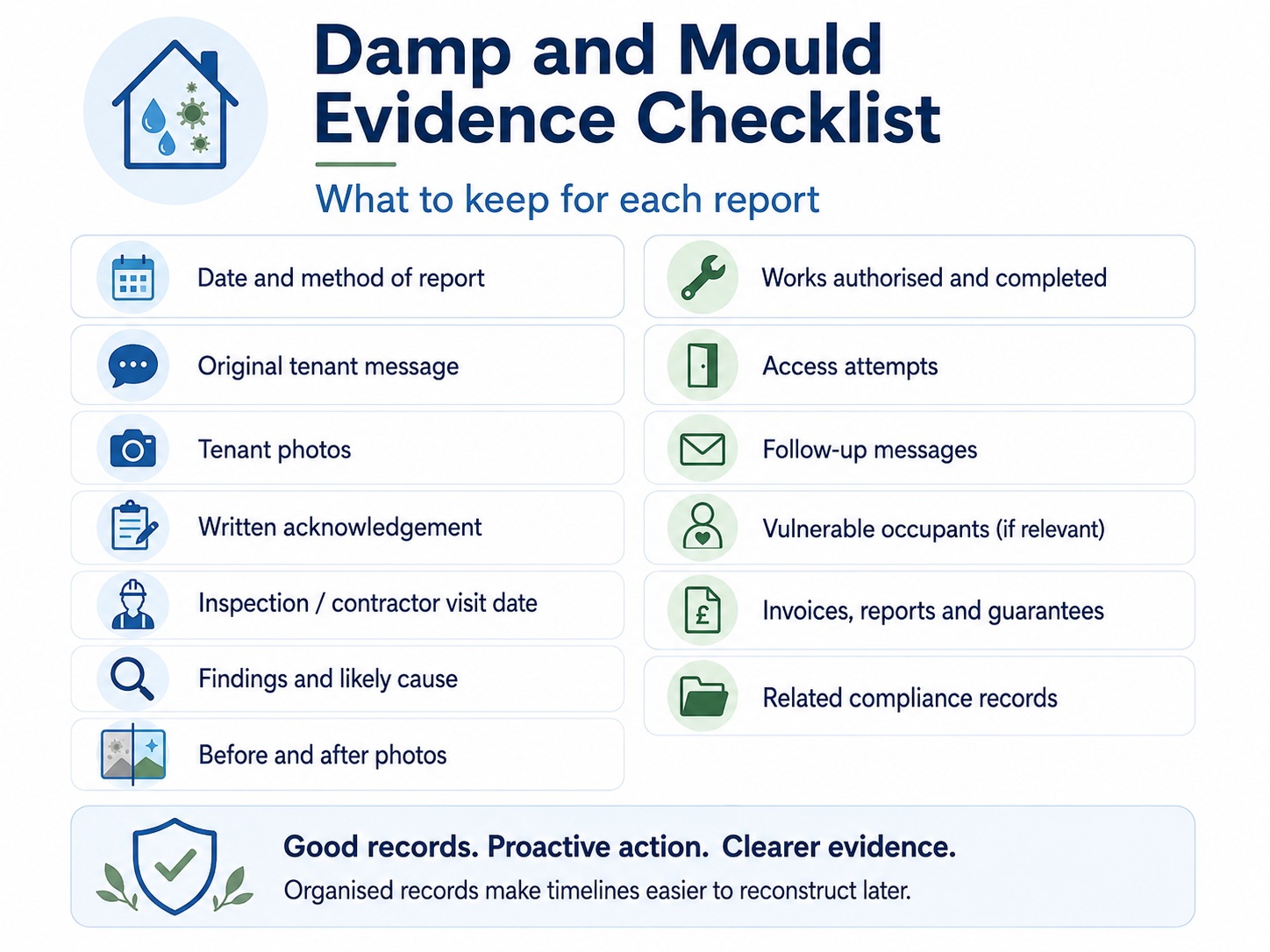
Free download: Damp & Mould Evidence Record (PDF)
A branded, printable version of the checklist below, one fillable sheet per report, with space for dates, contractor findings and evidence, so your timeline is ready if a council ever asks.
Download the free template →A practical evidence checklist for each damp or mould report
- date and method of the tenant's report, such as WhatsApp, email, phone or in person
- the original wording of the report, or a screenshot or export
- any photos the tenant supplied
- your written acknowledgement to the tenant
- the date of your inspection or contractor visit
- the contractor's findings and any notes on cause
- before and after photos of the work
- the works authorised and the date of completion
- any access attempts where the tenant did not allow access
- notes on vulnerable occupants where relevant and appropriate
- follow-up messages after the work
- any advice you gave the tenant, for example on ventilation or heating use
- any repeat reports or recurrence
- copies of contractor invoices, reports and guarantees
- relevant compliance records, such as EICR, Gas Safety, smoke and CO alarm checks, and extractor fan repairs
GOV.UK's Awaab's Law guidance for social landlords recommends clear records of engagement, investigations and communications, plus robust knowledge and information management. That language is being prescribed for social landlords, but a private landlord preparing for the PRS extension would do well to adopt the same operating principle now.
A spreadsheet helps up to a point. A property-by-property spreadsheet can hold dates and notes, but it tends to fall apart once photos, contractor reports and tenant messages come into the mix. We wrote about that gap in our landlord compliance spreadsheet template piece: useful for simple tracking, fragile for full audit reconstruction.
Imagine three damp reports across two properties in a single year. One turns out to be condensation, one a slow leak under a bath, and one a failed extractor fan. With structured records, each has its own clear story. Without them, the three blur into "there were mould complaints", which is exactly the framing no landlord wants in front of a council officer.
Not sure which of your properties are missing certificates before a council asks? Run a free compliance check — enter your properties and see at a glance what's current, what's expiring and where your exposure sits. No account, no upload, under a minute.
A practical damp and mould response workflow for landlords
This is a workflow, not a legal duty. Treat it as your internal preparation routine rather than a recital of Awaab's Law rules.
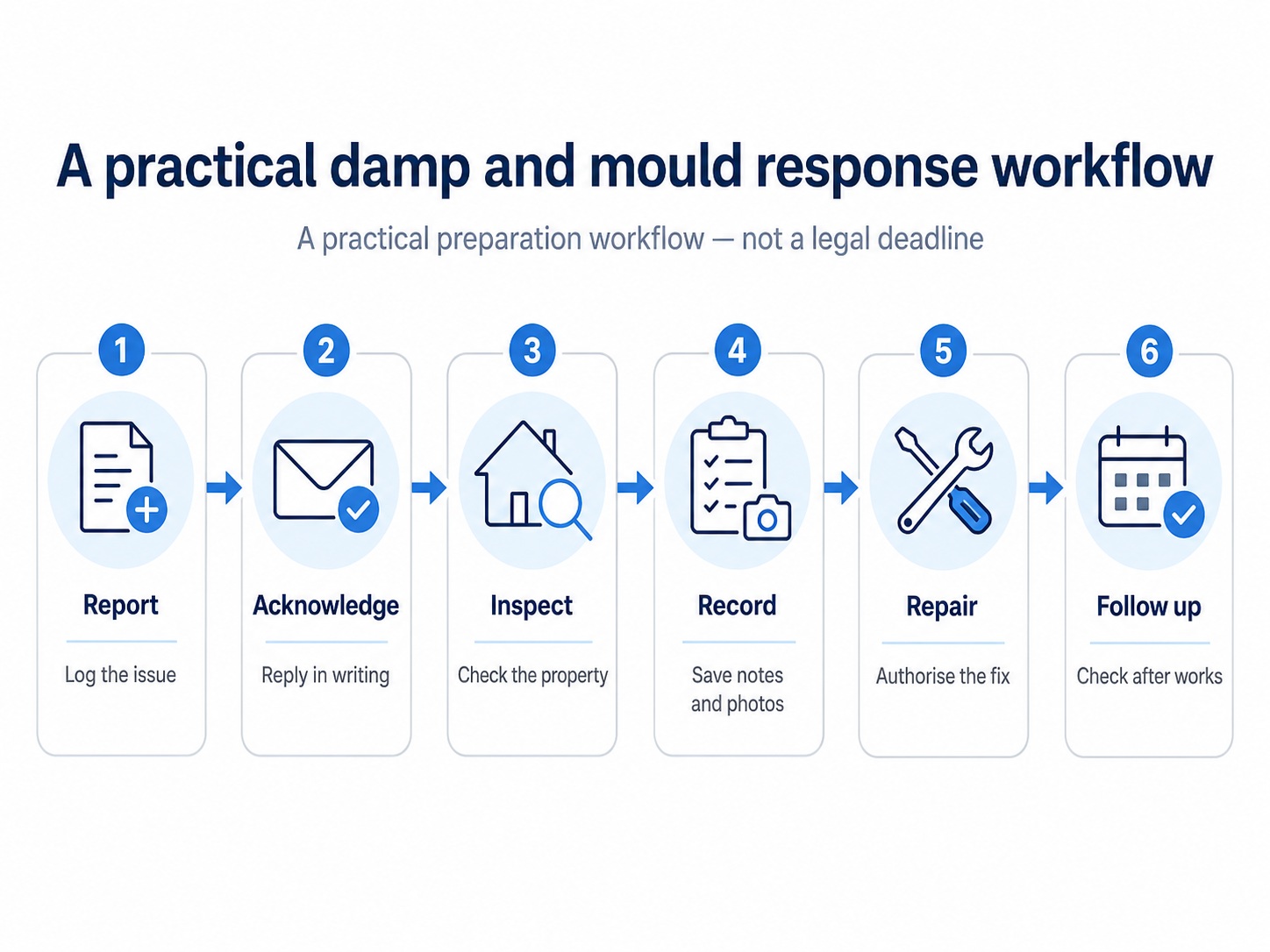
- Log the report on the same day it arrives. Capture the source, such as WhatsApp, email or phone, and the exact wording.
- Reply to the tenant in writing. Even a short acknowledgement confirming you have received the report and will arrange an inspection counts as evidence.
- Triage urgent risks. Look for water ingress, electrical issues, very young children, elderly occupants, or anyone with asthma or respiratory conditions, and treat anything urgent as urgent. Do not wait for medical evidence before acting on serious damp or mould. Record relevant vulnerability information the tenant has volunteered or that you already know, and respond promptly.
- Arrange an inspection or contractor visit. Aim for promptness rather than perfection: a holding response within a few days beats a perfect inspection three weeks later.
- Capture photos and findings from the inspection. Date them and save them against the property record.
- Identify the likely cause rather than defaulting to "tenant lifestyle". Condensation, a leak, ventilation failure, cold-bridging and rising damp all need different responses, and the cause needs evidencing whatever it turns out to be.
- Record access attempts if the tenant is not available. A missed appointment, properly logged, protects you later.
- Authorise the remedial works. Keep the invoice and store the contractor's notes alongside it.
- Follow up with the tenant a few weeks after the work. A short check-in message is both good practice and useful evidence.
- Store the complete record against the property. Do not leave the only record in a personal inbox or phone gallery.
A portfolio landlord with eight properties needs this to be repeatable, so that every mould report is handled the same way whether it lands in a quiet week or during a Christmas backlog, and so that the audit trail it leaves looks the same shape every time.
Common mistakes private landlords should avoid
Most of the common errors come from acting in good faith but documenting in chaos.
The biggest pattern to avoid is assuming Awaab's Law already applies to the PRS exactly as it applies to social housing, then either overreacting or freezing. Both responses are bad.
Other recurring mistakes include:
- ignoring the issue because PRS dates are TBC, when current HHSRS and disrepair routes already expose you
- blaming "lifestyle" or condensation without inspecting, which leaves you with no evidence either way
- keeping the only record of tenant communication in WhatsApp on a personal phone
- not logging access attempts when the tenant refuses or cancels appointments
- cosmetic mould cleaning that does not address the underlying cause, with no record of why a deeper investigation was ruled out
- sending a contractor and losing track of the contractor's notes and photos
- treating each report in isolation rather than linking it back to the property's history
The pattern most likely to cost you: a contractor attends to mould in a bathroom, cleans the visible spots, mentions in passing that the extractor fan is "tired", and leaves. Three months later the mould returns. The tenant complains to the council. No inspection record, no contractor note about the fan, no follow-up plan.
FAQs
Does Awaab's Law apply to private landlords?
Not yet, not in the form that now applies to social landlords. Awaab's Law came into force for social landlords on 27 October 2025. The Government has confirmed its intention to extend it to the private rented sector under the Renters' Rights Act 2025, with the detailed rules and implementation date subject to consultation.
When will Awaab's Law apply to private rented homes?
The Government's implementation roadmap currently places the PRS extension in Phase 3 and says timescales are subject to consultation. No firm date has been confirmed. Treat any specific date as commentary, not law, until the Government publishes the relevant consultation response and regulations.
Do private landlords have to fix mould within 24 hours under Awaab's Law?
No. The 24-hour rule for emergency hazards is a social-housing rule and not yet a confirmed PRS rule. Treating serious damp and mould as urgent, and having a routine that proves you did, is still sensible preparation.
What records should landlords keep for damp and mould complaints?
At a minimum: the tenant report with date and original wording, photos, your written acknowledgement, the inspection or contractor visit date, contractor findings, the works authorised, before and after photos, invoices, follow-up messages and any access attempts. Linking all of that to the specific property, rather than scattering it through a personal inbox, is what makes the record usable later.
Is Awaab's Law only about damp and mould?
In its first phase for social housing, Awaab's Law focuses on emergency hazards and significant damp and mould hazards. Later social-housing phases expand it to more HHSRS hazards through 2026 and 2027. The PRS version may follow the same broad model, but the precise scope, deadlines and enforcement route will be set after consultation.
Should landlords wait until the PRS rules are confirmed?
No. Damp and mould complaints are already a risk under current law. Cleaner record-keeping costs little to start now and far more to build under enforcement pressure later.
Keep repair evidence organised before you are asked for it
The clearest lesson from the social-housing rollout is not the timescales. It is the assumption baked into the regime that a landlord can produce a clean, dated, property-by-property record of what happened and when.
CertNudge helps landlords keep compliance and repair evidence organised by property.
It is not legal advice, and it does not verify that a repair was carried out correctly or that a certificate is authentic. What it does is help you organise certificates, contractor notes, repair evidence, exported messages, photos and supporting records against each property, so that when a council, insurer or solicitor asks for the timeline, you have one, instead of a search through three inboxes and a folder of phone photos.
For portfolio landlords managing several BTLs, the value is repeatability and inspection-readiness. See how inspection-ready compliance records work in CertNudge.
Last reviewed: 26 May 2026
Next review recommended: 26 November 2026, sooner if the Government publishes its consultation on PRS implementation of Awaab's Law.