Selective Licensing for Landlords: How to Check If Your Property Needs a Licence
Selective licensing can apply to ordinary rental properties, not just HMOs. Learn how to check your property against the council scheme, verify exemptions, apply if required and keep the right records.
Key takeaways: selective licensing for landlords
- Selective licensing can apply to an ordinary privately rented house or flat, not just an HMO, if the property is inside a current council designation.
- There is no single official England-wide postcode checker that replaces checking the relevant council’s designation, dates and exact boundary.
- From 23 December 2024, councils in England can introduce selective licensing schemes of any size under the General Approval 2024, provided its conditions and Part 3 requirements are met.
- A Part 3 licence cannot be transferred to another person, so a purchaser should not assume the seller’s selective licence follows the property.
- Keep the check, application, council correspondence, licence conditions and actual expiry date together with the property record.
A two-bedroom family let can need a selective licence even though it is not an HMO. The deciding factors are the local scheme, the exact property location and any relevant exemption or alternative licensing route. Selective licensing is therefore something landlords need to check property by property.
This guide explains how to check whether your property needs a selective licence using official council information, how to verify the exact designation boundary, what to do if a licence is required and what evidence to keep.
This guide covers England. Different systems apply in Wales through Rent Smart Wales, in Scotland through private landlord registration, and in Northern Ireland through the Landlord Registration Scheme.
What is selective licensing?
Selective licensing is a local property-licensing regime under Part 3 of the Housing Act 2004. Section 80 allows a local housing authority to designate the whole or part of its area for selective licensing.
Where a designation applies, privately rented housing within its scope must be licensed, subject to statutory exemptions and the interaction with Part 2 HMO licensing. The national framework is explained in the GOV.UK selective licensing guidance and Part 3 of the Housing Act 2004.
The useful question is therefore not, “Am I a licensed landlord?” There is no national selective landlord licence covering an entire portfolio. The question is: does this particular rented property fall within a current selective licensing designation, and is it within scope?
Councils can use selective licensing only where one of the statutory routes is met. Section 80 of the Housing Act 2004 covers low housing demand and a significant and persistent problem caused by anti-social behaviour. The Selective Licensing of Houses (Additional Conditions) (England) Order 2015 adds routes concerning poor housing conditions, an influx of migration, deprivation and crime, each subject to the further conditions in the Order.
These are tests for the council when making a designation, not tests an individual landlord applies to decide whether to obtain a licence.
Why selective licensing matters more now
A national procedural change took effect on 23 December 2024. Under the Housing Act 2004 General Approval 2024, English local housing authorities no longer need individual Secretary of State confirmation before implementing a selective licensing designation of any size, provided the designation satisfies the General Approval condition and the statutory requirements in Part 3.
The General Approval requires consultation with people likely to be affected for not less than 10 weeks. You can read the Housing Act 2004 General Approval 2024 on GOV.UK.
As at 3 September 2026, current council activity shows why. Leeds began a new selective licensing scheme in designated parts of six wards on 9 February 2026. Croydon’s new scheme is due to start in selected wards on 25 September 2026. In Islington, landlords and managing agents can start applying for licences under the new designation from 7 September 2026, with the scheme and licences taking effect from 23 November 2026.
See the current Leeds selective licensing information, Croydon Selective Licensing Scheme 2026 and Islington property licensing information.
A landlord might therefore have checked an address in 2024 and correctly recorded “no selective licence required”. That record only shows the position at the time. If the council subsequently makes a designation covering the address, the property needs to be reviewed against the new scheme.
For a portfolio landlord, that matters because the trigger is property-specific. Five rentals can produce five different answers if they sit under different councils or on different sides of designation boundaries.
Selective licensing vs HMO and additional licensing
Selective licensing, mandatory HMO licensing and additional HMO licensing all sit within the property-licensing framework, but they should not be treated as interchangeable.
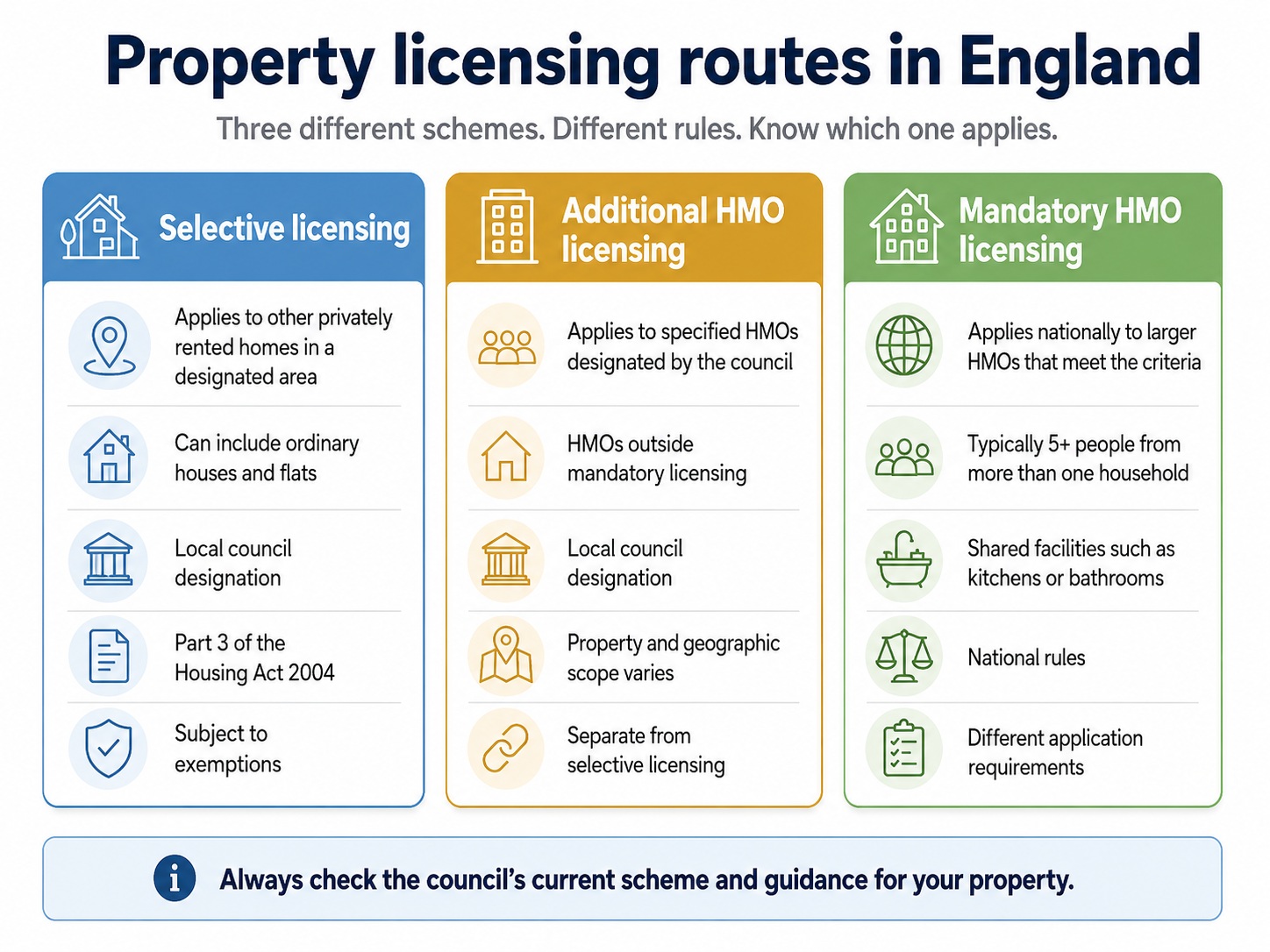
- Mandatory HMO licensing: applies nationally to HMOs meeting the prescribed criteria. GOV.UK describes the main mandatory category as properties occupied by five or more people forming more than one household, with facilities such as kitchens or bathrooms shared.
- Additional HMO licensing: allows a council to designate specified HMOs that fall outside mandatory licensing. Its geographical and property scope depends on the local scheme.
- Selective licensing: applies to other privately rented housing within a designated area and can therefore include ordinary single-household houses and flats. Under the Part 3 framework, a selective licence is not required where the property is an HMO that is required to be licensed under Part 2. That does not mean every HMO is automatically outside selective licensing: if an HMO is not required to be licensed under Part 2, it can still fall within a Part 3 selective designation, subject to the local scheme and relevant exemptions.
Suppose a postcode search tells a landlord that a shared house lies inside a selective licensing area. Applying immediately for a selective licence could still be the wrong move. The occupancy needs checking first because mandatory or additional HMO licensing may be the relevant route.
This article does not cover HMO operating standards in detail. If the property is occupied by multiple households, use the council’s licensing information alongside the current GOV.UK HMO guidance before deciding which application is required.
How to check if your property needs a selective licence
There is no single official national selective licensing checker that can make this decision for you. For a landlord managing several properties, the dependable approach is to verify each address against the council’s current scheme information using the same process every time.
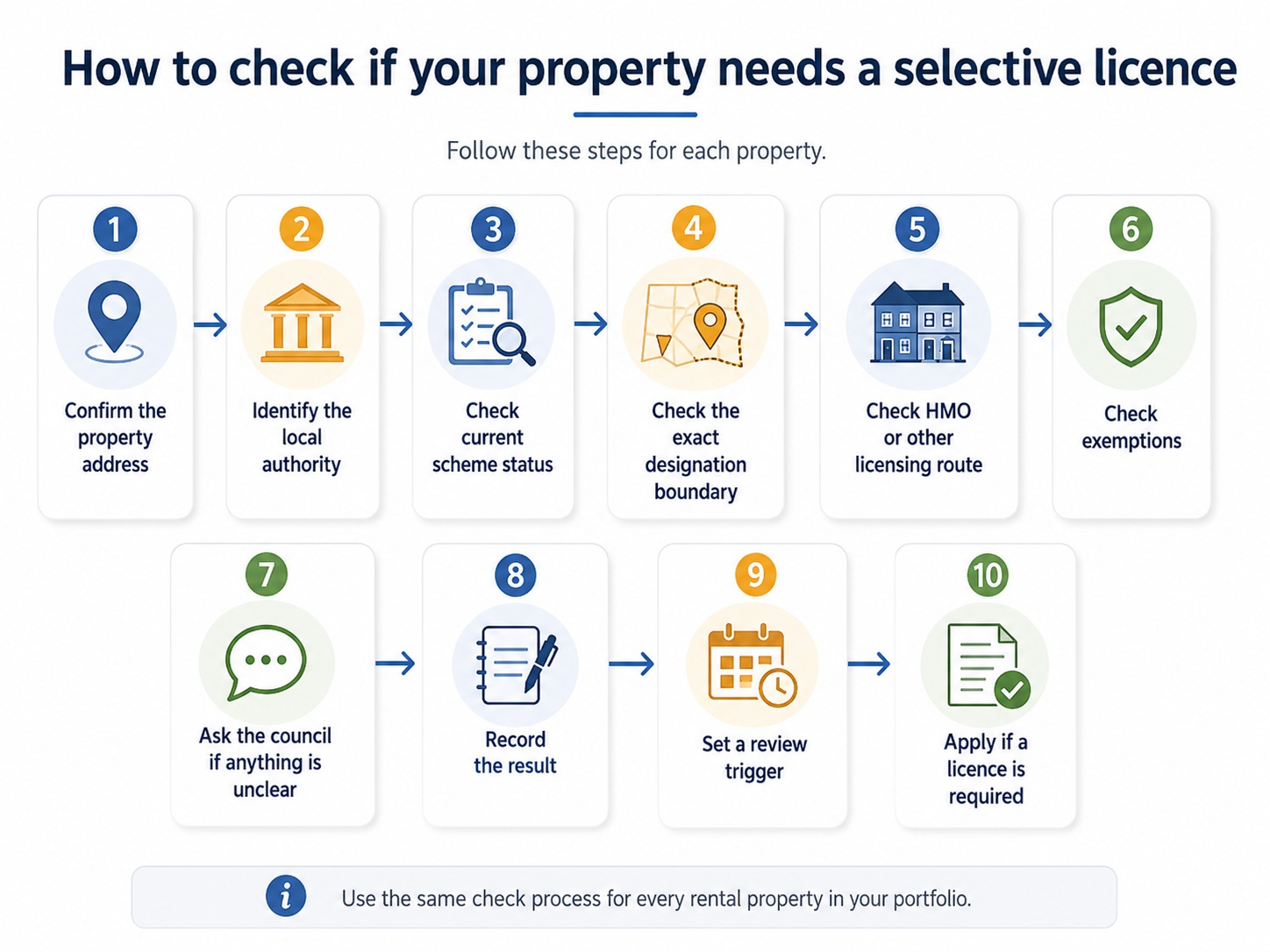
1. Confirm the local authority for the property
Start with the actual property address, not the postal town.
A Derby postal address, for example, does not by itself establish which district or borough council administers the property. Record the local authority against the property before checking its licensing pages.
2. Find the council’s current landlord or property-licensing page
Look specifically for selective licensing. Also note whether the council operates mandatory or additional HMO licensing, because occupancy can affect which route applies.
Use the council website rather than relying on a search-result snippet. Scheme pages are frequently updated with maps, application links and commencement dates.
3. Establish whether the scheme is active, proposed or finished
A consultation is not an active scheme.
Record the date on which the designation comes into force and, where published, its end date. The national guidance states that a selective licensing designation can last for up to five years.
Leeds, for example, records its current East, South and West Leeds designation as running from 9 February 2026 to 8 February 2031.
4. Check the exact property against the designation boundary
Do not stop when you discover that the council “has selective licensing”.
Schemes can cover specific wards, streets or mapped areas rather than an entire borough. Use whatever authoritative tool the council provides: an address search, selective licensing postcode checker, ward finder, interactive map, street list or signed designation document.
Two properties under the same council can therefore produce opposite results. Number 18 might sit just inside the designation boundary while number 42, a few streets away, is outside it.
5. Check whether another licensing route applies
If the property could be an HMO, verify its occupancy and the council’s HMO licensing schemes before choosing an application.
The presence of a selective designation does not automatically make a selective licence the correct licence for every rented property within the boundary.
6. Check exemptions against the official rules
Selective licensing has statutory exemptions. The main source is the Selective Licensing of Houses (Specified Exemptions) (England) Order 2006, supplemented by the council’s current guidance.
Do not infer an exemption from a short description such as “family let” or “student property”. Definitions and circumstances matter.
Leeds, for example, explicitly warns landlords that “family member” has a specific definition under the Exemptions Order and should not simply be assumed to apply.
Under section 86 of the Housing Act 2004, a person managing or having control of a Part 3 property can notify the council that they are taking particular steps so the property will cease to require a licence. The council may issue a notice lasting three months; a second three-month notice may be issued only in exceptional circumstances. It is discretionary, so an intention to sell the property or stop letting it does not by itself create an exemption.
7. Ask the council in writing if the answer is unclear
Boundary lines, unusual occupancy arrangements and exemptions can produce genuine uncertainty.
If the official map leaves the address unclear, email the licensing team with the full address and relevant facts. Keep the response with your property records.
A dated council email saying how the authority has treated the address is considerably more useful later than a note saying, “Checked online — think exempt.”
8. Record the check even when no licence is currently required
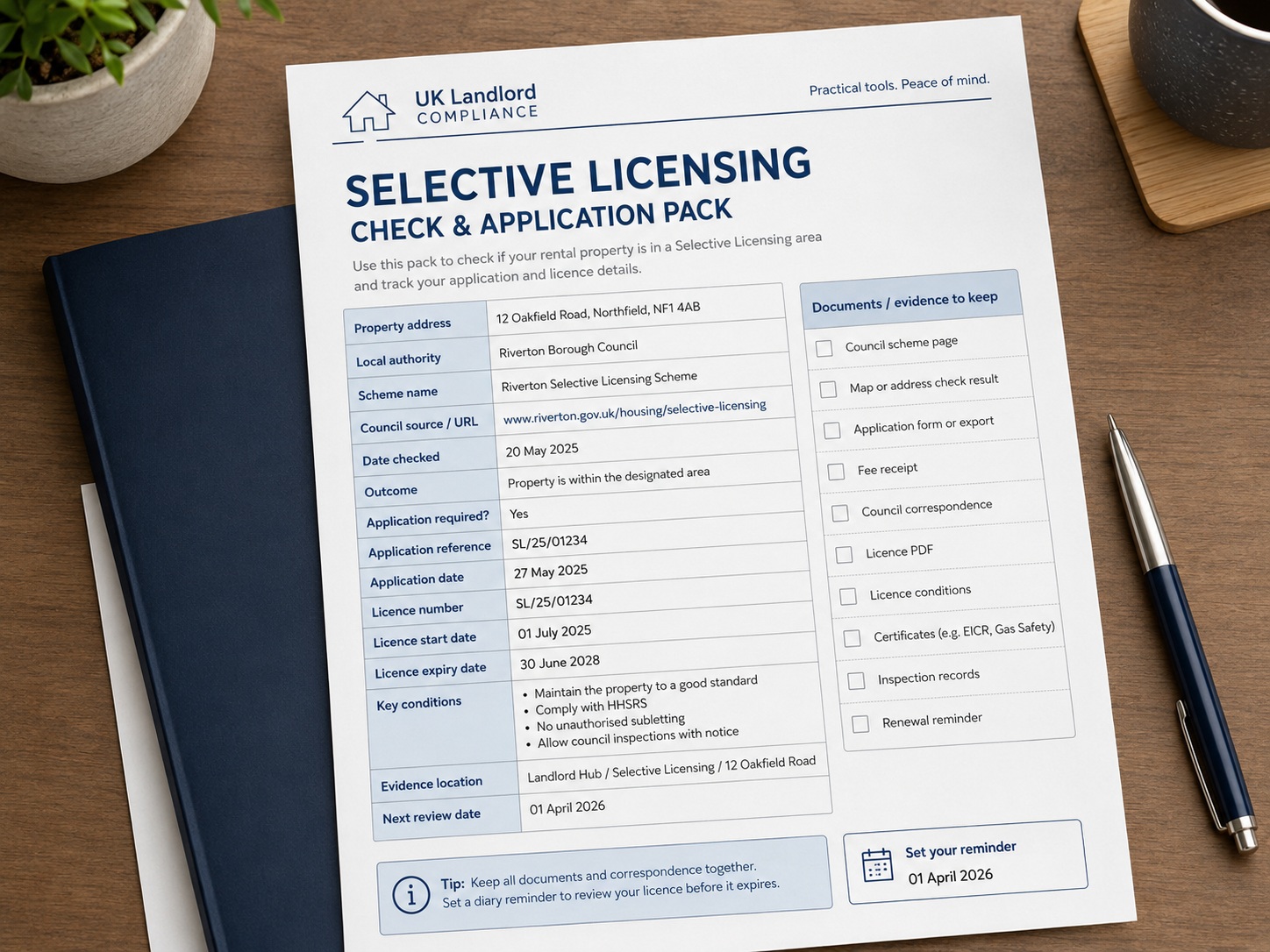
Record the council source, designation or scheme name, date checked, exact address or boundary result and your conclusion. Save the relevant screenshot, map extract or written council reply where practical.
Your record shows what you checked and when; it is not a legal ruling. The fuller evidence checklist appears below under “What selective licensing records should landlords keep?”
9. Set a reason to check again
Do not treat “no licence required” as permanent.
Useful review triggers include a new council consultation, a published scheme commencement date, purchasing another property, changing how a property is occupied, taking management back from an agent or carrying out a periodic portfolio review.
10. If a licence is required, move into the application workflow
Recording “licence required” is not the end of the job. Save the application requirements, gather the evidence requested by the council and record the submission reference and payment.
Is there a national selective licensing checker?
No. There is no single official GOV.UK address or postcode checker that replaces verification with the council responsible for the property.
GOV.UK provides the national selective licensing framework, while the designations themselves are made and administered locally. Councils publish their own scheme dates, boundaries, maps and application processes.
Private property licence checkers can still be useful as a first pass. They can point you towards a possible scheme or council. The problem comes when a landlord treats that initial result as the final answer.
Consider a checker that reports, “Selective licensing operates in this council.” The landlord then opens the official designation map and discovers that the property is three streets outside the boundary. The council source changes the action completely.
Postcode-only results can also miss relevant facts about the property itself, such as whether it falls under another licensing regime or a statutory exemption.
A useful check record therefore contains the source URL, date checked, designation name, map or address result and any saved screenshot or council response. The goal is not merely to remember the answer. It is to be able to see how you reached it.
What does a selective licence cost and how long does it last?
There is no national selective licensing fee. Councils set their own fees, payment arrangements and qualifying discounts.
As a dated example, Leeds currently charges £1,100 for an online application and £1,225 for a paper application, with the payment divided into two stages. A £150 discount is available in specified circumstances for members of the Leeds Rental Standard. Those figures were current when checked on 3 September 2026 and should not be used as a guide to another council’s fee.
Licence duration also needs recording rather than assuming.
Section 91 of the Housing Act 2004 says a Part 3 licence continues for the period specified or determined under the licence. That period must end no more than five years after the relevant grant or commencement point. Section 91 also states that a licence may not be transferred to another person.
If the seller shows you a selective licence, do not simply file it under the new ownership and assume the licensing issue is dealt with. The purchaser needs to check the council’s process and make the appropriate application for the new licence holder.
If you are taking over an occupied rental, the wider records to verify are covered in our buying a property with tenants in situ due-diligence checklist.
Use the actual start and expiry dates on the licence once issued. “Five years” is a statutory maximum, not a substitute for reading the document.
Before the recorded expiry date, check the council’s current renewal process and timing. Renewal arrangements are local, so do not assume the licence will continue automatically after the date shown on the licence.
How to apply for selective licensing
Applications are council-specific. There is no national form or standard evidence pack that every authority uses.
The council may ask for information about the applicant, proposed licence holder, property, occupants, management arrangements and other people with an interest in the property.
Before granting a Part 3 licence, section 88 of the Housing Act 2004 requires the council to be satisfied, among other things, that the proposed licence holder is a fit and proper person and the most appropriate person reasonably available to hold the licence. It must also be satisfied that any proposed manager is fit and proper and that the management arrangements are otherwise satisfactory. The supporting documents and declarations used to assess those matters vary by council.
Croydon provides a useful current example. Its new selective scheme is due to begin on 25 September 2026, and its application page says applicants will need information about the applicant, rented property, occupants and interested parties. It also lists a current gas safety certificate where applicable, an EICR and proof of the proposed licence holder’s address among the required documents.
Those are Croydon requirements, not a national checklist. See the current Croydon selective licence application requirements.
Before opening an application portal, create a small application folder for that property and save the council’s requirements into it. That avoids getting halfway through an online form and discovering that a certificate, ownership detail or interested-party address is missing.
Making an application is not the same as receiving a licence. However, section 95(3) of the Housing Act 2004 provides a defence to the section 95(1) unlicensed-property offence where a licence application has been duly made under section 87 and remains effective.
Keep the council’s acknowledgement and reference number, together with any request for further information and what you supplied in response. The protection depends on a duly made application, not an unfinished form saved in an online portal.
Where a letting agent handles the application, the landlord should still obtain copies of the submitted information, payment records, eventual licence and conditions. That is the same principle that applies during a broader letting-agent handover: responsibility for your property records should not depend on continued access to somebody else’s inbox or portal account.
Record the check and application property by property
Use the Selective Licensing Check & Application Pack to record the council source, designation check, application reference, licence dates, conditions and follow-up evidence for each rental property.
What selective licensing records should landlords keep?
The licence PDF is only one part of the record.
Section 90 of the Housing Act 2004 requires a Part 3 licence to include the mandatory conditions in Schedule 4 and allows the council to add conditions it considers appropriate for regulating the management, use or occupation of the property. Keep the complete conditions issued for that property rather than relying on a generic council checklist.
For each property, keep the following records.
The licensing check record:
- property address and local authority;
- designation name and official council scheme URL;
- designation map, boundary source or address-check result;
- date the licensing position was checked;
- screenshot, PDF or saved evidence of the check where practical;
- written council clarification where one was obtained; and
- recorded outcome: selective licence required, not currently required, another licensing route identified, or exemption requiring confirmation.
The application and licence record:
- copy or export of the application information submitted;
- submission date and application reference number;
- fee receipts and payment dates;
- licence decision and licence number;
- name of the licence holder;
- licence issue/start date and actual expiry date; and
- complete licence conditions.
Ongoing condition and review evidence:
- council correspondence and requests for further information;
- inspection or council visit records;
- certificates, invoices, photographs, contractor evidence or tenant communications relevant to licence conditions;
- correspondence about a sale, management change or other change of circumstances; and
- the next review or renewal date and who is responsible for it.
For a portfolio, a simple landlord compliance spreadsheet can provide the top-level register, but the underlying documents still need to remain attached to the correct property record.
A useful property record might show:
- application submitted and acknowledgement saved;
- council requests an EICR or other information;
- requested evidence supplied and a dated copy retained; and
- licence granted and the full conditions filed with the supporting evidence.
If a council later asks for evidence relating to one licence condition, you can then retrieve the condition, relevant certificate or invoice and the correspondence showing what was supplied.
If the council interaction involves a property-condition inspection, keep that evidence separately as well; the CertNudge guide to HHSRS inspections for landlords explains the wider inspection record.
Keeping these documents together does not prove that every legal obligation has been satisfied. It makes the underlying evidence considerably easier to retrieve and review.
What happens if a property should be licensed but is not?
Section 95 of the Housing Act 2004 creates offences connected with Part 3 properties that are required to be licensed but are not, as well as failures to comply with licence conditions.
The legislation also contains relevant defences and provisions dealing with applications and temporary exemptions, so an existing enforcement case needs to be considered on its facts.
For offences committed on or after 1 May 2026, the maximum civil penalty available for relevant offences under the Housing Act 2004 increased from £30,000 to £40,000. A civil penalty is an alternative to prosecution; £40,000 is the statutory maximum, not an automatic fine for every unlicensed property. For broader context on the changes that took effect on 1 May 2026, see our Renters’ Rights Act 2026 landlord compliance audit.
Current MHCLG guidance specifically includes an unlicensed property subject to selective licensing under section 95(1). See the current GOV.UK civil penalties guidance.
Rent repayment orders can also arise from licensing offences. For offences committed on or after 1 May 2026, current GOV.UK guidance says an RRO can cover up to two years’ rent, with the actual amount determined by the First-tier Tribunal. Failure to license a property as required is listed as an RRO offence.
An order is not automatic simply because a licensing issue exists. See the current GOV.UK Rent Repayment Order guidance.
There are also appeal routes. Under Schedule 5 to the Housing Act 2004, appeals against relevant licence grant, refusal, variation and revocation decisions are generally made within 28 days of the decision date specified in the notice. Current civil-penalty guidance also provides a 28-day First-tier Tribunal appeal period following a final penalty notice.
Do not try to reconstruct the legal position from an online article. Check the council’s current process promptly. If enforcement action, a rent repayment order or an appeal is already involved, take advice from a housing solicitor or other appropriately qualified housing professional.
Common selective licensing mistakes
Most selective-licensing mistakes begin with an assumption that sounds sensible but is wrong.
- Assuming selective licensing only applies to HMOs. A normal family house or flat can fall within a Part 3 designation.
- Checking the council but not the address. A scheme may cover only selected wards, streets or mapped areas.
- Treating a consultation as an active scheme. Record the actual commencement date.
- Treating an expired scheme as current. Check whether it ended, was renewed or was replaced.
- Using a third-party checker as the final answer. Return to the council’s official designation and boundary information.
- Ignoring HMO licensing because the postcode sits inside a selective area. Confirm the correct licensing route for the occupancy.
- Assuming an exemption from a short council summary. Check the statutory criteria and ask the council where necessary.
- Checking once and never revisiting the answer. A “not required” result from 2024 tells you nothing about a designation starting in 2026.
- Accepting an agent’s “licence sorted” without obtaining the records. Keep the application, reference, fees, licence and conditions yourself.
- Assuming the seller’s licence transfers with a purchased property. Section 91 says a Part 3 licence may not be transferred to another person.
- Assuming every licence lasts exactly five years. Record the dates actually stated on the licence.
- Using one council’s fee or document list for another council. Application requirements and charges are local.
A landlord with properties in Leeds and Croydon, for example, should have two separate council-source records. Copying the Leeds fee, application dates or boundary assumptions into the Croydon property file would create a neat spreadsheet containing the wrong information.
Frequently asked questions about selective licensing
What is selective licensing?
Selective licensing is a local property-licensing regime under Part 3 of the Housing Act 2004. Section 80 allows a local housing authority to designate the whole or part of its area for selective licensing. Where a designation applies, privately rented housing within its scope must be licensed, subject to statutory exemptions and the interaction with Part 2 HMO licensing.
Do I need a selective licence for a normal single-family rental?
Potentially. A single-family house or flat can require a selective licence if its exact address falls within an active designation and no relevant exemption or different licensing route applies. Check the council’s current scheme and boundary rather than assuming that only HMOs need licences.
How do I check if my property is in a selective licensing area?
Confirm the local authority, open its official property-licensing page, check whether the scheme is currently in force, then check the exact address against the council’s map, ward finder, street list or postcode/address checker. After that, consider the property’s occupancy and any relevant exemption.
Is there a selective licensing postcode checker for England?
Private checker services exist, but there is no single official GOV.UK address checker that replaces the relevant council’s designation information. Treat a third-party checker as a first pass and verify the exact property using the council source.
Is a selective licence the same as an HMO licence?
No. Mandatory and additional HMO licensing apply to HMOs, while selective licensing can apply to other privately rented housing inside designated areas. If a property is shared by several occupants, check the HMO route before assuming a selective licence is the correct application.
How much does selective licensing cost?
There is no national fee. Each council sets its own charges and may use staged fees or offer specific discounts. Check the current fee page for the council operating the scheme rather than using a figure quoted for another area.
How long does a selective licence last?
Section 91 of the Housing Act 2004 limits a Part 3 licence to no more than five years from the relevant grant or commencement point, but an individual licence can be shorter. Record the actual start and expiry dates printed on the licence.
Does a selective licence transfer when a property is sold?
No. Section 91(6) of the Housing Act 2004 states that a licence may not be transferred to another person. A purchaser should therefore check the council’s process rather than relying on the seller’s existing licence.
What records should I keep after applying?
Keep the application or export, submission acknowledgement, reference number, fee receipts, licence, licence conditions, council correspondence and evidence relating to any actions required under those conditions. Record the actual licence expiry date as well.
What happens if a property that needs a selective licence is unlicensed?
Operating a property that is required to be licensed under Part 3 but is not licensed can engage the offence provisions in section 95. Depending on the circumstances, prosecution, a civil penalty and rent repayment order proceedings can be relevant. If an actual unlicensed period or enforcement case has been identified, check with the council and obtain professional advice rather than relying on general guidance.
Keep the selective licensing decision and evidence with the property
Pick one rental property this week and run the ten-step selective licensing check above. Even if the answer is “no selective licence currently required”, record the council source, date and boundary result so you know what that conclusion was based on.
Use the Selective Licensing Check & Application Pack to record the check, application and conditions consistently across the portfolio.
After you have established the position from the authoritative council source, CertNudge’s inspection-ready compliance records can help keep the resulting licence, correspondence, supporting evidence and review dates organised with the property. CertNudge records the information you supply; it does not determine whether a selective licence is legally required.
Last reviewed: 4 September 2026
Next review recommended: 4 December 2026