EPC Exemption Register: What Landlords Need to Keep
A practical guide for landlords on when the EPC exemption register may apply, what evidence is usually needed, and how to keep exemption records organised by property.
Key takeaways
- The current minimum standard for covered domestic private rented properties is EPC E; an F- or G-rated property normally needs improvement or a valid registered exemption.
- An exemption is not automatic: GOV.UK says it must be registered before it can be relied on, and it takes effect from registration.
- Evidence depends on the exemption, but landlords should keep the EPC, supporting quotes or reports, registration details and any relevant correspondence together.
- Many current exemptions last five years, but the temporary exemption for certain new landlords lasts six months and some consent exemptions can end earlier.
- An exemption does not simply transfer with a sale, so a buyer intending to continue letting needs to check the position afresh.
The EPC exemption register (officially the PRS Exemptions Register) is the government register where landlords record exemptions from the minimum EPC E standard for covered domestic private rented properties in England and Wales. An exemption must be registered before a landlord can rely on it, and it applies from the point of registration.
Finding an EPC F at one property in a five-house portfolio does not automatically mean “get an exemption”. First establish whether the property is covered by the rules, what the EPC recommends and whether improvement to E is possible within the current cost rules. If an exemption does apply, registration is only part of the job: you also need the evidence that supports what you registered.

Who may need to use the EPC exemption register?
Start with two scope checks from GOV.UK:
- Is the property let on an assured tenancy, regulated tenancy or domestic agricultural tenancy?
- Is it legally required to have an EPC?
For a rental property covered by the domestic MEES rules, the current minimum EPC rating is E. If the answer to both scope questions is yes and the EPC is F or G, the landlord needs to take action. If the answer to either is no, GOV.UK says the property is not covered by these Regulations, so an F or G rating alone does not create a need to register a PRS exemption.
See the GOV.UK domestic MEES landlord guidance for the full scope test.
Example: Take a landlord with five older terraces in Derby. Four are rated D or E; the fifth comes back F. The useful first question is not “which exemption do I select?” It is whether that fifth property is within the Regulations and, if it is, whether the EPC E standard can reasonably be reached under the current rules.
This guide is written primarily for private landlords in England. The domestic MEES regime discussed here also applies in Wales. Scotland and Northern Ireland operate different landlord energy-efficiency frameworks, and commercial properties have separate MEES guidance. HMOs can also involve additional property-management requirements that are outside this article.
For a wider property-document overview, see what certificates landlords need.
What is the EPC exemption register?
The PRS Exemptions Register records exemptions from the current minimum EPC E standard under the Energy Efficiency (Private Rented Property) (England and Wales) Regulations 2015. For covered domestic properties, the practical rule is straightforward: an F- or G-rated property generally needs to reach E or have a valid exemption before it is let or continues to be let.
Landlords sometimes search for an “EPC exemption certificate”, but the official process is registration on the PRS Exemptions Register rather than obtaining a separate statutory certificate.
The important distinction: having circumstances that might support an exemption is not the same as having a registered exemption.
GOV.UK states that an exemption must be registered before a landlord can rely on it. Registration is on a self-certification basis and the exemption applies from the point at which it is registered. Writing “high-cost exemption applies” in your property notes, obtaining a surveyor’s report or collecting three quotes does not replace registration. If a covered F- or G-rated property was let or continued to be let before a valid exemption was registered, registering one later does not retrospectively cover that earlier period.
For example, suppose three qualified installers quote £3,700, £3,950 and £4,200 including VAT to purchase and install the cheapest recommended measure, with the third quote arriving on 12 August. Because even the lowest quote exceeds £3,500, those quotes may support a high-cost exemption. But the exemption does not take effect from 12 August simply because the evidence was complete then; GOV.UK says exemptions apply from registration.
The register is public. GOV.UK’s PRS Exemptions Register search service allows searches for registered exemptions and MEES penalties by postcode, street and town, landlord name or exemption/penalty type, and shows when an exemption was registered and its reason.
Keep current and future standards separate: As part of the Warm Homes Plan published on 21 January 2026, the government confirmed that private rented homes within scope are expected to meet a higher EPC C standard, assessed across new energy performance metrics, by 1 October 2030, unless a valid exemption applies. The proposed cost cap for that higher standard is £10,000 per property, not the current £3,500.
These changes depend on further legislation and on the new EPC methodology, whose timetable has moved, so detail may still shift; the existing EPC E standard and the £3,500 cap continue in the meantime. Our separate guide covers the EPC C 2030 rules for landlords.
Which EPC exemption may apply?
For domestic rented property, GOV.UK currently sets out six main exemption routes. Which one applies depends on why the property cannot meet EPC E; registering the most convenient-looking option is not enough.
- High cost: register this where no improvement can be made because installing even the cheapest recommended measure would exceed £3,500 including VAT. It requires three quotes from qualified installers for purchasing and installing the cheapest recommended measure, demonstrating the cost would exceed £3,500 including VAT, plus written confirmation that the landlord is satisfied the measure exceeds that amount. The exemption lasts five years.
- All relevant improvements made: used where all relevant improvements have been made, or none can be made, and the property remains below E. Evidence may come from the EPC or a separate report, together with details of improvements made. It lasts five years.
- Wall insulation: requires qualifying written expert advice showing that the recommended cavity, external or internal wall insulation would negatively affect the fabric or structure of the property or building. It lasts five years.
- Third-party consent: applies where required consent has been sought but refused, or granted subject to a condition the landlord could not reasonably meet. It generally lasts five years; where the missing consent is from the current tenant, it lasts only until that tenancy ends or is assigned.
- Property devaluation: requires a report from an independent surveyor on the RICS register of valuers advising that the relevant measures would reduce market value by more than 5%. It generally lasts five years.
- Recently becoming a landlord: available only in specified circumstances. The landlord records when and how they became the landlord, and the exemption lasts six months.
GOV.UK describes these as specific exemptions with their own conditions and evidence requirements. If the facts do not clearly fit one, check the current guidance or take qualified advice before registering.
How to register an EPC exemption: landlord action plan
Treat registration as the middle of a process, not the first step.
Already letting or about to let? If you are planning to let a covered property rated F or G, GOV.UK says you need to improve it to EPC E or register a valid exemption before entering into the new tenancy. If you are already letting a covered F- or G-rated property and have not taken action, you need to improve it to E or register an applicable exemption.
- Check whether the property is covered. Confirm that it is a domestic private rented property, let on a relevant tenancy type and legally required to have an EPC.
- Find the current EPC. Check the rating, date and recommended improvements. Do not work from a property-list spreadsheet that merely says “EPC F”; you need the actual certificate and its recommendations. For a quick initial check, you can use CertNudge’s free EPC risk checker to review EPC risk indicators and government-listed improvements for a property. Always verify the official EPC certificate before making compliance decisions.
- Check what improvement to E would involve. Under the current standard, a landlord is not normally required to contribute more than £3,500 including VAT of their own money towards relevant energy-efficiency improvements. If the property can reach E for less, that is all the landlord needs to spend.
- If third-party funding covers the full cost: GOV.UK says the £3,500 cap does not apply. The secured funding should be used to improve the property to E or, if possible, higher.
- If only partial third-party funding is available: the landlord may need to top it up with their own money up to the cost cap.
- Collect the evidence first. GOV.UK’s registration service says a new registration requires landlord details, the property address, a valid EPC and evidence showing how the property qualifies for the exemption selected.
- Register through GOV.UK. Use the GOV.UK PRS energy standards exemption service. The service now uses GOV.UK One Login; GOV.UK says the sign-in method changed on 5 May 2026.
- Save the registration record with the evidence. Record the exemption type, registration date, expected expiry or review point, the documents uploaded and any subsequent council correspondence.
- Diarise the end date early. Many current domestic exemptions run for five years. The temporary exemption for certain people who have recently become landlords lasts six months, while an exemption based on lack of tenant consent can end when the relevant tenancy ends or is assigned. When an exemption ends, the landlord needs to reassess the property: improve it to EPC E or, if that still cannot be achieved and another exemption applies, register a further valid exemption before continuing to let the property below E.
A high-cost case shows why the sequence matters. If a landlord receives three installer quotes as email attachments, registers the exemption and then leaves those emails buried in the inbox for four years, they have created an avoidable evidence problem. Save the original quotes against the same property as the EPC and registration details while the trail is still obvious.
EPC exemption registration: before, during and after
Before registration
Check scope → Review the EPC → Assess relevant improvements → Gather the required evidence
Register the exemption
Confirm the exemption route → Upload the required evidence → Submit through GOV.UK → Save the registration details
After registration
Keep the evidence with the property → Record council correspondence → Diarise the end date → Reassess before expiry
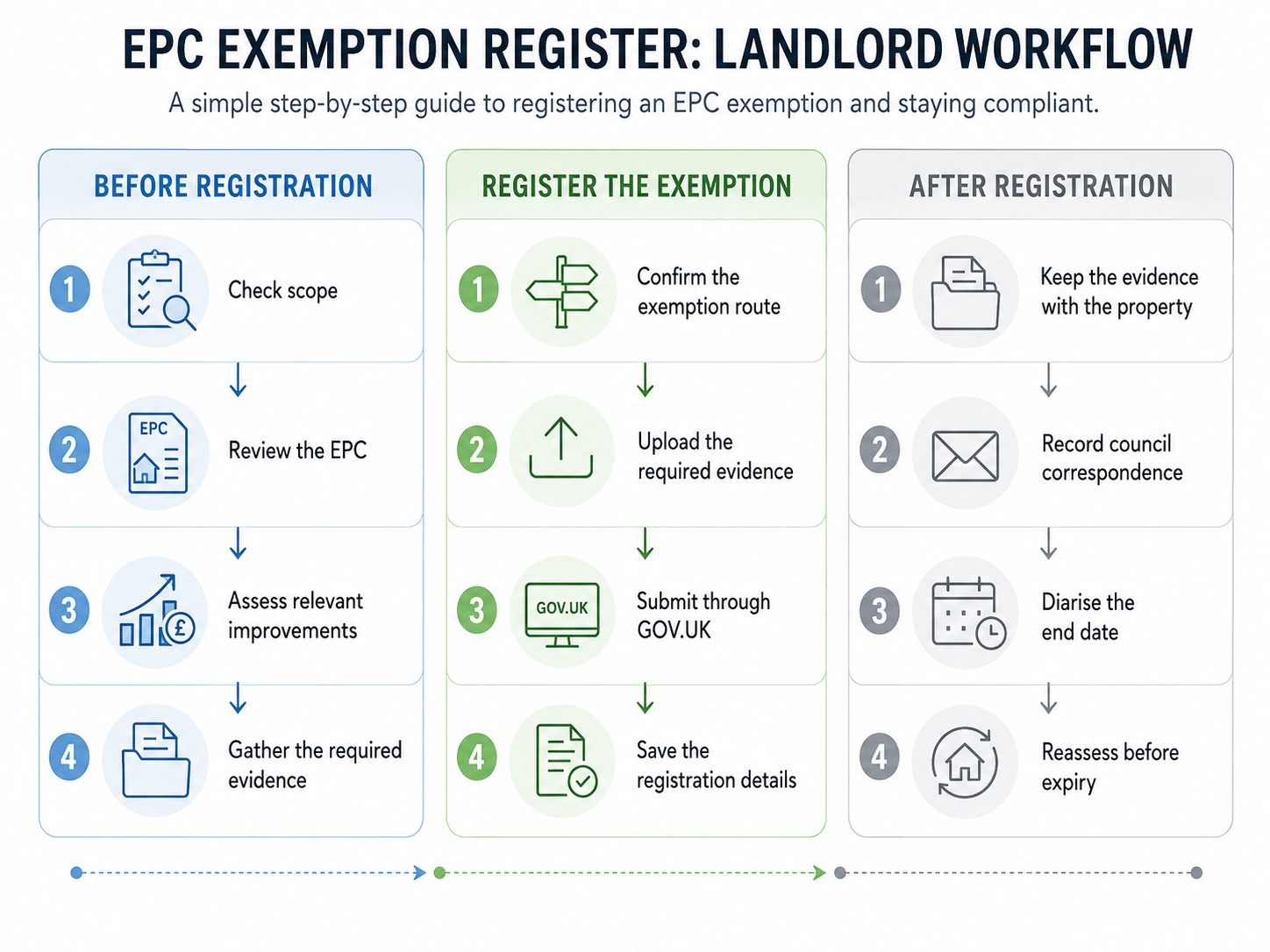
EPC exemption evidence checklist for landlords
The legal evidence requirement changes with the exemption. The good record-keeping practice is broader: keep enough information to reconstruct what was decided, when and on what evidence.
| Evidence item | Why it matters | Record-keeping note |
|---|---|---|
| Current EPC | Establishes the rating and recommendations. | Store the certificate itself, not just the rating and expiry date. |
| Property and tenancy details | Identifies the property and helps establish the letting context. | Keep them with the property record; a tenancy agreement can also be requested under a council compliance notice. |
| Exemption type | Evidence requirements differ by exemption. | Record the exact exemption selected and registration date. |
| Installer quotes | Required for the current high-cost exemption. | Keep the original emails/PDFs and quote dates. |
| Improvement evidence | Supports what has already been installed. | Retain invoices, work dates, installer details and relevant reports. |
| Surveyor/expert reports | Certain exemptions require specialist evidence. | Keep the report, author, date and conclusion together. |
| Consent correspondence | Can evidence that required third-party consent was sought but not obtained. | Retain the request, refusal or unacceptable conditions, not just a note saying “consent refused”. |
| Registration confirmation | Shows that the exemption was actually registered. | Record the registration date and save available confirmation details. |
| Expiry/review reminder | Current exemptions are commonly time-limited. | Set the reminder before the end date, not on it. |
| Council correspondence | A council can request further evidence. | Keep the request, your response and exactly what was supplied. |
Do not treat the high-cost exemption as a £3,500 opt-out. If a relevant improvement can be purchased and installed for £3,500 or less, the landlord needs to consider the applicable improvement requirements first. Quotes, reports and consent correspondence are therefore more than filing material where the exemption requires them — they are evidence supporting the route the landlord has registered.
A landlord who receives a council email asking about “12 High Street” should not have to work out whether quote-final2.pdf in an old inbox belongs to that address. Keeping the EPC, exemption evidence and correspondence together also makes wider compliance record retention easier. If you still manage dates manually, a landlord compliance spreadsheet can at least make the expiry or review point visible.
Common EPC exemption mistakes landlords should avoid
Mistaking evidence for registration
Three quotes, an expert report or consent correspondence can support an exemption, but those documents do not by themselves create one. The exemption still needs to be registered.
Using the £3,500 cap as a blanket reason to do nothing
If a recommended improvement can be made within the current cap, the landlord may still have to install relevant improvements. The high-cost exemption is specifically for cases where even the cheapest recommended improvement exceeds £3,500 including VAT.
Forgetting the evidence once registration is complete
Registration is self-certification. GOV.UK warns that the local council may contact a landlord for further information after a new exemption is registered.
Treating five years as a universal duration
Many exemptions currently last five years, but a qualifying new-landlord exemption lasts six months, and a tenant-consent exemption can end with the relevant tenancy. A reminder labelled simply “EPC exemption – five years” can therefore be wrong.
Assuming the exemption travels with the property
GOV.UK says a registered exemption ceases to be effective for a new owner on sale or transfer. If the buyer intends to continue letting, they need to improve the property to the minimum standard or register an exemption that applies to their own circumstances.
There is an enforcement reason to keep the file recoverable too. A local authority can serve a compliance notice requesting documents including the EPC that was valid when the property was let, the tenancy agreement and evidence of energy-efficiency improvements.
If a breach is confirmed, GOV.UK currently lists maximum penalties of:
- up to £2,000 and/or publication of the breach for letting a non-compliant property for less than three months;
- up to £4,000 and/or publication for letting it for three months or more;
- up to £1,000 and/or publication for providing false or misleading information on the PRS Exemptions Register; and
- up to £2,000 and/or publication for failing to comply with a compliance notice.
Financial penalties can apply to more than one breach, but the total is capped at £5,000 per property. A landlord who disagrees with a penalty notice can ask the local authority to review it and, if the notice is upheld, may appeal to the First-tier Tribunal on the grounds set out in the Regulations.
Think beyond the expiry date. If a council asks in November 2028 about an exemption registered in 2026, the useful record is not a calendar entry saying “exempt until 2031”. It is the original EPC, the evidence relied upon, the registration record and the subsequent history together.
EPC exemption register FAQs
What is the EPC exemption register?
The EPC exemption register, officially the PRS Exemptions Register, is the government register used for exemptions from private rented sector Minimum Energy Efficiency Standards (MEES). For the current domestic standard, a qualifying F- or G-rated property within scope needs the relevant exemption registered before the landlord can rely on it.
Can I rent out a property with an EPC F or G if I register an exemption?
Only where a valid exemption actually applies and has been registered. Registration is self-certification; simply submitting an exemption does not turn circumstances that fail the eligibility rules into a valid exemption. GOV.UK specifically recommends legal advice if you need help deciding which exemption applies.
What evidence do landlords need for an EPC exemption?
It depends on the exemption. GOV.UK says the core registration information includes the relevant property address, exemption type and valid EPC, with additional evidence required for particular exemptions. A high-cost exemption, for example, requires three qualifying installer quotes; a devaluation exemption requires the appropriate independent RICS surveyor evidence.
How long does an EPC exemption last?
Many current domestic EPC exemptions last five years, but not all do. The temporary exemption for certain circumstances where someone has recently become a landlord lasts six months, and an exemption arising from lack of tenant consent may end when that tenancy ends or is assigned. Check the duration of the specific exemption you have registered.
Does an EPC exemption transfer when a landlord sells the property?
No. GOV.UK says that, when a let property with an exemption is sold or transferred, the exemption ceases to be effective for the new owner. A buyer intending to continue letting must therefore establish whether the property meets the minimum standard or whether they can register an applicable exemption. If you are preparing for a sale, see our guide to selling a tenanted property and the compliance documents to prepare.
Is an EPC exemption certificate the same as registering an exemption?
“EPC exemption certificate” is a phrase landlords sometimes use when looking for proof of exemption, but the official process is registration on the PRS Exemptions Register. The important record is the valid registered exemption and the evidence supporting it, rather than assuming there is a separate statutory certificate with that name.
Keep your EPC exemption evidence ready
An exemption creates an evidence trail: the EPC, exemption type, quotations or reports, consent correspondence where relevant, registration date, council correspondence and the date on which the position needs reviewing again.
A practical job for this week is to pick any property in your portfolio with an exemption and see whether you can retrieve that complete trail without searching three inboxes and an old Google Drive folder.
Keep EPC evidence organised by property
CertNudge’s inspection-ready compliance records help landlords keep EPCs, supporting evidence, dates and documents organised by property, so related records can be pulled together into a clear compliance pack when someone asks for them.
CertNudge organises landlord-supplied evidence; it does not decide whether an exemption is legally valid or verify the authenticity of the documents you upload.
This article is for general information only and is not legal advice. Regulations change and individual circumstances vary — always check the latest guidance at GOV.UK or speak to a qualified housing professional or solicitor.
Last reviewed: 16 August 2026
Next review recommended: 30 September 2026 - the exemptions service changed in May 2026 and the higher PRS energy-efficiency regime is still moving through its legislative implementation.