
Written Statement of Terms for Landlords: What to Give Tenants and What Proof to Keep
A practical England landlord guide to the Written Statement of Terms: when prescribed tenancy information must be given, what it must cover, how it differs from the Information Sheet, and what evidence is sensible to keep.
Under the Renters’ Rights Act 2025, a Written Statement of Terms is the prescribed written information required by section 16D of the Housing Act 1988. For an ordinary new assured tenancy in England created on or after 1 May 2026, it must be given before the tenancy is signed or otherwise agreed, and it can be included in the tenancy agreement or supplied separately.
Key takeaways
- For a new assured tenancy created in England on or after 1 May 2026, the prescribed written information must normally be given before the tenancy is signed or otherwise agreed.
- There is no compulsory government “Written Statement” form: the required information can be included in a compliant tenancy agreement or supplied separately.
- The Written Statement of Terms is not the same as the Renters’ Rights Act Information Sheet used for the main transitional route for pre-1 May 2026 written tenancies.
- SI 2026/324 sets the statutory minimum information, including tenancy details, rent information, possession information and several conditional safety and tenant-rights statements.
- Keeping the final document and a dated record of what was supplied is sensible evidence practice, but the legislation does not prescribe a separate “Written Statement service log”.
A landlord preparing a new tenancy in July 2026 cannot simply take an old assured shorthold tenancy (AST) agreement, change the names and assume it still works. Since 1 May 2026, relevant new assured tenancies in England must be accompanied by prescribed written information before the tenancy is signed or otherwise agreed. That information can sit inside the tenancy agreement or be supplied separately and it is not the same document as the Renters’ Rights Act Information Sheet used for many older tenancies. See Housing Act 1988 section 16D, as inserted by the Renters’ Rights Act 2025.
Who needs to give a Written Statement of Terms under the Renters’ Rights Act?
For most private landlords creating a new assured tenancy in England on or after 1 May 2026, section 16D of the Housing Act 1988 now requires specified tenancy terms and other information to be provided in writing. Section 16D was inserted by section 12 of the Renters’ Rights Act 2025. The detailed minimum content is prescribed by The Assured Tenancies (Private Rented Sector) (Written Statement of Terms etc and Information Sheet) (England) Regulations 2026 (SI 2026/324).
This sits within the wider move to assured periodic tenancies from 1 May 2026. GOV.UK describes an assured periodic tenancy as the normal private-renting arrangement where, among other things, the landlord does not live in the property and it is the tenant’s main accommodation. See GOV.UK: Assured periodic tenancies — a guide for landlords.
That matters before you reach for a checklist. Resident-landlord and lodger arrangements, holiday lets, business tenancies, company lets and tenancies with annual rent above £100,000 sit outside this standard assured-tenancy route; regulated tenancies follow a different regime. SI 2026/324 also excludes social housing assured tenancies from these Written Statement requirements. Where tenancy status is uncertain, establish that first rather than assuming section 16D applies.
A letting agent or property manager can provide the information on a landlord’s behalf. The Act also says that where the landlord contracts with someone to ensure compliance with section 16D, the duty can apply to that person as well. Using an agent therefore does not make the issue disappear: the safest operational approach is still to obtain the final tenancy document and know what was actually supplied.
Portfolio example: A six-property landlord using two agents could easily have two different tenancy-start processes. If one agent is using a post-May 2026 assured periodic agreement while the other is still working from a document last revised in 2024, the practical check is straightforward: obtain the final document each agent actually uses and confirm that the prescribed information has been incorporated into the current process.
There is also an older-tenancy distinction:
- A tenancy entered into before 1 May 2026 with a wholly or partly written record generally followed the separate Renters’ Rights Act Information Sheet transitional route.
- A wholly oral existing assured tenancy generally had to receive the prescribed written information by 31 May 2026.
- A new in-scope tenancy entered into on or after 1 May follows the continuing section 16D Written Statement route.
What must be in a Written Statement of Terms and when must the tenant get it?
The timing rule comes first: for an ordinary new assured tenancy, section 16D says the statement must be given before the tenancy is entered into. GOV.UK translates that into a practical instruction: provide it before you and the tenant sign the tenancy agreement or otherwise agree the tenancy, including an oral agreement.
Timing rule: For a new in-scope assured tenancy, provide the prescribed written information before the tenancy is signed or otherwise agreed — not simply before move-in or key collection.
There is no compulsory government Written Statement PDF. The written information may be contained in the tenancy agreement itself or supplied separately. The final landlord and agent guidance also says landlords do not have to copy the statutory wording exactly, provided all the specified information is covered.
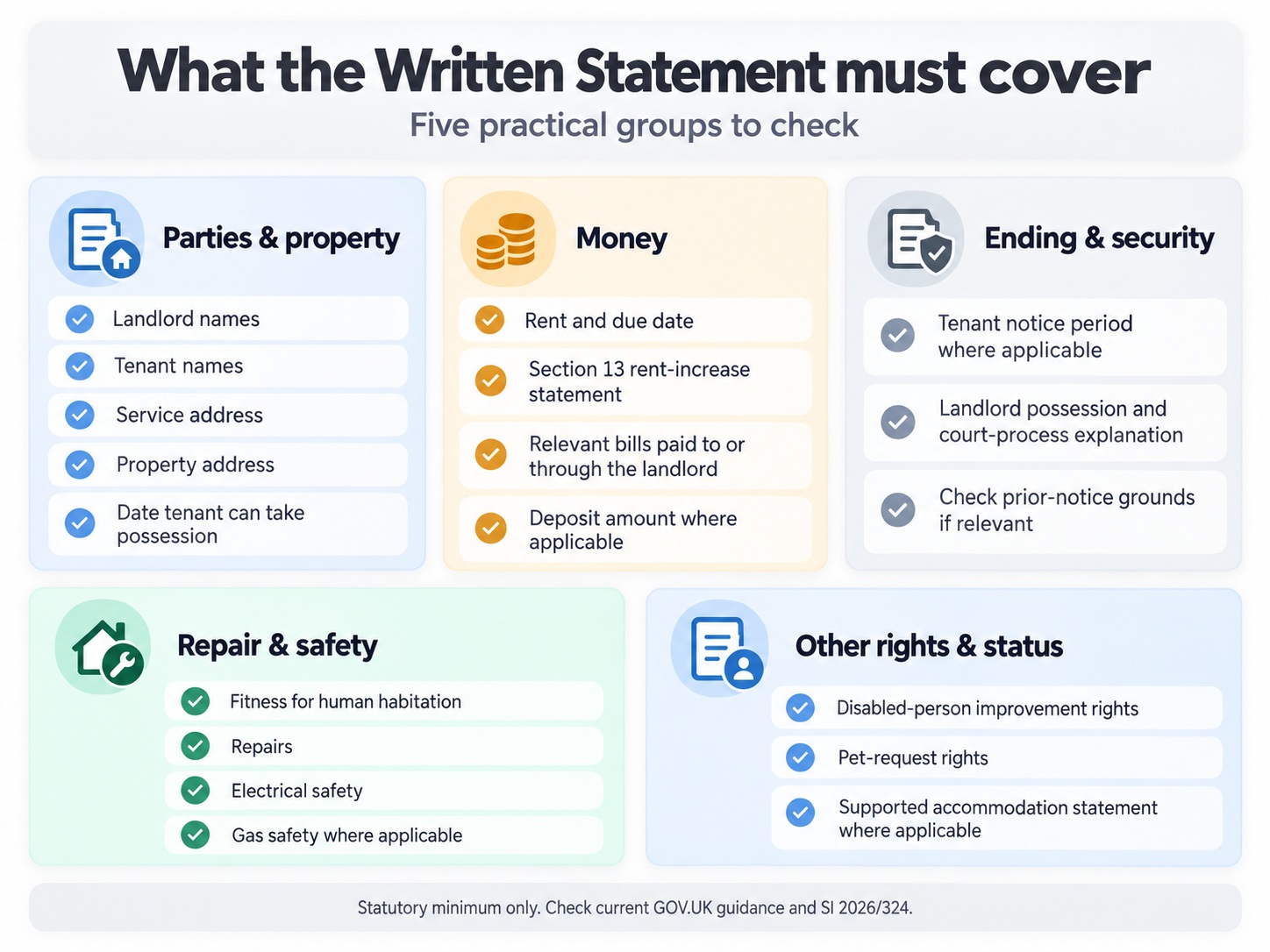
The prescribed list is a minimum, not a complete tenancy agreement. SI 2026/324 sets out the detail. For a standard buy-to-let landlord, it is easier to check it in five groups. These groups are a practical summary, so use the final government guidance and SI 2026/324 to check the full information and any conditions that apply.
1. Parties and property
The written information includes:
- the name of every landlord;
- the name of every tenant;
- an address in England or Wales at which notices, including notices in proceedings, may be served on the landlord by the tenant;
- the rented property address; and
- the date on which the tenant is first entitled to possession.
These requirements come from SI 2026/324.
A generic agreement headed “Landlord: ABC Properties” is not something to wave through automatically if the legal landlord names required by the regulations are different.
2. Rent, bills and deposit
The statement must include the rent and when it is due. It also requires a statement explaining that a new rent-increase proposal will be made by serving notice in accordance with section 13 of the Housing Act 1988. SI 2026/324.
If the rent includes relevant bills, the written information must explain which bills are covered. If the tenant makes separate payments to the landlord or someone connected to the landlord for relevant bills, it must explain what each payment covers, how much is due and when it is due — or explain how and when the tenant will be given those amount and due-date details. Relevant bills include council tax, utilities, a TV licence, communications services and certain Green Deal payments.
Where the Housing Act 2004 deposit requirements apply, the amount of the tenancy deposit must also appear. That does not replace the separate tenancy-deposit obligations. The separate prescribed deposit information must be provided within 30 days of receiving the deposit.
For the rent-increase process itself, see CertNudge’s Section 13 rent increase rules after the 2026 reforms. The tenancy deposit protection process remains separate.
3. Ending the tenancy and security of tenure
Where section 5(1) of the Protection from Eviction Act 1977 applies to the tenancy, the statement must set out the minimum notice period the tenant must give when giving notice to quit the property. Current government guidance says this cannot exceed two months and says that, if no notice period is included, two months applies automatically.
The prescribed information must also explain the landlord-side possession framework where section 5 of the Housing Act 1988 applies: in most circumstances the tenancy can only be ended through a possession order and execution of that order, and the possession process will usually involve a prescribed notice identifying the ground relied upon. It must also explain that the minimum notice period before court proceedings depends on the possession ground or grounds used. See the final landlord and agent guidance.
Prior-notice check: Some possession grounds require prior notice at the start of the tenancy. For Grounds 1B, 2ZA to 2ZD, 4, 5 to 5H, 6A and 18, the section 16D Written Statement must state that the landlord may wish to rely on the relevant ground. Ground 4A has a separate advance-notice condition before the tenancy starts. The consequences differ between grounds, so check the current possession-ground guidance rather than adding blanket clauses without knowing why they are there.
4. Property condition and safety
SI 2026/324 requires several statements where the underlying statutory duty applies. These cover:
- Fitness for human habitation under section 9A of the Landlord and Tenant Act 1985;
- Landlord repairing obligations under section 11 of that Act;
- Electrical safety obligations under regulation 3 of the Electrical Safety Standards in the Private Rented Sector and Social Rented Sector (England) Regulations 2020; and
- Gas safety obligations under regulation 36 of the Gas Safety (Installation and Use) Regulations 1998.
The prescribed wording and conditions are set out in SI 2026/324.
These are not generic boilerplate categories to expand into your own version of the safety legislation. Some are conditional. For example, the electrical statement refers to EICR inspection and testing at least every five years, or earlier where the latest report requires it, while the gas section only applies where a relevant gas fitting covered by regulation 36 is installed in or serves the property. CertNudge’s landlord gas safety certificate guide covers those separate gas-safety duties in more detail.
5. Other rights and tenancy status
The regulations also address:
- certain disability-related improvement rights under section 190 of the Equality Act 2010;
- the tenant’s right to request consent to keep a pet under section 16A of the Housing Act 1988, including that consent must not be unreasonably refused; and
- a statement and explanation where the tenancy is granted as supported accommodation.
These requirements are contained in SI 2026/324.
The practical problem with an old template is now clear. A 2024 AST may contain the rent, names and property address but still be missing the new section 13 statement, pet wording, required possession information and other prescribed material. It may also still purport to create a fixed term, despite new private assured tenancies being periodic. “I already have a tenancy agreement” is therefore not the same as “the final agreement covers the 2026 prescribed minimum”.
Written Statement of Terms vs Renters’ Rights Act Information Sheet
The correct route depends on when the tenancy was entered into and whether its terms were already recorded in writing. New assured tenancies entered into on or after 1 May 2026 follow the section 16D written-information route; many pre-1 May 2026 tenancies with wholly or partly written terms followed the separate Information Sheet route.
Main written-information route:
Prescribed Written Statement information, inside the tenancy agreement or separately
Timing:
Before signing or otherwise agreeing the tenancy
Main written-information route:
Prescribed written key-term information
Timing:
Transitional deadline was 31 May 2026
Main written-information route:
Renters’ Rights Act Information Sheet 2026
Timing:
Transitional deadline was 31 May 2026
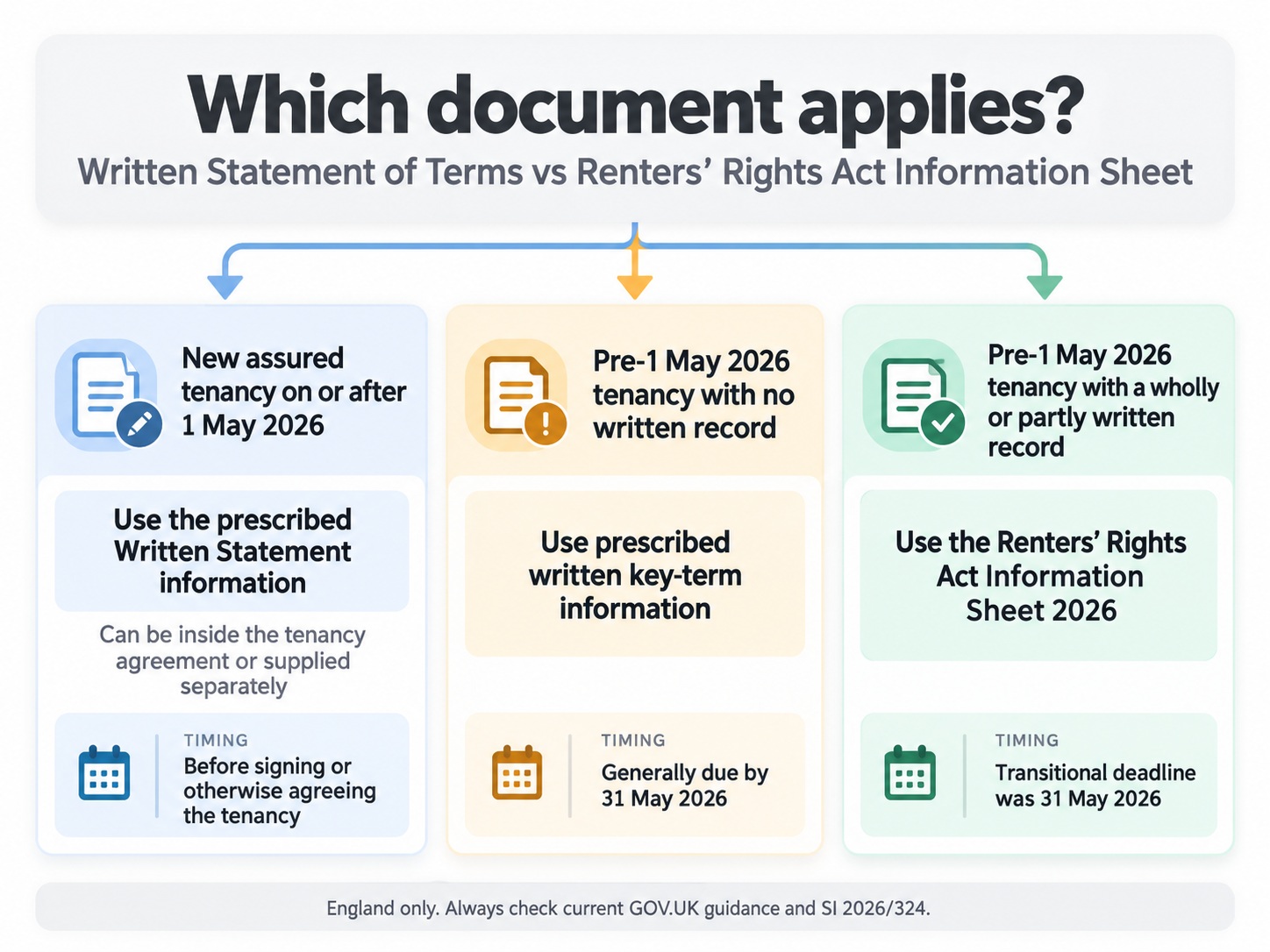
The distinction is more than terminology. For the Written Statement route, the government does not prescribe one document or insist on copying exact wording. For the Information Sheet route, the government requires the official PDF produced by the Secretary of State for that transitional purpose.
Example: A five-property landlord correctly sent the government Information Sheet to a tenant whose tenancy began in 2024. For a new July 2026 tenancy, sending that same PDF again would not satisfy the new-tenancy section 16D route. The landlord instead needs to check that the prescribed written information for the new tenancy is provided at the correct time.
If you are dealing with the older-tenancy route, use CertNudge’s separate Renters’ Rights Act Information Sheet 2026 guide rather than trying to combine the two processes.
Written Statement of Terms checklist for landlords: a pre-signing workflow
For a portfolio landlord, the useful control point is not move-in day. It is the point at which the tenancy is about to become binding.
- Confirm the tenancy type and date. Establish that the proposed letting is an assured tenancy within the post-1 May 2026 regime.
- Use a current document. Start with an assured periodic tenancy agreement or separate statement prepared for the current regime, not a saved AST simply because it worked in 2024.
- Check the final version against the current rules. Compare the document with the current GOV.UK written-information guidance and SI 2026/324.
- Check possession-ground prior notice separately. If a specialist ground could be material to the letting, confirm whether written prior notice is required and take housing-law advice where appropriate.
- Freeze the version to be used. A file such as
12-Market-St_Tenancy_2026-07-14_FINAL.pdfis easier to identify two years later thannew tenancy v3 final FINAL.pdf. - Provide the written information before agreement. Do not treat signature day or key collection as the deadline where the tenancy has already been agreed orally.
- Retain the exact final version supplied. Do this immediately, before another template revision overwrites or obscures it.
- Record the practical provision details. Note the tenant, property, date and time, channel and person who supplied the document, together with whatever contemporaneous evidence exists.
- If an agent handled it, obtain their file. Ask for the completed tenancy agreement or separate statement actually supplied to the tenant, together with the date and method of provision. “Our standard agreement is compliant” is not a substitute for possessing the actual document used for your property.
The phone-call edge case: A landlord agrees on Tuesday that the applicant will take 22 Station Road for £1,050 a month, with possession from Saturday, then emails the written agreement on Thursday. Section 16D refers to the statement being supplied before the tenancy is entered into; GOV.UK expressly includes otherwise agreeing the tenancy, including verbally. Sending paperwork before the keys are handed over does not solve the timing problem if the agreement was already made.
If an omission is discovered after agreement, provide the missing information promptly, preserve what actually happened and check current guidance. Do not rewrite the record to make it appear that a document was supplied earlier than it was.
What proof should landlords keep after providing the Written Statement?
There are two different questions here.
Legally required: provide the prescribed written information in accordance with section 16D.
Practical evidence: retain enough contemporaneous information to identify what was supplied, to whom and when.
Neither SI 2026/324 nor the current government Written Statement guidance prescribes a separate statutory “Written Statement service log”, requires the tenant to sign an acknowledgement of receipt, or specifies a standalone retention period for this particular record. Do not turn sensible evidence practice into a legal requirement that the legislation does not state.
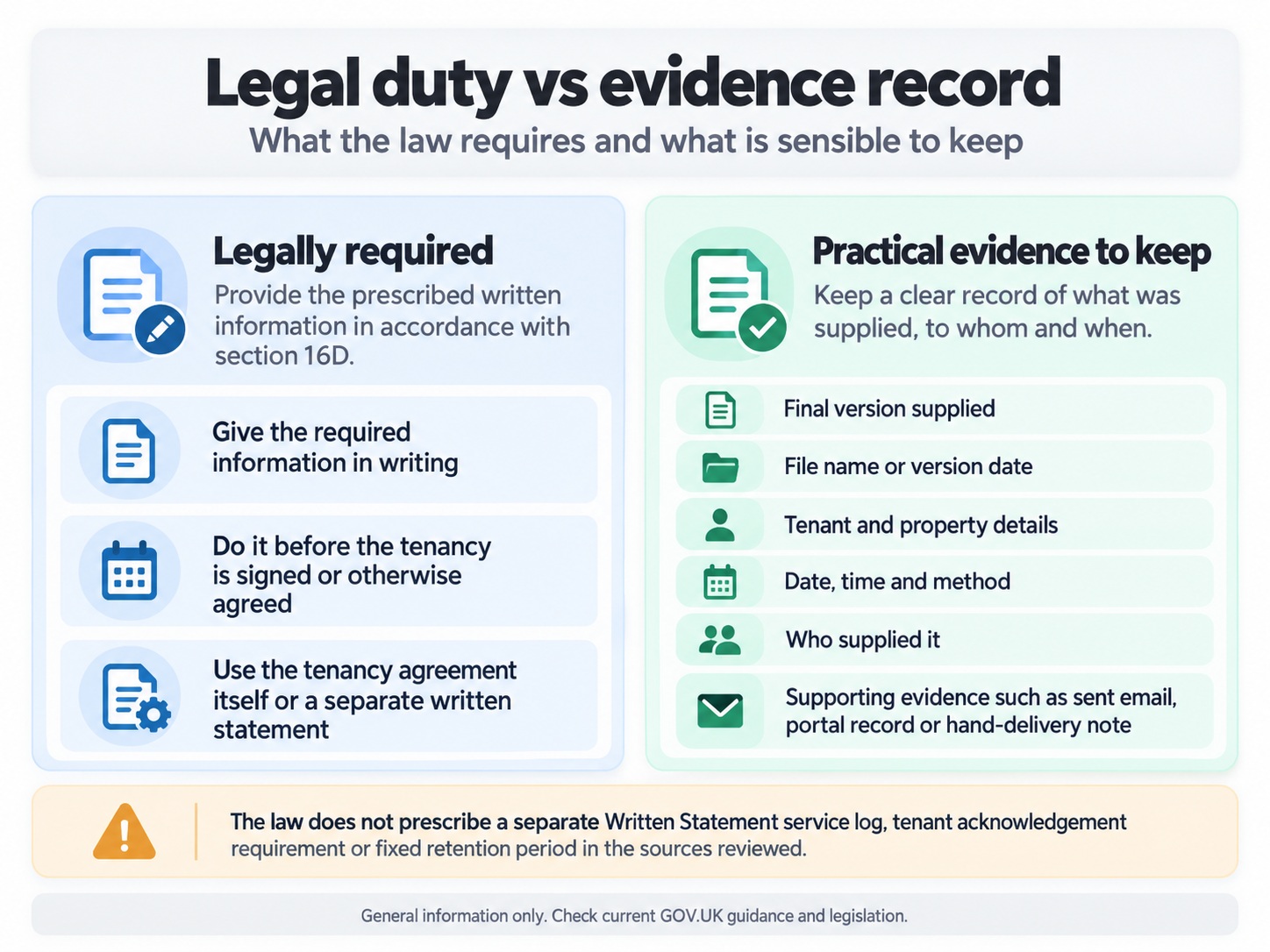
A useful property file would normally retain:
- the exact final tenancy agreement or separate statement supplied, rather than a blank master template;
- its file name, version or revision date;
- the tenant names and property;
- the date and time supplied;
- the channel used — for example email, portal or hand delivery;
- who supplied it;
- contemporaneous supporting material such as the sent email containing the attachment, portal history, a genuinely obtained signed copy, or a dated hand-delivery note;
- the version actually used by the letting agent, where an agent handled the tenancy; and
- a note of when the document was last checked against current government guidance.
Version-control example: Imagine opening the folder in August 2028 and finding tenancy.docx, tenancy-new.docx and tenancy-2026-final.docx. All three have different wording. None tells you which one was supplied before the tenancy was agreed. The valuable record is the actual final file used for that tenant, tied to a contemporaneous date and delivery trail.
The same principle matters when management changes. CertNudge’s letting-agent handover checklist for landlords covers the wider job of recovering the actual property and tenancy evidence file rather than relying on generic agency templates.
Common Written Statement mistakes after 1 May 2026
Check these process mistakes before agreeing the tenancy.
Using the Information Sheet for a new tenancy. The Information Sheet belongs primarily to the transitional pre-May written-tenancy route. A July 2026 new tenancy follows section 16D instead.
Using “before move-in” as the deadline. The ordinary new-tenancy rule is before the tenancy is entered into — GOV.UK says before signing or otherwise agreeing it.
Assuming any tenancy agreement is sufficient. The agreement must actually contain the prescribed information if it is being used to satisfy section 16D.
Reusing a pre-May AST. New assured tenancies are periodic, and section 16E(1)(a) of the Housing Act 1988 separately prohibits a relevant person from purporting to let an assured tenancy for a fixed term. Current statutory civil-penalty guidance uses £4,000 as the starting point for that fixed-term breach, with a statutory maximum of £7,000. An old fixed-term clause is therefore not simply another missing Written Statement term; it creates a separate enforcement risk.
Checking against the February draft. GOV.UK says a first draft of its Written information that must be given to tenants landlord document was published on 24 February 2026. Small changes were then made before the final version was published on 20 March 2026. A template checked against the February version should therefore have been rechecked against the final material.
Looking for an official Written Statement PDF. There is none. The prescribed information may be incorporated into the agreement and does not have to reproduce the legislation word-for-word.
Missing a relevant prior-notice requirement. Some possession grounds require the landlord’s intention to rely on them to be included in the section 16D Written Statement itself, while Ground 4A has its own advance-notice condition. These are additional pre-agreement checks beyond the standard SI 2026/324 minimum-content list — not tasks to leave until possession is later being considered.
Keeping the template but not the tenant’s version. A master template proves what your standard document looks like today. It does not show what was supplied for 18 King Street on 7 July 2026.
If an agent says its agreement is “Renters’ Rights compliant” but cannot supply the completed version actually used for your property, treat that as an evidence gap rather than relying on the description of its standard template. Ask for the final agreement or statement and retain it with the tenancy records.
What happens if a landlord does not provide the Written Statement?
Penalty position: Failure to comply with section 16D can lead to a local housing authority imposing a civil penalty of up to £7,000. The authority must be satisfied beyond reasonable doubt that the breach occurred; the maximum is not an automatic fine.
Current statutory civil-penalty guidance uses £4,000 as the national starting point for the section 16D written-statement breach. It also says there is no statutory minimum and requires authorities to consider case-specific aggravating and mitigating factors when setting the final amount.
That £4,000 penalty-setting table should not be read as changing the ordinary new-tenancy deadline. Section 16D itself says that, subject to specified exceptions, the statement is due before the tenancy is entered into. Separate 28-day rules exist for situations such as a tenancy becoming assured during its lifetime.
If a council proposes a civil penalty, it must first issue a notice of intent. The recipient has 28 days from the day the notice is issued to make written representations. A final notice can then be issued, and an appeal against the penalty or its amount can be made to the First-tier Tribunal within 28 days from the day the final notice is issued. See GOV.UK: Enforcement measures for landlords.
Continued or repeat non-compliance can become substantially more serious. If conduct that led to a relevant tenancy-duty civil penalty continues for more than 28 days after the penalty is imposed — or, where it is appealed, after the appeal is finally determined, withdrawn or abandoned — the person can commit an offence. A local authority may prosecute or, as an alternative, impose a civil penalty of up to £40,000. A different qualifying breach within five years of a previous relevant penalty can also trigger the repeat-breach offence.
If, for example, a council contacts a landlord in September 2026 and the landlord discovers that an outdated agreement was used for a June tenancy, the practical response is to preserve the original evidence, identify exactly what was missing, supply the required information promptly and take professional advice if enforcement is already under way. Late action should not be described as retrospectively erasing the earlier breach.
Written Statement of Terms FAQs
What is a Written Statement of Terms under the Renters’ Rights Act?
It is the written statement required by section 16D of the Housing Act 1988, inserted by the Renters’ Rights Act 2025. SI 2026/324 prescribes the minimum tenancy terms and information that must be covered. For an ordinary new assured tenancy, it can form part of the tenancy agreement rather than existing as a separate document.
Does every landlord need to give a Written Statement of Terms?
No. This article concerns relevant private assured tenancies in England. Resident-landlord and lodger arrangements, holiday lets, business and company lets, and tenancies with annual rent above £100,000 sit outside the standard assured-tenancy route; SI 2026/324 also excludes social housing assured tenancies from these Written Statement requirements. Pre-1 May 2026 tenancies have separate transitional rules depending on whether their terms were already recorded in writing.
Can my tenancy agreement itself be the Written Statement?
Yes. The prescribed written information can be included within the tenancy agreement. You do not automatically need a separate government form, and the government says exact statutory wording is not required, provided all specified information is covered.
When must a landlord give the Written Statement of Terms?
For an ordinary new in-scope tenancy entered into on or after 1 May 2026, give it before the tenancy is signed or otherwise agreed. The 31 May 2026 deadline concerned transitional existing-tenancy cases, including wholly oral pre-May tenancies.
Is the Written Statement the same as the Renters’ Rights Act Information Sheet?
No. The Written Statement is prescribed tenancy information that can be incorporated into a tenancy agreement. The Information Sheet is the specific government-produced PDF used for the principal transitional route for pre-1 May 2026 tenancies that already had a wholly or partly written record.
Keep the document and the evidence trail separate
For your next tenancy, make the Written Statement check a pre-agreement task rather than something done while preparing the keys. Confirm the final document against current guidance, provide the required information before agreement and retain a dated record of the version actually supplied.
That same discipline matters across the rest of a property’s compliance file: the useful record is not simply that a document exists somewhere, but that the correct evidence can be identified and produced when it is needed.
See what organised compliance evidence looks like
CertNudge is built around that wider evidence-readiness problem rather than tenancy-document drafting. If you want to see how organised property compliance evidence can be presented, view the sample CertNudge property compliance pack.
This article is for general information only and is not legal advice. Regulations and guidance change, and tenancy status and possession-ground requirements can depend on the facts. Always check the latest GOV.UK guidance and legislation, and speak to a qualified housing solicitor where you need advice on tenancy wording, status, possession grounds, a dispute or enforcement action.
Last reviewed: 14 September 2026
Next review recommended: 14 December 2026 — three-month review while the 2026 tenancy reforms remain newly implemented.