Right to Rent Checks for Landlords: Share Codes, Documents and Records
A practical guide for England landlords on Right to Rent checks, share codes, accepted documents, evidence records, follow-up dates and agent handovers.
Key takeaways
- A Right to Rent check is not just a tenant sending a passport photo or share code. The landlord must complete the correct check route and save the evidence.
- In England, landlords must check adult tenants aged 18 and over before the start of a new tenancy.
- British and Irish citizens do not use the Home Office share-code route; landlords usually check accepted documents or, where they choose to use one, an eligible digital identity route.
- Where a tenant has time-limited Right to Rent, record the follow-up date at the initial check so it is not missed.
- Right to Rent records should be kept for the tenancy period plus one year, then securely deleted or destroyed unless there is another lawful reason to retain them.
A Right to Rent check for landlords is more than collecting a passport photo or share code. Before granting a tenancy in England, you need to check the right adult occupiers, use the correct check route, save the evidence, record the check date and diarise any follow-up check.
What is a Right to Rent check for landlords?
A Right to Rent check is the process landlords in England use to check whether an adult tenant or occupier can legally rent residential property. The check should be completed before the start of a new tenancy, the evidence should be saved securely, and any follow-up date should be recorded where the tenant has time-limited Right to Rent.
Important: This article is general guidance for private landlords in England. It does not replace the Home Office Right to Rent guidance, the official Code of Practice, or legal advice. This article focuses on standard private residential tenancies in England, not specialist advice for lodgers, sub-letting disputes, company lets, licences to occupy or possession action. Home Office guidance and the legal position can change, especially around accepted evidence and follow-up checks. Immigration status checks involve sensitive personal data, so landlords should use official GOV.UK routes and store evidence securely.

Who needs to do Right to Rent checks?
Right to Rent checks apply to landlords letting residential accommodation in England. GOV.UK says landlords and letting agents must carry out checks before entering into a tenancy agreement, to make sure the person is allowed to rent.
For a standard buy-to-let tenancy, check every adult aged 18 or over who will occupy the property as their only or main home. That can include an adult occupier who is not named on the tenancy agreement, or a new adult occupier you are asked to authorise during the tenancy.
If a child living at the property turns 18 during an existing tenancy, the Home Office Code of Practice says you do not need to carry out a Right to Rent check just because they have turned 18. If follow-up checks are required for existing tenants, include the now-adult occupier when those checks are due.
Timing depends on the check route and the evidence used, but landlords should not complete the Right to Rent check too early. Where the 28-day rule applies, carry out and record the check no earlier than 28 calendar days before the tenancy starts. GOV.UK also warns landlords not to check only people they think are not British citizens, because checks must not be discriminatory.
The scheme is about people who will occupy the property as their only or main home. GOV.UK gives practical indicators such as whether the person lives there most of the time, keeps belongings there, has family living there, is registered to vote there, or is registered with a doctor at that address.
You do not need to carry out a Right to Rent check for property in Wales, Scotland or Northern Ireland. The GOV.UK share-code page states that the check is not needed for property in those nations.
This guide focuses on standard private tenancies. Lodger and sub-letting arrangements can involve separate responsibility questions, so check the current Home Office guidance if that applies.
Why agent handovers are a Right to Rent risk
A common problem is the tenant-find agent handover. A landlord may assume the agent has "done the checks", but later discover there is no saved profile page, no check date, and no follow-up date. The Home Office Code of Practice says landlords may appoint an agent to carry out Right to Rent checks on their behalf, but should keep a written agreement. That agreement should make clear whether the agent is responsible for the initial Right to Rent check and any follow-up checks for people with time-limited Right to Rent.
That matters especially if you use an agent for tenant-find only and then self-manage the tenancy. Before you accept the file as complete, ask where the Right to Rent evidence is stored and whether any follow-up check is due. For a broader handover process, see CertNudge's letting agent handover checklist for landlords.
The Right to Rent check routes in plain English
There are three main ways to complete a landlord Right to Rent check: a manual document check, a Home Office online Right to Rent check using a share code, or the prescribed use of a digital identity service provider for eligible checks. The route matters because it affects what the landlord must check and what evidence should be saved.
The right route depends on the tenant's circumstances.
A British tenant may provide a British passport. An Irish tenant may provide an Irish passport or Irish passport card. British and Irish citizens do not use the Home Office share-code route, so landlords usually check accepted documents manually or, where they choose to use one, use an eligible digital identity route for passport or Irish passport card checks.
A tenant with settled status, pre-settled status, an eVisa, or certain biometric immigration records may give you a share code. Where the tenant has a Biometric Residence Permit or Biometric Residence Card, the landlord should not rely on the physical card or permit as the Right to Rent check; the Home Office online share-code route should be used instead. A tenant with a BRP may still be able to use it to generate a share code for 18 months after the expiry date printed on the card. Frontier Worker Permit cases can involve the online service or other evidence routes, so landlords should follow the current Home Office guidance rather than relying on the physical permit alone.
If a tenant can prove their Right to Rent using an accepted original document, the landlord should not insist they use the online service instead.
The routes break down like this:
- Manual document check: used where the tenant provides accepted original documents.
- Digital identity route: an optional route for eligible British and Irish passport or Irish passport card checks where the landlord chooses to use a suitable provider and still checks the output belongs to the person.
- Home Office online share-code check: used where the tenant has a valid Right to Rent share code and the landlord completes the landlord-facing online check.
The check route is not just admin detail. It affects what evidence you need to keep.
How to check a tenant with a Right to Rent share code
For landlords, a Right to Rent share-code check needs two things: the tenant's date of birth and a current Right to Rent share code. GOV.UK currently says Right to Rent share codes are valid for 90 days. Right to Rent share codes should begin with "R"; a code beginning with "W" or "S" is for another service and should not be used for a Right to Rent check.
The important part is that you must use the landlord-facing GOV.UK checking service. A screenshot from the tenant's own UKVI account is not the same as you completing the landlord check.

Share-code workflow
- Ask the tenant for their share code and date of birth.
- Go to the official GOV.UK service, Check a tenant's right to rent in England: use their share code.
- Enter the share code and date of birth.
- Check that the profile details and photograph match the person.
- Save or print the profile/check result.
- Record the date you made the check.
- Store the evidence securely with the tenancy/property file.
- Add a follow-up date if the result shows time-limited Right to Rent.
GOV.UK says that if the share code is valid, you will be taken to the tenant's profile page. You then need to save the profile page, record the date of the check, keep the information for the time the tenant rents from you and for one year after, and follow data protection law.
In plain English, the evidence trail from a correctly completed Right to Rent check can help create a statutory excuse. That means the landlord has records showing they followed the prescribed process if the check is later questioned. It does not mean the landlord has verified immigration status themselves or received legal advice.
This is a common point of failure. The tenant sends a screenshot, the landlord files the email, and everyone assumes the job is done. It is not. The better evidence trail is the landlord's saved online check result from the landlord-facing GOV.UK service, dated and stored against the correct property and tenancy.
How to check original Right to Rent documents
Manual checks still matter. Not every tenant can provide a share code, and not every valid check is online.
GOV.UK's manual document process starts with identifying which adults will use the property as their main home. The landlord should then ask for original documents, check that they prove the tenant can live in the UK, check that they are genuine and belong to the tenant with the tenant present, then make copies and record the date of the check.
For example, if a British tenant sends a passport scan by email but you never check that the document belongs to the person applying, your evidence trail is weaker. The point is not simply to possess an image of a passport. The point is to complete the prescribed check properly and keep a clear record of what you checked and when.
If documents arrive through a representative, agent or email chain, do not treat that as enough by itself. The prescribed check still needs to confirm that the document or online profile belongs to the person who will occupy the property.
For copies, GOV.UK says landlords should make a copy that cannot be changed, such as a photocopy or good-quality photograph, copy the relevant passport pages or complete non-passport documents, and record the date the copy was made.
Practical tip: Do not reproduce the full acceptable-document list inside your own process notes from memory. Link your internal checklist to the latest GOV.UK guidance instead, because document rules and examples can change.
What Right to Rent evidence should landlords keep?
Once the check is complete, the Right to Rent task becomes a record-keeping task.
For a single tenancy, you may feel confident that the evidence is "somewhere in the emails". Across six properties, two letting agents and several changes of tenants, that confidence disappears quickly. One tenant has time-limited status, the follow-up date is not written down, and nobody can remember whether the saved check result is in Dropbox, Gmail, the agent portal or an old tenancy folder.
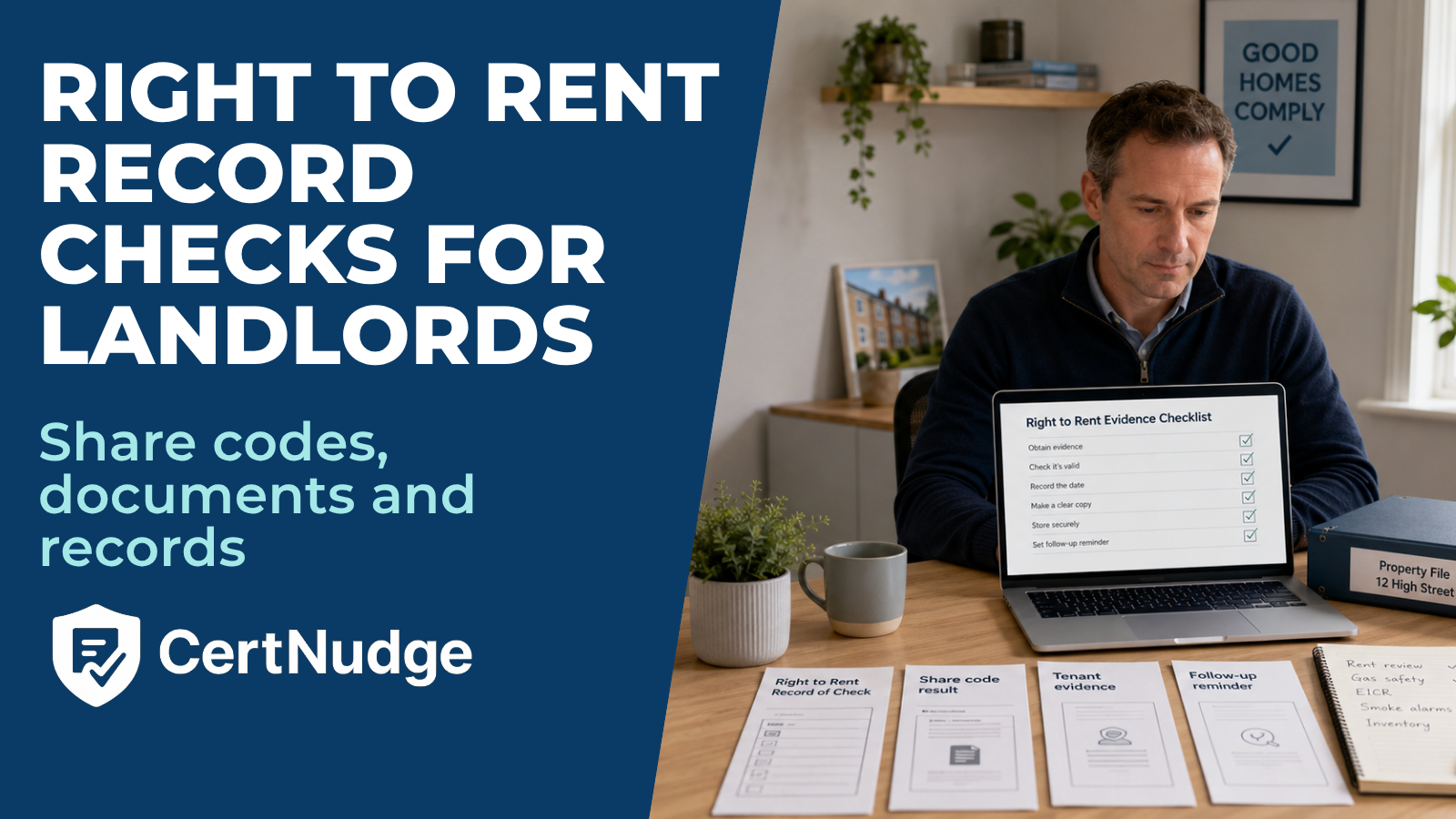
A useful Right to Rent evidence record should include:
- Full name of each checked adult occupier.
- Property address and the tenancy or application the check relates to.
- Tenancy or intended start date, so the evidence is linked to the tenancy rather than only to the applicant.
- Date the check was completed.
- Check route used: manual document check, digital identity route, Home Office online share-code check, or Landlord Checking Service.
- Copy of original document evidence where the manual route is used.
- Saved online profile/check result where the share-code route is used.
- Evidence that the person matched the document or online profile.
- Follow-up date if the tenant has time-limited Right to Rent.
- Any Landlord Checking Service response or Positive Right to Rent Notice.
- Agent confirmation or written agreement if an agent carried out the check.
- Secure deletion date once the retention period ends.
The legal requirement is to complete the correct check and retain the required evidence. The best practice is to store that evidence in a structured way, by property and tenancy, so you can find it later without searching across inboxes and folders.
If you currently rely on spreadsheets, a landlord compliance spreadsheet template can be a useful starting point for dates and follow-up reminders. The limitation is that a spreadsheet usually tracks the existence of evidence rather than holding the evidence trail itself.

How long should landlords keep Right to Rent records?
Right to Rent evidence should not be kept forever "just in case".
For manual document checks, the Code of Practice says landlords must make a clear copy of each document, retain it securely, record the date the check was made, and keep copies securely for at least one year after the tenancy agreement comes to an end.
For online checks, the Code of Practice says landlords must retain a clear copy of the online Right to Rent check response for the duration of the tenancy and for one year after the tenancy has ended, then securely delete or destroy it.
GOV.UK gives the same message on its checking pages: keep copies while the person is your tenant and for one year after, and follow data protection law. The ICO's storage limitation guidance is also useful when deciding how long to retain personal data.
The common mistake is keeping passport copies indefinitely in a general property folder. That may feel safe, but it creates unnecessary data protection risk. Right to Rent records can contain sensitive identity and immigration information. Store them securely, restrict access, and set a deletion date once the retention period ends unless you have another lawful reason to keep them.
For broader landlord record retention, see CertNudge's guide on how long landlords should keep records.
When are follow-up Right to Rent checks needed?
Follow-up checks are needed where the tenant has a time-limited Right to Rent.
GOV.UK says landlords must do a follow-up check where there is a time limit on the tenant's permission to stay. The follow-up should be done just before the later of the end of the tenant's permission to stay in the UK or 12 months after the previous check.
The Code of Practice explains this through the "eligibility period". Where a tenant has a time-limited statutory excuse, the eligibility period is the longest of: one year from the last check, until the person's permission expires, or until the document showing their right to be in the UK expires. Use the check result, evidence provided and current Home Office guidance to record the correct follow-up date. A follow-up check should be completed before the eligibility period expires.
Plain English: the legal requirement is to complete the follow-up check on time. For record-keeping, add the follow-up date when you complete the first check so it is not missed.
For example, a tenant with pre-settled status or another time-limited status may pass the initial check. But if you do not diarise the follow-up date, the evidence trail can fail months later. The check was done, but the workflow was not finished.
If a follow-up check indicates that the occupier no longer has Right to Rent, or the occupier does not co-operate, the Code of Practice says the landlord must report this to the Home Office using the prescribed online form to maintain their statutory excuse. Get legal advice before taking tenancy, possession or eviction steps.
For a portfolio landlord, reminders are what stop a completed check becoming a missed follow-up later. One missed follow-up can sit unnoticed because the original email is buried in a tenancy folder that nobody opens until there is a problem.
What if the tenant has no documents or valid share code?
Do not guess, and do not turn this into immigration advice.
GOV.UK says that if the tenant does not have the right documents or a valid share code, the landlord must use the Landlord Checking Service to request a Home Office Right to Rent check. The service may help where the Home Office has the tenant's documents, the tenant has an outstanding case or appeal, or the Home Office has told them they have permission to rent. GOV.UK says landlords should usually get an answer within 2 working days. Keep the response, any unique reference and any Positive Right to Rent Notice with the tenancy evidence. If the Landlord Checking Service does not respond within the stated period, follow the current Home Office guidance rather than guessing or creating your own workaround.
The Code of Practice also says the Landlord Checking Service can issue a Positive Right to Rent Notice, and that Home Office responses must be retained to maintain the landlord's statutory excuse.
A practical example: a prospective tenant says their documents are with the Home Office. The right response is not to invent your own process or automatically reject them without considering the official route. Use the Landlord Checking Service, save the response, record the reference, and keep it with the tenancy file.
Common Right to Rent mistakes landlords should avoid
The most common Right to Rent failures are not always dramatic. Often, they are admin failures.
A landlord asks the agent for the file after a handover. The agent says "checks were done", but there is no saved output, no check date and no follow-up date. At that point, the landlord does not have a clean evidence trail.
Avoid these mistakes
- Using the tenant's screenshot instead of the landlord-facing GOV.UK online checking service.
- Assuming every tenant can provide a share code. British and Irish citizens cannot get one.
- Forgetting to record the date of the check.
- Not saving the online profile or check result.
- Missing a follow-up check for time-limited status.
- Relying on an agent without a written responsibility trail.
- Keeping identity documents longer than necessary.
- Storing identity evidence in unsecured folders or general inboxes.
- Assuming Right to Rent applies across the whole UK.
Penalty figures should not be the main reason to build a proper process, but they are part of the context. The Home Office Code of Practice currently lists civil penalties of £10,000 per occupier for a first breach and £20,000 per occupier for a repeat breach, with separate lower figures for lodgers. Other consequences may also apply depending on the facts, so landlords should check the latest GOV.UK guidance rather than relying on penalty figures from an old checklist.
Keep Right to Rent evidence organised before you need it
CertNudge does not provide immigration advice, check immigration status or verify a tenant's Right to Rent. It helps landlords organise the evidence trail around the tenancy: check dates, document copies, saved online check outputs, property files, agent handover evidence and follow-up reminders.
For portfolio landlords, the value is repeatability. The process should not depend on remembering which inbox, portal or folder holds the proof when an agent, council, solicitor or internal reviewer asks for records.
Right to Rent FAQs for landlords
What is a Right to Rent check for landlords?
A Right to Rent check is the process landlords in England use to check whether an adult tenant or occupier can legally rent residential property. The check should be completed before the start of a new tenancy, the evidence should be kept securely, and any follow-up date should be recorded where the tenant has time-limited Right to Rent.
Do landlords have to check every tenant's Right to Rent?
Landlords must check all tenants aged 18 and over before the start of a new tenancy, even if they are not named on the tenancy agreement or there is no written agreement. GOV.UK also says landlords must not only check people they think are not British citizens.
Can a landlord use a share code for every tenant?
No. British and Irish citizens do not use the Home Office share-code route. They usually prove their Right to Rent with accepted documents or, where the landlord chooses to use one, an eligible digital identity route for passport or Irish passport card checks.
What should a landlord save after a Right to Rent check?
Save the check date, tenant name, property address, check route, and the relevant evidence. For manual checks, this usually means clear copies of the accepted documents. For online share-code checks, save or print the online profile/check result and record the date of the check.
How long should landlords keep Right to Rent records?
Keep Right to Rent evidence for the duration of the tenancy and for one year after it ends. The Code of Practice says online check responses must then be securely deleted or destroyed.
What happens if a tenant has time-limited Right to Rent?
You may need to complete a follow-up check before the tenant's eligibility period expires. Record the follow-up date at the initial check so it does not get missed.
Can a letting agent do Right to Rent checks for the landlord?
Yes, an agent can carry out checks for the landlord, but the agreement should be in writing. The Code of Practice says it should also make clear whether the agent is responsible for initial checks and follow-up checks.
What if a follow-up Right to Rent check fails?
If a follow-up check shows that the occupier no longer has Right to Rent, or the occupier does not co-operate, the Code of Practice says the landlord must report this to the Home Office using the prescribed online form to maintain their statutory excuse. Landlords should take legal advice before taking tenancy, possession or eviction steps.
Final practical takeaway
Keep Right to Rent evidence, certificate records, check dates and follow-up reminders organised by property, so proof is easier to find when an agent, council, solicitor or internal reviewer asks.
Information only: This article is for general information only and is not legal advice. Regulations change and individual circumstances vary. Always check the latest guidance at GOV.UK or speak to a qualified housing professional or solicitor.
Last reviewed: 29 June 2026
Next review recommended: 29 September 2026