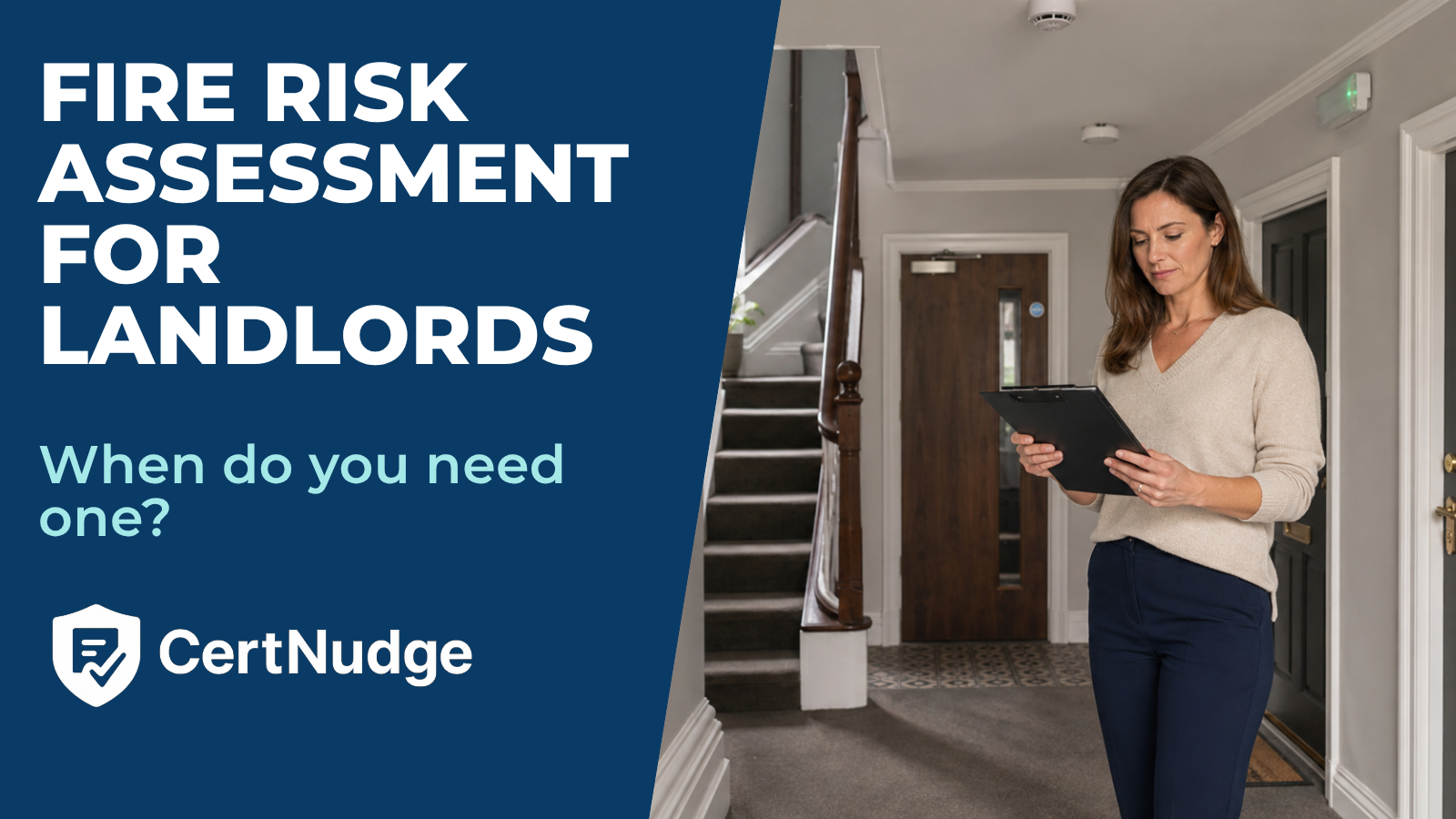
Fire Risk Assessment for Landlords: When Do You Need One?
Not every rental property needs the same fire risk assessment. Learn how building type, common parts and control affect landlord duties, and which records to keep for houses, flats and small blocks.
Do landlords need a fire risk assessment? A fire risk assessment for landlords is required where the Fire Safety Order applies and the landlord is a Responsible Person, for example, because they control common parts in a building containing two or more homes. The inside of an ordinary single private dwelling is generally outside the Order, although other fire-safety duties still apply. This guide explains the position for single lets, flats, shared areas and small blocks, and which records landlords should keep.
Key takeaways
- Fire risk assessment duties depend on the building and who controls its common parts.
- The Fire Safety Order generally applies to workplaces and the common parts of buildings containing two or more domestic premises, rather than inside an ordinary single private dwelling.
- A leasehold landlord may not control the block, but should know who the Responsible Person is and keep the fire-safety information supplied by the freeholder or managing agent.
- There is no universal “landlord fire safety certificate” equivalent to a CP12; different fire-safety records serve different purposes.
- Where the Fire Safety Order applies, the Responsible Person must record the fire risk assessment in full, act on its findings and keep it under review.
Fire risk assessment for landlords: who needs to think about it?
Start with the building, not the tenancy agreement. The Regulatory Reform (Fire Safety) Order 2005 applies to workplaces and to the common parts of buildings containing two or more domestic premises. It is particularly relevant to blocks and conversions with shared entrances, corridors or stairs, mixed-use buildings and shared properties.
HMOs need separate consideration: HMOs can also be subject to licensing conditions and additional housing requirements, so this article does not attempt to cover their operational rules. Check the licence and seek advice from the relevant council or a competent fire-safety professional.
An ordinary single-let house occupied as one private dwelling is different. Its interior is generally not subject to the Fire Safety Order in the same way as the common parts of a block. That does not remove the landlord’s other fire-safety duties. GOV.UK’s private renting safety guidance covers matters such as smoke alarms, escape routes and supplied furniture, while CertNudge’s smoke and CO alarm log guide explains the evidence worth recording at the start of a tenancy.
Imagine a landlord with a terraced house, a leasehold flat and a two-flat conversion with a shared entrance. The first has no common parts, the block may be controlled by a management company, and the conversion may leave the landlord responsible for its hallway.
This article focuses on England. The Fire Safety Order also extends to Wales, but devolved housing requirements differ in Wales, Scotland and Northern Ireland.
Do landlords need a fire risk assessment?
Where the Fire Safety Order applies, Article 9 says the Responsible Person must make a “suitable and sufficient” assessment of the risks to relevant people. The assessment is used to identify the general fire precautions needed for the premises.
In practical terms:
- A single private dwelling: the inside of a standard house or flat occupied as somebody’s home is generally outside the Fire Safety Order. Other housing and alarm duties still apply.
- A building with two or more homes and shared common areas: the common parts fall within the Fire Safety Order. A fire risk assessment is required for the premises in scope.
- A workplace or mixed-use area: a shop, office, caretaker’s room or another workplace in the building can create separate Fire Safety Order responsibilities.
- A shared or licensed property: additional requirements may apply. Do not use the single-let position as a shortcut for an HMO.
The Responsible Person is not every landlord connected to the address. Responsibility usually follows control. It is often held by the freeholder, building owner, management company or agent and there can be more than one.
For example, the freeholder of a two-flat conversion who controls its shared entrance cannot treat the hallway as part of one tenant’s private home. A leaseholder owning one flat may not control the block’s corridors at all.
Practical next step: If you control common parts, assume that fire risk assessment duties need proper attention. If ownership, leases and management arrangements leave the position unclear, ask the building owner or manager to confirm the division of responsibility in writing and obtain competent advice.
For most premises, the local fire and rescue authority enforces the Fire Safety Order. It can inspect the premises and fire-safety records and issue notices requiring action. Serious breaches that place people at risk, or failure to comply with a statutory notice, can lead to prosecution.
How to work out what you need to do
A PDF headed “Fire Risk Assessment” is only the starting point. Check each property separately.
- Classify the property. Record whether it is a single-let house, an individual flat, a small block, a conversion, an HMO or a mixed-use building.
- List the common parts. Check for shared entrances, stairs, corridors, bin stores, meter cupboards, plant rooms, basements and external escape routes.
- Identify who controls each area. This may be you, the freeholder, a management company, a right-to-manage company or a managing agent. Ask for written confirmation where it is not obvious.
- Locate the current assessment. Check the address, date, assessor and areas covered. An assessment for “Flat 2” is not necessarily the block’s common-parts assessment.
- Read the action plan, not just the conclusion. Note every action, priority, target date and person responsible. Check whether earlier actions were completed.
- Check whether a review is due. Article 9 of the Fire Safety Order does not set a universal annual expiry date. It requires the assessment to be reviewed regularly and when there is reason to suspect it is no longer valid or after a significant relevant change. Home Office guidance recognises annual review as good practice for small, simple premises.
- Bring supporting evidence together. Attach fire-door records, alarm and emergency-lighting maintenance reports, invoices, photographs, resident information and correspondence to the same property record.
- Set the next reminder. Use the assessor’s recommended review point, then bring it forward if the building, occupants, use, layout or management changes.
A landlord taking management back from an agent might receive a four-year-old assessment. Before filing it as “done”, check its scope, later building changes and whether every action was completed. CertNudge’s letting-agent handover checklist covers other records that should transfer too.
Doing this across a whole portfolio?
Working through classification, common parts, action logs and review dates one property at a time is where fire-safety evidence usually falls apart, not because a document is missing, but because the assessment, the completed actions and the proof sit in three different places. Our free Compliance Check gives you a quick, per-property view of which compliance records you hold and where the gaps are, so you can see at a glance which properties still need attention.
Run the free Compliance Check → No signup, no uploads.
What about fire risk assessments for flats, communal areas and small blocks?
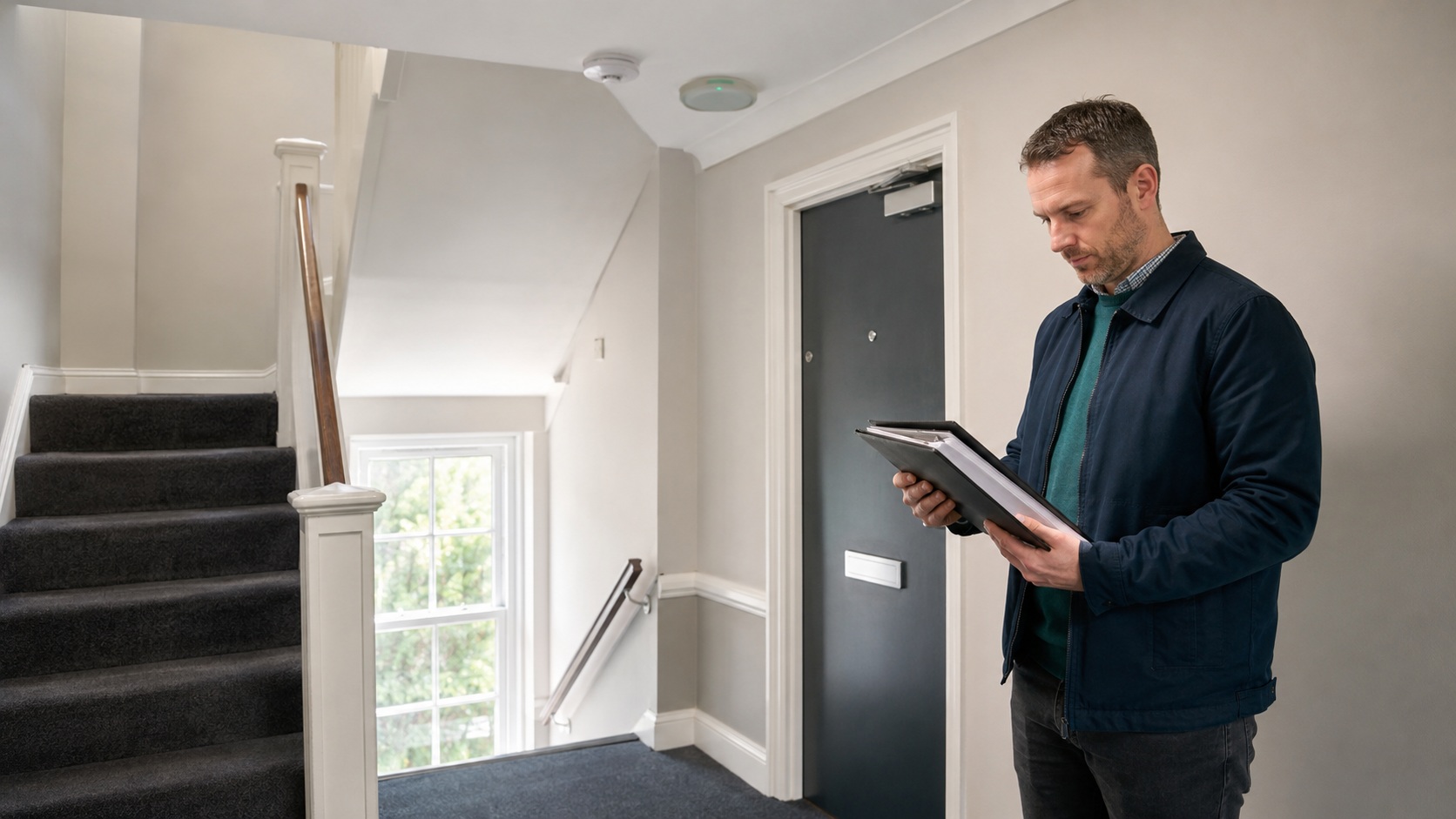
For a fire risk assessment for flats, split the evidence into two layers: the individual flat and the wider building. A leasehold landlord may be responsible for matters inside the flat while the freeholder or management company controls the common parts.
The Home Office’s small-block fire-safety guide applies to the common parts of small blocks of up to three storeys, along with the building’s structure, external walls and doors between flats and common parts. It describes a fire risk assessment as an inspection of the common areas to identify hazards and check that suitable precautions protect residents, visitors and contractors.
Common parts can extend beyond the main hallway to:
- entrances, corridors, landings and stairs;
- bin stores, meter rooms and communal cupboards; and
- external walkways or escape routes.
If you own one leasehold flat, request and retain the current common-parts assessment, the name and contact details of the Responsible Person, relevant fire-door information, evidence of completed actions and the fire-safety instructions issued to residents. If the managing agent will only provide a summary, keep the request and response rather than recording “FRA held by agent” with no further detail.
A landlord selling a flat may be asked for building fire-safety information. Keeping documents received during ownership avoids a paper chase once conveyancing starts.
Since 6 April 2026, the Fire Safety (Residential Evacuation Plans) (England) Regulations 2025 have applied to multi-residential buildings that are at least 18 metres above ground level or have at least seven storeys. They also apply to multi-residential buildings more than 11 metres above ground level where a simultaneous evacuation strategy is in place.
The Regulations introduce Residential Personal Emergency Evacuation Plan (Residential PEEP) and building emergency evacuation plan duties. Leaseholders in an affected building should ask the Responsible Person what arrangements apply; the detailed duties sit outside this guide.
Is a fire safety certificate the same as a fire risk assessment?
No. “Landlord fire safety certificate” is often used loosely, but England has no universal rental-property fire certificate equivalent to a gas safety record. Ask which document is needed.
A landlord asking an agent for the “fire certificate” might receive an alarm service sheet, fire-door inspection and common-parts assessment. The assessment explains the risks; the other records show particular precautions were checked.
Can you use a landlord fire risk assessment template?
A template can help organise information, but it does not make an assessment suitable and sufficient. The answer depends on the premises, the people at risk, the escape arrangements, the construction and the person completing it.
The Home Office says Responsible Persons can complete their own assessment if competent. Its small-block guide includes a checklist for premises within its scope, but recommends a competent assessor when the person cannot interpret and apply the guidance.
Professional input is particularly sensible for a conversion, mixed-use building, unusual layout, external-wall concern, vulnerable occupants or any property where the Responsible Person cannot confidently assess the risks.
When appointing an assessor, check that they have experience of the same type and complexity of premises. Home Office guidance on choosing an assessor advises:
- giving preference to firms or individuals certified under a recognised third-party certification scheme, or registered by a professional body;
- agreeing the scope of the work;
- obtaining comparable quotations;
- checking references and insurance; and
- keeping a record of the selection process.
Although a future statutory competence requirement for appointed assessors has not yet been brought into force, current GOV.UK guidance on Responsible Person duties recommends ensuring an assessor has sufficient training, experience, knowledge and other relevant qualities.
A template is not proof of suitability. A generic template for a two-flat conversion might cover alarms but miss the shared entrance, flat doors and meter cupboard. A neat form creates false confidence when its scope does not match the building. Do not treat it as proof that every risk was assessed.
What fire safety records should landlords keep?
Where the Fire Safety Order applies, Responsible Persons must record the assessment in full and record their fire-safety arrangements. The changes introduced by Section 156 of the Building Safety Act 2022 also cover the recording of assessor identity, cooperation between Responsible Persons and the handover of relevant fire-safety information to an incoming Responsible Person.
For each affected property, keep:
- the complete assessment, each review, relevant dates, scope and assessor details;
- the identified hazards, required measures, priorities and target dates;
- an action log showing the person responsible and completion date;
- invoices, reports and photographs supporting remedial work;
- relevant fire-door, alarm and emergency-lighting inspection or repair records;
- smoke and CO alarm test and fault records;
- fire-safety information issued to residents and the date supplied;
- correspondence with the freeholder, management company or agent; and
- notes of changes that prompted the latest review or were considered as part of it.
Recording the full assessment and fire-safety arrangements is a legal requirement for a Responsible Person. Linking invoices and dated photographs to each action is good evidence management; it does not prove the assessment or work was legally adequate.
If an assessment gives 30 days to correct an emergency-lighting fault, the PDF shows the problem, not its completion. Add the contractor evidence, completion date and any follow-up check.
The wider landlord record-retention guide explains how to set sensible retention periods. A compliance spreadsheet can track a review date, but it becomes fragile when the assessment, action evidence and messages remain in unrelated folders.
Keep fire-safety evidence organised by property. CertNudge can bring assessments, alarm logs, contractor reports, remedial actions and review notes into one property record, making the supporting evidence easier to find when asked.
Common fire risk assessment mistakes landlords make
Assuming every rental needs the same document
A single-let house, one leasehold flat and a freehold block have different common-parts and control questions. Classify each property first.
Ignoring the boundary of the assessment
A report for an individual flat is not necessarily the common-parts assessment. Check the address, areas inspected and exclusions.
Confusing maintenance records with the assessment
An alarm service certificate records work on the alarm system. It does not identify all fire risks within the premises.
Keeping recommendations without closure evidence
Transfer every action into a dated log and attach proof of completion. Do not leave “repair fire door” buried on page 18 of a PDF.
Treating the assessor’s suggested review date as a fixed expiry date
Article 9 requires regular review and a review when there is reason to suspect the assessment is no longer valid or after a significant relevant change. Building work, a change in layout, new external-wall information, a fire or a change in occupancy or management can bring the review forward. The Home Office guide for people with fire-safety duties confirms there is no single statutory review interval.
Relying entirely on the agent
Ask for copies. A landlord selling a flat should not discover during conveyancing that a former agent has the only assessment and no completed-action records can be found.
Fire risk assessment FAQs for landlords
Do landlords need a fire risk assessment?
It depends on the premises. The Fire Safety Order requires an assessment for workplaces and common parts of buildings containing two or more homes. An ordinary single private dwelling is treated differently.
Does a single-let house need a fire risk assessment?
The inside of a standard single-let house used only as a private dwelling is generally outside the Fire Safety Order. Alarm, escape-route, repair and supplied-furniture duties still apply. Mixed-use and shared buildings need separate consideration.
Do flats need a fire risk assessment?
Common parts of a building containing two or more homes are within the Fire Safety Order; the interior of each flat is treated differently. A leasehold landlord should identify who controls the block and request the current records.
Who is responsible for the fire risk assessment in a block of flats?
Responsibility normally follows control. It may sit with a freeholder, building owner, management company or another party, and there can be more than one Responsible Person. Obtain advice if the division is unclear.
Is a fire safety certificate the same as a fire risk assessment?
No. There is no single universal landlord fire safety certificate. A fire risk assessment, alarm service record, fire-door inspection, emergency-lighting test and resident information are different records with different purposes.
Can landlords use a fire risk assessment template?
A suitable template may help a competent person with straightforward premises. It does not replace competence or consideration of the actual building and occupants. Complex or unusual premises are likely to need professional input.
What fire safety records should landlords keep?
Keep the full assessment, review history, assessor details, action plan, completion evidence, maintenance records, resident information and correspondence. Connect every action to dated evidence of how it was addressed.
How often should a fire risk assessment be reviewed?
There is no universal annual expiry date. Review regularly and after a significant relevant change. The Home Office recognises annual review as good practice for small, simple premises; other buildings depend on their complexity and risk.
Keep fire safety records organised by property
Choose one property this week and check who controls the common parts, whether the assessment is current, which actions remain open and when review is due. That reveals more than a spreadsheet showing only “FRA: yes”.
Fire-safety records are useful only when the assessment, actions and completion evidence can be followed as one story. CertNudge’s inspection-ready compliance records help landlords organise fire risk assessments, alarm logs, contractor reports, remedial work and review dates by property, without claiming to assess the building or verify legal compliance.
Keep the assessment and its evidence together
See how CertNudge helps organise assessments, action evidence, contractor records and review dates into an inspection-ready record for each property.
This article is for general information only and is not legal advice. Regulations change and individual circumstances vary, always check the latest guidance at GOV.UK or speak to a qualified housing professional or solicitor.
Last reviewed: 21 July 2026
Next review recommended: January 2027