Private Landlord Ombudsman: Complaint Records to Organise Now
The PRS Landlord Ombudsman is expected to become mandatory in 2028. This guide explains what is confirmed, what is still undecided and the complaint records England landlords can organise now.
The private landlord ombudsman won’t be mandatory until 2028 but the complaint records you’ll need for it are the ones you’re creating (or losing) right now.
A tenant messages you on WhatsApp about damp behind the bedroom wardrobe. You send a contractor, the work gets done, you move on. Six months later the tenant disputes what happened and the photos, access messages and contractor notes are scattered across four different places. That gap is the real problem, and it is fixable today.
This guide does two things. First, it cuts through the misinformation: what the Renters’ Rights Act 2025 actually confirms about the future PRS Landlord Ombudsman, what is still undecided, and why you cannot register for it yet, whatever an advert tells you. Second, and more usefully, it shows you the complaint records to organise now, so that when the scheme does arrive you already have one clear chronology per property instead of a scramble.
You do not need a corporate complaints department to do this. A five-property landlord needs a repeatable way to record what the tenant raised, what you checked, what you decided and what happened next. That is the practical standard this guide works toward.
Key takeaways
- The private landlord ombudsman is not open for mandatory registration today. The Government’s Renters’ Rights Act implementation roadmap expects landlords to be required to join the PRS Landlord Ombudsman in 2028.
- The Renters’ Rights Act 2025 already creates the statutory framework for a landlord redress scheme in England, but important operational details including the final fee, joining process and complaint procedure are still being developed.
- You do not need a corporate complaints department. A repeatable process that records what the tenant raised, what you checked, what you decided and what happened next is a sensible starting point.
- Keep the original complaint, communications, access arrangements, contractor findings, decisions and completion evidence together. An invoice on its own rarely tells the whole story.
- Do not copy the Housing Ombudsman Complaint Handling Code 5/10/20-working-day social-housing timetable into a private-landlord policy and describe it as current PRS law.
This article is for general information only and is not legal advice.
Scope: This guide focuses on private landlords in England with assured or regulated residential tenancies. Housing redress arrangements differ in Wales, Scotland and Northern Ireland.
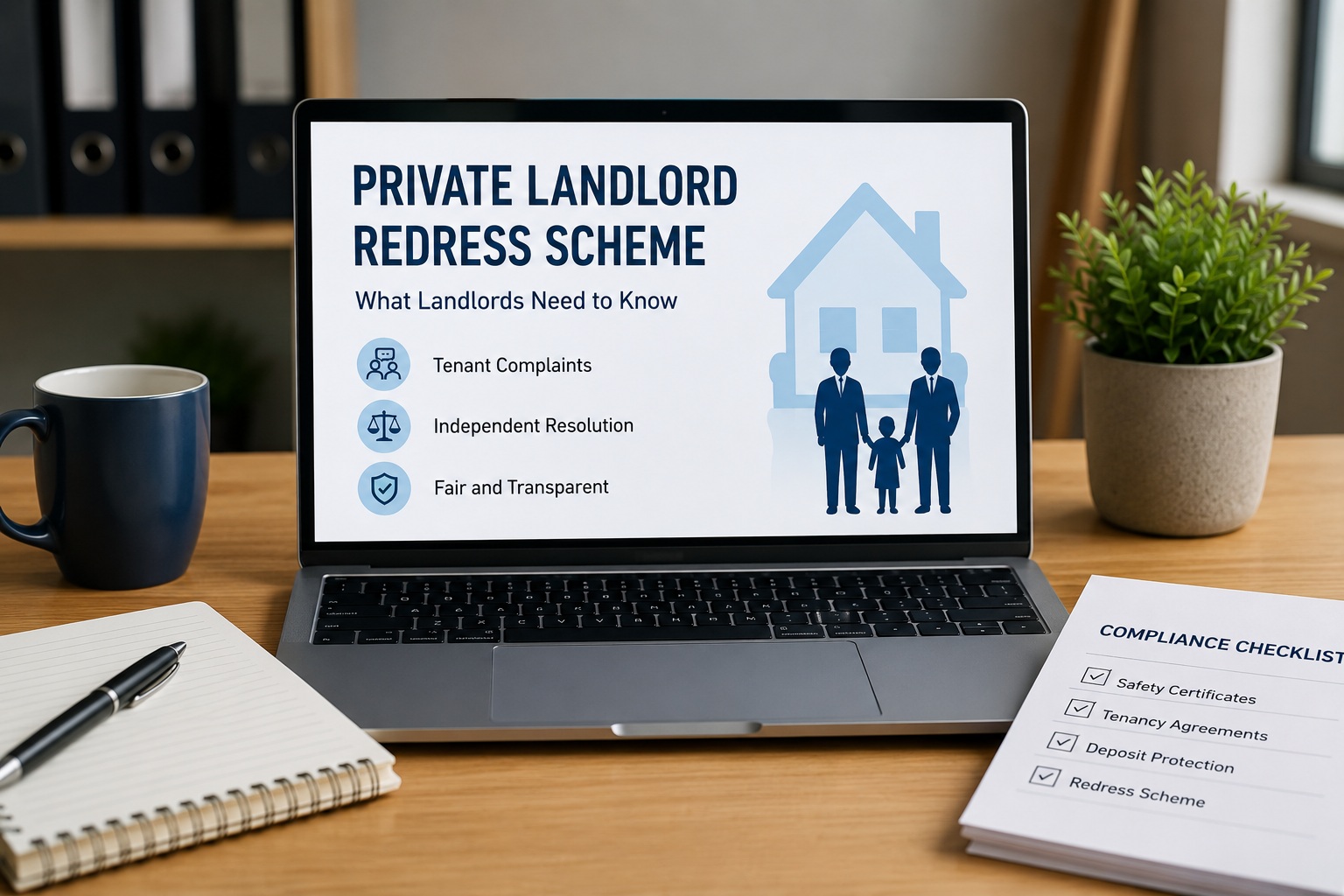
Who the private landlord ombudsman will apply to and what is live now
Start with the useful bit: there is currently no mandatory PRS Landlord Ombudsman registration for private landlords to complete.
The Renters’ Rights Act 2025 creates the statutory framework for what the Act calls a “landlord redress scheme”. Section 64 of the Act defines that in terms of complaints made by or on behalf of prospective, current or former residential tenants against scheme members.
“PRS Landlord Ombudsman” is the more recognisable public-facing description of the future private rented sector ombudsman. The Government’s implementation roadmap says the scheme will be mandatory for PRS landlords and expects the stage requiring landlords to become members to begin in 2028, after an earlier stage in which an administrator is selected and the service is scaled up.
This is separate from the PRS Database, whose landlord and council rollout is scheduled to start from late 2026. For the wider reform sequence, see our Renters’ Rights Act compliance audit.
Confirmed and not yet confirmed as at 7 August 2026
Statutory landlord redress framework
Confirmed. It is contained in the Renters’ Rights Act 2025.
Will the scheme be mandatory?
Yes, once the membership duty is brought into effect. The GOV.UK implementation roadmap says the Ombudsman scheme will be mandatory for PRS landlords.
Mandatory landlord sign-up
Expected in 2028. No precise joining day has been announced. See the Government implementation roadmap.
Can landlords register for the future scheme now?
No. The Housing Ombudsman expressly warns that its existing voluntary membership form is not an application for the future PRS Landlord Ombudsman.
Membership fee
Not yet set. The Government roadmap says landlords will fund the service through a fair and proportionate charging model confirmed closer to launch.
Scheme operator
Government intention, but not formal appointment. Ministers intend the Housing Ombudsman Service to operate the scheme and describe it as the preferred provider, subject to final assurance on deliverability. Formal appointment or designation has not yet taken place.
Final complaint procedure and PRS response deadlines
Not yet published. Do not treat the existing Housing Ombudsman Complaint Handling Code timetable as the future PRS rule.
Private Landlord Redress Schemes (Approval and Designation) Regulations 2026
Parliament approved the draft Regulations in June and July 2026, but as at 7 August 2026 legislation.gov.uk still lists them as a UK Draft Statutory Instrument. They have not yet been made.
Why this distinction matters: The draft Private Landlord Redress Schemes (Approval and Designation) Regulations 2026 set conditions a future approved or designated scheme must satisfy; they do not themselves create a live Ombudsman service or impose an immediate duty to join one. Ministers made that distinction clear when the Regulations were debated.
Another point is not yet settled: the final scheme has not said whether it will accept complaints about events that happened before a landlord became a member. The draft Regulations require the scheme to set complaint time limits, but the detailed jurisdiction has not yet been published. Organising records now is therefore sensible administration, not a claim that every complaint arising in 2026 will fall within the future Ombudsman’s remit.
Imagine an eight-property landlord sees an advert headed “Register for the new landlord ombudsman now — avoid being non-compliant”. Before entering payment details, the sensible check is GOV.UK and the future scheme administrator’s official material. At present, an existing Housing Ombudsman voluntary membership application is not registration for the forthcoming PRS service.
Landlords who use managing agents should not assume the agent’s existing redress membership will remove their own future obligation. Current GOV.UK guidance on the Renters’ Rights Act says landlords with assured or regulated tenancies will have to join even where a managing agent looks after the property, with landlord and agent responsibility potentially overlapping.
What complaints and redress could the PRS Landlord Ombudsman cover?
The safest way to think about the future Ombudsman is not as a repairs tribunal with a fixed list of eligible defects.
Current GOV.UK guidance on the Renters’ Rights Act describes complaints more broadly: actions, inactions or behaviours by a landlord that cause a tenant harm or inconvenience. It specifically leaves room for the Ombudsman to consider individual circumstances rather than putting an exhaustive complaint list into the Act.
That makes the handling of the problem important as well as the underlying problem.
Example: Suppose a boiler fails on 4 January. The landlord instructs an engineer the next morning, but parts are delayed and the repair is finally completed on 24 January. The landlord has dealt with the physical fault — but if the tenant received no meaningful update for three weeks, a later complaint could involve communication and the handling of the issue as well as the repair itself.
Current GOV.UK guidance says the future service is intended to provide binding resolution and may require a landlord to take or stop an action, provide information, make an apology or explanation, take remedial action or pay compensation. Landlords will be required to comply with Ombudsman decisions; failure to do so may lead to expulsion from the scheme and subsequent council enforcement. Once the separate membership duty is in force, councils will also be able to impose civil penalties of up to £7,000 for an initial failure to join. Continuing or repeated breaches can become offences, for which a council may impose a financial penalty of up to £40,000 instead of prosecution. Tenants may also be able to seek a rent repayment order where the persistent-failure offence is committed. None of those membership sanctions applies today because the duty to join is not yet in force. The Act also provides a route to appeal a final local-authority financial penalty notice to the Tribunal, including against the decision to impose the penalty or the amount. Schedule 5 of the Renters’ Rights Act 2025 sets out the appeal process.
The draft Private Landlord Redress Schemes (Approval and Designation) Regulations 2026 provide that a scheme’s redress orders may include an apology or explanation, compensation of no more than £25,000, or other action in the complainant’s interests. Because the Regulations have not yet been made and no live PRS Landlord Ombudsman scheme exists, £25,000 is not a current compensation limit for private landlords today.
The scheme is tenant-facing. GOV.UK guidance says landlords will not be able to use it to obtain binding decisions against tenants, although the Government is exploring landlord-initiated mediation as a separate form of dispute resolution.
For complaints involving serious property conditions, remember that an Ombudsman process will not replace other routes. A tenant may also approach the council where housing hazards or enforcement are involved; our Housing Health and Safety Rating System (HHSRS) inspection guide covers that process.
Damp and mould complaints also need to be considered separately from the future extension of Awaab’s Law to private landlords, whose PRS implementation timetable remains subject to further consultation.
Set up a simple landlord complaints procedure now
There is no current PRS rule requiring an ordinary private landlord to adopt the Housing Ombudsman’s two-stage complaints process or its social-housing response deadlines. Section 65 of the Renters’ Rights Act 2025 does, however, require the future scheme rules to include time for members to resolve matters before a complaint is accepted. That makes a clear internal process sensible preparation now, but the final PRS stages and response deadlines have not yet been published.
For a landlord with six flats, the process can be one page rather than a corporate manual.
- Choose a clear contact route. Give tenants an obvious email address or other route for complaints, while recognising that dissatisfaction might first arrive by WhatsApp, text, telephone or through an agent.
- Separate the issue from the label. “The kitchen tap is dripping” may simply be a repair report. “I reported this three times and nobody has dealt with it” contains dissatisfaction with how the matter has been handled. Do not make the record depend on the tenant using the word complaint.
- Acknowledge it in writing. Record the date received and briefly state what you understand the complaint to be. For example: “I understand your complaint concerns the continuing leak beneath the kitchen sink and the missed contractor appointment on 6 August.” Then give a realistic date for your response.
- Give one person ownership. If an agent receives the complaint and a contractor performs the work, somebody still needs responsibility for keeping the chronology together. For a self-managing landlord, that will usually be the landlord.
- Check urgency first. A complaint involving no heating in winter, exposed electrics, significant water ingress, a vulnerable occupier or another immediate safety concern should not sit in an ordinary complaint queue while somebody works out the paperwork. Deal with the risk and record what you did.
- Investigate the underlying record. Look at the tenancy information, earlier emails and messages, inspection notes, photographs, previous repairs, invoices, contractor findings and access arrangements. Record evidence that contradicts your initial view as well as evidence that supports it.
- Give a written decision. Address the separate points raised. State what you found, why you reached that view and what you will do next. If the tenant is right about one part and not another, say so rather than forcing the whole complaint into “upheld” or “rejected”.
- Keep tracking work after the response. A complaint response dated 14 September does not make an outstanding repair disappear. Keep its owner, target date, delay reason and completion evidence in the same record.
- Provide a proportionate review route. A small landlord might ask a co-owner, another director of the property-owning company, or — if the agent had no involvement in the original issue or first response — the managing agent to reconsider it. Do not describe a two-stage process as a legal PRS requirement unless the final rules eventually make it one.
- Close the record deliberately. Note the final decision, remedies, completed actions and anything still outstanding. A complaint marked “closed” while scaffolding is still booked for the following Tuesday is not really an accurate record of the position.

A WhatsApp message shows why this matters. A tenant sends: “Still no one here to look at the loose bathroom tiles. This is the third time I’ve chased.” Rather than arguing six weeks later over whether the tenant formally “complained”, a short acknowledgement on the day fixes the scope: what was reported, what previous contacts are being considered and what happens next.
The Housing Ombudsman Code is a useful benchmark — not the current PRS timetable
The Housing Ombudsman Complaint Handling Code currently requires landlords within its statutory social-housing regime to acknowledge stage-one complaints within 5 working days, respond within 10 working days of acknowledgement, acknowledge a stage-two escalation within 5 working days, and normally give the final stage-two response within 20 working days of acknowledgement.
Those numbers should not be copied into a standard private-landlord procedure with the words “legally required”.
What is useful is the structure behind them. The Code expects a written response to identify the complaint, decision, reasons, remedy and outstanding actions. Those are sensible fields for a private landlord’s own records even before the future PRS rules are finalised.
Complaint records landlords should keep
A good complaint file should let somebody who was not involved on day one understand what happened three or six months later.
That becomes particularly useful where different people hold different fragments. For example, the managing agent received the tenant’s first email, the landlord approved a £420 repair, the contractor arranged access directly with the tenant and the landlord only received the final invoice. Without one chronology, all four parties can hold an accurate but incomplete version of the same event.
For each complaint, keep:
- a unique complaint reference and the relevant property and tenancy;
- the original complaint in its original form where practical, including the date, time, channel and recipient;
- a neutral summary of each issue raised and the outcome the tenant says they want;
- any urgency or safety assessment;
- only the vulnerability or reasonable-adjustment information genuinely needed to handle the issue;
- the written acknowledgement and your definition of the complaint;
- relevant emails, messages and notes of telephone conversations involving the tenant, landlord, agent, contractor, insurer, council or other party;
- inspection dates, reports, photographs, videos, readings, surveys and contractor findings;
- access requests, dates offered, alternative appointments, missed visits or refused access, recorded factually rather than emotionally;
- the evidence considered and reasons for the decision on each point;
- actions promised, who owns them, target dates and delay updates;
- evidence showing whether promised work was actually completed;
- any repair, apology, explanation, reimbursement, compensation or other remedy offered;
- an escalation request and review outcome where you provide an internal review;
- the final response, closure date and any actions still open;
- a retention-review date rather than an assumption that the file will be kept forever; and
- a clear distinction between what the tenant alleged, what the evidence showed, what a contractor advised and what the landlord concluded.
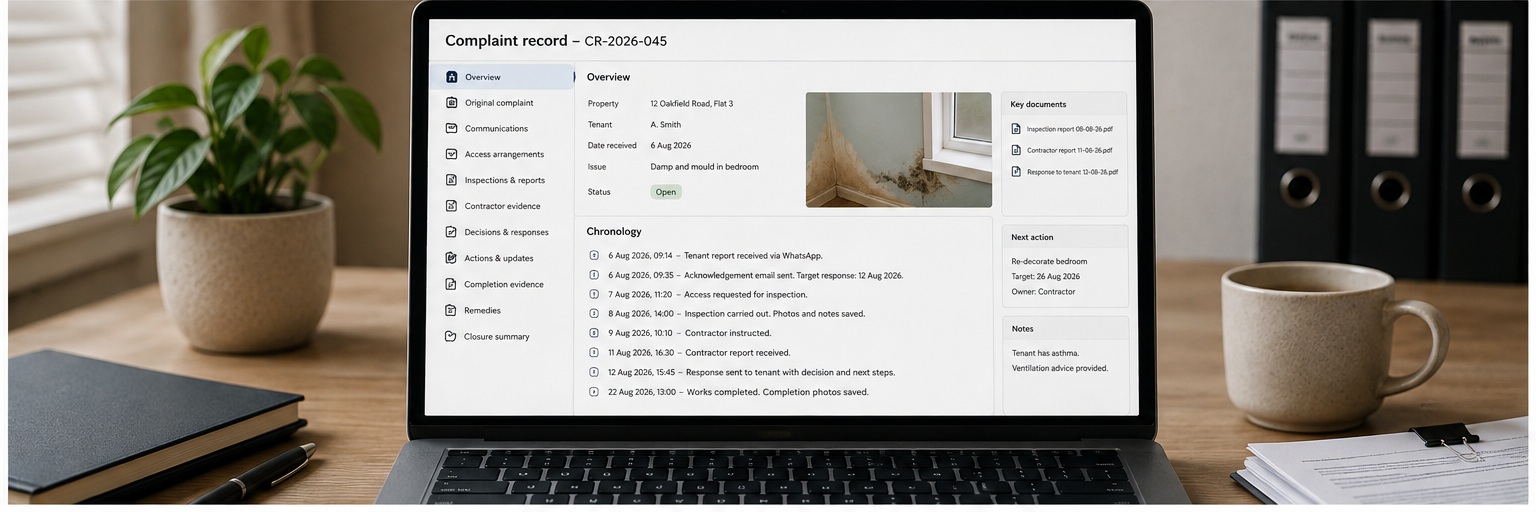
Preserve the original record. If a note made on 8 August says the contractor attended at 10:30 but you later discover the appointment was at 11:30, correct it transparently rather than silently replacing the earlier entry.
Personal information also needs discipline. UK GDPR requires personal data to be adequate, relevant and limited to what is necessary for the purpose (data minimisation), and not kept in identifiable form for longer than necessary (storage limitation). UK GDPR does not set one universal retention period for complaint files, so the retention decision should be tied to the purpose for which the information is still needed.
So “tenant advised that morning appointments are required because of a disability” might be relevant to arranging access. A detailed medical history usually is not. Health information is special-category data under UK GDPR and has additional processing requirements. Where the complaint only requires a practical adjustment, record the adjustment rather than a diagnosis unless the medical detail is genuinely necessary. Apply the same restraint to family circumstances, immigration information and criminal allegations: do not record them simply because they were mentioned if they are not genuinely needed to handle the complaint.
Our guide to how long landlords should keep records looks at the wider retention question.
Keep a landlord complaint log and case file in one place
The free Private Landlord Complaint Record Pack includes an individual landlord complaint form, portfolio complaint log and complaint chronology, so you do not have to build your own system from scratch.
Common mistakes that weaken a landlord complaint file
Ignoring messages because they did not arrive on the complaint form
A form is useful for organisation. It should not become a reason to lose sight of a problem already reported through another channel.
If your agent forwards a screenshot saying, “The bedroom ceiling is leaking again and nobody replied last time”, save the original message and start the chronology from when the issue was actually received — not from the later date when somebody persuaded the tenant to complete a form.
Keeping the invoice and nothing around it
An invoice proves much less operationally than landlords sometimes assume.
18 June — ABC Plumbing — “Leak repair — job complete” — £186
The tenant says water continued to appear below the bath on 20 June.
Without the original report, contractor findings, access record, photographs or follow-up, you cannot tell whether the first repair failed, a second fault developed or the tenant reported something different. “Job complete” is not the end of a chronology simply because it appears on an invoice.
Recording the answer but not how you reached it
“Complaint rejected” tells a future reviewer almost nothing.
A more useful record says that the landlord reviewed the inspection photographs dated 3 March, the contractor report dated 6 March and the tenant’s email dated 7 March, then explains which part of the complaint was accepted and why another part was not.
The aim is not to produce legal submissions. It is to preserve an intelligible decision trail.
Assuming the agent owns the whole problem
Using a managing agent does not remove the landlord from the future Ombudsman framework. GOV.UK guidance says landlords using agents will still need to join, while landlords and agents remain accountable for their respective actions and responsibilities.
This is also why record handover matters. If an agency relationship ends while complaints or repairs are open, use a structured letting agent handover checklist rather than assuming the new agent will be able to reconstruct old email threads.
Closing the complaint while the promised work is still open
You can issue a decision before every action is complete. What matters is that the remaining actions stay visible.
The Housing Ombudsman’s current social-housing Complaint Handling Code makes this distinction expressly: a complaint response can be given when the answer is known, while outstanding work should continue to be tracked and the resident kept updated. That is a sensible administrative principle for private landlords too, even though the Code’s timetable is not current PRS law.
Turning the record into an argument
Avoid notes such as “tenant being difficult again”.
Record the event instead:
“12 Aug, 09:14 — tenant declined access offered for 15 Aug because they would be at work. Alternative appointments of 17 Aug after 16:00 and 19 Aug at 10:00 offered by email.”
The second version tells you what actually happened. The first mainly records somebody’s frustration.
The same caution applies to CertNudge or any other record system. An audit note can help show what you recorded doing and when; it does not by itself prove legal service, receipt, certificate authenticity, that a tenant’s complaint is justified or unjustified, or that your actions complied with the law.
FAQs about the PRS Landlord Ombudsman
When will the private landlord ombudsman start?
Mandatory landlord membership of the private landlord ombudsman is expected in 2028. That is the current milestone in the Government’s Renters’ Rights Act implementation roadmap; an exact mandatory membership date has not yet been announced. The roadmap says the administrator-selection and service-building stage will begin at least 12 to 18 months before implementation.
Because the scheme is still being built, check GOV.UK again before acting on a future joining date, fee or registration process.
Do private landlords need to register with an ombudsman now?
No, not for the future mandatory PRS Landlord Ombudsman.
The Housing Ombudsman currently offers voluntary membership to some landlords, but its own website expressly states that its voluntary application form is not an application for the new PRS Ombudsman.
If an eight-property landlord is offered “mandatory 2026 Ombudsman registration”, that is therefore a reason to verify the claim against GOV.UK before paying anything.
How much will the private landlord ombudsman cost?
The membership fee has not yet been confirmed. The Government’s implementation roadmap says landlords will fund the PRS Landlord Ombudsman through a fair and proportionate charging model, with the amount to be confirmed closer to launch.
What complaint records should a landlord keep?
At minimum, keep the original complaint, acknowledgement, relevant communications, inspection and contractor evidence, access arrangements, decisions and reasons, actions promised, completion evidence, remedies, subsequent updates and a clear closure record.
Keep a chronology when several people are involved. Separate allegations, evidence, professional opinions and your own conclusions rather than blending them into one running note.
Does the Housing Ombudsman Complaint Handling Code apply to private landlords?
Not as a general current legal code for ordinary PRS landlords.
The current Housing Ombudsman Complaint Handling Code became a statutory requirement in the social-housing regime on 1 April 2024, following the Social Housing (Regulation) Act 2023. Private landlords who voluntarily join the existing Housing Ombudsman Scheme also take on obligations associated with that membership.
Its record structure can still provide useful ideas, but do not state that its two stages or 5/10/20-working-day timetable are already mandatory for an ordinary private landlord.
Will landlords using a letting agent still have to join the scheme?
Current GOV.UK guidance says yes. Landlords with assured or regulated tenancies are expected to have their own membership obligation even when a managing agent looks after the property. Where responsibility overlaps, the legislation allows cooperation between the future landlord scheme and existing agent redress arrangements.
That makes shared records particularly important. Decide now whether the agent or landlord owns the master complaint chronology, how contractor evidence is returned to it and what happens to open files when the agent changes.
Build the complaint file before you need to explain it
A five-property landlord does not need a complaints department.
They do need to be able to open the record for Flat 3, see that the complaint arrived on 6 August, confirm that access was offered on the 8th and 10th, find the electrician’s report from the 10th, read the response sent on the 12th and see that the final repair photograph was added on the 14th.
That is the practical standard to work towards now: one fair, dated, property-specific account of what was raised, what you checked, what you decided, what you did and what is still outstanding. It will make day-to-day complaint handling easier regardless of the exact rules the future private landlord ombudsman ultimately adopts.
You can start with the free Private Landlord Complaint Record Pack, which is designed to give small landlords a repeatable complaint log and case-file structure without imposing social-housing deadlines that do not currently apply to them.
If the harder problem is that the supporting property evidence itself is scattered between folders, inboxes and different people, see how CertNudge keeps property evidence organised and inspection-ready. CertNudge can organise certificates and supporting files, status information and secure sharing, and lets you keep self-entered service logs as management-grade audit notes; it is not an Ombudsman case-management or legal proof-of-service system.
This article is for general information only and is not legal advice. Regulations and official guidance change, and individual circumstances vary. Always check the latest GOV.UK guidance. If you need advice about scheme membership, your complaint-handling duties, a dispute with a tenant or the effect of a future Ombudsman decision, speak to a qualified housing professional or an England housing solicitor.
Last reviewed: 7 August 2026
Next review recommended: 7 November 2026, or immediately if the final regulations are made, the scheme operator is formally designated, a fee or registration route is announced, a PRS complaint code is published or the mandatory membership date changes.