Fire Risk Assessment Records and Action Plan for a Block of Flats
Learn how to organise a block-of-flats fire risk assessment, action plan, completion evidence and review history so common-parts records remain clear and ready to hand over.
If a fire risk assessment finding in a block of flats is ever questioned by the local fire and rescue authority, an incoming manager, an insurer or after an incident, the issue is rarely whether the assessment existed. It is whether you can show what was done about each finding, against the right communal area, and when. That is the record-keeping problem this guide solves.
For a block of flats specifically: file the assessment against the correct building and shared areas, turn each finding into a tracked action tied to the exact corridor, door or feature it concerns, hold the right completion evidence, keep who is responsible for the common parts clear where a freeholder or agent is involved, and prepare a clean handover when management changes. If you are still working out whether an assessment is required, what areas it should cover or who the Responsible Person may be, our broader guide to fire risk assessments for landlords covers that first.
Scope: This guide focuses on organising fire risk assessment records for blocks of flats in England. Different legislation and guidance apply in Wales, Scotland and Northern Ireland.
Key takeaways
- Check the property, assessment date, version, scope, limitations and assessor details before filing the report.
- Record each finding against the exact common area or building feature it concerns.
- Keep quotations, appointments, invoices and completion evidence distinct because they show different stages of an action.
- Do not overwrite earlier assessments or remove the original wording when an action changes.
- Prepare a clear handover record whenever the person or organisation managing the block changes.
What to do when you receive a block-of-flats fire risk assessment
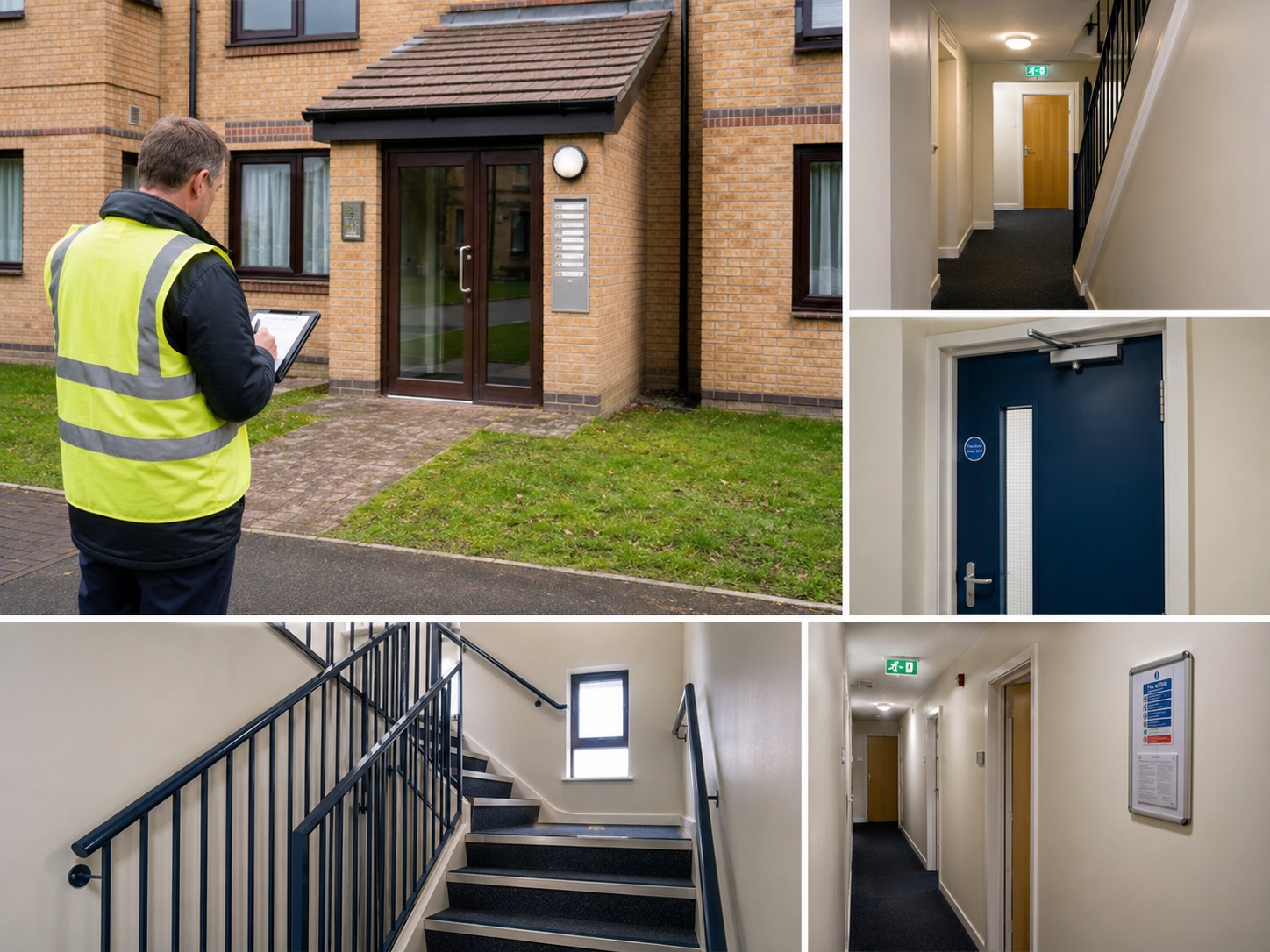
Start by checking that the document can be matched to the correct building and understood without relying on somebody’s memory. A PDF called fire report.pdf is not enough if nobody can tell whether it covers the whole block, one common stair or an earlier inspection.
Where the Fire Safety Order applies, current Home Office guidance says the Responsible Person must record the completed fire risk assessment in full, record the identity of anyone engaged to undertake or review it, and record the fire-safety arrangements for the premises.
First check the assessment itself
- Match it to the building. Confirm the full address and, where relevant, the block, entrance or shared area.
- Identify the document. Record whether it is a new assessment, review, addendum or supporting report.
- Record the date and version. Make clear which document is current without deleting the earlier history.
- Check the scope. Note the common parts, structure, external walls, flat entrance doors or other features included, as stated in the assessment.
- Preserve limitations. Keep any exclusions, access restrictions, assumptions or missing information visible.
- Record the assessor. Retain the individual or organisation named in the report and any relevant selection or competence information supplied.
- Locate every attachment. Check that referenced plans, photographs, schedules and appendices were actually received.
The assessment’s scope should not be expanded or narrowed by whoever files it. For example, if the assessor did not inspect a locked meter cupboard or could not access a particular door, preserve that qualification rather than recording the area as complete.
The Home Office’s small-block guide addresses common parts, the building’s structure, external walls and doors between flats and common parts, but it has a defined scope. It is intended for qualifying blocks limited to three storeys and no more than six flats, with further conditions for converted buildings. Use guidance appropriate to the particular building rather than applying a small-block checklist to every block.
Record the assessment type and scope
For purpose-built blocks, the 2011 Local Government Group guide, now hosted by the Home Office, describes four assessment types: Type 1 covers common parts using a non-destructive inspection; Type 2 covers common parts with some destructive inspection; Type 3 covers common parts and a sample of flats non-destructively; and Type 4 covers common parts and flats with some destructive inspection.
These labels describe the inspection scope, not a pass or fail grade. Record the type stated by the assessor, together with any access limitations or recommended further investigation. Do not assign or change the assessment type administratively.
The Home Office says this older guide is no longer comprehensive. BSI suspended PAS 79-2:2020 in March 2021 and announced its withdrawal on 6 August 2021 while a British Standard was developed. BS 9792:2025 was published on 1 August 2025 and is described by BSI as a full revision and formal conversion of the withdrawn PAS. Record the assessment standard or methodology stated by the assessor, but do not describe PAS 79-2 as the current residential standard.
Turn each finding into a usable action record
The assessment records what the assessor found. The action record shows how each finding was taken forward. The two should stay linked, but they should not be merged in a way that changes the assessor’s original wording.
For each finding, record:
Finding and location
The original issue and the precise corridor, landing, door, cupboard, wall or other feature concerned.
Priority and timing
Any priority, target date or sequence stated by the assessor, without inventing a new deadline.
Action owner
The person or organisation taking the matter forward and any dependency on another party.
Current position
A factual status such as awaiting advice, quotation requested, work booked, evidence received or further review needed.
Supporting evidence
The report, service note, photograph, invoice or other record connected to the action.
Further outcome
Any limitation, follow-up recommendation, changed review point or unresolved question.
Use a stable action reference where several similar issues exist. “Second-floor corridor — flat 8 entrance door — action 04” is much easier to follow than “fire door job”, especially if the assessment identifies several doors.
Example: A finding concerning a flat entrance door
An assessment records damage to the entrance door of flat 8 and gives the issue a stated priority. The action record should retain that wording, identify the exact door, show who is contacting the relevant owner or contractor, preserve key correspondence and link the eventual inspection or completion report. If the contractor identifies a further issue, record it rather than changing the original action to “complete” without qualification.
What counts as evidence that an action was completed?
There is no single document that proves every type of fire-safety action has been completed. The appropriate evidence depends on the finding, the work and whether technical inspection or professional judgement is needed.
Different records show different stages of an action, and their value depends on the detail they contain:
Quotation or appointment
Shows that work was priced or arranged. It does not show that the work took place.
Invoice or receipt
Supports the financial trail, but may not identify the exact location, result or outstanding recommendations.
Contractor report or service note
May describe the work, location, date, result and further action, depending on the detail supplied.
Dated photograph
May support the record when its subject, location, date and connection to the finding are clear.
Follow-up inspection or revised assessment
May be appropriate where the outcome needs competent technical review or affects the wider assessment.
Before changing an action to complete
- Does the evidence identify the correct block and exact location?
- Can it be linked back to the assessment finding?
- Is the work or inspection date clear?
- Does it explain what was done or found?
- Does it contain qualifications, further recommendations or unresolved points?
- Is competent confirmation needed before the action can reasonably be treated as complete?
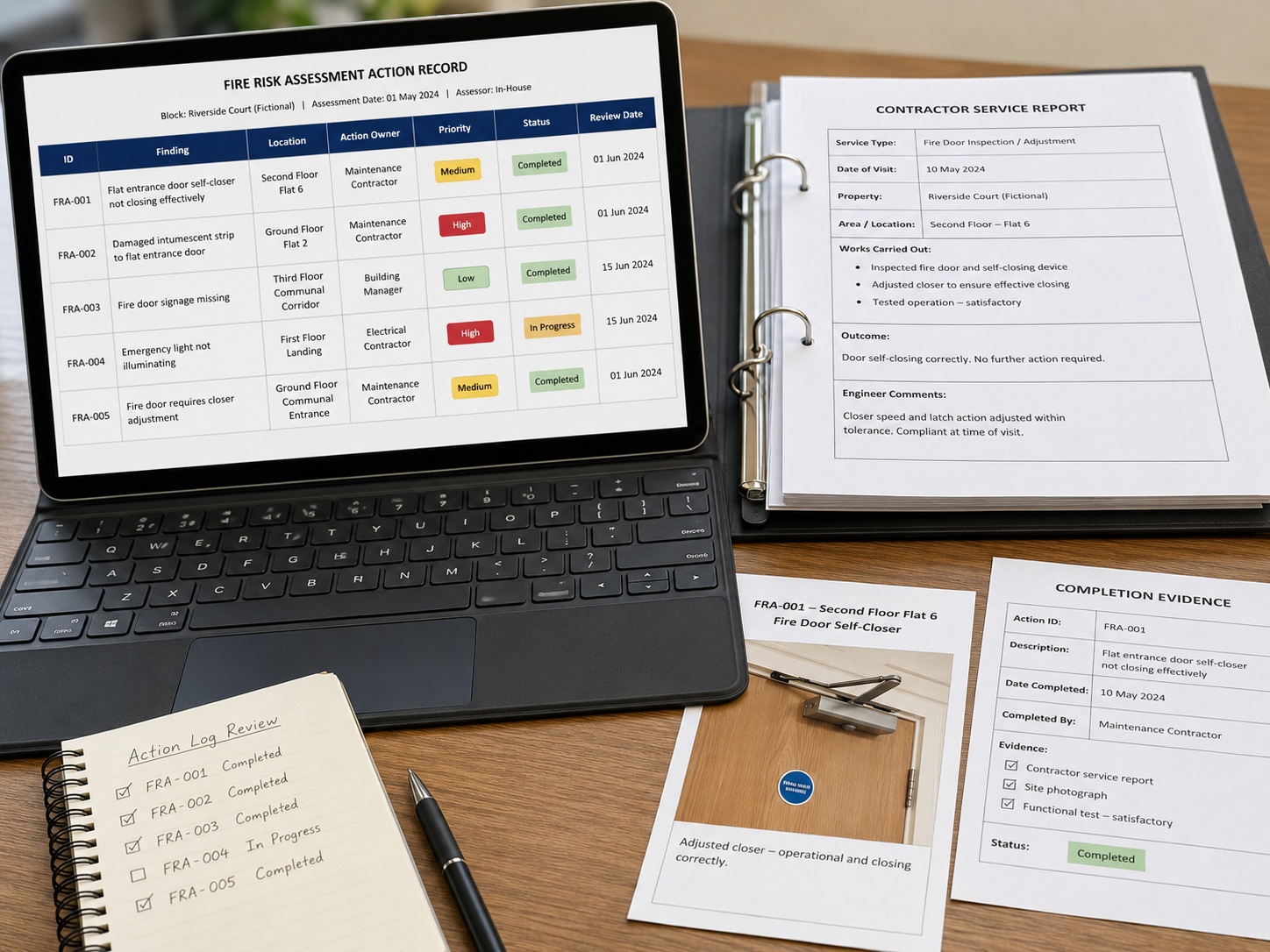
A short factual note can preserve context where a document is unclear. For example: “Received from ABC Contractor on 12 July in response to action 04 concerning the flat 8 entrance door.” The note should not claim that the work was technically adequate unless the underlying evidence supports that conclusion.
Important: Organised records do not replace competent work, a suitable and sufficient assessment or professional judgement. They make it easier to see what evidence exists, what it relates to and what remains unresolved.
Not sure whether the property file contains the evidence you expect?
CertNudge helps you keep the fire risk assessment, contractor reports, review dates and supporting evidence organised against the correct property, so missing or disconnected records are easier to spot during a file review.
If you own one flat rather than the whole block
A landlord who owns one leasehold flat may not control the common parts or hold the block’s master fire-safety file. The freeholder, management company, right-to-manage company, managing agent or another person may have responsibilities for the shared areas. The position depends on the ownership and management arrangements, so do not assume it from job titles alone.
The practical aim is to know who manages the relevant records and to retain information that affects your flat, your tenant or your own responsibilities. Depending on the circumstances, it may be useful to ask for:
- confirmation of who is responsible for the common parts and how to contact them;
- the date or status of the current assessment and the areas it covers;
- relevant fire-safety information provided to residents;
- information about findings or work that affects the flat, its entrance door or the route from it;
- updates on outstanding actions relevant to the property; and
- clarification of who is arranging work where responsibility is not clear.
Keep the request, the response and the version or date of any document supplied. If only a summary or extract is provided, label it accurately rather than filing it as the complete assessment. Access to particular records and responsibility for work can depend on the lease, control of the premises and the applicable legal duties. Seek appropriate advice where the position is disputed or unclear.
Keep block records separate from records for the flat
A contractor document for work inside the flat should not automatically be treated as evidence for the common parts. Equally, an assessment of the shared stairwell should not be buried only in the tenancy file for the nearest flat. Link both to the same property where useful, but label the area and responsibility clearly.
Records kept for the individual flat may include evidence of required alarm checks. Our smoke and carbon monoxide alarm compliance log guide explains what England landlords should test and record for a tenancy.
Keep the assessment history and review trail visible
A new review should not erase the earlier assessment. The earlier version provides the baseline; action records show what followed; and the later review explains the current position. Together, they create a sequence that another landlord, manager, assessor or Responsible Person can understand.
For each new assessment, review or addendum, record:
- the document date and version;
- who undertook or reviewed it;
- why the review took place;
- whether the scope or assumptions changed;
- which earlier actions remain open, changed or were closed;
- new findings and their action references; and
- the next recommended review point or reminder.
Article 9 of the Fire Safety Order requires the assessment to be reviewed regularly and where there is reason to suspect it is no longer valid or there has been a significant relevant change. There is no universal statutory annual expiry date for every block. Follow the assessment and current guidance, and bring the review forward when relevant circumstances change.
If an action changes after further professional input, keep the original entry and add the revised position, date, reason and supporting record. Avoid silently editing “replace door” into “inspect door”, for example, because that removes the history explaining why the action changed.
For wider retention planning, see our guide to how long landlords should keep records. It is safer to make a deliberate retention decision than to let an old assessment disappear when a shared drive is tidied or an agent’s portal closes.
Keep recurring fire-safety checks as separate records
The fire risk assessment action plan should not be used as a substitute for recurring checks required under separate fire-safety duties. Where the Fire Safety (England) Regulations 2022 apply, keep each check as its own dated record and link it to the relevant door, lift or item of equipment.
- Multi-occupied residential buildings with storeys over 11 metres: keep dated records of quarterly checks of all fire doors in the common parts and of the Responsible Person's best endeavours to carry out annual checks of flat entrance doors, including self-closing devices.
- High-rise residential buildings of at least 18 metres or seven storeys: keep dated records of the minimum monthly checks on lifts for firefighters and essential firefighting equipment, together with faults and any notification to the fire and rescue service where an item remains out of order for more than 24 hours.
- All multi-occupied residential buildings: keep copies of the fire-safety instructions and fire-door information provided to residents, together with the issue date or version.
These records support ongoing fire-safety management, but they do not replace the assessment, action plan or review history. See the government guidance on the Fire Safety (England) Regulations 2022 for the duties that apply to different building heights.
Residential PEEPs and evacuation records from 6 April 2026
The Fire Safety (Residential Evacuation Plans) (England) Regulations 2025 apply to multi-residential buildings that are at least 18 metres high or have at least seven storeys. They also apply to multi-residential buildings more than 11 metres high where a simultaneous evacuation strategy is in place.
For relevant residents who would have difficulty evacuating without assistance because of a physical or cognitive impairment or condition, the Responsible Person must use reasonable endeavours to identify them and offer a person-centred fire risk assessment. Where the resident agrees, the process considers their particular risks, reasonable and proportionate mitigating measures and what they should do in the event of a fire.
Keep a clear record of:
- Identification and contact: approaches made to potentially relevant residents, responses received and cases where a resident declined or could not be contacted.
- Person-centred fire risk assessment: the resident-specific risks considered, the assessment outcome and the measures discussed.
- Mitigating measures: measures considered reasonable and proportionate, who is taking them forward and the evidence that they were implemented.
- Emergency evacuation statement: the written statement agreed with the resident, the date it was recorded and confirmation that a copy was provided to them.
- Reviews: the review date, any relevant change or resident request that triggered it, and updates to the assessment, measures or statement.
- Building and fire-service records: the building emergency evacuation plan and any prescribed resident information shared with the fire and rescue authority with the resident's explicit consent.
The assessment, mitigating measures and emergency evacuation statement must be reviewed no later than 12 months after the statement is first recorded, or after the assessment where no statement was agreed, and at least every 12 months after that. An earlier review is required where an update may be needed or where a relevant resident makes a reasonable request.
A person-centred fire risk assessment is specific to the resident and is not intended to duplicate the building's fire risk assessment. It may form part of a wider assessment process if the full requirements are covered, but the resident-specific record should remain clearly identifiable and access-controlled. There is no explicit requirement for the resident to supply medical records, and personal information must be handled in accordance with data-protection requirements.
Higher-risk buildings and the golden thread
A residential building that is at least 18 metres high or has at least seven storeys and contains at least two residential units may fall within the higher-risk building regime, subject to the detailed criteria and exclusions.
Those buildings have additional requirements for keeping and providing prescribed building-safety information as part of the digital golden thread. Do not treat the fire risk assessment file as the whole golden thread. Cross-reference relevant assessment and action records and follow current Building Safety Regulator guidance.
Prepare the file for a management or Responsible Person handover
A handover is the moment when weak record keeping becomes obvious. The assessment may be in a shared folder, while action updates sit in personal inboxes, contractor evidence is attached to messages and the next review date exists only in a calendar.
Home Office guidance says a departing Responsible Person must share relevant fire-safety information with an incoming Responsible Person. The guidance lists the fire risk assessment and review records, the identity of anyone who assisted with the assessment or review, relevant Responsible Person and Accountable Person details, and certain building information among the records that may need to pass across.
Even where the change is an administrative handover rather than a change of Responsible Person, the same organised structure is useful. The incoming manager should be able to identify:
the current assessment, its scope and its limitations;
open, completed, disputed and review-needed actions;
who is taking each outstanding matter forward;
the evidence already received and what it relates to;
missing documents, unanswered requests and access limitations;
the planned review point and any earlier trigger for review.
Record what was transferred, when, to whom and by what method. Where management is moving between a landlord and agent, our letting agent handover checklist covers the wider property records that may also need attention.
Common block-of-flats record mistakes
Filing everything against one flat
A communal stairwell assessment belongs to the block or common-area record, even if one flat owner arranged it. Link records to an individual flat as well where relevant, but do not lose the building-wide context.
Recording vague locations
Descriptions such as “hall door” become ambiguous when the block has several halls and doors. Use the assessor’s reference and a precise location that another person can recognise.
Treating an appointment or invoice as automatic completion
An appointment shows intention, while an invoice shows a charge. Neither necessarily records the technical outcome or any further recommendation. Match the evidence to the nature of the action.
Overwriting the original finding
If the action changes, preserve what the assessment originally said and record the reason for the revision. Otherwise, the audit trail can make a material issue look as though it was never raised.
Assuming the managing agent has the complete file
Ask what is held, request relevant copies and record unanswered gaps. This is particularly important before an agent changes or access to an online portal ends. A landlord compliance spreadsheet can help track dates and document locations, but the underlying reports and evidence still need to be retained.
Letting supporting documents become detached
A photograph or contractor report is much less useful if nobody can identify its block, location or related action. Use consistent references and add short factual context when needed.
Fire risk assessment action and record FAQs
What should a fire risk assessment action plan contain?
A fire risk assessment action plan should connect each finding to its exact location, the assessor’s recommendation, any stated priority or timing, the person taking it forward, its factual status, supporting evidence and any further review. Preserve the original finding rather than replacing it with a shorter internal note.
Is an invoice enough to close a fire-safety action?
No, not automatically. An invoice may support the payment trail, but it may not show the exact location, work completed, inspection result or further recommendations. The appropriate completion evidence depends on the action and may include a contractor report, service note, dated photograph or follow-up professional review.
Should previous fire risk assessments be kept?
Yes, earlier assessments and reviews should normally remain available as part of the building’s fire-safety history where they are relevant. Label the current version clearly, but avoid silently overwriting earlier findings, actions and evidence. Apply a considered retention policy and seek advice if a specific legal or contractual retention question arises.
What should a landlord who owns one flat ask the managing agent for?
Ask who manages fire safety for the common parts, the date and scope of the current assessment, relevant information for residents, and updates about findings or work affecting the flat or its escape route. The documents available and the parties’ responsibilities depend on the building, lease and management arrangements.
Does completing remedial work mean a new assessment is always required?
No, not always. Update the action and evidence records, then follow the assessor’s recommendation and current guidance. A review may be needed where the work, new information or another significant relevant change affects the validity of the existing assessment.
Is a person-centred fire risk assessment the same as the building fire risk assessment?
No. A person-centred fire risk assessment considers the additional fire and evacuation risks faced by an individual relevant resident. It is not intended to duplicate the building fire risk assessment, although it may be incorporated into a wider assessment process if all the requirements of the Residential PEEPs regulations are covered.
Keep each finding and its evidence connected
A useful block-of-flats record shows more than the existence of a fire risk assessment. It shows which document is current, what each finding relates to, what happened next, what evidence supports the status and what still needs attention.
If you are reviewing the wider property file at the same time, our free landlord compliance checklist provides a practical prompt list for common certificates and supporting evidence.
Keep property evidence ready when it is requested
CertNudge helps landlords, SPVs and small property teams keep fire risk assessments, contractor reports, review dates, reminders and supporting documents organised by property, ready to assemble into a compliance pack when information is requested.
Sources and standards
- Regulatory Reform (Fire Safety) Order 2005, Article 9
- Home Office guidance on Section 156 fire-safety responsibilities
- Home Office guide to making a small block of flats safe from fire
- Home Office guide for people with duties under fire-safety legislation
- Home Office guidance on the Fire Safety (England) Regulations 2022
- Fire Safety (Residential Evacuation Plans) (England) Regulations 2025
- Residential PEEPs: guidance for Responsible Persons
- Building Safety Regulator guidance on the golden thread
- BS 9792:2025 — Fire risk assessment: Housing
This article is for general information only and is not legal advice. Regulations and guidance change, and individual circumstances vary. Check the latest official guidance and seek advice from a competent fire risk assessor or other appropriate fire-safety professional; obtain legal advice where interpretation of duties or a dispute requires it.
Last reviewed: 3 August 2026
Next review recommended: January 2027, or earlier if relevant fire-safety legislation or guidance changes.