
Vacant Property Inspection Checklist for Landlords
Use this policy-led vacant property inspection checklist to record visit dates, internal and external checks, evidence, defects and follow-up actions during a rental void without assuming one universal insurer rule.
Your tenant returns the keys on Friday. By Monday the house is empty, the decorator has a set of keys and two viewings are booked. A vacant property inspection is a documented check of an empty rental during a void, recording the visit, access, condition, issues found and supporting evidence. Casual activity is not the same as a recorded inspection: check the policy, schedule any required visits and keep a dated evidence record from day one.
For UK landlords managing standard residential buy-to-let properties during void or unoccupied periods. General information only; not legal, insurance, security, surveying or claims advice. Policy wording and local requirements vary.
Key takeaways
- There is no single inspection interval that works for every vacant rental property: your policy wording, schedule, endorsements and insurer or broker instructions are the starting point.
- Treat a void as an evidence chain, beginning with the vacancy date and policy conditions and ending when the property is occupied, sold or formally handed over.
- A viewing, cleaner or contractor attending the property does not automatically mean the property is occupied or that an insurer-required inspection has been completed.
- Each inspection record should identify who attended, when they arrived and left, whether they inspected internally and externally, what they found, what evidence they captured and what happens next.
- A good inspection log can make your records much clearer, but it does not prove policy compliance or guarantee that an insurer will accept a claim.

Start the vacant-property inspection record on day one
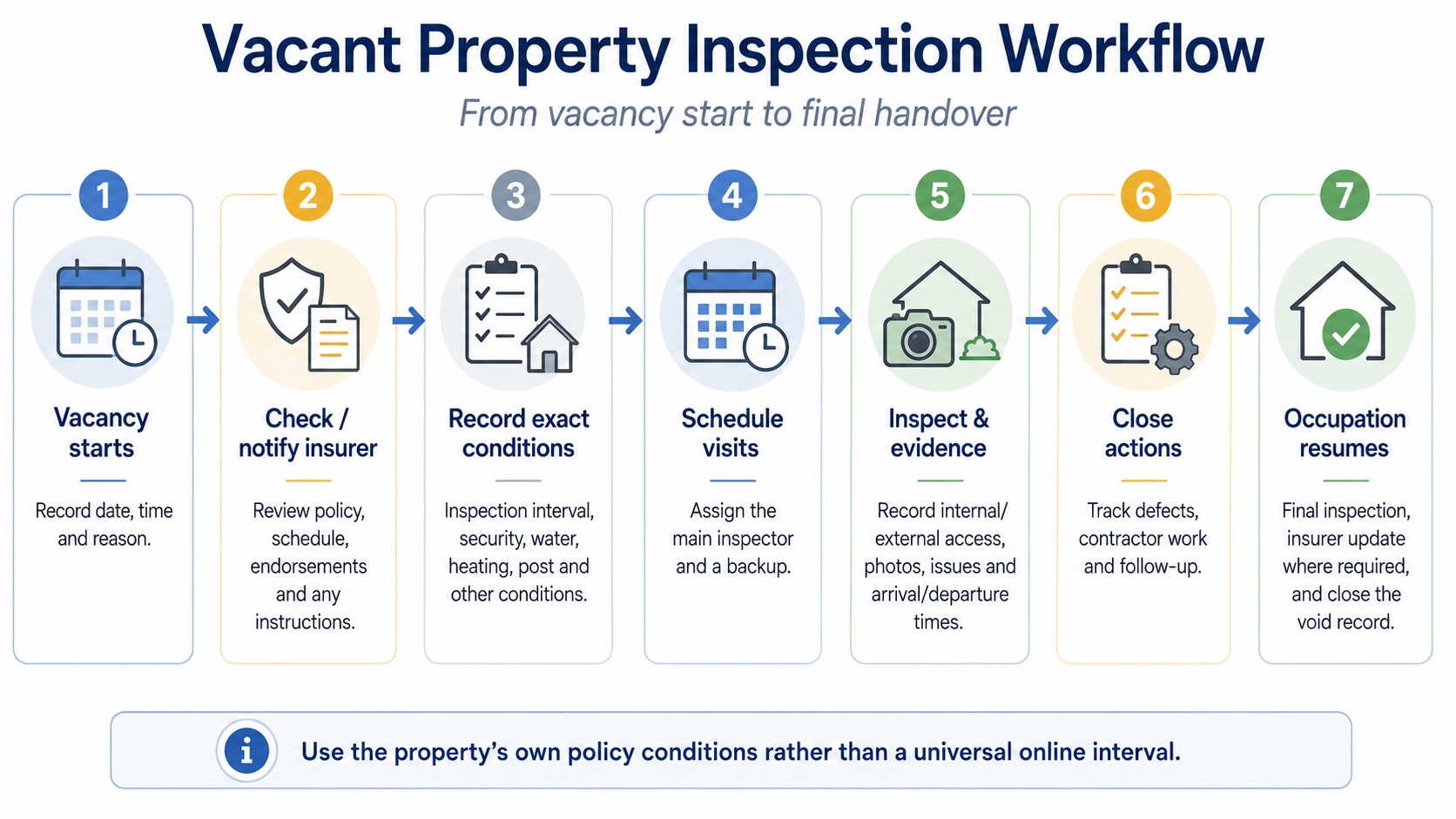
- Record the date and time the property became unoccupied and why.
- Check the policy wording, schedule, endorsements and any insurer or broker instructions. Notify them where your policy requires it.
- Write down the exact inspection interval and any security, heating, water, post, garden or other conditions applying to this property.
- Assign the inspections to a named person, with a backup, and schedule the visits before the first deadline.
- For every visit, record the date, arrival and departure time, internal and external access, photographs, issues found, action taken and next inspection due.
- When occupation resumes, complete a final inspection, update the insurer where required and formally close the void record.
Download the free vacant-property inspection log to record the policy conditions, recurring visits and follow-up actions in one place.
When does a rental property need a vacant-property inspection record?
Start the record when the property becomes empty, rather than waiting until somebody remembers to make the first inspection.
That might be the afternoon a tenant hands back the keys, the date an owner moves out before sale, or the point at which a property becomes temporarily uninhabitable during works. For a normal residential landlord, the most common period is the gap between one tenancy ending and the next beginning.
A tenancy check-out report and a vacant-property inspection log do different jobs. The check-out gives you a starting condition: keys returned, meter readings, cleanliness, damage and photographs at the end of the tenancy. The void log then records what happens while nobody is living there.
Once the keys are back, the property can change quickly: a small leak can start, post can accumulate or a contractor can leave a window unsecured. Insurance wording can also treat “vacant”, “empty” and “unoccupied” differently from everyday use. The Financial Ombudsman Service says it often sees disputes involving properties that are visited during refurbishment but remain uninhabitable, and notes that many home policies restrict some cover after a period commonly 30 or 60 days. Your own policy remains the document to follow.
For example, a Derby landlord with six rentals has a three-week void while a kitchen is redecorated. A painter attends on Tuesday, an estate agent runs a viewing on Thursday and the landlord collects a parcel on Saturday. The property is busy, but nobody has been assigned to complete and evidence the insurer-specified inspection. That is why the void needs its own recurring record after check-out.
It is not a statutory inspection certificate. Nor should you assume that contractor attendance, a viewing or a quick visit automatically meets your insurer's requirements. Separate what the policy requires from what you choose to record as good management practice.
How often should a vacant property be inspected?
There is no universal seven-day, fourteen-day or thirty-day inspection rule for every vacant rental property.
The correct interval comes from the individual policy wording, schedule, endorsement and any written instructions from the insurer or broker. The same applies to the point at which additional unoccupancy conditions start.
The Financial Ombudsman Service's guidance on unoccupied properties says periods are commonly 30 or 60 days, but that is context about insurance disputes, not a deadline landlords should copy into their own inspection calendar. Its guidance was updated on 10 July 2026.
As checked on 20 August 2026, Direct Line for Business states that after 30 days unoccupied it excludes damage caused by escape of water, malicious damage and theft. Its published conditions for that product context also require, among other things, internal and external inspections every seven days, mail removal, specified mains-service isolation and a minimum 10°C heating condition between 1 October and 31 March. This is a Direct Line product example, not a market-wide rule.
AXA's current landlord insurance page gives a different product-specific example: 45 days of full cover after the property becomes unoccupied, after which cover is reduced and an unoccupancy condition applies. AXA also says the policyholder must notify it when the property becomes unoccupied.
A Financial Ombudsman decision, DRN-4979244, shows another variation. The policy in that particular case said that once the property had been vacant for more than 31 consecutive days, internal and external inspections had to take place at least every 14 days and an inspection log had to be retained for at least 24 months.
The complaint was upheld. Although the landlord had not provided evidence of the required inspections, the Ombudsman was not satisfied that the failure increased the risk of the particular break-in that occurred and required the insurer to reconsider the claim under the remaining policy terms.
So the practical rule is straightforward: copy the condition from your own current policy into the property record and calculate the next inspection from that condition.
For example, suppose an endorsement takes effect after 31 consecutive days and then requires an internal and external inspection at least every 14 days. A diary entry saying “checked house” on 12 November is weak operationally. A stronger record says the inspector arrived at 10:14, left at 10:31, gained internal access, checked the kitchen and bathroom for visible leaks, recorded three photograph references and scheduled the next inspection for 26 November.
That extra detail is good evidence management. It still does not guarantee that an insurer will accept a future claim.
If the policy wording is unclear about when the condition starts, what “unoccupied” means, what counts as an inspection or what must be retained, ask the insurer or broker and keep the written answer with the policy record. If a dispute later reaches the Financial Ombudsman Service, it says that where an insurer has not clearly defined “unoccupied” it may interpret the term itself and can, in some cases, regard reasonably frequent visits as enough for the property to remain occupied. That is not a reason to assume a viewing or contractor visit counts under your policy; it is a reason to get unclear wording confirmed before a claim arises.
Set up and run a policy-led void property inspection routine
A reliable routine starts before you walk through the front door. Ten steps are enough for most standard houses and flats.
- Close the tenancy cleanly. Complete the check-out, record the returned keys and meter readings, photograph the starting condition and identify outstanding repairs. Keep that check-out separate from subsequent void visits.
- Create the vacancy setup record. Record the property, vacancy start date and time, reason for the void, expected duration and responsible person. Add the insurer, policy number, broker where applicable and the expected new-tenancy, sale or handover date.
- Preserve the policy instructions. Save the relevant policy wording, schedule and endorsements rather than relying on a browser bookmark that may later change. Record the policy's definition or wording around unoccupancy, any threshold, inspection frequency, security conditions, water or heating instructions and requirements relating to post, gardens or other risks.
- Notify the insurer or broker where required. Record the date, method, person spoken to, reference number and what you were told. Save the email or written confirmation with the vacancy record.
- Schedule the whole inspection series. Do not wait for each visit to remind you about the next one. Calculate future dates from the actual policy condition, assign the main inspector and identify who will cover holidays or illness.
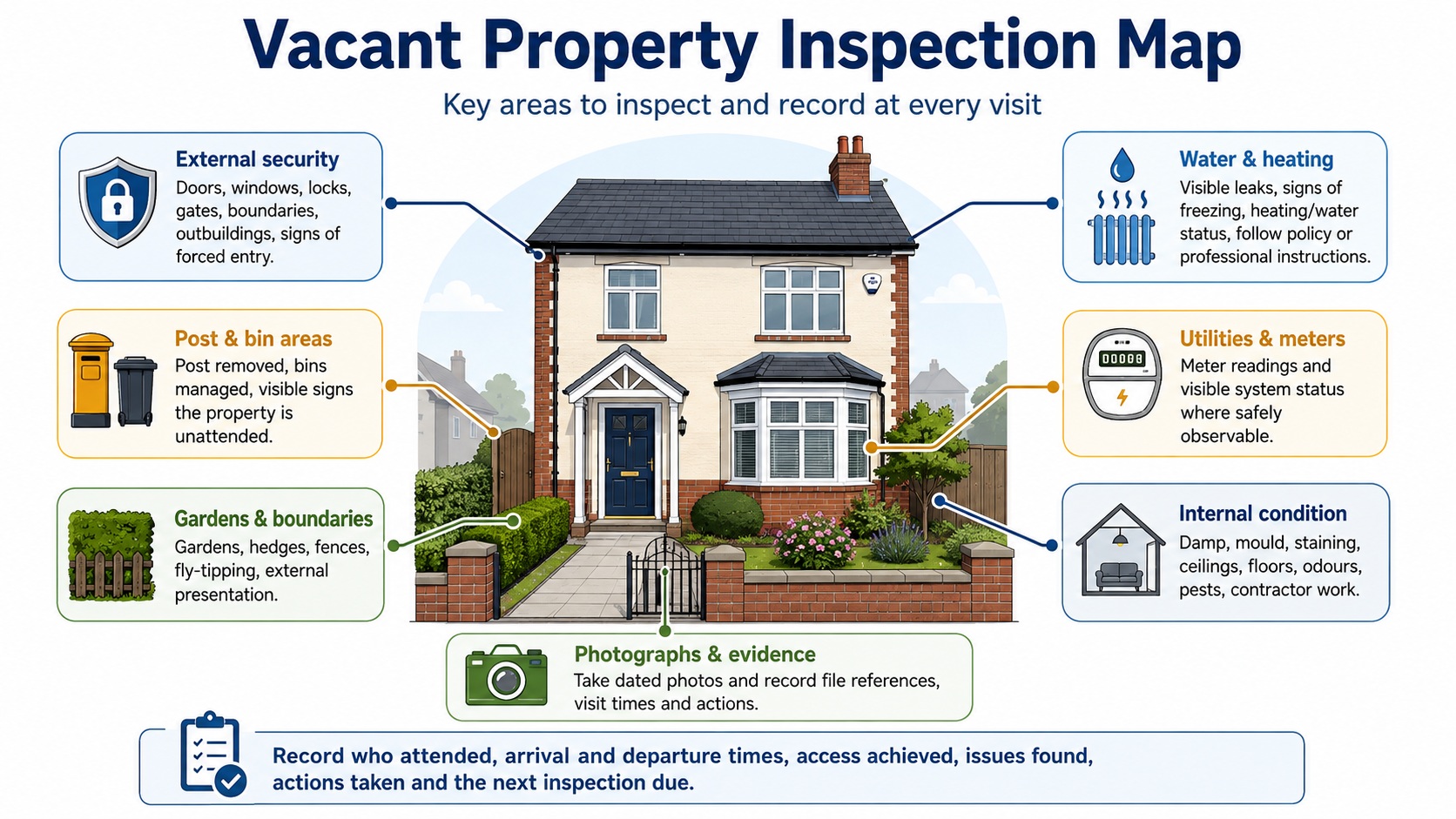
- Inspect externally. Record what you can safely observe around doors, windows, gates, boundaries, gardens, bins and outbuildings. Check for signs of unauthorised entry, storm damage, external water problems or anything making the property obviously appear unattended. Roofs and gutters should only be observed from a safe position; a checklist is not a reason to climb onto a roof.
- Inspect internally. Record whether access was actually achieved. Check for visible leaks or staining, damp or mould, unusual odours, pests, ceilings, floors, post, contractor work and the status of heating, water, utilities or security systems where these can be safely observed.
- Capture evidence consistently. Record arrival and departure times, inspector identity and whether the inspection covered both inside and outside. Give photographs useful labels such as
V05_Kitchen_Sink_01.jpgrather than leaving 20 anonymous images in somebody's phone camera roll. - Raise a separate action for every defect that needs one. If inspection visit V05 finds staining under the kitchen sink, create defect V05-D01. Record when the plumber was instructed, when they attended, their findings, the invoice or report reference and whether a later visit confirmed the issue was closed.
- Close the void deliberately. When a new tenant moves in, a sale completes or the property otherwise returns to occupation, record the final inspection date, meters and keys, deal with any open defects, notify the insurer where required and stop the recurring inspection reminders.
A November void shows why the setup record matters. Rather than reading a generic article and deciding that every empty house should be heated to a particular temperature or have its water switched off, the landlord checks the policy instructions for that property and asks a heating engineer where system-specific advice is needed. The chosen approach and its source are recorded, then checked during subsequent visits.
That creates a decision trail: the policy said this; the engineer advised this; the landlord chose this; the inspector observed this on the next visit.
Those are much more useful statements than “heating OK”.
What should a vacant property inspection checklist include?
A useful void property inspection checklist should let another person reconstruct what happened without calling the landlord six months later. It should record the policy-specific conditions as well as what was actually checked on each visit.
At minimum, record:
- Vacancy setup: property, vacancy start date and time, reason, expected duration, responsible person and keyholder.
- Policy evidence: insurer, policy number, relevant policy wording/schedule/endorsement, notification date and reference, policy-defined threshold, required frequency and special conditions.
- Visit identity: visit number, date, arrival and departure time, inspector and any agent or inspection company used.
- Access: whether internal access was achieved, whether the external inspection was completed and any inaccessible area with the reason.
- Security: doors, windows, locks, gates, alarms and outbuildings, including signs of attempted or unauthorised entry.
- Water and heating: recorded status, visible leaks or signs of freezing, plus any relevant policy or professional instructions being followed.
- Utilities and systems: meter readings and electricity, gas, alarm or contractor-equipment status where safely observable.
- Property condition: damp, mould, staining, ceilings, floors, storm damage, pests, odours, drainage, rubbish and work in progress.
- External presentation: post, newspapers, bins, gardens, hedges and visible signs that the property is unattended.
- Evidence references: photograph or video filenames, report references and the location of the original files.
- Actions: defect ID, priority, contractor, instruction and attendance dates, outcome, evidence and follow-up inspection.
- Next visit: the due date calculated from the applicable condition, assigned inspector and reminder status.
- Void closure: final inspection, occupation or sale date, insurer notification where required, final meters, keys, check-in or handover reference and remaining defects.
A chronological log becomes particularly useful when something goes wrong between visits.
In Financial Ombudsman decision DRN-5010249, a flat had a policy condition requiring an internal and external inspection every seven days. The last evidenced visit before an escape-of-water problem was discovered had been 17 days earlier. The Ombudsman considered the missed interval likely material because an inspection in line with the condition might have reduced the water damage. The complaint was not upheld.
That does not turn seven days into a general rule. It shows why a policy-specific inspection condition and a dated record can matter.
What each piece of inspection evidence can and cannot show
If you are later asked for proof of vacant property inspections, no single document proves everything. The value comes from a consistent record showing the applicable policy condition, the visit itself and the supporting evidence around it.
Policy schedule or endorsement
What it may help show: The definitions, threshold, interval and conditions applying to that policy.
What it does not prove by itself: That every condition was followed or that a claim is covered.
Dated inspection log
What it may help show: When a visit was recorded, who attended and what was checked.
What it does not prove by itself: That every observation was accurate or every area was accessible.
Photographs or video
What it may help show: Visible condition at a point in time when clearly labelled.
What it does not prove by itself: The cause of hidden damage or automatic policy compliance.
Agent or inspector report
What it may help show: A third party's recorded attendance and findings.
What it does not prove by itself: That the insurer will accept the report format or conclusions.
Contractor report or invoice
What it may help show: The diagnosis or work the contractor recorded.
What it does not prove by itself: That every defect has been resolved or a claim must be paid.
Insurer email or call note
What it may help show: What was reported and what instructions were given.
What it does not prove by itself: Compliance with every other policy term.
Calendar reminder
What it may help show: That an inspection was scheduled.
What it does not prove by itself: That anybody actually attended or inspected internally.
Keep the originals as well as the log reference. IMG_4831.jpg sitting in a WhatsApp conversation is much harder to retrieve later than an entry saying Visit V07 – Kitchen – IMG_4831.jpg, with the original stored in the property's evidence folder.
Where a visit identifies ongoing damp or mould, move the issue into a separate damp and mould evidence record rather than trying to manage the whole response in one inspection-note box. If a defect remains unresolved before the property is re-let, the HHSRS inspection guide for landlords explains the separate housing-hazard context in England.
There is no sensible one-size-fits-all retention period to add to a generic void checklist. Keep anything for as long as your own policy requires and make the wider retention decision in context; CertNudge's guide to how long landlords should keep records covers that separately.
A void inspection can also reveal a different records problem: the EICR in the folder is not the current one, the gas certificate is sitting in an agent's email or an EPC is approaching expiry. A visit log is not the right place to manage those certificate records; the landlord compliance spreadsheet template covers certificate and deadline tracking separately. CertNudge keeps certificates and supporting compliance evidence organised by property, with reminders, compliance packs and secure sharing. It does not verify insurance terms, certify the inspection or determine whether a policy condition has been satisfied.
Vacant property inspection mistakes that weaken the record
The most common problem is not that landlords inspect nothing. It is that the evidence does not show exactly what was done.
Copying another insurer's inspection interval
A seven-day requirement on one live insurer page does not mean your policy requires seven days. Use the current wording applying to the insured property.
Treating activity as occupation
A decorator painting for five hours or an estate agent opening the door for a ten-minute viewing does not automatically answer the policy question of whether the building is occupied. The Financial Ombudsman Service says refurbishment cases frequently produce disputes precisely because properties can be visited often while remaining uninhabitable or unoccupied for policy purposes.
Using the check-out report for later visits
A photographic check-out on 3 September says nothing about whether somebody inspected internally on 17 September.
Writing “all OK”
That tells you neither when the person attended nor whether they entered the building. “Arrived 09:42; left 09:58; internal and external inspection completed; no visible leak at kitchen sink; four photos in V04 folder” is far more useful.
Making generic heating or water decisions
Policy terms, building systems, season and professional advice can point to different approaches. Record what applies rather than inserting a universal temperature or instruction into the checklist.
Hiding a missed inspection
Do not backdate an entry or reconstruct a visit as fact because a deadline was missed. Record the gap honestly, preserve whatever genuine evidence exists, contact the insurer or broker where appropriate and resume the correct routine.
Leaving defects buried in visit notes
“Small leak — plumber needed” should become a traceable action, with an instruction date, contractor, attendance, outcome and follow-up.
Forgetting to end the void
The evidence chain needs an end date just as much as a start date. Record the new occupation or completion date, final inspection and any insurer notification required.
Consider a landlord whose letting agent sends an email every Friday saying only “property visited”. Six weeks later, that does not show whether anyone went inside, removed post or took photographs. For future visits, the instruction can be explicit: “Record arrival and departure time, confirm internal and external access, attach dated photo references, note any issue and action, and state the next inspection due.”
If the landlord is away, the same brief can be given to a named agent or backup inspector. Keep the old “property visited” emails as they are and ask for any underlying reports or photographs that genuinely exist; do not rewrite them into stronger evidence.
Frequently asked questions about vacant property inspections
How often should a vacant rental property be inspected?
Use the interval in your policy wording, schedule, endorsement or written insurer instructions; there is no universal landlord interval. Current examples vary from seven days in Direct Line's published scenario to 14 days in the specific policy considered in Financial Ombudsman decision DRN-4979244, which is why unclear wording should be confirmed with your insurer or broker.
Does landlord insurance cover an empty or unoccupied property?
It can, but cover and conditions depend on the individual policy. The Financial Ombudsman Service says periods are commonly 30 or 60 days, while AXA currently states 45 days of full cover before reduced cover and an unoccupancy condition apply; check your own policy and notify the insurer or broker where required.
What should a vacant property inspection checklist include?
Record the policy conditions, visit date and times, inspector, internal and external access, security, water and heating status, utilities, post and gardens, photographs, defects, actions and the next inspection due. Keep the evidence references with the chronological visit record rather than relying on an “all OK” note.
Do contractor visits or property viewings count as an inspection or make the property occupied?
Not necessarily. The policy wording and circumstances control: Financial Ombudsman decisions show that visits by estate agents, builders or the owner do not automatically establish occupation or provide the inspection evidence required by a particular policy.
Should a landlord turn off the water or leave the heating on in an empty property?
There is no universal answer. Follow the requirements applying to your policy and property, consider the season and system involved, obtain appropriate professional advice where necessary, and record both the decision and its source.
Separate from the insurance question, HSE guidance for landlords says water should not be allowed to stagnate in properties left vacant for extended periods. It advises considering a suitable flushing regime or, for long vacancies, other measures such as draining the system, and lists flushing the system before letting as a simple control measure. Any approach should therefore be checked against both the property's water system and the insurer's requirements rather than copied from a generic checklist.
Keep every void inspection and follow-up action in one clear record
Before your next property becomes empty, create the record at the same time you close the tenancy: enter the vacancy date, preserve the current policy documents, copy the actual inspection condition into the setup sheet and schedule the first visit. Then give every inspection, photograph and defect a reference you can retrieve later.
Free Vacant Property Inspection Log and Insurance Evidence Checklist
Keep the policy setup, recurring visits, defects and actions, and final handover in one chronological record.
Completing it does not confirm policy compliance or guarantee that an insurer will accept a claim.
If the inspection exposes gaps in your certificates or supporting compliance documents, see how CertNudge keeps compliance evidence organised by property. CertNudge helps organise landlord-supplied certificates, supporting evidence, reminders and compliance packs; it does not schedule void inspections, verify policy terms or certify the property's condition.
This article is for general information only and is not legal or insurance advice. Insurance terms, regulations and guidance change, and individual circumstances vary. Check your current policy wording, schedule and endorsements, obtain confirmation from your insurer or broker where necessary, and check current official guidance at GOV.UK for any legal obligations affecting the property. For questions about insurance cover or a claim, speak to your insurer, broker or an appropriately qualified insurance professional; seek advice from a solicitor where you need legal interpretation or are dealing with a dispute.
Last reviewed: 20 August 2026
Next review recommended: 16 February 2027, or sooner if a cited insurer changes its unoccupied-property terms or relevant Financial Ombudsman guidance changes.