
The New Landlord Database for England: What Landlords Need to Know
A practical 2026 guide to England’s new landlord database, what is confirmed, what is still subject to regulations, and the records landlords should gather now.
Key takeaways
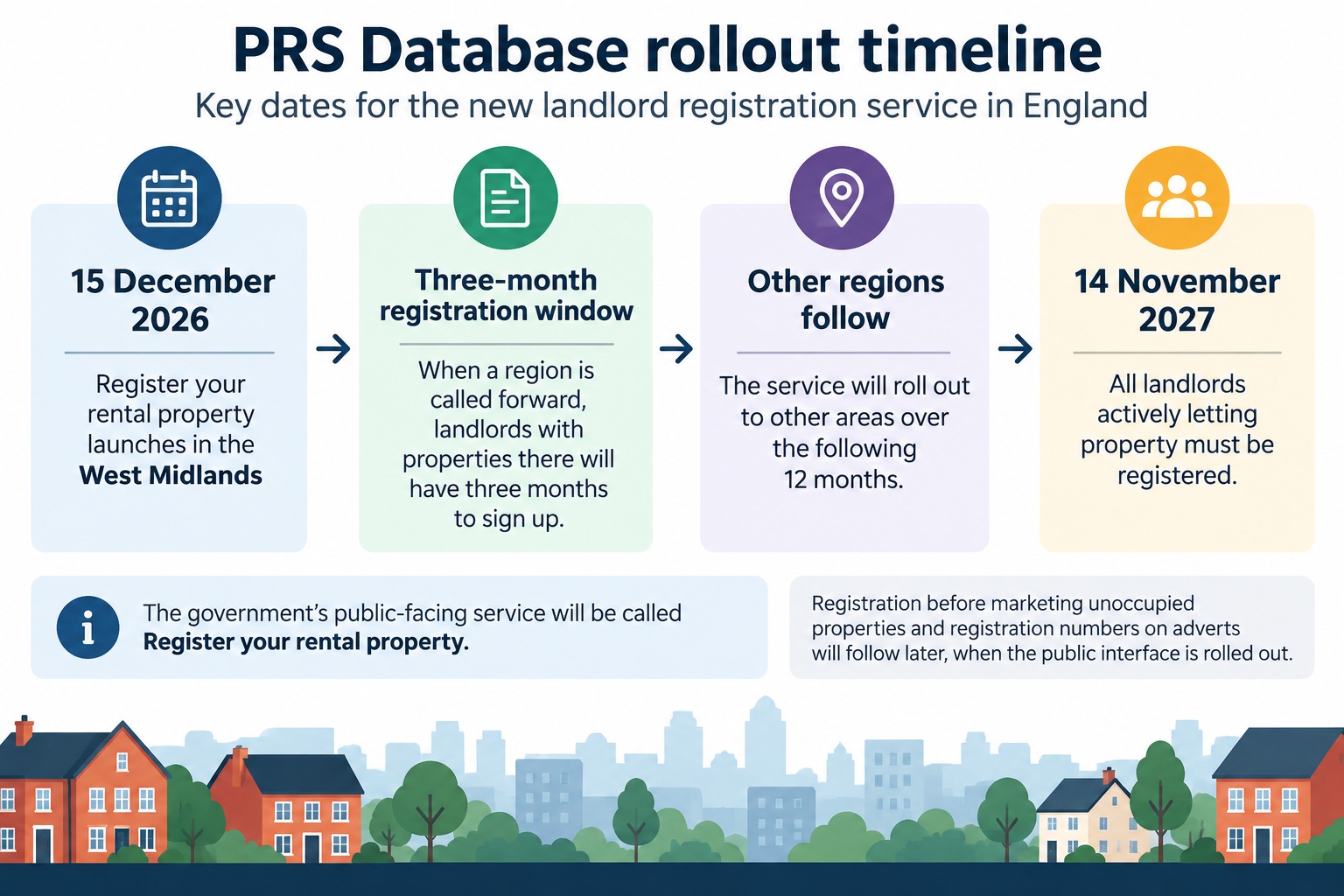
- The new landlord registration service for England, known as Register your rental property and supporting the Private Rented Sector Database, will start rolling out on 15 December 2026, beginning in the West Midlands.
- When a region is called forward, landlords with properties there will have three months to sign up. The full regional schedule is now published, with all landlords actively letting property required to be registered by 14 November 2027.
- PRS Database registration costs £65 per property per year. Each property registration must be renewed annually, so four registered properties would cost £260 a year at the current published fee.
- Current government guidance says landlords will need to provide identity and contact details, property and tenancy information, rent and licensing information, and gas, electrical and EPC evidence.
- The work landlords can do now is practical: organise identity details, property records, certificates, licence evidence, deposit records and proof that documents were issued.
- This article is for landlords in England. Scotland, Wales and Northern Ireland have separate landlord registration or renting systems.
This article is for general information only and is not legal advice. Regulations change and individual circumstances vary — always check the latest guidance at GOV.UK or speak to a qualified housing professional or solicitor.
Scope note: this article focuses on the new landlord database for private rented sector landlords in England. It does not cover Scotland, Wales, Northern Ireland, holiday lets, lodger arrangements, social housing or non-PRS tenancies.
As of 9 September 2026, mandatory PRS Database registration has not yet begun, but the first launch date is now confirmed. The government says its Register your rental property service will launch on 15 December 2026, starting in the West Midlands before rolling out to other areas. When a region is called forward, landlords with properties there will have three months to sign up, and all landlords actively letting property must be registered by 14 November 2027. The government has set the registration fee at £65 per property per year, with each property registration renewed annually. Further operational guidance will still be published ahead of rollout.
What is the landlord database? The Renters’ Rights Act 2025 creates the legal framework for the Private Rented Sector (PRS) Database. The government’s landlord registration service will be called Register your rental property. The government says landlords in scope will pay £65 per property per year and renew each property registration annually. Current government guidance also lists landlord identity and contact details, property and tenancy information, rent information, licensing information and gas, electrical and EPC evidence among the information landlords will be asked to provide.
A landlord with four rental properties might not find the new PRS Database difficult because of one form. The difficulty is usually everything around it: old certificates in email threads, an EPC in an agent portal, missing EICR remedial evidence, and no single view of what is current for each property.
The Renters’ Rights Act 2025 received Royal Assent on 27 October 2025, but the PRS Database provisions are not yet fully operational for landlord registration and will depend on commencement and supporting regulations.
The government has now published the first launch date, the full regional rollout timetable, the three-month registration deadlines, the £65 annual fee per property and detailed information landlords should have ready. Some later-stage details still need further regulations or guidance, including exactly what information will be publicly visible and the future requirements for registering unoccupied properties before marketing them.

What is the PRS Database for landlords in England?
The Private Rented Sector Database is part of the Renters’ Rights Act 2025. GOV.UK describes it as a way to bring together key information for landlords, tenants and councils, helping landlords understand their obligations and demonstrate compliance while helping councils target enforcement.
You may see it described as:
- the PRS Database
- the private rented sector database
- the landlord database
- the landlord registration database
- the property portal
- Register your rental property
Register your rental property is now the government’s public-facing name for the registration service supporting the PRS Database.
For most landlords, those terms point to the same broad change: England is moving towards a national digital record of private rented sector landlords and properties.
On 9 September 2026, MHCLG confirmed the first rollout details. The Register your rental property service will launch on 15 December 2026 in the West Midlands before moving to other areas over the following 12 months. When an area is called forward, landlords with properties there will have three months to sign up. The government’s wider implementation roadmap says public access and data sharing will follow landlord registration, with the PRS Landlord Ombudsman introduced later in Phase 2.
Example: a landlord with four occupied rental flats in Birmingham will be in the first regional rollout because the West Midlands is first. The registration requirement starts on 15 December 2026 and the West Midlands deadline is 14 March 2027. At the published fee of £65 per property per year, registering all four properties would cost £260 a year.
This article focuses on standard private buy-to-let properties in England. Scotland already has a Scottish Landlord Register, Wales has Rent Smart Wales, and Northern Ireland has its own rules. Do not assume that the English PRS Database will work in the same way as those systems.
For wider Renters’ Rights Act context on the gas-safety evidence the database is expected to draw on, see CertNudge’s guide to the gas safety certificate grace period for landlords.
Confirmed vs still subject to regulations
The safest way to understand the PRS Database is to separate the framework already confirmed from the operational detail still waiting for secondary legislation.
Launch timing
Confirmed: rollout starts on 15 December 2026 in the West Midlands. The government has now published the full regional schedule, with a three-month registration window for each region. All landlords actively letting property must be registered by 14 November 2027.
The government’s published regional registration schedule is:
West Midlands
Registration starts: 15 December 2026
Deadline: 14 March 2027
East of England
Registration starts: 15 January 2027
Deadline: 14 April 2027
East Midlands
Registration starts: 15 February 2027
Deadline: 14 May 2027
South East
Registration starts: 15 March 2027
Deadline: 14 June 2027
Yorkshire and Humber
Registration starts: 15 April 2027
Deadline: 14 July 2027
North West
Registration starts: 15 May 2027
Deadline: 14 August 2027
North East
Registration starts: 15 June 2027
Deadline: 14 September 2027
London
Registration starts: 15 July 2027
Deadline: 14 October 2027
South West
Registration starts: 15 August 2027
Deadline: 14 November 2027
Who must register
Confirmed: landlords of assured and regulated tenancies will be legally required to register themselves and their properties. During the initial rollout, the government says the requirements will apply to properties already let or which become occupied during the rollout.
Later phase: the government says unoccupied properties will also need to be registered before being marketed for let when the public interface is rolled out, and landlords and letting agents will then need to include registration numbers on adverts.
Information required
Current government guidance: landlords will be asked for identity and contact details, property and tenancy information, licensing details, rent information and health and safety evidence.
This includes information such as date of birth for individual landlords, property address and bedroom count, numbers of occupants and households, rent charged and payment frequency, relevant licence details, and gas, electrical and EPC information or documents. Organisational landlords have additional information requirements.
How much does PRS Database registration cost?
£65 per property per year. The fee applies separately to each registered property.
Each property registration must be renewed annually. For example, four registered properties would currently cost £260 per year.
Public visibility
Confirmed direction: some database information is expected to be available to support tenant transparency and council enforcement.
Still subject to regulations: which fields are public, restricted or private.
Possession impact
Confirmed framework: failure to comply can prevent the court from making a possession order in most cases, subject to statutory exceptions.
Still subject to commencement: the exact practical timing depends on when the relevant provisions come into force.
Confirmed framework: the legal basis explained
The detail below sets out each confirmed framework point with the current source position.
Confirmed: the database is coming
The Renters’ Rights Act 2025 creates the legal framework for the Private Rented Sector Database. The Act says the database operator will be either the Secretary of State or a person arranged by the Secretary of State to operate it.
The Act also allows regulations to set out how landlord and dwelling entries are made, who can make them, what information or documents must be provided, and what fees must be paid.
GOV.UK’s current landlord guidance says all landlords of assured and regulated tenancies will be legally required to register themselves and their properties on the database. In practical terms, most standard BTL landlords will be dealing with assured tenancies; regulated tenancies are a much smaller category covering tenancies that pre-date January 1989.
The Act provides for penalties where the relevant database requirements are breached. During the initial rollout, registration applies to properties already let or which become occupied. The government says restrictions requiring unoccupied properties to be registered before marketing will apply later, when the public interface is rolled out.
Confirmed: the database is tied to property and compliance information
The government has now published detailed guidance on the information landlords will be asked to provide. This includes landlord identity and contact details, property and tenancy information, rent and licensing information, and health and safety evidence.
Landlord details
Contact details, including relevant information for joint landlords.
Property details
Full address, property type, number of bedrooms, households or residents, occupancy and furnishing status.
Safety information
Gas safety, electrical safety and EPC information.
The published guidance shows that the database will be more than a name-and-address register. It will connect landlord and property records with tenancy, rent, licensing and compliance information. Further regulations and service guidance may still refine how these requirements operate in practice.
Confirmed: non-registration can affect possession and enforcement
Can a landlord get possession if they are not registered on the PRS Database? Once the relevant provisions are in force, a landlord in breach of the database duty may be blocked from obtaining a possession order in most cases. The stated exceptions are where possession is sought under Ground 7A or Ground 14, both linked to serious anti-social behaviour.
The current GOV.UK guide says landlords in breach of the duty to register will not be able to get a possession order except where those exceptions apply. The Act itself says the court may not make a possession order while the landlord is in breach of the database duty, subject to the statutory exceptions.
Important wording point: the safer statement is not “you cannot serve a Section 8 notice”. The verified position is that failure to comply can block the court from making a possession order in most cases, unless the statutory exceptions apply.
Local councils will also be able to take enforcement action once the relevant database duties apply. A breach of the requirements in section 82 can result in a civil penalty of up to £7,000. Offences under section 92 — including knowingly or recklessly providing false or misleading information and certain continuing or repeat breaches — can result in a civil penalty of up to £40,000 as an alternative to prosecution. These are the current statutory caps, although the Act allows the Secretary of State to amend the amounts to reflect changes in the value of money. The government says the requirements to register unoccupied properties before marketing and include registration numbers on adverts will apply at a later stage when the public interface is rolled out.
Confirmed: regional dates and the £65 annual fee
The government has now published the full regional registration timetable and set the registration fee at £65 per property per year. Each property registration must be renewed annually.
Although the legal requirement is staggered by region, the government says landlords will be able to register properties from 15 December 2026 even before the deadline for their region. This means a landlord with properties in several regions can choose to register them together rather than waiting for each regional window.
The main details still to follow concern the later public interface. The government says it will publish further guidance on registering unoccupied properties before marketing, registration numbers on adverts and which database information tenants and the wider public will be able to see.
Example: a landlord planning to sell a tenanted property in 2027 should not leave database preparation until the week they need to act. If the database requirement is live by then and the landlord has not registered properly, possession routes linked to selling may become harder to use until the breach is fixed. That does not mean every sale is blocked. It means database compliance becomes part of the possession-readiness file.
The same evidence discipline applies to your day-to-day gas compliance: keeping each certificate current and on file is what makes any future registration a quick task rather than a document hunt. See CertNudge’s guide to the gas safety certificate grace period for how the timing works.
How to prepare in 2026
The best preparation is not to guess the final form. It is to get your property records into a state where registration becomes a short admin task, not a document hunt.
Now: September 2026
Start with the records GOV.UK now says landlords will need to provide or upload, including gas, electrical and EPC information.
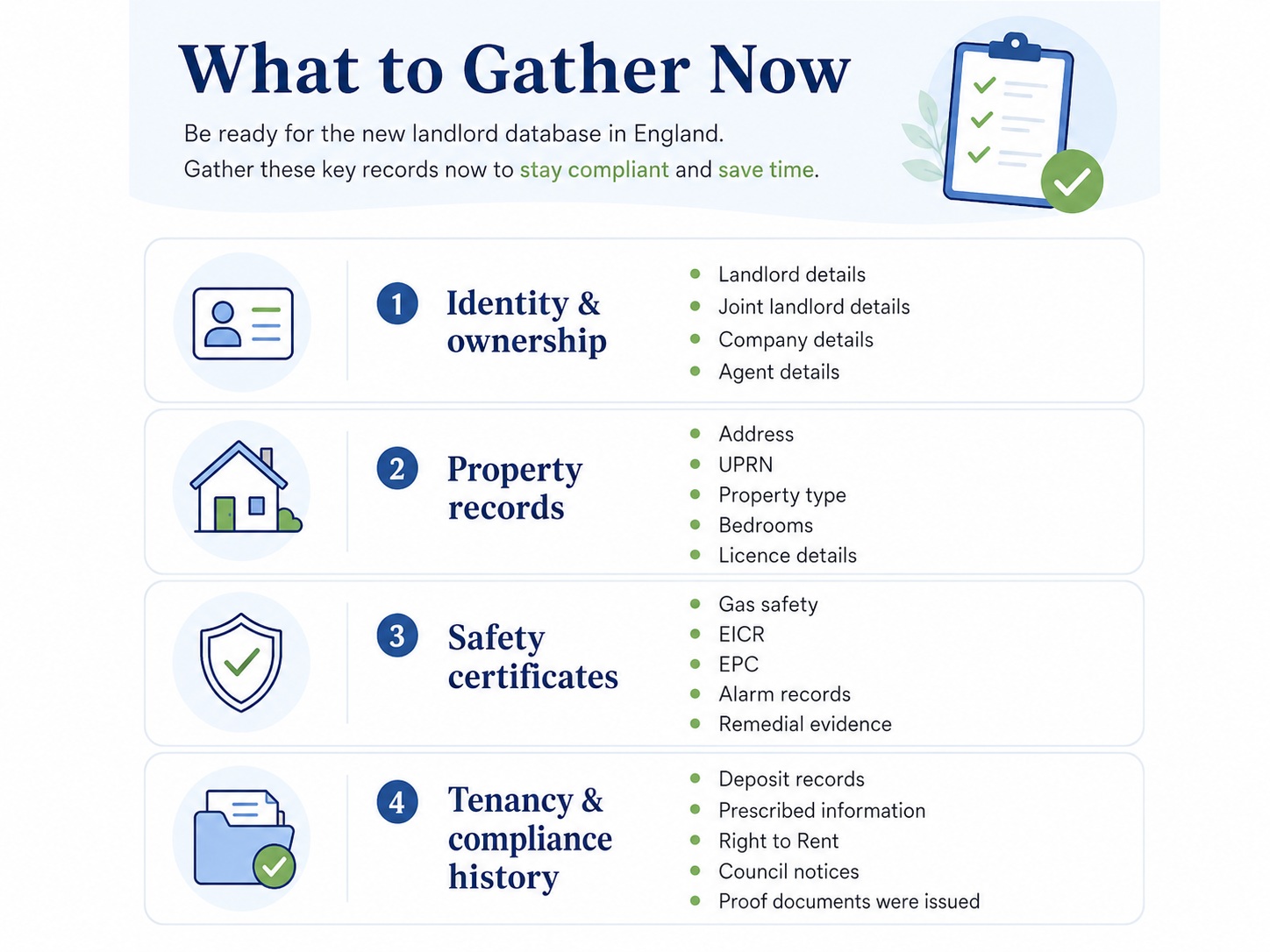
For each property, gather:
- current gas safety certificate, where gas is present
- current EICR and any remedial work evidence
- current EPC
- property address details exactly as used in official records
- property type, bedroom count and occupancy details
- landlord contact details and joint landlord details
- current agent details, if managed
- licensing details, if the property is subject to HMO or selective licensing
- deposit protection records and prescribed information
- smoke and carbon monoxide alarm records
- any council correspondence, improvement notices or penalty records
That is partly legal requirement and partly best practice. The certificates and licence duties already exist where they apply. The single, organised evidence pack is the preparation layer.
Example: a landlord with three flats and one licensed HMO audits her records in September 2026. She finds that one property’s EPC cannot be located, another EICR has remedial evidence stored separately, and some documents remain inside an old letting-agent portal. Reconstructing that file now is easier than doing it when registration opens in her area.
Before your region’s registration window opens
The first rollout date is now confirmed: 15 December 2026 in the West Midlands. Other areas will follow, with the government saying landlords will have a three-month registration period when their region is called forward. All landlords actively letting property must be registered by 14 November 2027.
The initial requirement applies to properties already let or which become occupied during the rollout. The government says registration of unoccupied properties before marketing, together with registration numbers on adverts, will follow later as the public interface is introduced.
Before your registration window opens, landlords should:
- check GOV.UK for the confirmed date their region is called forward
- identify which properties are already let or are likely to become occupied during the rollout
- budget £65 per property per year for registration and annual renewal
- make sure each property has a clear owner and contact record
- make sure information held by a managing agent can be retrieved when needed
- decide who is responsible for registering properties and keeping entries updated
The Act allows regulations to require active landlord and dwelling entries to be kept up to date. That means this is unlikely to be a one-off registration job. It will probably become an ongoing record-maintenance duty, with exact rules to follow in secondary legislation.
Once rollout reaches your area
Once the database is live in your area, expect the process to become part of your annual compliance rhythm.
The likely workflow is:
- register the landlord entry
- register each property entry
- provide the required property and safety information
- pay the annual £65 registration fee for each property
- update entries when circumstances change
- renew each property registration annually
The Act provides for unique identifiers to be allocated to landlord and dwelling entries and contains restrictions on marketing a dwelling without active entries. It also requires written adverts to include the relevant identifiers once those provisions apply. However, the government’s 9 September announcement makes clear that these marketing requirements are part of a later stage: during the initial rollout, registration applies to properties already let or which become occupied, while registration before marketing unoccupied properties and registration numbers on adverts will follow as the public interface is rolled out.
For a landlord with eight or ten properties, the important shift is rhythm. Certificate expiry dates, database renewal dates, licence renewal dates and tenant information duties all need to sit in one practical operating calendar.
What documents to gather now
This is a preparation checklist, not a substitute for the official registration guidance. The government has now published detailed information about what landlords will be asked to provide. The list below combines those registration fields with additional records that are sensible to keep for wider landlord compliance; not every record listed below is necessarily a PRS Database upload requirement.
Identity and ownership records
Keep:
- full name and date of birth for an individual landlord
- residential address
- telephone number and email address
- company or organisation details, if the property is held through a limited company or other organisation
- joint landlord details, where applicable
- proof of authority where someone is acting under a power of attorney, as a personal representative or in another specified capacity
- letting agent or property manager details, if applicable
If the landlord is a limited company or other organisation, the government’s current guidance lists additional information including the organisation name, legal entity type, address, telephone number, email address, details of the person making the entry, a nominated contact and a Companies House registration number where applicable. Additional officer, trustee or governing-body details may be required in some circumstances.
If you use a letting agent or property manager, you as the landlord will still need to start and end the registration process. The government says you can agree for your agent or property manager to provide certain information on your behalf, but the landlord remains responsible for providing all required information. Further guidance for letting agents and property managers will be published before rollout.
Property records
For each property, keep:
- full postal address
- UPRN, if you can confirm it
- property type, such as flat or house
- number of bedrooms
- number of occupants and households
- occupied or vacant status
- furnished or unfurnished status
- rent charged and frequency of payment
- whether the rent includes utilities and, if so, which utilities
- tenancy start date and current tenancy status
- licence details, if HMO or selective licensing applies
A UPRN is a unique property reference number used to identify a specific addressable location. It is worth confirming now rather than trying to find it during a time-pressured registration process. Landlords can usually check official address and UPRN details through FindMyAddress or relevant local authority records.
A landlord with six properties in two council areas should not wait for registration to discover whether one property is under selective licensing. If a licence applies, that evidence belongs in the same property file as the certificates.
For HMO landlords, the database is likely to sit alongside existing HMO licensing rather than replace it. The exact interaction between HMO licence records and PRS Database entries has not yet been fully confirmed, so HMO landlords should watch for specific guidance from GOV.UK and their local council.
Certificate and safety evidence
For each property, keep:
- gas safety certificate, where required
- EICR
- EICR remedial work evidence, if the report was unsatisfactory
- EPC
- smoke alarm and carbon monoxide alarm test records
- PAT testing records, where carried out
- fire safety or communal-area records where relevant
- contractor invoices or engineer notes linked to safety work
Current government registration guidance says landlords will need to provide gas safety information where the dwelling has a gas supply, electrical safety information including an EICR or appropriate Electrical Installation Certificate, and EPC information. Where relevant, the guidance also asks for information about MEES exemptions.
For EPC planning, see CertNudge’s EPC C 2030 guide. For retention periods, see How Long Should Landlords Keep Records in the UK?.
Tenancy and compliance history
Keep:
- deposit protection certificate
- prescribed information and proof it was given
- Right to Rent check records
- How to Rent guide or historic tenant document evidence where relevant
- Renters’ Rights Act Information Sheet evidence, where relevant
- complaints and repair correspondence
- council letters, notices and responses
- penalty notices, if any
- proof of document service or sharing
Some of these records may not be database-upload requirements. They are still useful because the Renters’ Rights Act reforms are moving the sector towards evidence-led compliance, not memory-based compliance.
Example: a landlord with eight properties tries to gather records after hearing the database is launching. Three certificates are in Gmail. Two are in a Dropbox folder from an old agent. One EPC is missing. Two are inside a portal he no longer has access to. The hard part is not registration. It is recovering the scattered evidence.
Want to check certificate gaps before your registration window?
CertNudge’s free compliance check can help you identify missing or expiring certificate dates across your properties. It does not determine whether a property is fully “PRS Database-ready”, because the final registration requirements have not yet been confirmed.
Run the free compliance check — identify certificate gaps before your registration window opens.
If you have recently switched agent or taken management back in-house, use CertNudge’s letting agent handover checklist before portal access disappears.
Common mistakes landlords should avoid
The landlord database is not live nationally yet, but the first launch date and registration window are now confirmed. The risk is that landlords wait until their own region is called forward and then discover that missing evidence takes weeks to find.
Mistake 1: waiting until the end of your registration window
The launch announcement has now arrived. The West Midlands starts on 15 December 2026, and landlords will have three months to sign up when their region is called forward. Waiting until the end of that window could turn missing certificates, incomplete agent handovers or unclear ownership records into a time-pressured problem.
A landlord with three properties can usually organise the core records quickly if the evidence already exists. If certificates are missing, licences are unclear or agent handover records are incomplete, the work takes longer.
Mistake 2: assuming the letting agent has everything
Many agents hold only the records they needed during their management period. If there has been a change of agent, a portfolio sale, a long-term tenancy or a missed handover, the file may be incomplete.
A landlord in Newcastle switched from managed to self-managed in 2025 and assumed her agent held the full record. When she asked for a handover, two of four properties had complete files. The other two needed a reissued gas safety record, a replacement EPC download and deposit paperwork traced through old emails.
That is a business-process failure, not just an admin nuisance.
Mistake 3: confusing the PRS Database with the PRS Landlord Ombudsman
They are separate reforms.
The PRS Database is about landlord and property information. The PRS Landlord Ombudsman is a redress service for tenant complaints. GOV.UK’s roadmap says both sit in Phase 2, but the Ombudsman follows the database. The roadmap says the government expects mandatory Ombudsman membership to be in 2028, when the Secretary of State is confident the service is ready, but the detailed rules still need to be confirmed.
Mistake 4: treating England, Scotland and Wales as the same
Do not use the Scottish Landlord Register or Rent Smart Wales as a direct template for the English PRS Database. They are useful comparisons, but the English system is being created under its own legislation and regulations.
This matters for landlords with cross-border portfolios. A landlord with properties in Bristol and Cardiff will need to follow separate English and Welsh regimes.
Mistake 5: underestimating possession consequences
The database is not just an information portal. Once the relevant provisions are in force, failing to maintain active database entries can affect a landlord’s ability to obtain a possession order in most cases, except the stated anti-social behaviour grounds.
For landlords, the practical lesson is simple: possession-readiness is no longer only about the tenancy agreement and the ground for possession. It also includes the wider compliance file.
For landlords still using spreadsheets, CertNudge’s landlord compliance spreadsheet template explains what to track and where spreadsheets usually start to break down.
FAQs about the landlord database
When does the PRS Database open for registration?
The government says the Register your rental property service will launch on 15 December 2026, starting in the West Midlands. Other areas will follow as the service rolls out across England.
When a region is called forward, landlords with properties there will have three months to sign up. The full schedule is now published: West Midlands starts 15 December 2026; East of England 15 January 2027; East Midlands 15 February; South East 15 March; Yorkshire and Humber 15 April; North West 15 May; North East 15 June; London 15 July; and South West 15 August 2027. The final regional deadline is 14 November 2027.
How much does PRS Database registration cost?
PRS Database registration costs £65 per property per year. The government says the fee applies separately to each property and each property registration must be renewed annually.
For example, a landlord with four registered properties would pay £260 per year, while a landlord with ten registered properties would pay £650 per year at the current published fee.
Do I need to register every property separately?
The legal framework uses a landlord entry for the landlord and a separate dwelling entry for each rental property in scope.
During the initial regional rollout, the government says the requirement applies to properties already let or which become occupied during the rollout. A later stage will extend the requirement so unoccupied properties must also be registered before they are marketed for let.
How do I register as a landlord in England?
As of 9 September 2026, mandatory registration is not yet open for general landlord use. The government has now confirmed that its Register your rental property service will launch on 15 December 2026, beginning in the West Midlands. Other regions will follow, and landlords will have three months to register when their area is called forward.
The detailed live registration instructions have not yet been published. Once the relevant duties apply in your area, the Renters’ Rights Act framework provides for active entries for the landlord and each dwelling in scope. Existing HMO, selective and additional licensing duties remain separate and should continue to be checked with the relevant local council.
What happens if I do not register?
Once the relevant database duties apply, breaching the registration requirements can result in a civil penalty of up to £7,000. Continuing or repeat breaches, and offences such as knowingly or recklessly providing materially false or misleading information, can lead to a civil penalty of up to £40,000 as an alternative to criminal prosecution. The government says the later public-interface stage will also require unoccupied properties to be registered before marketing and registration numbers to appear on adverts.
Once the relevant provisions are commenced, failure to comply can also affect possession. The Act prevents the court from making a possession order while the landlord is in breach of the active-entry requirement, except for Ground 7A or Ground 14 anti-social behaviour cases.
There can also be rent repayment order exposure for certain more serious PRS Database offences, but this should not be confused with every first-time failure to register. Section 98 of the Renters’ Rights Act extends the rent repayment order regime to specific offences under section 92, including knowingly or recklessly providing materially false or misleading information and certain continuing database breaches after enforcement action. For a qualifying database offence, a tenant may be able to seek a rent repayment order covering up to two years of rent, subject to the statutory rules and the facts of the case.
Will my information on the database be visible to tenants?
Partially. Some information is expected to be visible to tenants, councils or prospective tenants, but the exact public visibility rules have not been finalised.
GOV.UK says the exact information available to the public will be set out in regulations, and that it does not expect all data to be publicly accessible. A sensible preparation step is to assume selected property and compliance information may be visible, while private or restricted data will be governed by the final regulations.
Preparation now beats panic later
The landlord database is part of a wider shift in England’s private rented sector: Section 21 abolition, stronger Section 8 evidence requirements, the PRS Database, the PRS Landlord Ombudsman, Decent Homes reforms, Awaab’s Law for serious hazards such as damp and mould, and stronger council enforcement all point in the same direction.
That hazards strand is worth watching alongside the database, because the same evidence trail supports both. For how councils assess serious hazards under the framework that sits behind Awaab’s Law, see CertNudge’s guide to HHSRS inspections for landlords in England.
Landlords will increasingly need to show what is compliant, what has been renewed, what has been served and what evidence sits behind each property.
A landlord who starts with organised records will treat database registration as an admin task. A landlord who starts with scattered inboxes, missing certificates and unclear agent files will experience it as a scramble.
See how an inspection-ready property record can look.
CertNudge helps landlords organise certificates, expiry dates and supporting evidence by property, so records are easier to find, share and review when needed.
Last reviewed: 9 September 2026
Next review recommended: 1 October 2026, or sooner if MHCLG publishes further registration regulations, detailed service guidance, letting-agent guidance or information about the later public-interface and pre-marketing requirements.