
Tenant Caused Damage to Property: Evidence Landlords Should Keep
A practical landlord guide to recording tenant damage, separating it from fair wear and tear, and keeping evidence for deposit deductions or disputes.
When a tenant has caused damage to a property, landlords should record the condition before repairs begin, compare it with the signed check-in inventory, retain relevant messages and obtain itemised quotes or invoices. The aim is to separate damage from fair wear and tear and prepare a reasonable, evidence-based deposit deduction.
Key takeaways
- Before repairing tenant damage, photograph it in context and compare it with the signed check-in record.
- A landlord proposing a deposit deduction should be ready to show the tenant’s obligation, the change in condition and the financial loss.
- Fair wear and tear must be allowed for; replacing an older item with a new one does not automatically justify claiming the full cost.
- Keep inventories, photographs, messages, inspection notes, quotes, invoices and calculations together by property.
- Good evidence supports a fair, explainable decision, but it does not guarantee the outcome of a deposit dispute.
A tenant moves out and leaves a hole in a bedroom door, a stained lounge carpet and a missing freezer drawer. For a landlord dealing with tenant caused damage to property, the first job is not deciding how much to deduct. It is recording what has changed, comparing it with the tenancy’s starting condition and gathering evidence of a reasonable repair or replacement cost.
Scope: This guide focuses on evidence for suspected tenant damage and deposit deductions in standard private tenancies in England. It does not cover court claims, insurance recovery or recovering losses above the deposit. Tenancy deposit protection guidance also commonly covers relevant tenancies in Wales, while Scotland and Northern Ireland operate separate deposit protection systems.

When tenant damage becomes an evidence problem
Suspected tenant damage can arise during a tenancy, at a routine inspection or after the keys have been returned. It may be reported by the tenant, noticed by a contractor or discovered during the check-out inspection.
Consider a landlord inspecting a two-bedroom flat after a three-year tenancy. The bedroom door has a hole near the handle, the carpet has several dark stains and one of the freezer drawers is missing. None of those findings automatically proves that the tenant is responsible.
The landlord still needs to establish:
- What condition the item was in when the tenancy started.
- Whether the tenant had an obligation to look after it.
- Whether the change is damage rather than normal deterioration.
- Whether the tenant’s actions or omissions caused a financial loss.
- How the proposed deduction has been calculated.
That distinction matters because a deposit is not a repair fund that the landlord can allocate unilaterally. The Tenancy Deposit Scheme explains that the burden of proof lies with the landlord and that the starting point is showing that the tenant had a contractual obligation and breached it. Read the TDS guidance on damage and negligence claims.
The same evidence may also be needed before the tenancy ends. If a mid-tenancy inspection reveals a broken internal door, for example, record the condition and communicate with the tenant before arranging non-urgent work. That creates a clearer timeline than waiting until check-out and trying to reconstruct when the damage occurred.
Tenant damage, fair wear and tear and landlord deductions from deposit
Not every mark, worn fitting or tired item is tenant damage.
Fair wear and tear is the deterioration that occurs through age and ordinary use. Examples might include faded paint, light scuffing, carpet wear along a frequently used route or a door handle gradually becoming loose.
Damage is more likely to involve an accident, negligence, misuse, an unauthorised alteration or a missing item. A burn in a carpet, a large hole in a door, a cracked washbasin caused by an impact or a removed freezer drawer may fall into this category, depending on the evidence.
mydeposits gives the practical comparison of a carpet worn by normal foot traffic versus one left with stains or burns. It also warns landlords to account for betterment when calculating a claim. See the mydeposits guidance on fair wear and tear.
How deposit deductions for tenant damage are assessed
Where a protected deposit is disputed, the government-approved tenancy deposit scheme can offer a dispute resolution process. If both parties agree to use the service, they are asked to provide evidence and an independent adjudicator decides how the disputed amount should be distributed.
GOV.UK states that, where a landlord and tenant dispute how much deposit should be returned, the deposit remains protected in the tenancy deposit protection scheme until the issue is resolved. Read the GOV.UK tenancy deposit protection guidance.
There is no universal price list stating that a stained carpet is worth a particular deduction or that a damaged door always produces a fixed award. The decision depends on the tenancy agreement, the starting condition, the evidence, the cause of the damage and the reasonableness of the amount claimed.
A landlord may therefore be able to propose a deduction where tenant damage is supported by evidence, but should not treat the deduction as automatic. For the wider rules on protecting and handling a tenancy deposit, see the tenancy deposit protection checklist for England.
Best practice: calculate the loss, not the upgrade
Suppose a lounge carpet cost £700 and was already five years old when the tenant moved in. After a two-year tenancy, a permanent burn means that it needs replacing.
A quote for a new £700 carpet does not necessarily make £700 a reasonable deposit deduction. The landlord has already received years of use from the original carpet. Claiming the whole cost of a brand-new replacement could place the landlord in a better position than before.
Age, original quality, condition at check-in, tenancy length and expected remaining life should all be considered. mydeposits describes this as avoiding betterment and gives examples where only a proportion of the replacement cost may be appropriate.
Important: That calculation is best practice rather than a fixed statutory formula. The aim is to produce an amount that can be explained, supported and assessed fairly.
What landlords should do when they find tenant damage
Deal with the situation in two stages. First, preserve enough evidence to show what was found and how it compares with the tenancy’s starting condition. Then assess the cost, explain the proposed deduction and keep the resulting correspondence together.
Phase 1: Record and compare the damage
The evidence is easiest to preserve before contractors begin work. A landlord who discovers damage at 10am and has a decorator arriving at midday should take the photographs and notes first, rather than relying on pictures of the completed repair.
1. Do not repair or dispose of the evidence immediately
Make the property safe where urgent action is needed, but record the condition before routine repairs begin.
Do not throw away a broken fitting, remove a damaged appliance or replace a missing item without first recording what was found. Where keeping the item is impractical, photographs and a clear written description may be the best available record.
2. Take wide, close and contextual photographs
One close-up of a mark is rarely enough. Take:
- A wide photograph identifying the room.
- A mid-range photograph showing the item and its surroundings.
- A close-up showing the damage clearly.
- Additional angles where depth, size or location matters.
- A short video where the overall condition is difficult to show in still images.
Use dates and descriptive file names. “Bedroom 2 door lower panel – 14 July 2026” is more useful than “IMG_4821”.
For video evidence, DPS advises guiding the viewer around the property and identifying which room is being shown.
3. Compare the damage with the check-in evidence
A check-out photograph proves what the property looked like at the end. It does not, by itself, prove that the condition changed during the tenancy.
Compare it with:
- The check-in inventory and any accompanying schedule of condition.
- Check-in photographs or video.
- Signed tenant comments or amendments.
- Earlier inspection reports.
- Contractor records showing previous condition.
- Any inventory received during a letting agent handover.
For example, “freezer drawer missing” is a stronger claim where the check-in inventory lists three drawers and includes a clear photograph showing all three.
4. Check the tenancy agreement
Identify the clause or obligation relevant to the alleged damage. This might concern looking after fixtures, reporting damage, obtaining consent before alterations or returning supplied items.
Do not assume that a broadly worded clause settles responsibility. The landlord should be able to identify the relevant tenant obligation, show how it was breached and connect that breach to the loss being claimed. DPS guidance confirms that the burden is on the landlord to establish a legitimate claim against the deposit. Read the DPS guidance on deposit claims and evidence.
The evidence must also connect that breach to an actual loss.
5. Separate damage from ordinary use
Consider the item’s age, condition at the start, quality, number of occupants, tenancy length and normal expected use.
Light marks after several years of occupation may be fair wear and tear. A punched hole in an internal door is different. A failed pipe behind a bath may instead fall within the landlord’s own repair responsibilities, even if the resulting water damage is discovered at check-out. GOV.UK lists pipes, drains and sanitary installations among the repairs for which landlords are normally responsible, and the property’s own safety records such as a current EICR for the electrical installation - can help show a defect was pre-existing rather than tenant-caused. Prompt reporting by the tenant may still be relevant when assessing whether any additional damage could reasonably have been avoided. Check the GOV.UK guidance on landlord repair responsibilities.
Phase 2: Calculate and communicate the proposed deduction
Once the condition and likely cause have been recorded, move on to the financial evidence. The aim is not simply to collect a repair invoice, but to reach an amount that is itemised, proportionate and explainable.
6. Obtain detailed quotes, invoices or receipts
A one-line invoice stating “repairs to flat — £900” does not explain which work relates to the tenant damage.
Ask the contractor to separate:
- The damaged item or area.
- The work required.
- Labour and materials where practical.
- Repair costs versus replacement costs.
- Unrelated maintenance or improvement work.
Deposit scheme guidance identifies invoices, estimates, receipts and quotes as useful evidence. mydeposits also gives examples where vague invoices weakened a landlord’s explanation of the amount claimed.
7. Produce an itemised calculation
Avoid a single rounded deduction covering several issues.
A clearer record might say:
- Bedroom door repair: £145 contractor invoice.
- Freezer drawer replacement: £38.50 like-for-like part.
- Lounge carpet: £160 proposed contribution after allowing for age, previous condition and normal use.
Record how any contribution was calculated. Even where the tenant disagrees, they can see the reasoning behind each figure.
8. Keep communication in writing
Save emails, text messages, WhatsApp screenshots and repair conversations. These may show when damage was reported, whether access was offered, what explanation was given and whether the tenant accepted or disputed responsibility.
If the tenant later retracts, qualifies or disputes an earlier admission, keep both messages. Do not treat the first statement as conclusive on its own; assess the full exchange alongside the inventory, photographs, inspection records and any contractor findings.
9. Store the records by property and event
Create a clear sequence:
- Check-in condition.
- Periodic inspection evidence.
- Damage report or discovery.
- Tenant communication.
- Check-out evidence.
- Quotes and invoices.
- Proposed deduction.
- Deposit scheme correspondence.
A spreadsheet can record dates and document locations, but the photographs, messages and invoices still need to be stored somewhere reliable. CertNudge’s landlord compliance spreadsheet guide explains where manual tracking can become difficult as a portfolio grows.
Tenant damage evidence checklist for landlords
A landlord may have gathered the right evidence but still struggle to use it because the inventory is in an agent portal, the photographs are on an old phone and the invoice is buried in an email account.
Would your evidence survive a dispute right now?
Adjudicators decide on the balance of probabilities, and the landlord with the clearer contemporaneous record usually prevails. Run a free 60-second check to see whether your check-in inventory, photographs and cost evidence are actually retrievable, or scattered across devices and accounts.
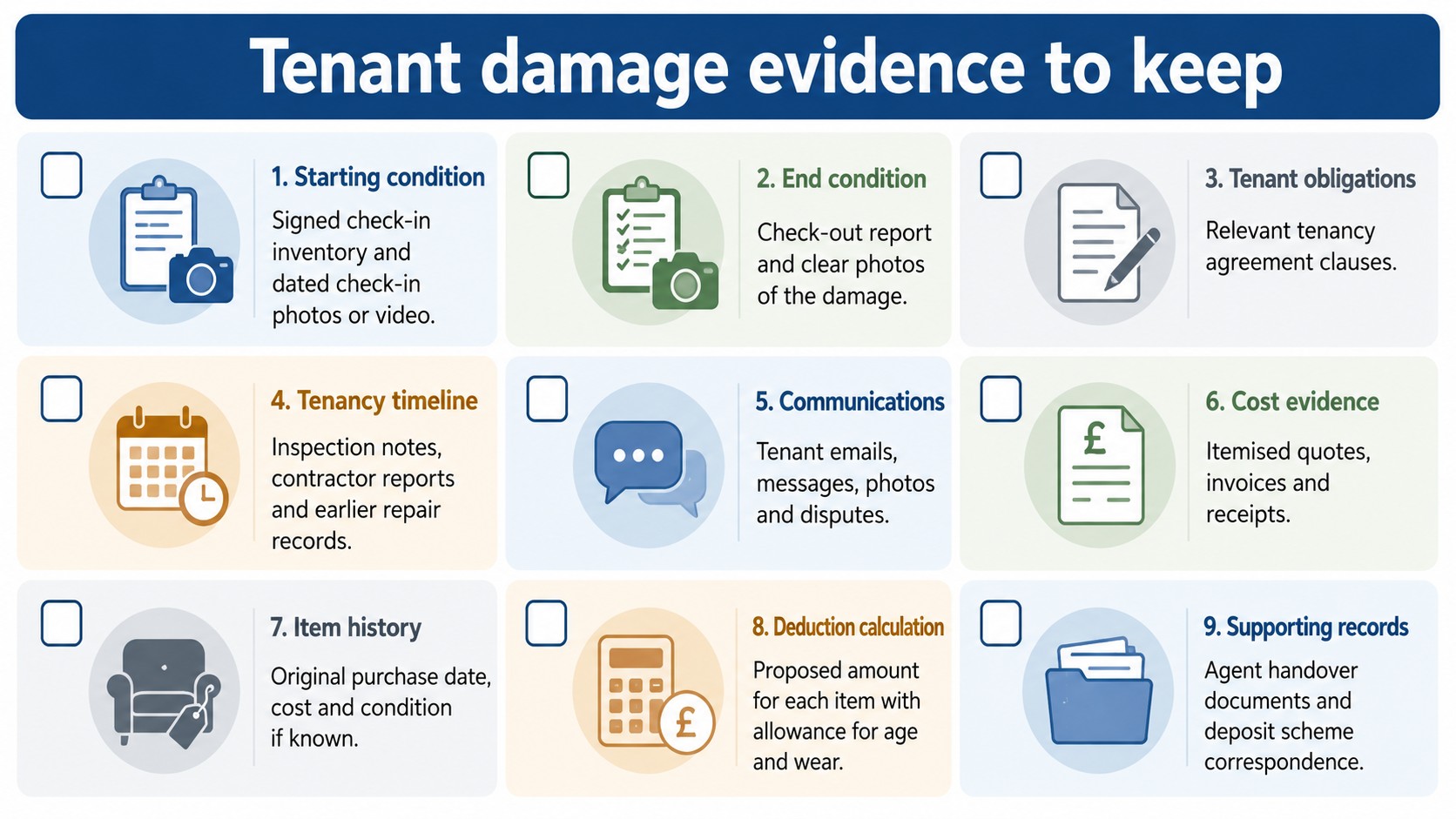
A usable tenant-damage record should show the starting condition, what changed, why the tenant may be responsible and how the proposed financial loss was calculated. Keep the following together for each damage event:
Starting condition
Signed check-in inventory and dated check-in photographs or video.
End condition
Check-out report and photographs showing the room, item and damage clearly.
Tenant obligations
The relevant tenancy agreement clauses.
Tenancy timeline
Periodic inspection notes, contractor reports and earlier repair records.
Those records establish what changed and when. The remaining evidence should explain the landlord’s response, the amount proposed and how the issue was communicated.
Communications
Tenant emails, messages, photographs, admissions, explanations and disputes.
Cost evidence
Itemised quotes, invoices, receipts and details of the work completed.
Item history
Original purchase date, cost, quality and condition where these are known.
Deduction calculation
The amount proposed for each item and any allowance made for age, condition or fair wear and tear.
Supporting records
Agent handover documents and deposit scheme correspondence where relevant.
Download the free tenant damage evidence checklist
Use this editable two-page Word checklist to organise the starting condition, photographs, tenant communications, contractor evidence and calculation for each separate damage event.
Save the records under the property and the specific event rather than leaving them across different devices and accounts. CertNudge’s guide to how long landlords should keep records explains how legal minimums and practical retention periods can differ.
Common mistakes landlords make with tenant damage evidence
A claim can fail even where genuine damage occurred. The weakness is often not the repair itself, but the missing comparison or unexplained calculation.
Photographing only the damage
A close-up of a stained carpet does not show whether the stain was already present.
Photograph the room, compare it with the check-in record and identify the exact change. The baseline matters as much as the end condition.
Treating all deterioration as damage
A carpet that has flattened along the hallway after four years is not the same as a carpet with a cigarette burn.
Record age, tenancy length and previous condition before deciding what proportion, if any, should be attributed to the tenant.
Claiming the full replacement cost
Replacing an older appliance or carpet with a brand-new equivalent may improve the landlord’s position. Consider the item’s age, quality, previous condition and remaining useful life rather than automatically passing on the whole invoice.
Using vague descriptions
“Tenant ruined bedroom” gives an adjudicator very little to assess.
A clearer record would be:
“Hole measuring approximately 8cm in the lower panel of the bedroom door. Not visible in the signed check-in photograph dated 3 September 2024. Check-out photograph taken 12 July 2026.”
Specific descriptions connect the location, condition and comparison evidence.
Combining several costs into one deduction
A £750 “damage charge” does not show what is being claimed.
Separate the door, carpet, missing item and cleaning issues. Attach the relevant evidence and calculation to each.
Leaving messages on a phone
WhatsApp threads, text messages and photographs can disappear when a phone is replaced or an agent account closes.
Export or save relevant communications into the property record while the tenancy and event are still easy to identify.
Assuming organised evidence guarantees the outcome
Strong evidence helps explain a claim, but it does not determine liability or guarantee the amount requested. The tenant may provide different evidence, a contractor may identify an underlying defect, or the deduction may be reduced for fair wear and tear or betterment.
Frequently asked questions about tenant damage to rental property
What counts as tenant damage to a rental property?
Tenant damage generally means deterioration beyond fair wear and tear that is connected to negligence, misuse, an accident, an unauthorised alteration or a missing item. Whether an issue counts as damage depends on the starting condition, tenancy circumstances and supporting evidence.
Can a landlord deduct from a deposit for tenant damage?
A landlord may propose a reasonable, itemised deduction where the evidence indicates that the tenant breached an obligation and caused a financial loss.
The landlord should allow for fair wear and tear and avoid betterment. TDS guidance places the burden of supporting the claim on the landlord. If the deduction is disputed, the tenancy deposit scheme may ask both parties to provide evidence before deciding how the disputed amount should be distributed.
What evidence does a landlord need to prove tenant damage?
The strongest evidence usually combines a signed check-in inventory, dated before-and-after photographs, the tenancy agreement, check-out or inspection reports, tenant communications and detailed cost evidence.
DPS specifically lists inventories, tenancy agreements, inspection reports, invoices, estimates, receipts, quotes, photographs, videos and correspondence among the evidence that may be submitted.
What if there was no check-in inventory?
A claim is more difficult without a reliable record of the starting condition because the landlord may be unable to show that the damage arose during the tenancy. TDS guidance explains how the absence of an inventory affects a deposit claim.
Other records may still help, including dated photographs, purchase receipts, contractor reports, earlier inspection notes, agent files and tenant messages. Their value will depend on what they prove and how clearly they relate to the property and item.
Can a landlord charge the full replacement cost?
Not automatically. mydeposits guidance explains that age, original condition, quality and previous use should be considered to avoid betterment. A reasonable contribution may therefore be more appropriate than the entire replacement invoice.
Keep tenant damage evidence with the rest of your landlord records
The practical step to take this week is to choose one current tenancy and check whether you can find its signed inventory, check-in photographs, inspection notes and item purchase records without searching several devices or accounts.
For a landlord with four properties, that test quickly shows whether the evidence system works before a deduction is questioned. CertNudge keeps supporting records organised by property alongside the wider compliance file.
See how an inspection-ready CertNudge compliance pack works
Deposit evidence is the same discipline the rest of landlord compliance now demands. As the private rented sector database rolls out across England from late 2026, registration will expect current gas, electrical and EPC records per property — kept in exactly the structured, retrievable form a deposit dispute needs. Keep check-in photographs, check-out notes, invoices and compliance certificates organised by property, so the records are easier to retrieve when they are needed.
CertNudge does not decide whether a tenant caused damage, verify liability or guarantee a deposit dispute outcome. It helps keep the documents and evidence trail structured so records are easier to retrieve when they are needed.
This article is for general information only and is not legal advice. Regulations change and individual circumstances vary — always check the latest guidance at GOV.UK or speak to a qualified housing professional or solicitor.
Last reviewed: 14 July 2026
Next review recommended: 30 June 2027