
Buying a Property with Tenants in Situ: Due Diligence Checklist
Buying a property with tenants in situ in England? Use this practical checklist to verify tenancy, deposit, safety, repair, Right to Rent and licensing records before exchange.
Buying a property with tenants in situ means purchasing the building subject to an existing tenancy. In England, where the sale is subject to that tenancy, the buyer normally becomes the landlord on completion. This checklist shows what to verify before exchange — tenancy type, rent history, deposit protection, gas safety records, EICR, EPC, Right to Rent, licensing and repairs — and which gaps to raise with your conveyancer.
At first, the seller’s file may look complete: a tenancy agreement, a current gas safety check record and an EICR. Then the gaps appear: no evidence the tenant received those documents, a deposit held under the seller’s insured-scheme account, and a damp complaint marked “open”. Audit the tenancy and evidence before exchange, classify unresolved items by timing, and carry the handover through completion with a dated checklist.
Can you buy a property with tenants in situ?
- A landlord can buy a property with tenants in situ in England. Where the sale is subject to the tenancy, the existing tenancy normally continues and the buyer becomes the landlord on completion.
- Verify the tenancy, deposit, rent history, safety records, repairs, licensing, Right to Rent evidence and proof of tenant communications before exchange.
- Raise serious omissions or contradictory records with your conveyancer before the transaction becomes binding.
- Do not treat a file marked “current certificates” as proof that historical remedial work, tenant-supply duties or complaints were dealt with.
Key takeaways
- You are buying an existing landlord-and-tenant relationship, not merely a property with rent already coming in.
- Match every record to the correct property, occupier, date and supporting evidence; filenames and agent summaries are not enough.
- Put unresolved tenancy, deposit, Right to Rent, licensing, electrical and repair issues into a dated pre-exchange question list.
- Preserve the inherited history and set each future deadline as soon as completion is confirmed.
For private landlords buying tenanted property in England. This is general information only, not legal, conveyancing, mortgage, tax or investment advice.

Buying property with tenants in situ: what are you actually acquiring?
A tenanted property is not an empty investment with rent already switched on. You are buying the building while stepping into an existing landlord-and-tenant relationship containing its own payment history, agreed terms, repairs, complaints, evidence gaps and future deadlines.
“Tenant in situ” and “tenanted property” are usually broad descriptions. “Sitting tenant” is also widely used in property listings, but it can sometimes refer to an older protected or regulated tenancy rather than an ordinary private tenancy. Verify the tenancy type and start date from the underlying documents; do not rely on the selling agent’s label.
This checklist is intended for standard private rented properties in England sold subject to an existing residential tenancy. It is not the main workflow for contractual vacant-possession purchases, resident-landlord arrangements, lodgers, company lets, social housing or specialist protected tenancies.
This article does not cover possession strategy or whether vacant possession could be obtained later. Do not buy on that assumption without transaction-specific advice from your conveyancer or a housing solicitor.
Most existing assured shorthold tenancies in England became assured periodic tenancies on 1 May 2026. A limited transitional exception applies where a valid section 8 or section 21 notice served before that date was followed by possession proceedings started in time: the tenancy can remain an AST while those proceedings continue. If the proceedings finish without possession being granted, it becomes an assured periodic tenancy at that point. New assured tenancies are normally periodic from the start, subject to statutory exclusions and specialist cases. An old agreement may still be useful evidence of the agreed rent, payment day and other terms, but its former fixed end date does not necessarily describe the tenancy’s current legal structure. Use the current GOV.UK guidance for landlords when reviewing the paperwork.
Consider a Derby landlord buying their fourth BTL. The agent describes the occupier as a “long-term, reliable tenant paying £925 a month”. The signed agreement says £875, the rent ledger shows an informal move from the first to the fifteenth of each month, and three repair emails refer to recurring bedroom damp. None of that is visible in the sales particulars.
You are not certifying the seller’s file as compliant. You are collecting the underlying records, matching them to the property and occupants, identifying contradictions and giving your conveyancer clear questions while there is still time to act.
The corresponding seller-side exercise is covered in the documents a seller should prepare before sale. The distinction matters: the seller assembles; the buyer verifies.
Before you email the seller, know what to ask for
Download the free tenanted-property due-diligence checklistWhat transfers, what does not and which deadlines start on completion?
Completion does not reset the tenancy’s history. It changes the landlord, but certificate dates, unresolved repair reports, follow-up checks and tenant communications remain relevant.
The existing tenancy and the new-landlord notices
Where the property is sold subject to the tenancy, do not assume you can replace the agreement, change the payment day or alter other terms unilaterally. Ask your conveyancer to confirm the tenancy type, the contractual documents that remain relevant and any unusual arrangements.
Under section 3 of the Landlord and Tenant Act 1985, the new landlord must give the tenant written notice of the assignment and the new landlord’s name and address no later than the next day on which rent is payable — or, if that day falls within two months of the assignment, by the end of that two-month period.
Section 48 of the Landlord and Tenant Act 1987 is separate. It requires an address in England and Wales where the tenant can serve notices on the landlord. Rent or service charges are treated as not due during a period when a compliant address has not been supplied, although the sum becomes due once the address is provided. See section 48.
Suppose completion takes place on Friday 14 August and rent is due on Monday 17 August. Because the next rent day falls within two months of the assignment, the section 3 deadline is the end of that two-month period rather than Monday 17 August. That is the statutory backstop, not a reason to delay: prepare the section 3 and section 48 information before completion and send it promptly afterwards so the tenant knows who owns the property, where to serve notices, how to report repairs and where to pay rent.
Legal requirement: comply with the statutory notice duties.
Good practice: prepare the notices before completion, serve them promptly afterwards, keep a copy, and record the date and method used. A management note is useful audit context, but it is not legal proof of service or receipt.
The deposit needs a scheme-specific completion plan
Do not assume a protected deposit follows the Land Registry title without further action. Establish:
- which authorised scheme holds or protects it;
- whether the arrangement is custodial or insured;
- who physically holds the money;
- the protected amount and named payer;
- what prescribed information was given;
- whether there is an existing dispute; and
- what the scheme requires when the landlord changes.
The government framework requires tenancy deposits to be handled through an authorised scheme, but the mechanics of a sale can differ between schemes and protection types. For example, the Tenancy Deposit Scheme describes its own re-registration process when a property changes landlord; that should not be treated as universal instructions for every scheme. Agree responsibilities and money movements through the conveyancers and check the relevant scheme’s current process.
Where the statutory conditions are met, section 214 of the Housing Act 2004 allows the court to order payment of between one and three times the deposit. That does not mean the buyer automatically becomes liable for every historic error by the seller, but it is a strong reason to have the scheme, money transfer and post-completion information steps confirmed before exchange.
Use the tenancy deposit protection evidence checklist to audit the underlying protection and prescribed-information records. A screenshot showing “protected” does not, by itself, reconcile the deposit amount, payer, tenancy details and completion arrangements.
Right to Rent records include future dates
The current Home Office code says that a buyer acquiring a property with sitting occupiers should confirm that checks were completed, retain the previous landlord’s evidence and record whether any follow-up checks are due. For a tenancy predating the scheme, obtain evidence of when the tenancy began.
The June 2025 Home Office Landlord’s guide adds an important distinction. If the occupier had no right to rent when the tenancy was granted, the original landlord remains liable. If the occupier originally had a time-limited right to rent and a required follow-up was missed, the landlord in place when the breach is identified can be liable. Where the seller cannot evidence a completed follow-up check, the guide advises carrying one out; if the occupier no longer has a right to rent, a report to the Home Office is required to maintain the statutory excuse.
A check after purchase can establish the occupier’s current position, but it does not recreate missing evidence of the original check. Treat an absent initial check or missed follow-up as a red item for specialist advice rather than assuming a fresh check cures the history.
A replacement Right to Rent code is due to take effect on 1 October 2026. For a transaction completing on or after that date, recheck the Home Office guidance before relying on this workflow.
Licences do not transfer, and safety clocks do not restart
Sections 68(6) and 91(6) of the Housing Act 2004 provide that Part 2 HMO licences and Part 3 selective licences cannot be transferred. The seller’s licence therefore does not authorise the buyer. If the property will remain licensable, the incoming owner will normally need to make a fresh application or take the council-specific step required for the change of ownership, so confirm the process and timing before completion.
Keep this as a transaction check rather than drifting into detailed HMO operations. The useful questions are whether a scheme applies, who holds the current licence, whether an application is pending, which conditions affect the property and what the incoming owner must submit.
The same evidence-chain principle applies to safety records:
- Under the Gas Safety (Installation and Use) Regulations 1998, relevant landlord-provided appliances and flues must normally be checked every 12 months. Match the gas safety check record — often called a Gas Safety Certificate or CP12 — to the property and appliances. HSE says existing tenants must receive a copy within 28 days of the check and describes the record as a “living document” that should be supplemented with relevant follow-up action.
- Under the Electrical Safety Standards in the Private Rented Sector (England) Regulations 2020, electrical installations must generally be inspected and tested at least every five years, or sooner if the report specifies an earlier date. Where the report requires remedial or further investigative work, the landlord must complete it within 28 days or any shorter period stated in the report. Within 28 days of completion, the tenant and the local council must receive the report and written confirmation from the qualified person who carried out the work. Where genuine practical obstacles prevent completion on time, keep clear evidence of every reasonable step taken.
- Current domestic MEES guidance uses EPC band E as the existing minimum standard, subject to exemptions and the property falling within scope. Planned future reforms should not be mistaken for the current transaction test.
A purchase does not give the property a fresh five-year electrical period or a new gas anniversary. Record the original inspection dates, relevant remedials, supply evidence and next actions.
The buyer’s due-diligence workflow before exchange and completion
Speak to your conveyancer
Tenancy type, historic breaches, deposit remedies, rent apportionment, contract protections, licence timing and missing records are transaction-specific. This workflow organises the evidence and questions; it does not decide whether you should exchange or complete.
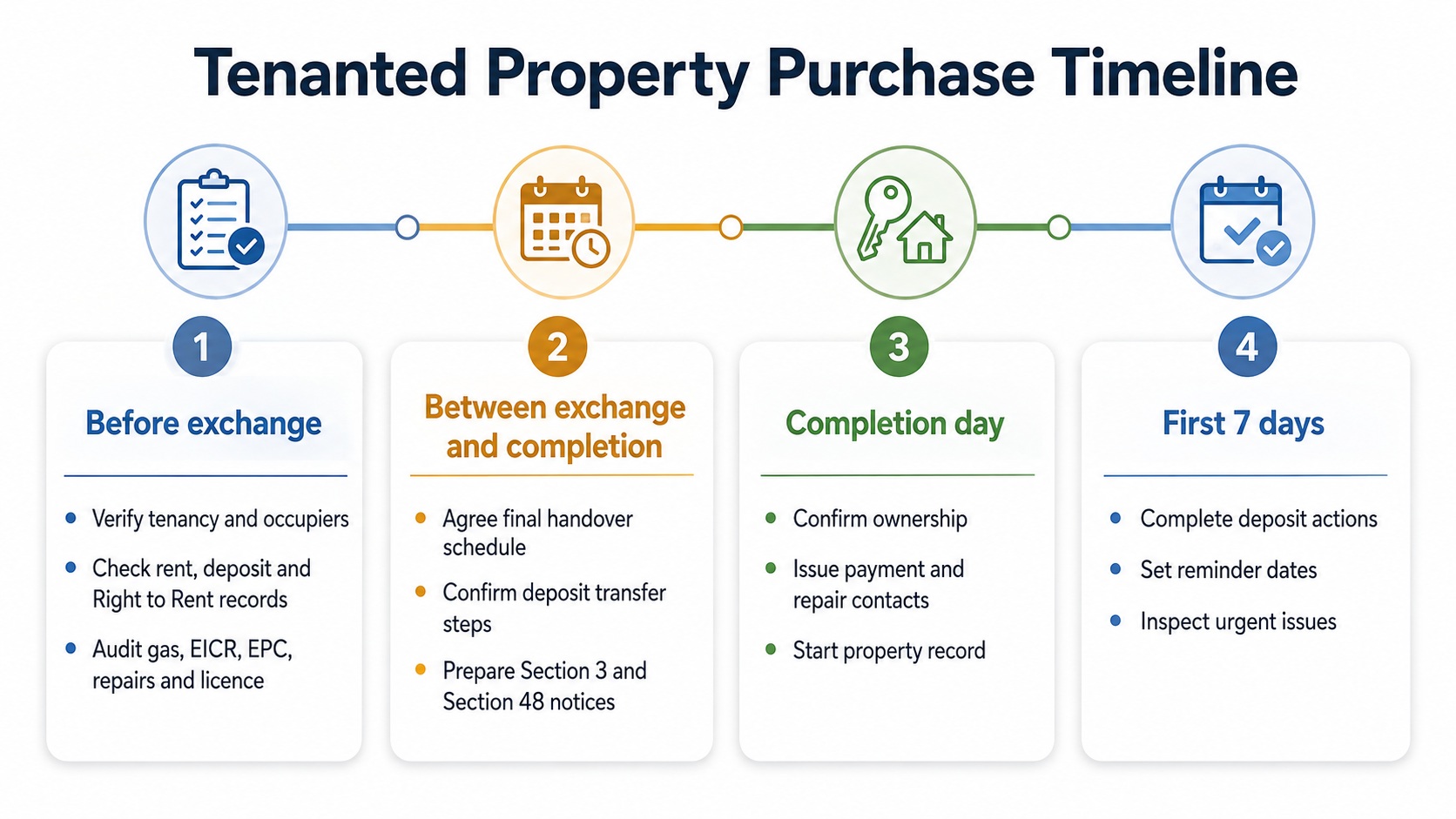
Before exchange
- Confirm what is being sold.
Record the property, seller, managing agent, proposed exchange and completion dates, and whether the contract provides for vacant possession or sale subject to the tenancy. List every known tenant and adult occupier rather than copying one name from the sales memorandum. - Verify the tenancy documents.
Obtain the signed agreement, subsequent written terms, rent variations, guarantor documents, statutory information, notices and evidence of any oral arrangements. Check that the property address and parties are consistent across versions. Ask specifically whether a valid section 8 or section 21 notice was served on or before 30 April 2026 and whether possession proceedings were started in time and remain live. For most cases, 31 July 2026 was the final long-stop date, although some notices expired earlier and a narrow breathing-space extension can apply to certain section 8 notices. Ask the conveyancer to confirm the status and effect of any transitional notice or court case. - Reconcile at least 12 months of rent records.
Compare the contractual rent with the ledger, bank or agent statement. Record arrears, credits, payment plans, direct-payment arrangements and the actual rent day. A brochure showing “£1,100 PCM” is not a rent history. Ask the conveyancers to state how any pre-completion arrears will be treated and whether any right to recover them is being assigned. Do not assume the rent ledger alone answers that question. - Map the deposit process.
Identify the scheme, protection type, protected amount, payer and current holder. Obtain the certificate, prescribed information, proof of supply and dispute history. Ask who will transfer money, update the scheme and send any required information after completion. - Audit the gas, electrical and energy file.
Obtain current and relevant historical gas records, the EICR, coded observations, remedial confirmations, appropriate electrical certification, EPC and any MEES exemption evidence. The EICR rules, remedials and proof-to-keep guide explains why the original report and remedial evidence should be reviewed together. - Read the repair and complaint history.
Request inspection reports, inventories, repair logs, photographs, access correspondence, contractor invoices, insurer claims and council communications. Separate closed repairs from recurring or unresolved issues. Where a council has inspected or hazards have been alleged, use the HHSRS inspection evidence guide to identify the records worth preserving. Where access can be agreed through the seller or managing agent with the tenant’s cooperation, carry out a pre-exchange inspection and compare the property’s condition with the repair file. Do not approach the tenant as though the proposed purchase gives you a right of entry. - Check licensing and planning status.
Search the relevant council scheme information and obtain the licence, conditions, named holder, expiry date and correspondence. Ask the council or your adviser whether a fresh application or other action is needed from the incoming owner. - Audit Right to Rent by occupier.
Record the original check route and date, the evidence transferred, any written agent responsibility and each follow-up date. If the seller cannot evidence a completed follow-up for an occupier who had time-limited status, the Home Office guide advises carrying out a check. Record any required report to the Home Office. For a tenancy predating the scheme, obtain evidence of the tenancy start date rather than inventing a check date. For the full checking routes, evidence and follow-up workflow, use the Right to Rent checks and records guide. - Separate the document from evidence it was supplied.
For gas safety check records, EICRs, EPCs, deposit information and Renters’ Rights Act information, record the exact version, recipient, date and delivery method.- For most assured or assured shorthold tenancies created before 1 May 2026 with wholly or partly written terms, the official Renters’ Rights Act Information Sheet 2026 had to be given to every named tenant by 31 May 2026.
- GOV.UK says the official PDF should be posted, handed over or sent electronically as an attachment. Sending only a link is not one of the specified delivery methods.
- Where a valid section 8 or section 21 notice was served before 1 May 2026, separate transitional timing applies. If the notice ceased to be valid or proceedings ended without possession, the landlord then had one month to give the Information Sheet.
- Wholly oral pre-1 May 2026 tenancies had a separate written-information requirement.
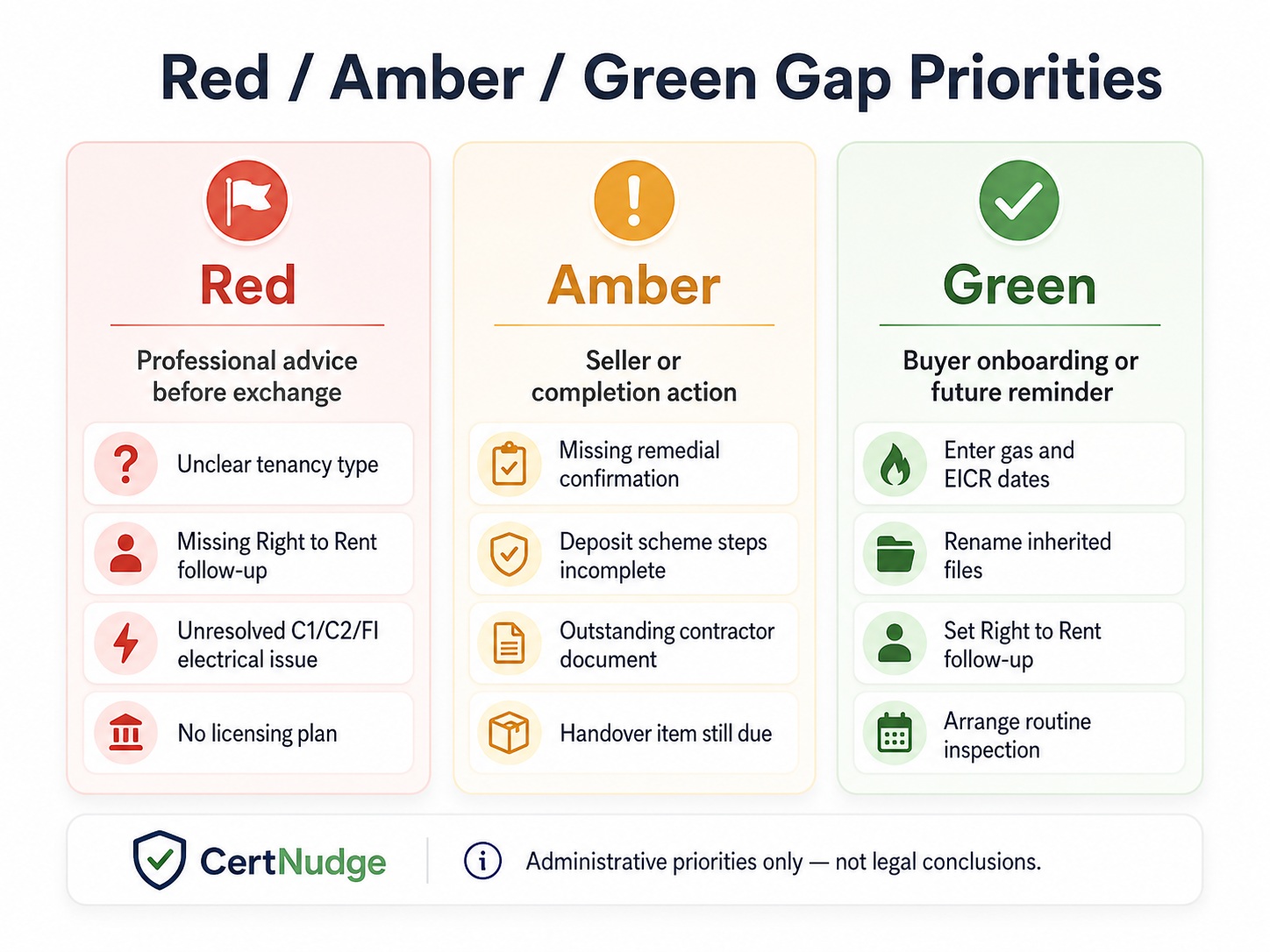
- Classify every gap.
Use three administrative priorities:- Red — professional advice before exchange: an unclear or possibly protected tenancy; missing Right to Rent evidence where a time-limited follow-up may have been missed; an unresolved C1, C2 or FI electrical finding; or no confirmed licensing plan for a licensable property.
- Amber — seller or completion action: missing remedial confirmation, incomplete deposit-scheme instructions, an outstanding contractor document or an agreed item still due in the completion handover.
- Green — buyer onboarding: entering the next gas check, EPC expiry or Right to Rent follow-up date; renaming inherited files; or arranging a routine post-completion inspection.
These are administrative priority labels. They do not determine whether the property or landlord is legally compliant.
Between exchange and completion
- Agree the final handover schedule.
List the documents still expected, deposit mechanics, rent apportionment, keys, fobs, contractor contacts, open repairs, original records and secure transfer method. Where the seller’s agent holds the operational file, use a structured letting agent handover checklist rather than accepting an unindexed download folder.
Ask the conveyancer which agreed actions need to be reflected in the transaction documents. Do not attempt to draft your own contractual retention, indemnity or undertaking from an article checklist.
Completion day and the first seven days
- Run the day-one landlord checklist.
Confirm completion before representing yourself as the new landlord. Then deal promptly with the section 3 and section 48 information, payment instructions, repair reporting route, management contacts, deposit-scheme actions and any urgent inspection or work.
Create the property record while the handover is still fresh. Enter the gas anniversary, EICR review date, EPC expiry, Right to Rent follow-up and licence action as separate dates. Preserve superseded documents rather than overwriting them with filenames such as EICR-FINAL-NEW.pdf.
A five-property landlord might receive 68 files split between the seller, agent and conveyancer. Their checklist shows an EICR for Flat 7 with C2 observations and a separate file named C2 remedials.pdf. Opening it reveals the certificate is for Flat 17. Because the evidence is matched by address and reference before exchange, the buyer raises the discrepancy rather than inheriting a falsely “complete” electrical file.
Compliance records to obtain and what to verify
A current gas safety check record (often called a Gas Safety Certificate or CP12) and EICR do not close the audit where there is no historic gas file, no tenant-supply evidence, an open boiler repair and an email alleging repeated loss of heating. Use the checklist below to test what each record proves, what gaps remain and what to ask next.
Transaction and tenancy
What to obtain: Sale contract, tenancy schedule, signed agreement, written terms, amendments, guarantor and notices.
What to verify: Correct property, parties, tenancy start, rent, payment day and current terms.
Red flags: Missing signatures, conflicting versions, oral variation, or a “sitting tenant” with unclear status.
Next action: Ask the conveyancer to confirm the tenancy type and which documents govern the continuing tenancy.
Rent and accounts
What to obtain: At least 12 months of ledger entries, arrears statement, credits, payment plans and rent-review records.
What to verify: The ledger total matches the stated rent and payment day, and every balance can be explained.
Red flags: Marketing rent differs from the ledger, unexplained credits, or recurring late payments.
Next action: Reconcile the figures and agree completion apportionment.
Deposit
What to obtain: Scheme certificate, amount, payer, protection type, prescribed information, supply evidence and dispute history.
What to verify: Scheme details match the property, tenancy and occupiers.
Red flags: Seller’s account only, wrong amount, missing information or unresolved dispute.
Next action: Obtain scheme-specific instructions and allocate completion responsibilities.
Gas safety
What to obtain: Current and relevant historic gas safety check records (often called Gas Safety Certificates or CP12s), appliance list, repair evidence and tenant-supply records.
What to verify: Address, check date, engineer details, appliances, defects, follow-up and next check.
Red flags: Missing annual period, unresolved defect or wrong property.
Next action: Ask for the missing evidence chain and arrange competent Gas Safe advice where required.
Electrical safety
What to obtain: EICR, outcome and codes, remedial or investigative evidence, appropriate electrical certification, and proof of supply to the tenant and local council where required.
What to verify: Address, inspection date, result, each C1/C2/FI item, work reference, qualified-person confirmation and next inspection date.
Red flags: C1, C2 or FI without matched completion evidence, confirmation sent only to the tenant, or remedial evidence for another property.
Next action: Ask a qualified electrician to confirm the technical position and raise missing remedial or supply evidence before exchange.
EPC and energy
What to obtain: Current EPC, exemptions and records of planned or funded works.
What to verify: Address, rating, issue and expiry dates, exemption basis and conditions.
Red flags: EPC for the wrong dwelling, F/G without a documented exemption, or grant obligations not explained.
Next action: Check the current register and ask how outstanding work affects the transaction.
Smoke, CO and fire evidence
What to obtain: Check-in alarm record, fault reports, repair evidence and property-specific fire records.
What to verify: Alarm locations, dates, faults and completed work.
Red flags: Repeated faults, missing repair confirmation or licence conditions not addressed.
Next action: Arrange an early property check and seek competent advice where fire duties are unclear.
Right to Rent
What to obtain: Dated evidence by adult occupier, check route, agent agreement and follow-up dates.
What to verify: Every relevant adult is covered, and the copies and dates are retained securely.
Red flags: “Checked by agent” with no evidence, missed follow-up or unknown tenancy start.
Next action: Request the underlying record and assign each future check.
Licensing and council
What to obtain: Licence, conditions, correspondence, inspections, notices and completed-work evidence.
What to verify: Correct property, holder, scheme, expiry and conditions.
Red flags: Seller named as holder, pending application, Improvement Notice or incomplete works.
Next action: Contact the council and obtain advice on the buyer’s application and timing.
Repairs and condition
What to obtain: Inventory, inspections, complaint log, access attempts, photographs, invoices and work orders.
What to verify: Whether each issue is closed, recurring or awaiting access or work.
Red flags: Repeated damp, heating loss, leak, unsafe condition or undocumented contractor visit.
Next action: Inspect promptly, preserve the history and agree who deals with open work.
Tenant information
What to obtain: Copies supplied, version, recipient, date and delivery method.
What to verify: Evidence relates to each named tenant and the correct document version.
Red flags: File exists but no supply record, or one joint tenant omitted.
Next action: Ask what evidence exists and obtain legal advice where the consequences matter.
Operational handover
What to obtain: Keys, fobs, codes, meter details, contractor contacts, warranties and agent records.
What to verify: Item count, access permissions, account ownership and open instructions.
Red flags: Missing communal key, seller-only contractor account or personal mailbox access.
Next action: Agree a secure, dated completion handover.
Privacy and retention
What to obtain: Necessary tenant, complaint and compliance files plus a transfer index.
What to verify: Data is relevant, access-controlled and retained for a defined reason.
Red flags: Passport images sent in open email, duplicate data dumps or unnecessary financial records.
Next action: Use secure transfer, restrict access and apply the landlord record-retention guide.
Put three retention rules into the handover schedule.
- Gas safety records must normally be kept for at least two years, and longer where the early-check deadline-preservation rules have been used.
- Right to Rent evidence must be kept securely for the duration of the tenancy and at least one year afterwards, then securely destroyed.
- Keep the current EICR until the next inspection is due or completed, whichever is later, and give it to the next inspector.
Thirteen record types, one dated audit schedule
Download the free tenanted-property due-diligence checklistWhen a record is missing
A missing record does not have one universal remedy. The answer can depend on the tenancy type, document, date, wording of the transaction, available alternative evidence and the legal consequence being considered.
If the seller or agent refuses or is unable to provide a key record, classify the gap as red and ask your conveyancer what further enquiries or transaction protections are appropriate. Do not prescribe your own retention, indemnity or price adjustment from a generic checklist.
Do not recreate, alter or backdate evidence. A new inspection may establish the property’s current condition, but it does not automatically prove that an earlier duty was met or that a document was supplied on time.
Record the gap honestly:
- What is missing? For example, the written confirmation following an EICR C2 remedial item.
- What has been checked? Seller’s file, agent portal, contractor and tenant correspondence.
- Who owns the next action? Seller, agent, buyer, conveyancer, council or competent contractor.
- When must it be addressed? Before exchange, before completion or after completion.
- What evidence will close the item? Name the expected report, confirmation, reply or professional advice.
Speak to your conveyancer before treating a red item as resolved. A seller’s explanation, fresh certificate or indemnity proposal may not answer the same legal or evidential question.
Tenanted-property due-diligence mistakes
A buyer assumes the seller’s selective licence and insured deposit registration will carry across. Two weeks after completion, they discover that the seller’s licence does not authorise them and the deposit remains under the seller’s scheme account. The checklist should have treated both as pre-exchange items.
- Waiting until after exchange. Once the purchase is binding, the buyer may have less practical scope to obtain explanations or agree seller actions. Send the evidence schedule early and escalate unresolved red items before exchange.
- Accepting a current certificate without its evidence chain. Check the property address, inspection date, result, defects, remedial evidence, tenant supply and next deadline. A contractor invoice is not a substitute for the appropriate technical confirmation.
- Assuming the deposit automatically follows the property. The scheme and protection type affect the process. Confirm who holds the money and who will complete every scheme and communication step.
- Treating the seller’s licence as the buyer’s licence. Part 2 and Part 3 Housing Act licences cannot be transferred. Obtain the current licence as evidence, then check the council’s process for the incoming owner.
- Using the agent’s summary instead of the underlying file. “No arrears and no maintenance issues” should be tested against the ledger, inspections, repair emails and contractor records.
- Ignoring old complaints after a satisfactory inspection. A dry wall on one visit does not explain three previous damp reports, an intermittent leak or repeated heating failure. Preserve the sequence and determine whether the underlying cause was dealt with.
- Collecting every item of tenant data available. Right to Rent and complaint files can contain sensitive information. Transfer what is reasonably necessary, use a secure route and restrict access.
- Assuming “sitting tenant” means a standard assured periodic tenancy. An unusual start date, protected status or incomplete agreement needs specialist review rather than a replacement tenancy downloaded from the internet.
- Trying to cure history by recreating records. Never fabricate supply evidence, inspection dates or contractor confirmations. Record the omission and obtain current professional work where appropriate.
- Forgetting completion-day communication. Prepare the statutory notices, rent instructions, repair number and emergency contacts in advance. Keep a copy of what was sent and how, but do not describe a management log as legal proof of service or receipt.
Buyer questions about property with tenants in situ
A landlord completing on 14 August with rent due on 17 August, a deposit transfer still pending and a Right to Rent follow-up due in October needs separate answers to each issue. “The tenancy transfers” is not a complete completion plan.
Does the existing tenancy continue when I buy a property with tenants in situ?
Where the contract provides for a sale subject to the existing tenancy, the tenant does not have to leave simply because ownership changes. Verify the tenancy type, terms and start date, and do not assume that completion allows you to issue a replacement agreement or change the rent.
Most former ASTs in England became assured periodic tenancies on 1 May 2026, but exclusions and specialist tenancy types remain. Ask your conveyancer to review anything unusual or described as protected or regulated.
What documents should I obtain before exchange on a tenanted property?
At minimum, request the tenancy documents, 12-month rent history, deposit records, gas records, EICR and remedials, EPC, alarm evidence, Right to Rent file, licence and council correspondence, inspections, repair history, complaints, notices and proof of relevant information being supplied.
The exact schedule depends on the property, tenancy, local licensing scheme, installed appliances, previous problems and the documents identified by your conveyancer.
What happens to the tenancy deposit when the property is sold?
The buyer and seller need a scheme-specific plan. Establish the amount, payer, protection type, scheme, current holder, prescribed information and dispute status. Then confirm what the scheme and conveyancers require for the change of landlord.
Do not assume that an insured and a custodial deposit use the same process, or that updating an online account completes every required step.
Do I need to repeat Right to Rent checks after buying a tenanted property?
The incoming landlord should confirm the previous checks, retain the evidence and record any follow-up dates. If the seller cannot evidence a required follow-up check for an occupier with time-limited status, Home Office guidance advises carrying out a check; if the occupier no longer has a right to rent, report this to the Home Office to maintain the statutory excuse. A tenancy predating the scheme should be supported by evidence of its start date. Missing historic evidence is a legal-advice item, not something a later check automatically cures.
What notices must a new landlord give the tenant after completion?
Address the section 3 change-of-landlord notice and the separate section 48 service address. Also provide clear rent-payment instructions, repair reporting details and management contacts, and complete any deposit-scheme communications required by the transaction.
Section 3 has its own statutory timing formula. Section 48 has a different purpose and affects when rent is treated as due. Do not combine the duties in your records merely because both pieces of information are sometimes placed in one document.
Turn the handover into an inspection-ready property record
The purchase checklist is not finished when a zip file arrives from the seller. Each record needs to be matched to the correct property, given a meaningful name, linked to its supporting evidence and assigned a follow-up date.
Before sending the first document request, create the audit schedule. Add one row for every expected record and record its owner, deadline and timing: before exchange, before completion or after completion. That prevents the seller’s 68 files from becoming an unreviewed folder marked “conveyancing pack”.
Carry the audit through to completion day
Download the free tenanted-property due-diligence checklistAfter completion, CertNudge can help turn the inherited files into inspection-ready compliance records: certificates and supporting evidence organised by property, dates entered for reminders, and records available for a structured compliance pack. It does not verify authenticity or replace the conveyancer, council or competent contractor who must answer the underlying legal or technical question.
For example, the new property record might show a gas check due on 10 September, a time-limited Right to Rent follow-up on 18 October and a selective-licence application awaiting the council’s acknowledgement. Those are three separate actions, not one “compliance complete” tick.
This article is for general information only and is not legal or conveyancing advice. Regulations, official guidance and deposit-scheme processes change, and the correct action depends on the tenancy, property and transaction. Check current GOV.UK guidance and legislation, and speak to your conveyancer or a housing solicitor about legal consequences. Use the relevant council, a qualified electrician, a Gas Safe registered engineer or another competent specialist for licensing and technical safety questions.
Last reviewed: 10 August 2026
Next review: 10 October 2026, when the replacement Home Office Right to Rent code is due to take effect; review every six months thereafter or sooner following material tenancy, deposit, licensing or Renters’ Rights Act guidance changes.