
Tenant Refused a Gas Safety Check? What Landlords Should Do Next
A practical guide for landlords in England on what to do when a tenant refuses a gas safety check, with a clear timeline, evidence checklist and record-keeping tips.
Key takeaways
If a tenant refuses access, your first three actions this week are: log what's happened, rebook the engineer, and start a simple written evidence trail.
- A tenant refusing a gas safety check does not remove the landlord’s duty to arrange an annual check by a Gas Safe registered engineer. Existing tenants must receive a copy of the gas safety record within 28 days after the check is completed, and the record must be kept for at least two years.
- You must not use force to enter the property. Your protection is a clear record showing repeated, reasonable attempts to arrange access.
- HSE says inspectors will look for repeated attempts and, in its landlord FAQ, says they will look for at least three attempts. That does not create a safe harbour. Whether your steps were reasonable will still depend on the facts of the case and may ultimately be judged by a court.
- The practical job is not just booking an engineer. It is building an evidence trail that shows what you did, when you did it, and how the tenant responded.
- If you use the two-month flexibility to carry out the check early while keeping the same renewal date, the record needs to be kept until two further gas safety checks have been carried out.
If your tenant refuses access for a gas safety check, your job is to keep arranging visits and building a clear evidence trail – not to give up or force entry. Landlords in England still need to arrange the annual gas safety check, use a Gas Safe registered engineer, and give existing tenants the gas safety record within 28 days once the check is completed. HSE landlord guidance and HSE record guidance set out those duties clearly.
The practical issue is access. HSE says landlords must not use force to enter the property, and inspectors will look for repeated attempts together with clear written records showing what you did and when. Read HSE guidance on access and reasonable steps.
If you’re still getting to grips with the wider rules, read our landlord gas safety certificates guide. If you’re worried about enforcement or possession risk, see our guides on gas safety fines and Section 21 and gas safety certificates.
Need a simple way to log access attempts?
Use our gas safety access attempt log to record missed appointments, tenant responses, engineer notes and follow-up actions in one place.
Get the gas safety access attempt log
Not sure where your other properties stand? Run a free compliance check — no upload, no card, just your dates.

What to do immediately if a tenant refuses a gas safety check
This guide focuses on privately rented properties in England. Landlords in Scotland and Wales should check for any jurisdiction-specific differences.
- do not force entry.
- rebook quickly.
- confirm the request in writing.
- keep evidence of every attempt.
Start with three simple actions: 1) log what has already happened, 2) book the next visit, and 3) start a simple evidence log. HSE says landlords must not use force to enter and should keep records of correspondence and repeated attempts to gain access. See HSE access guidance.
Tip
There is also one useful piece of flexibility worth knowing. Regulation 36A allows the annual check to be completed up to two months before the due date while keeping the same renewal date, provided the legal conditions are met. In plain English, that means a landlord who books early does not have to lose part of the next 12-month cycle.
A landlord with a terraced house in Nottingham who starts trying to arrange access six weeks before the due date is in a much safer position than a landlord who waits until the final few days. Early booking is not just tidy admin. It is what gives you room to deal with refusal, missed appointments and rebooking delays without creating a panic.
What the law requires when a tenant refuses access
The legal duty is the starting point. You must arrange the annual gas safety check, use a Gas Safe registered engineer, and provide the gas safety record to the tenant within 28 days once the check has been completed.
The harder question is what happens when the tenant will not cooperate. HSE says your tenancy agreement should allow access for maintenance or safety-check work, but landlords must not use force to enter the property. Instead, a landlord has to show they took all reasonable steps to comply with the law. HSE recommends leaving a notice after a failed visit, writing to explain that the safety check is a legal requirement and for the tenant’s own safety, giving the tenant the opportunity to arrange their own appointment, and keeping a record of all correspondence.
This distinction matters
Legal requirement: arrange the annual check, use a Gas Safe registered engineer, and provide the gas safety record within 28 days once the check is completed.
Best practice: build a dated evidence trail showing repeated attempts, sensible written communication, and clear opportunities for the tenant to cooperate. HSE says inspectors will look for at least three attempts, but it also says the approach must be appropriate to the circumstances and may ultimately be judged by a court. Three attempts are therefore a sensible benchmark in many routine cases, not an automatic pass.
That means landlords should avoid two opposite mistakes. One is doing too little and assuming one casual text message is enough. The other is overstating what the law lets you do and threatening entry you are not entitled to force. A landlord with one flat in Sheffield who sends a single message at 9pm and then gives up is in a weak position. A landlord who makes repeated written attempts, offers clear appointment options, keeps engineer no-access notes and explains the safety reason for the visit is in a much stronger one.
Warning
Do not force entry. Do not tell the engineer to go in without lawful authority. Do not assume a tenancy agreement clause by itself lets you ignore HSE’s guidance.
A timeline landlords can follow when access is refused
This is the part that matters most in practice. The goal is not to create drama. It is to create a credible, dated record showing steady, reasonable action.
Day 1: the appointment is missed or the tenant refuses access
Log the failed attendance immediately. Save the original booking confirmation, the engineer’s attendance note and any message from the tenant explaining why access did not happen. If the engineer can provide a no-access job sheet, keep it. HSE strongly advises landlords to keep a record of all correspondence with the tenant, and your file should also show every attempt to carry out the gas safety check.
Send a short written follow-up the same day. Keep the tone calm. Confirm that the engineer attended. State that the gas safety check is a legal requirement. Explain that it is for the occupier’s safety. Ask the tenant to confirm availability for a rebooked appointment.
A landlord with a buy-to-let flat in Bristol whose tenant missed a Tuesday morning appointment should send that follow-up on Tuesday afternoon, not next week. Delay weakens the evidence trail and makes the issue look less urgent than it is.
Day 2 to Day 3: put the request in writing and offer options
If the tenant has not engaged properly, send a more formal written communication. HSE specifically recommends writing to explain that the check is a legal requirement and that it is for the tenant’s own safety, then giving the tenant the chance to arrange their own appointment.
This is a good point to offer two or three appointment windows. A vague line such as “tell me when suits” often drifts into silence. A message saying “the engineer can attend Wednesday 8 to 10, Thursday 1 to 3, or Saturday 10 to 12” is much stronger evidence of reasonable effort.
For a landlord with a maisonette in Leeds, this could mean sending an email with those options, sending a text to say the email has been sent, and posting a paper copy if digital replies have been patchy. You are not trying to overwhelm the tenant. You are trying to make cooperation easy and refusal harder to dispute later.
Day 7: make the second booked attempt
At this stage, make a second actual attempt where possible. Keep the booking confirmation and ask the engineer to note attendance and outcome clearly. If access is refused again, ask for a no-access notation. The engineer’s record is not the whole story, but it is valuable supporting evidence.
This is also the point to be more direct in writing. Explain that the annual check is due or close to due, remind the tenant that it is a legal safety requirement, and ask them to contact you urgently if the proposed time is unsuitable. HSE does not prescribe one perfect script, but it is very clear that written records and repeated attempts matter.
A landlord with one AST in Birmingham might now have an initial booking email, an engineer attendance note, a first follow-up email, a second letter with appointment options, a second booking confirmation and a second no-access note. That is already much stronger than simply saying, “I tried to arrange it.”
Final pre-deadline step: make a third attempt and record the escalation
HSE’s landlord FAQ says inspectors will look for at least three attempts to complete the gas safety check, including the best-practice steps it lists. It also says the approach must be appropriate to the circumstances and that a court may ultimately decide whether the action taken was reasonable.
Your third attempt should usually include a final written notice, a clear appointment date or dates, a plain explanation that the check is a legal safety requirement, and a request for urgent contact if the proposed time is unsuitable. Keep proof of sending.
For a landlord in Reading with a renewal due in five days, this final step might be a posted letter, an email and a text pointing the tenant to the same appointment details. You are not trying to sound threatening. You are making your evidence trail harder to challenge.
If the record is about to expire
This is where landlords often make bad decisions. The safer approach is to stay methodical.
- Do not force entry.
- Do not tell the engineer to go in without lawful authority.
- Do not assume a tenancy agreement clause lets you ignore HSE’s guidance.
Instead, make sure your file shows when the check was due, when you first tried to arrange it, each contact method used, each appointment offered, each failed attendance or refusal, and your plan to rebook as soon as access becomes available.
A landlord with a house in Liverpool who reaches the due date without access is still in a better position with a full evidence file than with nothing more than memory and a few loose texts. The evidence does not erase the missed check. What it does is show that the failure was not caused by silence or neglect.
If access problems become prolonged or unusually contentious, treat legal advice as a practical next step rather than repeating the same failed approach indefinitely.
When to get legal advice
Most access refusals resolve with steady, documented follow-up. A landlord who keeps trying, keeps records and communicates in writing is usually in a strong position.
Some situations warrant advice from a solicitor or specialist landlord service sooner rather than later:
- a tenant is actively and repeatedly obstructing access with no clear reason.
- you suspect a gas emergency is being blocked, in this case, treat it as urgent and contact the Gas Emergency Service (0800 111 999) and seek immediate legal advice.
- a refusal coincides with an ongoing Section 8 possession process, where the access dispute could affect your position.
- you have made four or more documented attempts and the tenant has not engaged at all.
- the tenancy is an HMO licence property, where additional obligations may apply.
Getting advice early costs less than dealing with the consequences of a misstep. A landlord who forces entry or sends aggressive written threats because they feel stuck has created a new problem on top of the original one.
If you are also managing a possession process alongside an access dispute, see our guide on how gas safety affects possession in England.

Evidence checklist: what to store and how to prove it
If access is refused and the issue escalates, this is the evidence a council officer, insurer or court will want to see.
HSE says landlords should keep records of all correspondence with the tenant. HSE also says electronic gas safety records are acceptable if they can be reproduced in hard copy when needed, are secure from loss and interference, and can identify the operative who carried out the check. A landlord or engineer may provide the electronic record directly to the tenant if the tenant is happy with that arrangement and can access it.
For a standard buy-to-let landlord, the minimum evidence pack should include:
- the property address and current due date;
- engineer booking confirmations;
- no-access or aborted-visit notes from the engineer;
- copies of emails, letters, texts or WhatsApp messages;
- proof of posting where letters were sent;
- notes of any phone calls, including date, time and what was said;
- the tenancy agreement clause dealing with access for safety checks;
- the completed gas safety record once access is finally gained;
- any follow-up notes or records of remedial work, because HSE says the gas safety record is a “living document” and should be supplemented where necessary.
If you use the two-month flexibility to keep the original renewal date, keep that gas safety record until two further gas safety checks have been carried out, not just for the usual two-year minimum.
A landlord with two properties in Leicester should be able to open one file per property and see the whole timeline in order. If the evidence is scattered between an inbox, a letting agent’s phone and an engineer’s portal, it is much harder to rely on when you need it.
If you want a ready-made format for tracking refusals, missed visits and follow-up actions, use the gas safety access attempt log template and keep it with your property file.
Build an inspection-ready gas safety file for each property
CertNudge helps landlords track gas safety due dates, engineer visits, no-access notes, service records and supporting evidence per property.
Sample evidence record
- Property: 14 Example Road, Leeds
- Annual check due date: 18 April 2026
- Engineer: Gas Safe registered, booking confirmed 2 April 2026
- Attempt 1: 4 April 2026, 9:00am. Engineer attended. No access. Job sheet saved.
- Same-day follow-up: Email sent 4 April 2026, 1:15pm. Explained legal requirement and requested rebooking.
- Attempt 2: 9 April 2026, 2:00pm. Engineer attended. Tenant declined entry. Engineer note saved.
- Written notice: Letter posted 9 April 2026; copy retained. Text sent confirming letter and offering three alternative slots.
- Attempt 3: 15 April 2026, 10:00am. Engineer booked. Tenant asked to confirm by return.
- Outcome: Access granted on 16 April 2026 / still pending.
- Record served: Sent to tenant and stored in property file once completed.
- Next action: Review follow-up, chase tenant, store completed record.
If access is still refused after three attempts, keep making further documented attempts and consider seeking legal advice - three is a starting point, not a finishing line.
That sort of log is not exciting, but it works. A council officer, insurer or court is far more likely to trust a dated sequence than a landlord saying, “I definitely tried a few times.”
Common mistakes landlords make
- Assuming one text message is enough. It usually is not. HSE talks about repeated attempts and recorded correspondence, not one casual nudge.
- Failing to get anything useful from the engineer. If the contractor attended and could not gain access, that should be recorded. If the visit was cancelled by the tenant, keep that message too. The engineer’s note is not your whole file, but it is an important part of it.
- Confusing pressure with evidence. Threatening entry, becoming aggressive in writing or claiming the tenant has no choice can make the situation worse. HSE says landlords must not use force to enter.
- Leaving everything until the last week. Regulation 36A exists precisely to give landlords room to complete the check up to two months early without losing the original renewal date.
- Treating service and storage as the same thing. Good software can help you organise the gas safety record, reminders and evidence trail. It does not by itself prove legal service, receipt or that a tenant actually read the document. Keep the article careful on that point.
FAQs
What counts as reasonable steps for a gas safety check?
There is no single checklist that guarantees compliance in every case. HSE says landlords should leave notice after a failed attempt, write to explain that the safety check is a legal requirement and for the tenant’s own safety, give the tenant the chance to arrange their own appointment, and keep a record of all correspondence. Whether those steps are reasonable will still depend on the facts.
How many times should a landlord try to arrange access?
HSE’s landlord FAQ says inspectors will look for at least three attempts, but it also says the approach must be appropriate to each case. In practice, three documented attempts are a sensible baseline in many routine cases, not a guaranteed defence.
Can a landlord force entry for a gas safety inspection?
No. HSE says landlords must not use force to enter the property for this purpose.
What evidence should I keep if a tenant refuses access?
Keep booking confirmations, engineer notes, copies of messages and letters, proof of posting, call notes, the tenancy agreement clause on access, and the completed gas safety record once the check is eventually done. HSE also accepts electronic records where the conditions it sets out are met.
Do I still need to give the gas safety record within 28 days?
Yes. Existing tenants must be given a copy of the gas safety record within 28 days after the check is completed. Prospective tenants must receive a copy before they move in.
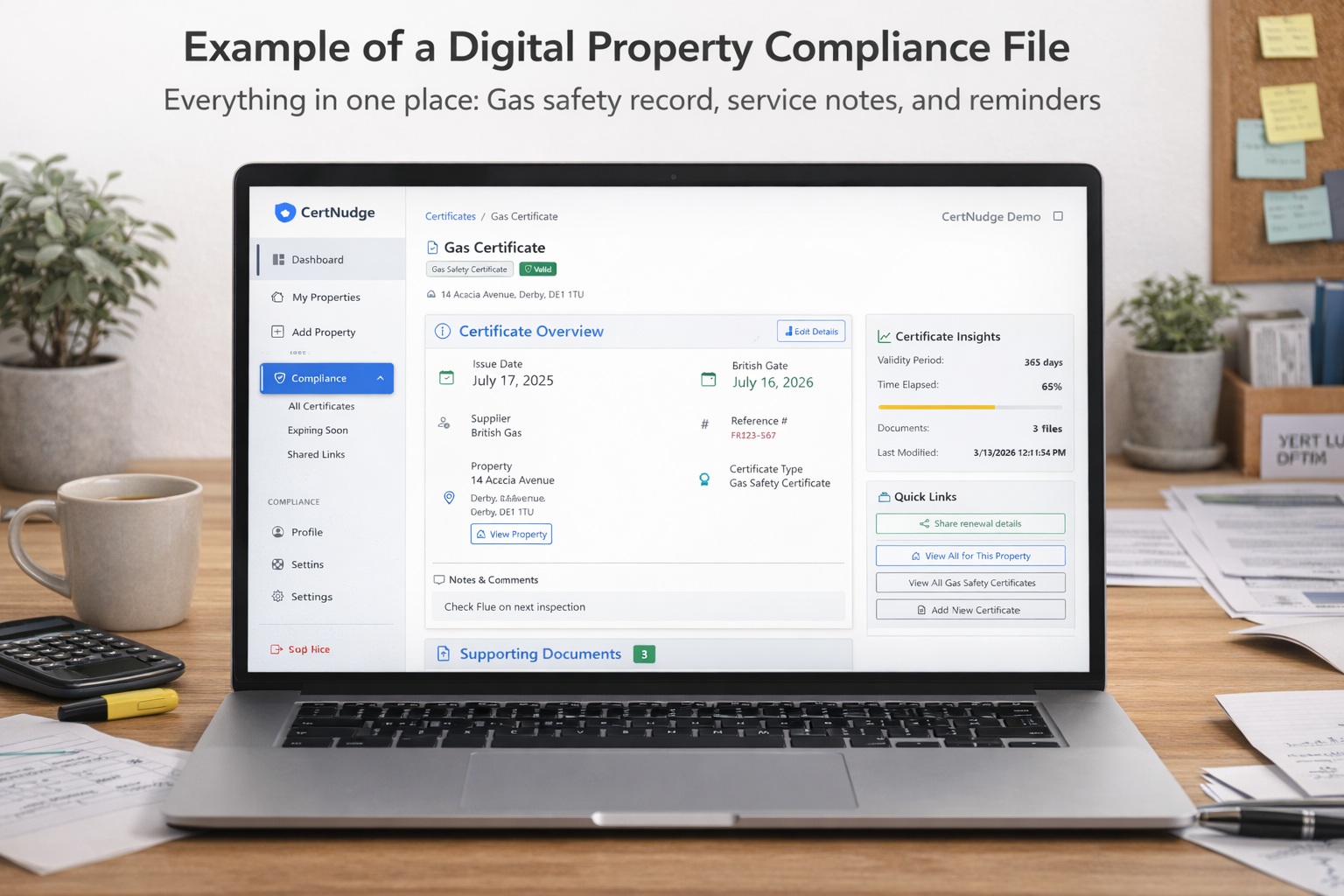
Keep your gas safety evidence inspection-ready
When a tenant refuses access, the landlord’s real job is not just to rebook the engineer. It is to build a calm, credible file showing that the annual gas safety check was taken seriously and chased properly.
For a landlord with a small portfolio, that usually means one thing: stop leaving the paperwork across inboxes, texts and memory. Keep the booking trail, no-access notes, service notes and completed gas safety record together under the correct property.
Related landlord compliance guides
To make that easier, check which of your properties have gas safety gaps free, no signup.
This article is for general information only and is not legal advice. Regulations change, always check the latest guidance at GOV.UK or speak to a qualified professional.
Last reviewed: 16 July 2026
Next review recommended: 16 February 2027